
Guides · Transport
JKIA Airport Guide: Arriving in Nairobi & Getting Into Town (2026)
JKIA Airport Guide: Arriving in Nairobi & Getting Into Town (2026)
Almost everyone moving to Nairobi arrives the same way: a long flight, a slow taxi down the jetway, and then Jomo Kenyatta International Airport — JKIA, code NBO — at the end of it. It’s East Africa’s busiest hub, and your first hour on the ground sets the tone for the whole move. The good news is that it’s a straightforward airport once you know the order things happen in.
Here’s the short version. You’ll need an approved eTA before you fly — there’s no visa on arrival anymore. You clear immigration, collect your bags, walk through customs, and step into the arrivals hall. There you can pick up a SIM card and M-Pesa, get some Kenyan shillings, and arrange a ride into the city. The whole thing, plane door to a car, usually takes 45 to 90 minutes depending on your flight and the immigration queue.
This guide is for Americans landing at JKIA for the first time — whether you’re here to scout neighbourhoods or you’ve already committed to the move. We’ll walk through what to have ready before you fly, what arrival actually looks like, how to get connected and get cash, and the real options for getting into town, including the Nairobi Expressway and how to sidestep the taxi touts. Prices are 2026 figures in Kenyan shillings (KES) and US dollars at roughly KES 130 to the dollar — treat them as current guidance and confirm the live ones.
TL;DR: Arriving at JKIA (Jomo Kenyatta International Airport, code NBO) as an American in 2026: have your eTA approved before you fly (about $30, applied for at etakenya.go.ke — there is no visa on arrival). On the ground you clear immigration (biometric photo and fingerprints; queues run roughly 20–45 minutes), collect bags, and pass customs. In the arrivals hall, buy a Safaricom or Airtel SIM with your passport (a tourist data pack is roughly KES 700–1,000), set up M-Pesa, and draw KES from an ATM. For the ride into town, a pre-booked transfer or an Uber/Bolt/Little pickup from the car park is calmer and usually cheaper than the taxi touts — figure KES 2,000–3,500 to the western suburbs, and ask the driver to take the Nairobi Expressway (toll about KES 400 for a car) to skip the worst of Mombasa Road. A serviced apartment with a pre-arranged pickup is the softest possible landing for your first night.
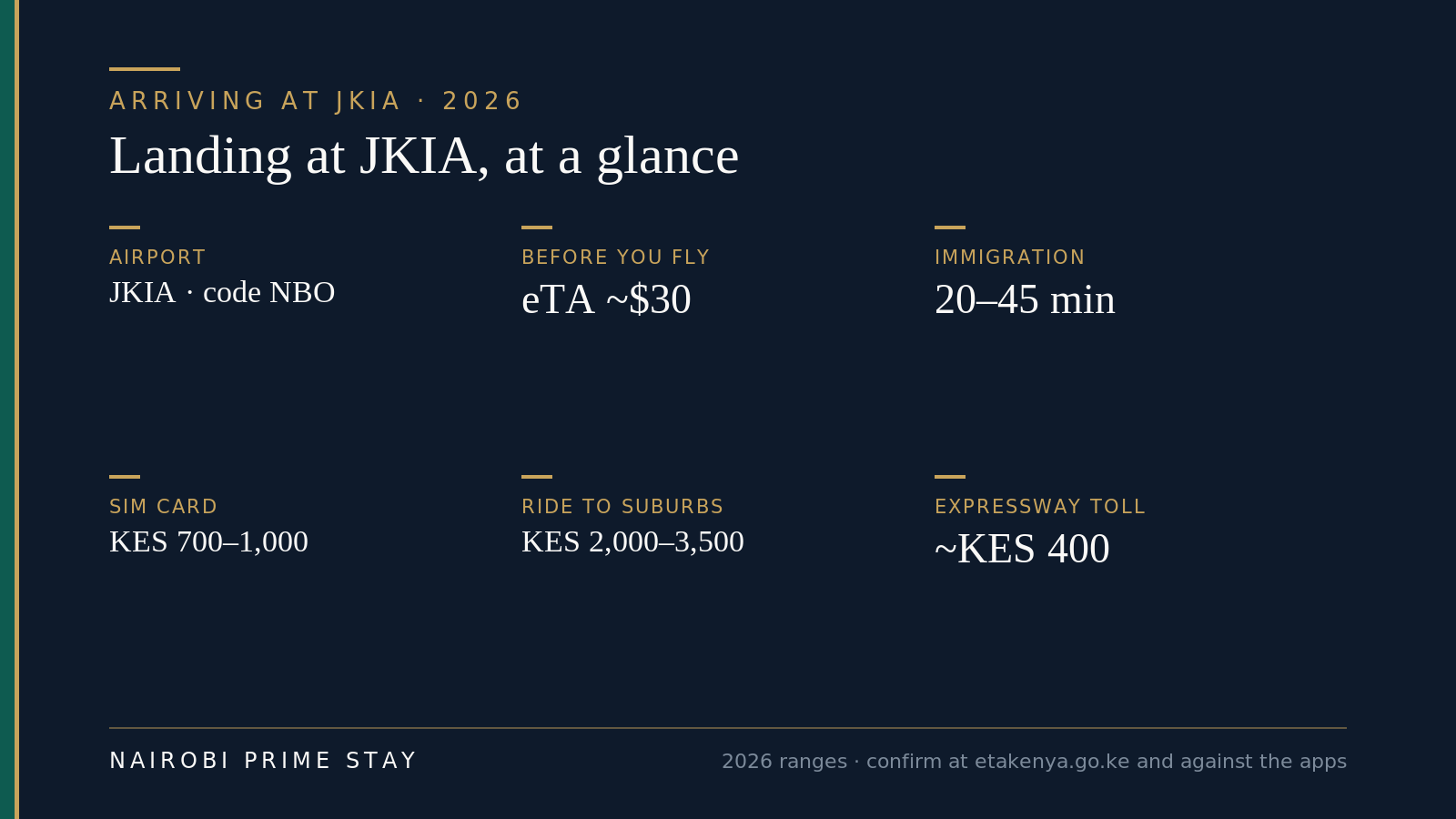 The headline facts for landing at JKIA in 2026. Figures are ranges in Kenyan shillings — confirm fares and fees against the apps and official portals.
Before you fly: what to have ready
Sort these out at home, and arrival is easy. Leave them to the last minute and JKIA gets stressful fast.
The single most important thing is your eTA — Electronic Travel Authorization. Kenya replaced visas on arrival with this online approval, so you cannot simply show up and pay at the desk. You apply at etakenya.go.ke, the only official portal, pay about $30, and wait for the approval to land in your email. Officially it takes 3–5 business days; in practice it’s often quicker, but apply at least a week ahead to be safe. Print the approval and keep a copy on your phone — you’ll be asked for it at check-in and again at immigration. Our Kenya visa guide for Americans walks through the eTA and the longer-stay permits in detail.
A few other things belong in your carry-on, not your checked bag:
- A passport valid for at least six months beyond your arrival, with a blank page.
- Your eTA approval, printed and on your phone.
- Proof of where you’re staying — a hotel or serviced-apartment booking confirmation. Immigration occasionally asks, and the eTA form requires it.
- A little US cash — a couple of hundred dollars in clean, newer bills. You won’t need much (M-Pesa covers daily life), but cash is a useful backup before your cards and SIM are sorted.
- A yellow-fever certificate only if you’re arriving from or transiting a country where yellow fever is a risk. Coming straight from the US, you don’t need one.
If you’ve arranged an airport pickup — through your serviced apartment, a transfer company or a hotel — have the driver’s name and phone number saved offline, plus your booking reference. That one detail removes most of the friction from a late-night arrival.
Landing at JKIA: from the plane to the hall
JKIA’s main international building is Terminal 1, split into several connected units (1A through 1E). The big carriers most Americans fly — Kenya Airways, Emirates, Qatar, KLM, Turkish, plus connections from Europe and the Gulf — all land here, and the arrival flow is the same regardless of which unit your gate is in: you walk from the gate toward Immigration, then down to baggage reclaim, then through customs into the public arrivals hall. Don’t worry too much about the terminal lettering; just follow the Arrivals signs and the crowd from your flight.
It’s worth knowing the airport had a serious fire in the international arrivals area back in 2013, and parts of the passenger experience have been rebuilt and patched in the years since. In 2026 it works fine, but it’s a busy, sometimes worn airport rather than a gleaming Gulf mega-hub — set your expectations to “functional and friendly,” not “spa.” Walkways can be long, signage is decent, and there are usually staff to point you the right way if you look lost.
If you’re catching a domestic connection to the coast or a safari strip, check carefully whether it leaves from JKIA’s domestic section (Terminal 1D) or from Wilson Airport across town — more on Wilson below, because mixing the two up is the classic newcomer mistake.
Immigration and the eTA on arrival
Immigration is the one part of arrival you can’t speed up much, so plan for it. Have your passport and eTA approval in hand before you reach the hall. Kenya uses biometric processing, so the officer will likely take your fingerprints and a photo along with the usual questions: why you’re visiting, how long you’re staying, where. Answer plainly. If you’re moving here on a longer-term plan but entering on the eTA to scout and get set up, “visiting” and a hotel or serviced-apartment booking is the honest, simple answer — the eTA is for visits and scouting, and you arrange the right residence permit once you’re on the ground.
How long does it take? Budget 20 to 45 minutes at the immigration queue, sometimes longer when several wide-body flights land together (early mornings and late evenings are the crunch). Move briskly off the plane — being near the front of the queue genuinely saves you half an hour. There are separate lines for Kenyan citizens, East African residents and foreign visitors; join the visitors’ line.
A note on the rules, because they shift: the eTA is the current system for 2026, and the days of buying a visa sticker at the desk are gone. If anything about your entry status feels unclear, the officers and the signage will guide you — and you can always confirm the latest at etakenya.go.ke before you travel.
Baggage, customs and what you can bring
After immigration, follow signs to baggage reclaim and find your flight’s carousel on the screens. Free trolleys are usually available. If a bag doesn’t show up, find your airline’s desk in the baggage area before you exit and file a report there — it’s much harder to chase once you’ve left.
Customs uses the familiar green and red channel system. If you’re carrying only personal effects within the normal allowances, walk the green channel. Use the red channel if you’re bringing commercial goods, anything over the duty-free limits, or large amounts of cash — you must declare currency of USD 10,000 or more (or the equivalent). Bags are sometimes scanned on the way out; it’s routine, not a cause for nerves.
If you’re shipping a household rather than just suitcases, that’s a separate process handled by a clearing agent, not something you sort out in the customs channel — see our guides on shipping your belongings to Kenya and bringing pets for how those work. For a normal move-in trip, you’ll just have your luggage, and the green channel is a thirty-second walk.
Getting connected: SIM card and M-Pesa at the airport
Get a local SIM before you leave the airport. It’s the single best thing you can do for a smooth first week, because almost everything in Nairobi — paying for your ride, topping up, even buying water — runs through your phone.
Safaricom and Airtel both have official kiosks in the arrivals area (Safaricom is the bigger network and the one that runs M-Pesa, so it’s the default choice for most newcomers). Bring your passport — SIM registration is mandatory and tied to your ID, so a street agent outside can’t do it for you. A tourist SIM with a data bundle runs roughly KES 700–1,000 (about $6–8); the agent will register you, activate data and help with settings. The desks generally run long hours but aren’t strictly 24/7, so if you land in the small hours and the kiosk is shut, you can buy and register a SIM at any Safaricom shop in town the next morning.
While you’re there, ask them to set up M-Pesa on the line. M-Pesa is Kenya’s mobile-money wallet, and it’s how you’ll pay for taxis, rent, groceries and bills. You can register it with your passport then and there, load a little cash, and walk out able to pay by phone. If you’d rather understand it before you arrive, our M-Pesa guide for newcomers explains exactly how it works. Tip: have your phone unlocked before you fly, or the new SIM won’t work in it.
Getting cash: ATMs and forex at JKIA
You’ll want some Kenyan shillings in hand, even though M-Pesa means you need far less cash than you’d expect. There are ATMs and licensed forex bureaus in the arrivals hall. The simplest move is to draw KES from an ATM with your debit card — the rate is usually fairer than the airport exchange counters, which build a margin into their rates. Pull out a modest amount to start; you can always get more in town, and you don’t want a thick wad of cash on your first night.
A few habits worth keeping from the start: tell your bank you’re travelling so the card isn’t blocked, take the ATM’s offer to be charged in shillings (not dollars) to avoid a poor built-in conversion, and shield the keypad. If you change cash, use the official bureaus inside the terminal, not anyone who approaches you. Once your SIM and M-Pesa are live, you’ll find you reach for cash surprisingly rarely.
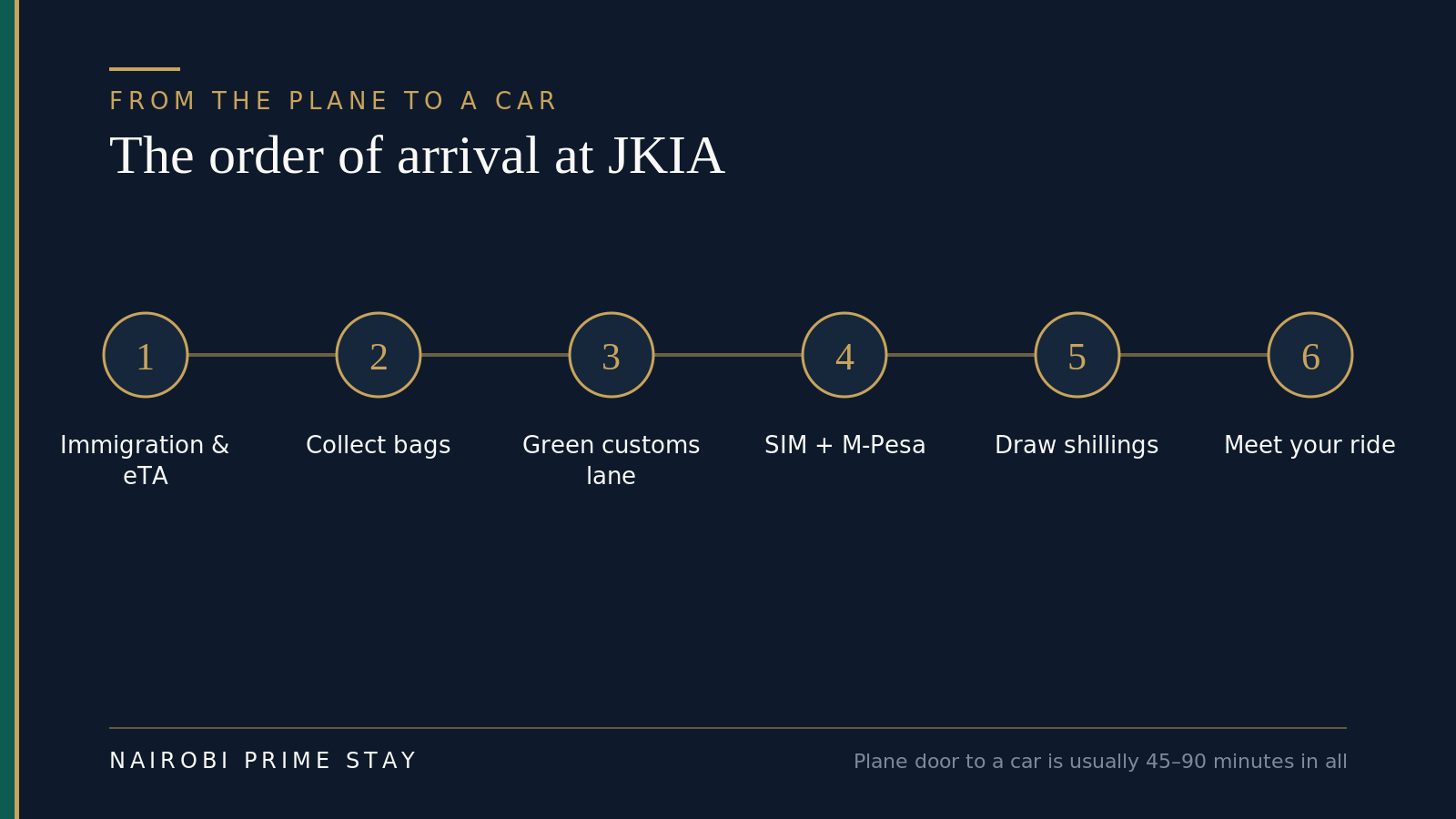 Plane door to a car, in order. Sorting the SIM and a little cash before you leave the hall makes the ride into town effortless.
Getting into the city: your options
JKIA sits about 15–18 km southeast of the city centre, off Mombasa Road. In light traffic that’s a 25-minute drive; in the daily jams it can be well over an hour. So the question isn’t just which ride but what time you land — and whether your driver takes the Expressway. Here are the four ways in, from easiest to most adventurous.
Pre-booked transfer (the soft landing). You arrange a driver in advance — through your serviced apartment, a hotel, or a transfer company — and they’re waiting in the hall with your name on a sign. You pay a fixed, known price, there’s no app or haggling, and someone helps with the bags. For a first arrival, a long-haul-tired arrival, or a late-night one, this is the calmest option, and it’s what we set up for guests. Expect roughly KES 2,500–4,000 to the western suburbs depending on the company and the hour.
Ride-hailing: Uber, Bolt and Little. Once your SIM and M-Pesa are live, the apps work exactly as they do at home and are usually the cheapest way in — roughly KES 2,000–3,500 to Westlands, Gigiri or Upper Hill. The catch is the pickup point: drivers can’t collect you at the arrivals door. They use the designated ride-hailing zone at the car park opposite the terminal (often signed for Uber/Bolt), a short walk away, so watch the app for where your driver actually is. JKIA doesn’t add a fee for app pickups. Little is a Kenyan app that’s especially strong on airport runs, so it’s worth having alongside Uber and Bolt.
Official airport taxi. Licensed taxis queue outside arrivals with fixed, posted fares — around KES 2,000–3,500 to the western suburbs. They cost a little more than the apps but need no SIM, no app and no walk to the car park, which makes them a fine backup if your phone setup hasn’t gone to plan. Use the official taxi desk, agree the fare before you get in, and you’re set.
Matatu or public transport. Technically possible, realistically not for your arrival. Hauling luggage onto a shared minibus on Mombasa Road, jet-lagged and new to the city, isn’t worth the few dollars saved. Once you’re settled and travelling light, our getting around Nairobi guide covers matatus properly.
Transfer options compared
| Option | Typical cost to western suburbs | Best for | Watch out for |
|---|---|---|---|
| Pre-booked transfer | KES 2,500–4,000 | First arrivals, late nights, families | Book ahead; save the driver’s number |
| Uber / Bolt / Little | KES 2,000–3,500 | Cheapest, once your SIM is live | Pickup is at the car park, not the door |
| Official airport taxi | KES 2,000–3,500 | No-app backup, fixed fare | Use the official desk; agree fare first |
| Matatu / public | A few hundred KES | Not realistic on arrival with bags | Skip it for your first trip |
2026 ranges; fares move with traffic, demand and fuel. The Expressway toll (about KES 400 for a car) may be added on top or built into a transfer price — ask.
The Nairobi Expressway from the airport
If you land in daytime traffic, the Nairobi Expressway is the difference between a 20-minute ride and a 90-minute one. It’s a 27 km elevated toll road running from Mlolongo, just past the airport, straight over the top of Mombasa Road and Uhuru Highway to Westlands, bypassing the worst of the city’s congestion. There’s an entry right by JKIA, so it’s the natural route into the western suburbs where most expats live.
For a normal saloon car (Class 3), the toll from the airport to Westlands is about KES 400 (the full network ranges from roughly KES 170 to KES 500 depending on where you enter and exit). In a taxi or ride-hailing trip, the toll is usually added to your fare or already included in a transfer price — it’s worth asking so there’s no surprise. Note that motorbikes and tuk-tuks aren’t allowed on the Expressway, which is another reason a car beats a boda boda for the airport run with luggage.
Is it worth it? At rush hour, almost always yes — the time saved is real and the road is smooth and safe. Off-peak or late at night, Mombasa Road and Uhuru Highway can be clear enough that your driver skips the toll, and that’s fine too. Let the driver judge it, or ask for the Expressway if you’re in a hurry.
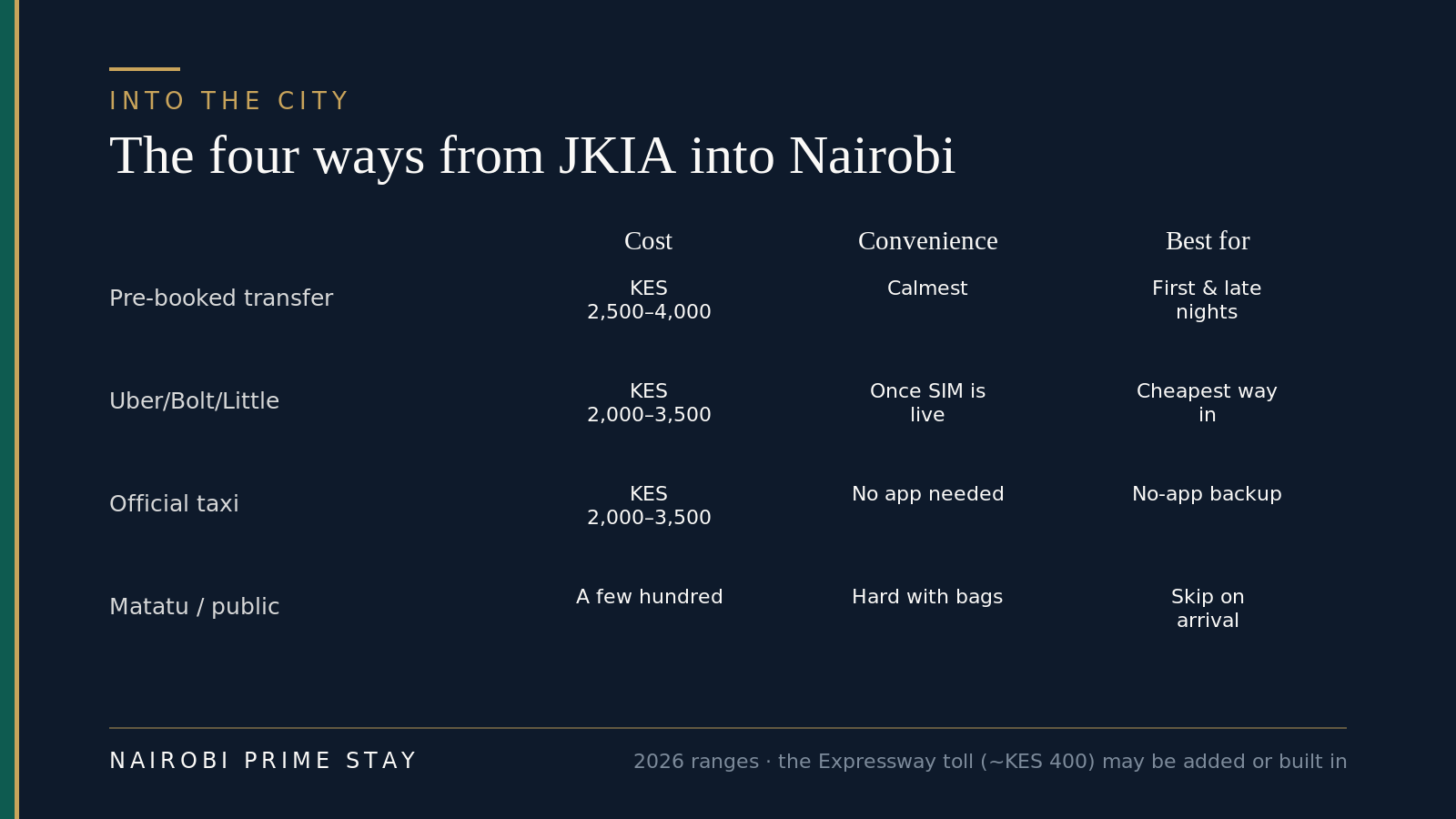 How the airport-to-city options stack up. For a first or late-night arrival, paying a little more for a pre-booked transfer buys a lot of calm.
Avoiding touts and arrival scams
The arrivals hall is safe, but it’s busy, and tired travellers are an easy mark for overcharging. None of this is dangerous — it’s the ordinary airport hustle you’d find in many big cities — but a few habits keep your first hour clean.
The main thing: ignore anyone who approaches you offering a taxi, a “good rate,” or help with your bags. The official taxis queue at a marked desk, and your pre-booked driver will be holding a sign with your name — you don’t need a freelancer. Someone who grabs a trolley uninvited will expect a tip; a friendly “no thank you” is all it takes. Real airport staff wear uniforms and ID.
A short list of street-sense that makes arrival uneventful:
- Book your ride before you land, or use the official taxi desk or the apps. Decide how you’re getting to town on the plane, not in the scrum.
- Agree the fare before you get in any taxi, and prefer M-Pesa or card on the apps so there’s a record.
- Don’t follow anyone to a car park or a vehicle that isn’t the official rank or your named driver.
- Change money only at the licensed bureaus inside the terminal, never with someone offering a better rate by hand.
- Keep your passport, phone and cash zipped away and your bags where you can see them, the same as any airport.
Do those, and the touts simply melt away. Our honest safety guide for Nairobi puts the airport in the wider picture: the real risk in this city is opportunistic overcharging and petty theft, not personal danger, and a little preparation handles both.
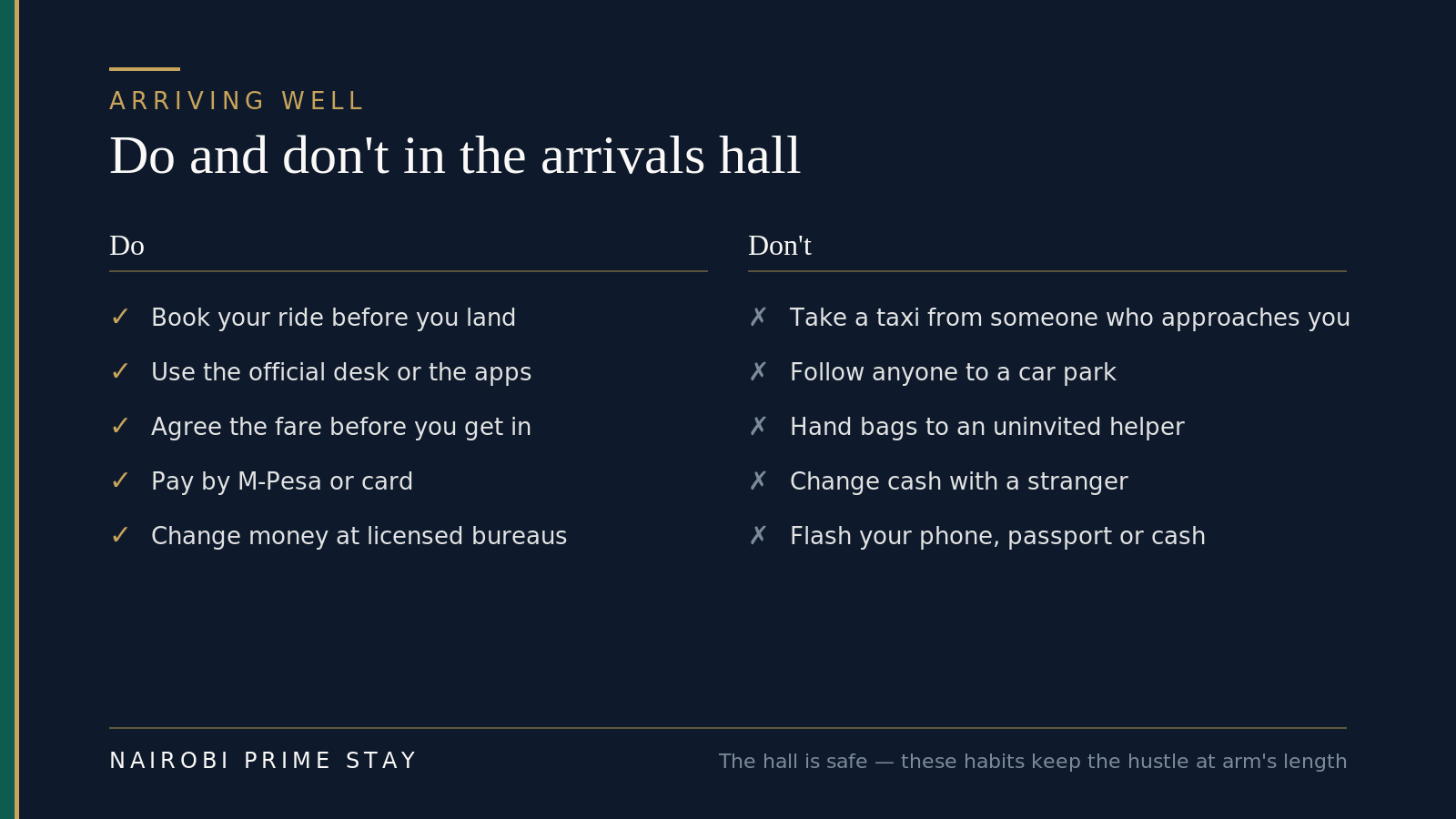 The arrivals hall is safe — these habits just keep the hustle at arm’s length on a tired first night.
Wilson Airport: the other airport
Nairobi has a second airport, and confusing the two is the classic newcomer slip. Wilson Airport (WIL) sits southwest of the city, off Langata Road, about 15 km from JKIA — a 30-to-60-minute drive across town depending on traffic. JKIA handles the big international jets; Wilson is the hub for light aircraft: safari flights to the Maasai Mara, Amboseli and the coast, charters, and some domestic hops.
Why it matters on arrival: if your plan is to land at JKIA and connect onward to a safari strip or a smaller airfield, your second flight may leave from Wilson, not JKIA. That means a cross-city transfer with time built in for traffic — don’t book a tight connection assuming it’s all one airport. Equally, some domestic flights (to Mombasa, Kisumu, Eldoret) leave from JKIA’s domestic terminal, so check your specific airline and airport code carefully. When in doubt, confirm with the airline which field you’re flying from, and give yourself a generous buffer for the drive.
The soft-landing option: a transfer straight to a serviced apartment
Here’s the arrival we’d wish on anyone moving to a new city: you walk out of the hall, a driver with your name is waiting, your bags go in the car, and 30 to 60 minutes later you’re in a clean, fully-equipped apartment with Wi-Fi, hot water, a working kitchen and a bed — no hunting for a hotel, no signing a lease while jet-lagged, no furnishing anything.
That’s the whole idea behind a serviced apartment for your first weeks. It’s all-inclusive (Wi-Fi, cleaning, generator, security), flexible by the month, and it gives you a secure base to do the real work of settling in: viewing homes, testing commutes, getting your bank account and permit sorted, and learning which neighbourhood actually fits your life. When we arrange a stay, we can line up the airport pickup to match your flight, so the transfer and the apartment are a single handover rather than two problems to solve at midnight.
You don’t have to book through anyone to land well — a pre-booked transfer to a good hotel does the job too. But pairing the ride with a place that’s ready for you removes nearly every first-night headache at once, which is exactly when you have the least energy to deal with them.
A real arrival: landing late with a family
Say you’re moving with two kids and you land at JKIA at 11pm after 20 hours of flying. Here’s the version that goes smoothly. Weeks earlier, you got your eTAs approved and booked a serviced apartment in Lavington with an airport pickup arranged for your flight. You step off the plane, walk briskly to immigration, and you’re near the front of the queue. Biometrics, a few questions, stamped through in half an hour. Bags, green channel, and into the hall — where a driver is holding a sign with your name. You skip the SIM kiosk because it’s late and you’ve got airport Wi-Fi and a transfer already sorted; you’ll grab SIMs in the morning. The driver takes the Expressway, empty at that hour, and 35 minutes later the kids are asleep in real beds. The next day, rested, you buy SIMs, draw some shillings, and start looking at homes. That’s the soft landing — and almost all of it was decided before you boarded.
Your JKIA arrival checklist
Work through this in order and your first hour is sorted.
Before you fly
- Apply for and download your approved eTA (etakenya.go.ke, about $30) — print it and save it to your phone.
- Check your passport is valid 6+ months with a blank page.
- Have proof of accommodation (hotel or serviced-apartment booking) ready to show.
- Arrange your ride into town — pre-booked transfer, or plan to use the official taxi desk or apps.
- Make sure your phone is unlocked so a local SIM will work; pack a couple of hundred US dollars in newer bills.
At the airport
- Move quickly to immigration; have passport and eTA in hand for biometrics.
- Collect bags; file a report at the airline desk before exiting if anything’s missing.
- Walk the green customs channel (red only if you have goods to declare or USD 10,000+).
- Buy a Safaricom or Airtel SIM with your passport and set up M-Pesa.
- Draw some KES from an ATM (choose to be charged in shillings).
- Meet your named driver, or book an Uber/Bolt/Little from the car park, or use the official taxi desk — ignore anyone who approaches you.
Frequently asked questions
Do I need a visa to arrive at JKIA, or can I get one on arrival? You need an approved eTA before you fly — there is no visa on arrival anymore. The eTA is an online travel authorization you apply for at etakenya.go.ke, the only official portal, for about $30. Officially it takes 3–5 business days, so apply at least a week ahead, and arrive with the approval printed and on your phone. Without it, you can be denied boarding.
How long does immigration take at JKIA? Budget 20 to 45 minutes at the immigration queue, occasionally longer when several big flights land together, which tends to happen early morning and late evening. Kenya uses biometric processing, so expect to give fingerprints and a photo. Getting off the plane quickly and being near the front of the queue is the easiest way to save time — it can be the difference of half an hour.
Where do I buy a SIM card at JKIA? Safaricom and Airtel have official kiosks in the arrivals area. Bring your passport, since SIM registration is mandatory and tied to your ID. A tourist SIM with a data bundle costs roughly KES 700–1,000, and the agent can also set up M-Pesa for you. Safaricom is the bigger network and the one that runs M-Pesa, so it’s the usual choice. If you land very late and the kiosk is closed, buy one at any Safaricom shop in town the next day.
How do I get from JKIA to the city or Westlands? The easiest options are a pre-booked transfer with a driver waiting in the hall, or an Uber, Bolt or Little pickup once your SIM is active — both calmer and usually cheaper than the taxi touts. The official airport taxi desk is a reliable no-app backup at a fixed fare. Depending on traffic and where you’re staying, the trip takes 25 to 90 minutes, and your driver can take the Nairobi Expressway to skip the worst of Mombasa Road.
How much does a taxi from JKIA to Nairobi cost? Figure KES 2,000–3,500 (about $15–28) to the western suburbs like Westlands, Gigiri or Upper Hill by ride-hailing or official taxi; a pre-booked private transfer runs a little more, around KES 2,500–4,000. The Nairobi Expressway toll for a car is about KES 400 and may be added on top or built into a transfer price — ask. Fares move with traffic, demand and fuel, so treat these as 2026 ranges.
Can I use Uber or Bolt from JKIA? Yes, and it’s usually the cheapest way into town once your SIM and M-Pesa are working. The one quirk is the pickup point: drivers can’t collect you at the arrivals door and instead use the designated ride-hailing zone at the car park opposite the terminal, a short walk away. Watch the app for where your driver actually is. JKIA doesn’t charge an extra fee for app pickups. Little, a Kenyan app, is also strong on airport runs.
Is JKIA airport safe? Yes. JKIA is a normal busy international airport, and the arrivals hall is safe. The main thing to manage is the ordinary airport hustle — people offering taxis, “good rates,” or unsolicited help with bags. Ignore them, use the official taxi desk or the apps or your pre-booked driver, agree any fare first, and keep your passport, phone and cash zipped away. The real risk in Nairobi is overcharging and petty theft, not personal danger.
What’s the difference between JKIA and Wilson Airport? JKIA (Jomo Kenyatta International, code NBO) is the big international airport southeast of the city where your long-haul flight lands. Wilson (WIL), southwest of the city off Langata Road, is the hub for light aircraft — safari flights to the Maasai Mara, Amboseli and the coast, plus charters. They’re about 15 km apart, a 30-to-60-minute drive. If you’re connecting onward to a safari strip, your second flight may leave from Wilson, so build in time to cross town and confirm which airport with your airline.
Final thoughts
JKIA is an easy airport once you know the order: eTA approved before you fly, then immigration, bags, customs, a SIM, a little cash, and a ride. The two decisions that matter most are made before you board — sorting your eTA, and deciding how you’ll get into town. Get those right and the rest is just following signs.
The single best gift you can give your jet-lagged self is a plan for the last 20 km. A driver holding your name, a known price, and a ready apartment at the end of it turns a daunting first night into a non-event. Everything else about settling into Nairobi — the neighbourhood, the bank account, the permit — is easier when you start it rested.
Related reading
- Moving to Nairobi: the complete guide — the end-to-end overview that ties all of this together.
- Kenya visa guide for Americans — the eTA and the longer-stay permits, step by step.
- Getting around Nairobi — ride-hailing, matatus, the Expressway and whether you need a car.
- Is Nairobi safe? An honest guide — the real picture on safety, including arrival and street sense.
- M-Pesa guide for newcomers — set up mobile money so you can pay by phone from day one.
- Serviced apartments in Nairobi — what a soft-landing stay includes and who it suits.
When you land, land softly
A serviced apartment with the airport pickup arranged for your flight is the calmest way to arrive in Nairobi — you skip the hotel hunt and the midnight lease-signing and wake up somewhere that’s already home. Browse our serviced apartments, or tell our AI relocation assistant your flight and where you want to be, and it’ll shortlist places and sort the transfer in a couple of minutes. A $50 deposit reserves your apartment; you pay the balance on arrival.
Ready to look?
Find your apartment in Nairobi
Browse verified serviced apartments, or ask the AI concierge which area fits your life.