
Guides · Healthcare
Having a Baby in Nairobi: Maternity Care for Expats (2026)
Having a Baby in Nairobi: Maternity Care for Expats (2026)
Plenty of expat babies are born in Nairobi every year, and most parents come away calm about the care. The private maternity hospitals here are good — modern delivery suites, English-speaking obstetricians, neonatal units for when something needs watching. The part that trips people up isn’t the medicine. It’s the money and the paperwork.
This guide is for Americans expecting a baby in Nairobi, or thinking about it before they move. It covers the hospitals expat families actually use, what a delivery really costs in 2026, the insurance waiting period that catches almost everyone out, the antenatal routine, and how to register the birth — both the Kenyan certificate and the US paperwork that makes your baby a documented American. We use current figures, flag what changes, and point you to the official sources to confirm against.
If you’re already pregnant and reading this in a hurry, start with the next two sections.
Quick answer
Maternity care in Nairobi is good if you use the private system, which is what expats do. The hospitals to know are Aga Khan University Hospital and The Nairobi Hospital at the top end, with MP Shah, The Mater and Nairobi West as strong, often cheaper alternatives. A straightforward normal delivery at a top private hospital runs roughly KES 100,000–150,000 (about $800–1,200) as a package; a planned C-section is more, roughly KES 180,000–350,000+ (about $1,400–2,700+). Complications or time in the neonatal unit can push that higher, so budget a cushion.
The single most important thing: maternity insurance has a waiting period of about 10–12 months. If you wait until you’re pregnant to buy cover, the pregnancy won’t be covered. Sort insurance before you conceive, or plan to pay cash. Kenya’s national scheme, SHA, is a small baseline, not real maternity protection for private care.
After the birth, you’ll register it with Kenya’s Civil Registration Services (the hospital starts this with a birth notification), and — because Kenya doesn’t grant citizenship by birthplace — US-citizen parents get a Consular Report of Birth Abroad (CRBA) from the US Embassy in Gigiri to document the baby as American.
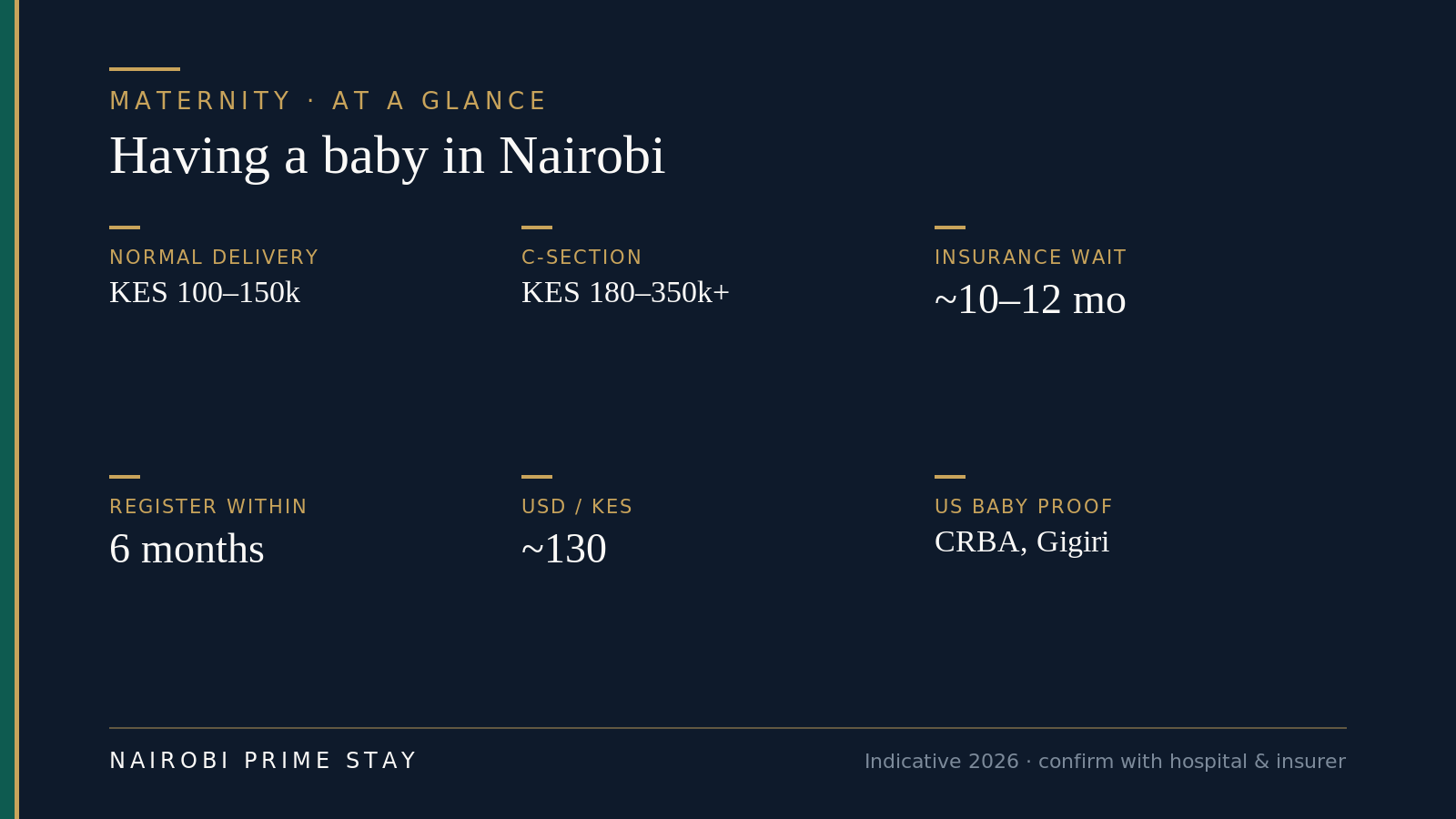 The numbers that shape a Nairobi birth, at a glance — all indicative for 2026; confirm with the hospital and insurer.
Why this matters
Having a baby far from home is the kind of thing that feels enormous until you’ve mapped it, then feels manageable. The reassuring news is that Nairobi gives you genuine choice and genuine quality. The catch is that almost everything good runs through the private system, and the private system is pay-to-play. Get the insurance timing wrong and a normal, happy delivery still lands as a five-figure shilling bill you weren’t expecting.
The other reason to plan early is logistical. The best obstetricians book up. Maternity insurance has to be in place months before you’ll use it. And the after-birth paperwork — Kenyan certificate plus US documents — is straightforward only if you know the order to do it in. None of this is hard. It just rewards starting before the third trimester.
Is maternity care in Nairobi any good?
Yes — in the private hospitals. Nairobi has some of the best private healthcare in the region, and maternity is one of its strengths. You’ll find consultant obstetrician-gynaecologists trained to international standards, dedicated labor and delivery suites, epidurals on request, operating theaters for C-sections, and neonatal intensive care units (NICUs) for premature or sick newborns. Most staff speak fluent English, and many expat mothers describe the nursing as warmer and more attentive than they expected.
The honest caveat is the same one that runs through all our healthcare in Nairobi coverage: the public system is overstretched, so the quality you’ll want comes from private hospitals you pay for. Use them, insure for them, and the experience is reassuring. The other caveat is variation — a top-tier private hospital and a budget maternity clinic are not the same thing, so choose deliberately rather than by whoever is nearest.
The best maternity hospitals in Nairobi
Most expat families deliver at one of a handful of private hospitals clustered in Parklands, Upper Hill and the western suburbs. Here’s how they compare.
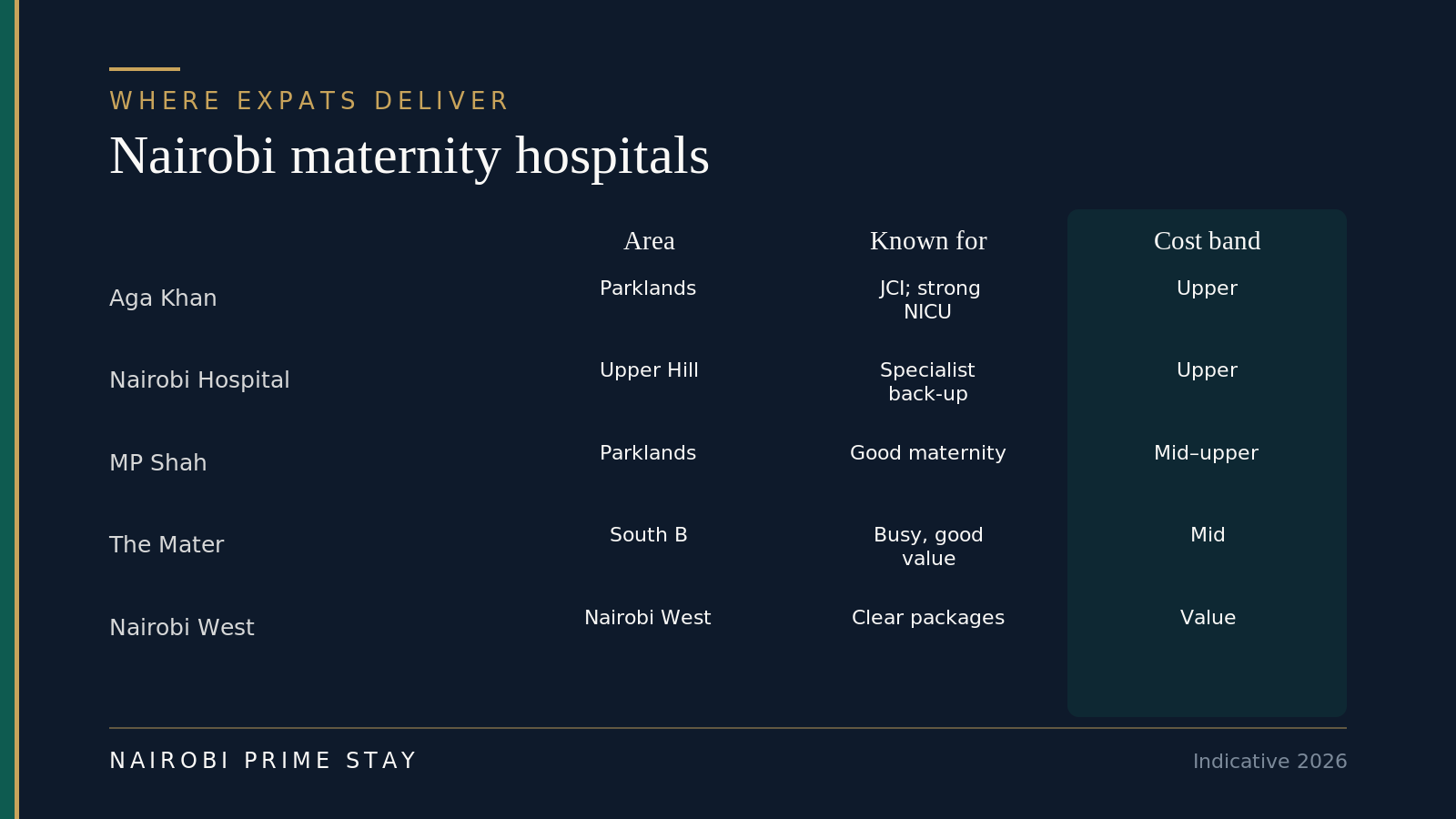 Where expat families deliver in Nairobi, by area and rough cost band.
| Hospital | Area | Known for | Indicative package band |
|---|---|---|---|
| Aga Khan University Hospital | Parklands | JCI-accredited flagship; strong NICU; many expats’ first choice | Upper |
| The Nairobi Hospital | Upper Hill | Long-established, broad specialist back-up, antenatal + delivery packages | Upper |
| MP Shah Hospital | Parklands | Well-regarded private general hospital, good maternity reputation | Mid–upper |
| The Mater Hospital | South B | Known for maternity, busy delivery unit, often better value | Mid |
| Nairobi West Hospital | Nairobi West | Clear maternity packages, generally cheaper | Mid–value |
| Gertrude’s Children’s Hospital | Muthaiga | Paediatrics — for the baby afterward, not the delivery | — |
A few notes on each.
Aga Khan University Hospital (Parklands). The one most expats name first. It’s JCI-accredited (an international quality mark), has a well-equipped NICU, and runs structured normal and C-section packages. It tends to sit at the top of the price range, and it’s the hospital many embassy and UN families choose. Maternity enquiries go through its dedicated line and the nbi.maternity@aku.edu address.
The Nairobi Hospital (Upper Hill). Long-established and expat-trusted, with a full antenatal-to-delivery package and the deep specialist bench of a large general hospital — reassuring if you want every other department on site. Central location, easy from most western suburbs outside rush hour.
MP Shah Hospital (Parklands). A respected private general hospital with a solid maternity unit, often a touch cheaper than Aga Khan while still firmly in the trusted-private tier. Worth a tour if you’re comparing.
The Mater and Nairobi West. Both deliver a lot of babies and are popular with budget-conscious families. The Mater in South B has a strong maternity name; Nairobi West publishes clear packages. Care is good; the surroundings are less plush than Aga Khan, which is reflected in the price.
Gertrude’s Children’s Hospital (Muthaiga). Not a delivery hospital — it’s the leading paediatric hospital, where many expat families take the baby for newborn checks, vaccinations and anything that comes up in the first years. Worth knowing before you need it.
Wherever you lean, book a tour and meet the obstetrician while you’re still choosing. Where you live shapes this too: Parklands and Upper Hill hospitals are quickest from the western suburbs, so families weighing where to live in Nairobi — especially diplomatic-belt areas like Gigiri or the apartment districts around Parklands — often factor the hospital run into the decision.
What it costs to give birth in Nairobi
Private hospitals sell maternity packages — a fixed price that bundles the delivery and a set number of nights. The headline ranges below are current as of July 2026, converted at roughly KES 129 to the dollar (see our dollar-to-shilling guide for how the rate behaves). Treat them as indicative and confirm the current package directly with the hospital, because prices move and depend on room type and length of stay.
| Type of birth | Top private hospital (indicative) | In US dollars (~KES 130/$) | Notes |
|---|---|---|---|
| Normal (vaginal) delivery package | KES 100,000–150,000 | ~$800–1,200 | Bundles delivery + a couple of nights in a general ward |
| Planned C-section package | KES 180,000–350,000+ | ~$1,400–2,700+ | More staff, theater, longer stay; private room costs more |
| Mid-range hospital (Mater / Nairobi West) | Often 20–40% less | — | Good care, plainer surroundings |
| Antenatal care (the 9-month run-up) | Budget separately | — | Scans, bloods, consultant visits add up |
| NICU / neonatal stay (if needed) | Charged on top, can be large | — | The real budget risk — see below |
To put the shilling figures in context, a normal delivery at a top hospital costs less than the equivalent would in a US hospital even before insurance — one of the reasons families don’t dread the bill the way they might at home. For a fuller picture of how medical and everyday costs compare, see our cost of living in Nairobi guide.
What a maternity package usually includes
At a hospital like Aga Khan, a normal-delivery package typically covers admission to the ward for the set period, the full delivery team (midwife-led with an obstetrician on hand if labor slows or there’s a concern), induction if needed, immediate newborn care, routine painkillers, vitamin K for the baby, the baby’s first routine vaccinations (hepatitis B, polio and BCG), lactation and breastfeeding support, and anti-D medication where the mother is Rhesus-negative. A C-section package adds the theater team — obstetrician, anaesthetist, midwife and nurses — spinal anaesthesia (the usual, and your partner can often be in theater for it), daily post-natal reviews, and options like a contraceptive coil or tubal ligation on request.
What’s not in the package — the parts that catch you out
This is where budgets blow up, so read it twice. A package is a baseline, not a ceiling. Watch for:
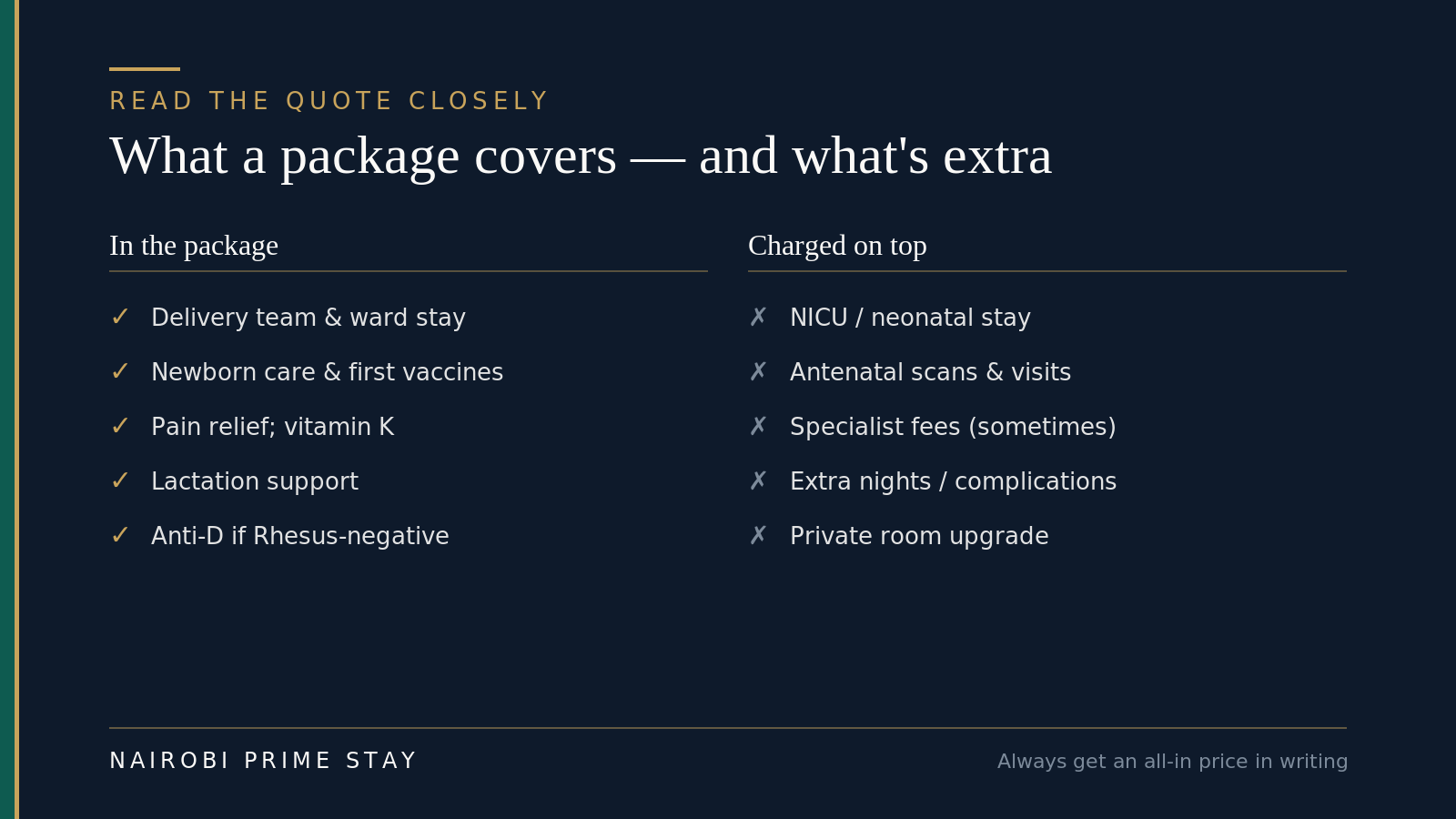 A package is a baseline, not a ceiling — always get an all-in price in writing.
- The neonatal unit (NICU). If the baby arrives early or needs monitoring, NICU days are charged separately and can dwarf the delivery cost. This is the single biggest reason to carry real insurance, not just cash for the package.
- Specialist fees billed separately. Some hospitals quote the package but charge the surgeon, anaesthetist or paediatrician on top. Always ask for a written, all-in breakdown.
- Antenatal care. The nine months of scans, blood tests and consultant visits usually sit outside the delivery package. Budget for them separately.
- A longer stay or complications. Extra nights, an emergency C-section after planning a normal birth, or any complication push the bill up.
- Room upgrades. A private or VIP room costs more than the general-ward package rate.
The practical takeaway: get the quote in writing, ask exactly what’s included, and assume you may need the cushion above the headline package price.
Insurance and the waiting-period trap
If you remember one thing from this guide, make it this: maternity cover almost always has a waiting period of about 10–12 months. You have to hold the policy, with the maternity benefit added, for the better part of a year before the delivery for it to pay out. Buy cover when you’re already pregnant and the pregnancy counts as pre-existing — it won’t be covered, and you’ll pay the package out of pocket.
So the timing rule is simple. If a baby is on your horizon, add maternity cover before you conceive. A year’s lead time is the safe assumption.
A few more things worth knowing:
- Maternity is usually an optional add-on, not automatic. It’s a specific benefit you elect (and pay extra for), often only on higher tiers. Check the wording.
- Private maternity limits are capped. Typical private plans cover something like KES 100,000–250,000 per delivery, sometimes with separate sub-limits for normal vs C-section. A top-hospital C-section can exceed the cap, so know your number.
- International plans (Allianz, Bupa Global, AXA and similar) can cover maternity too, usually as a higher-tier add-on and still with a waiting period. They cost more but travel with you. Our health insurance for expats in Kenya guide breaks down international vs local plans in detail — read it alongside this one.
SHA/SHIF — the national baseline
Kenya’s national scheme, the Social Health Authority (SHA), replaced NHIF in late 2024 and runs the Social Health Insurance Fund (SHIF). If you’re employed on a Kenyan contract you’ll contribute 2.75% of gross salary into it. For maternity, SHA has no waiting period, but its payouts are built around public and empaneled facilities and are modest — reimbursement tariffs in the region of KES 11,200 for a normal delivery and KES 32,600 for a C-section at the relevant facility levels. Under a 2026 measure the government also funds free delivery at Level 2 and 3 public facilities for registered SHA members.
That’s a genuine safety net, but it’s nowhere near the cost of a private package. Treat SHA as a small baseline you may pay into, not as your maternity plan. Confirm current rules at sha.go.ke.
If you’re already pregnant
If you’re moving to Nairobi already expecting, you’ve likely missed the insurance window — so plan to pay the package in cash, and budget the cushion for antenatal care and any complications. The care is still excellent and the out-of-pocket cost is far below a US equivalent. Some international policies you already hold from home may have maternity benefits that travel; check your existing cover before assuming you have none. And if a chronic condition or a high-risk pregnancy is in the picture, factor in the possibility of NICU costs and ask hospitals directly about their high-risk and neonatal capacity.
This is general information, not insurance or medical advice — confirm specifics with the insurer and your doctor.
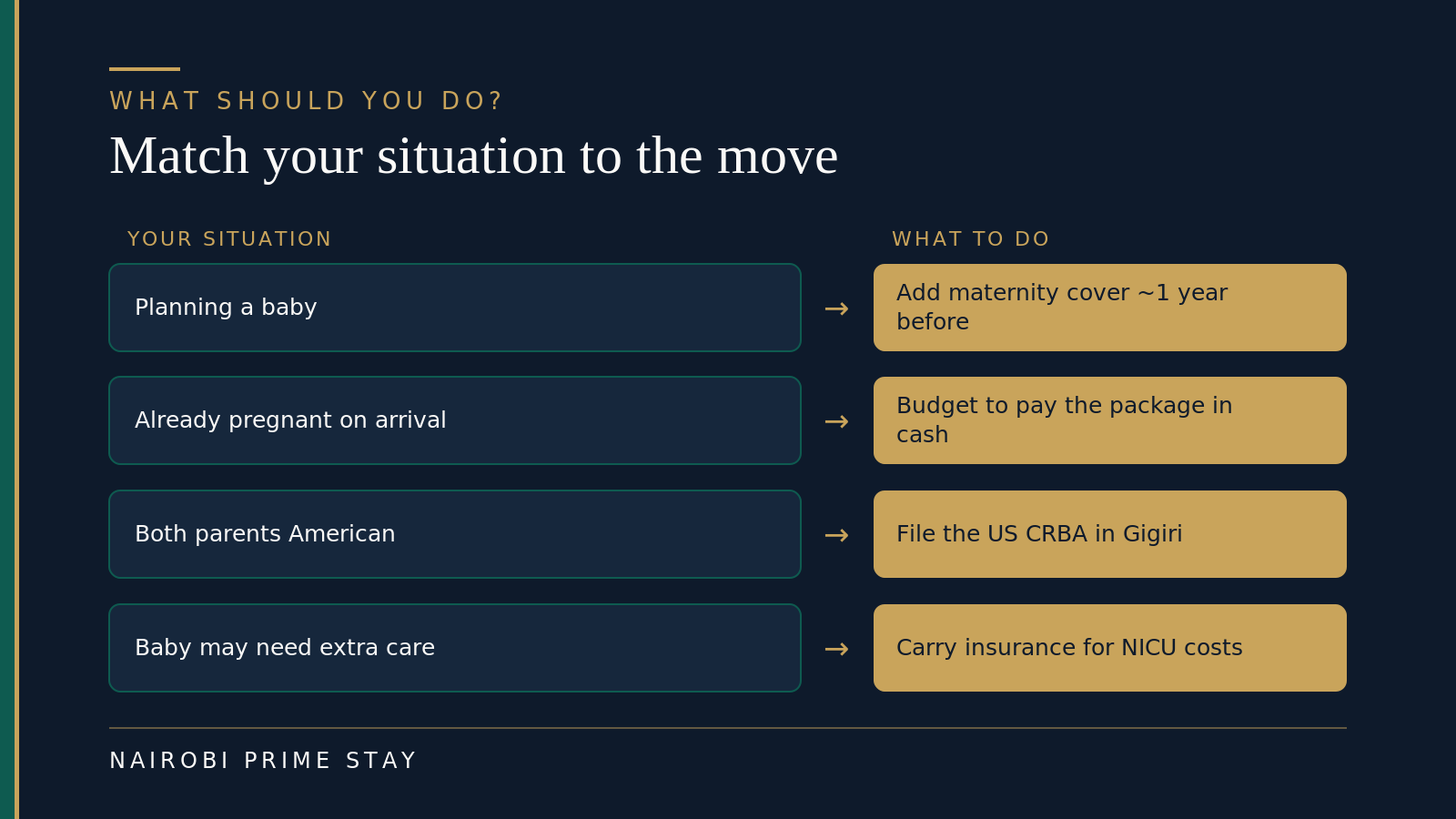 Match your situation to the right next move.
Antenatal care — what to expect
Antenatal care in Nairobi’s private hospitals will feel familiar. You’ll pick an obstetrician (or a hospital’s antenatal clinic), attend regular check-ups, and have the usual scans and blood tests through the pregnancy. Booking your consultant early matters — the well-regarded ones fill up, and continuity with one doctor is part of what makes the experience calm.
Practical notes: pharmacies in the suburbs are well stocked, so prenatal vitamins and prescriptions are easy to fill. Malaria is very low risk in Nairobi itself thanks to the altitude (~1,795 m), but it’s a real consideration if you travel to the coast or lower areas while pregnant — talk to your doctor about prevention before any trip. If you’re new in town and still settling, a serviced apartment close to your chosen hospital makes the early appointments far less stressful than a cross-town commute.
Registering the birth
There are two pieces of paperwork after the birth, and they do different jobs. Don’t skip either.
The Kenyan birth certificate
Every birth in Kenya must be registered, by law, within six months. The good news is the hospital starts it for you: a private hospital issues a birth notification (increasingly a digital e-notification in Nairobi as of 2026) that goes to the Civil Registration Services (CRS). You then apply for the actual birth certificate through the CRS service on eCitizen (crs.ecitizen.go.ke), using the notification number, a parent’s eCitizen account and ID. The standard fee is around KES 200, and certificates are typically processed within 7–14 working days — and from mid-2026 you can download and print the approved certificate from home.
This Kenyan certificate is your baby’s civil birth record. It does not make the baby Kenyan (more on that below), but you’ll want it as the official record of the birth.
The US Consular Report of Birth Abroad (CRBA)
This is the piece American parents must not overlook. A baby born in Kenya to a US-citizen parent is generally a US citizen at birth — but you have to document it. You do that with a Consular Report of Birth Abroad (CRBA) from the US Embassy in Nairobi, on UN Avenue in Gigiri. The CRBA is the official proof of your child’s US citizenship, and you’ll typically apply for the baby’s first US passport (and Social Security number) at the same time.
How it works in practice: you start the CRBA application online, upload documents and pay, then attend an in-person interview at the embassy with the baby and at least one parent. Apply before the child’s 18th birthday (in reality, do it in the first weeks so you have a US passport for travel). Citizenship transmission depends on at least one parent being a US citizen who meets the residency requirements in US law, so check your eligibility early. Questions go to NairobiCRBA@state.gov, and current steps are on ke.usembassy.gov.
What citizenship does your baby have?
Kenya does not grant citizenship simply for being born on Kenyan soil — Kenyan citizenship passes by descent (having a Kenyan parent), not by birthplace. So a baby born in Nairobi to two American parents is American, not Kenyan. The baby will need the same immigration status as the rest of the family to live in Kenya long-term, usually a dependant’s pass linked to a parent’s permit — worth raising with your immigration lawyer. Our Kenya visa guide for Americans explains how the passes fit together. If one parent is Kenyan, the child can be Kenyan by descent; dual citizenship is allowed. When in doubt, confirm with the immigration authority and a lawyer rather than assuming.
Should you fly back to the US to give birth?
For most expat families in Nairobi, no — and it’s worth saying plainly that citizenship is not a reason to fly home. A baby born in Nairobi to a qualifying US-citizen parent is American at birth; the CRBA (below) documents it. What flying home buys you is the US medical system at US prices: an uncomplicated delivery there commonly bills in the tens of thousands of dollars before insurance, against a low four-figure dollar package at Nairobi’s best private hospitals.
Where flying home does make sense: a genuinely high-risk pregnancy where you want a specific US specialist or unit; a US insurance policy that only pays in-network at home while you’d be paying cash in Nairobi; or a family-support situation where being near relatives for the birth matters more than the logistics. Those are all real reasons — just weigh them against splitting the household for two to three months.
If you do decide to fly, decide early. Most airlines want a doctor’s letter from around 28 weeks and stop carrying pregnant passengers around 36 weeks for a single, uncomplicated pregnancy (earlier for twins) — check your airline’s exact cut-off, because they differ. In practice that means booking the trip in the second trimester, not the third.
What maternity leave do you get in Kenya?
If you’re employed on a Kenyan contract, the Employment Act gives mothers three months (90 calendar days) of maternity leave on full pay, and fathers two weeks (14 calendar days) of paternity leave on full pay — calendar days, so weekends count, and the entitlement is the law’s floor rather than a negotiation (figures current as of July 2026). International employers in Nairobi often top this up; ask HR what the house policy adds.
If you’re a remote worker on a US contract, your US employer’s parental-leave policy follows you — Kenyan law doesn’t apply to a foreign employment relationship. The practical move is to confirm in writing how your employer treats a birth abroad before the third trimester, especially anything that assumes US paperwork like FMLA notices.
How soon can you travel with your newborn?
Plan on several weeks to a couple of months before an international trip, and let the paperwork — not the baby — set the pace. Airlines will carry healthy newborns from as young as a couple of days to two weeks old (policies vary), but your baby can’t board anything without a passport, and the passport runs through the CRBA process at the embassy in Gigiri.
The sequence: collect the hospital’s birth notification, then file the CRBA online (Nairobi uses the electronic eCRBA system — you complete the application, upload documents and pay online, then wait at least 72 hours before booking the in-person interview). Appointment availability is the wildcard: the embassy has at times flagged long waits for CRBA appointments, so book the interview the moment the system lets you. After the interview, the CRBA and first US passport are typically produced in a few weeks. If you have a genuine emergency need to travel, ask the embassy about expedited options — but don’t build a trip around getting one.
A realistic timeline
Here’s the order that keeps it smooth, from planning to paperwork:
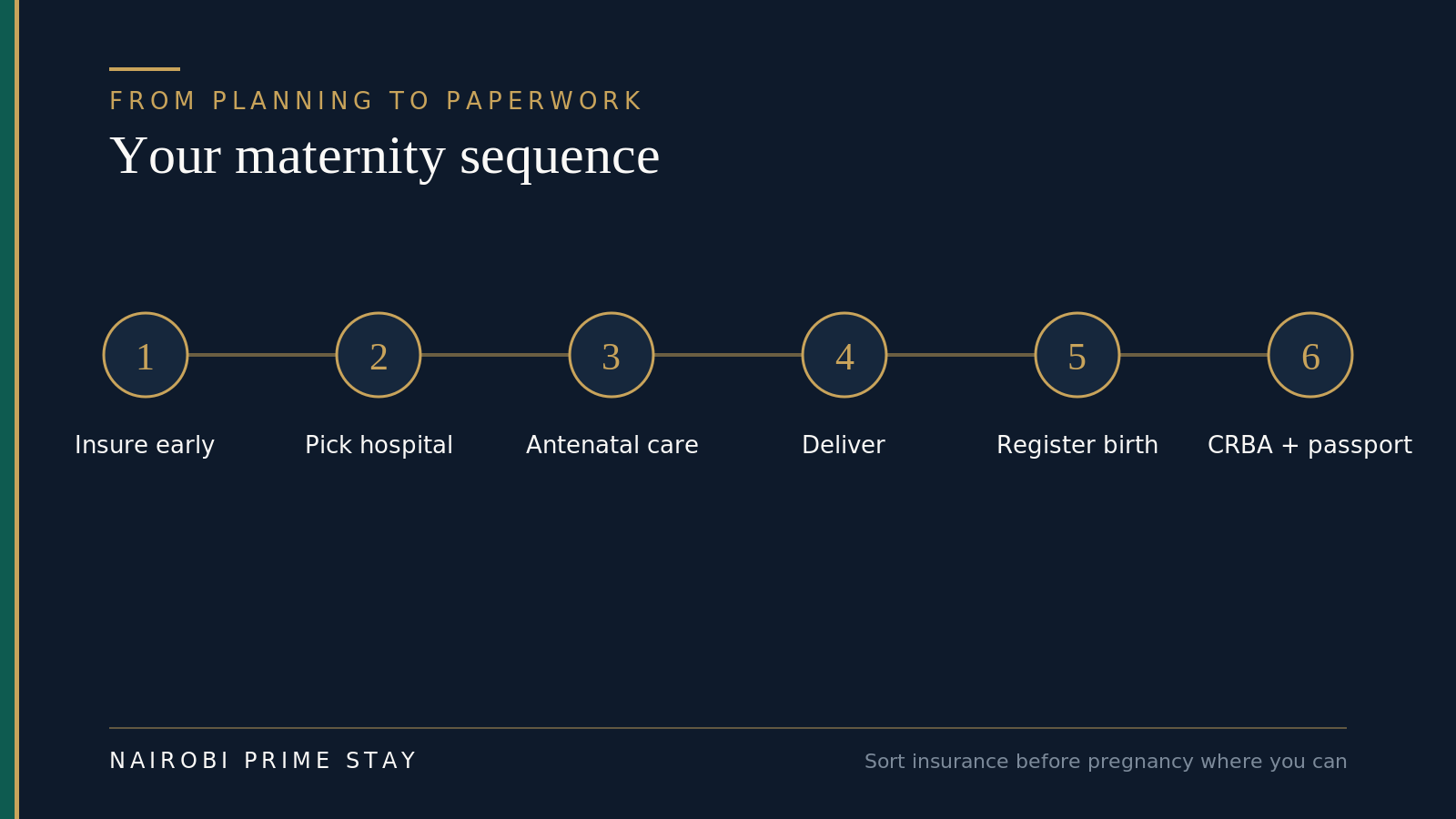 From planning to paperwork — sort insurance before pregnancy where you can.
- About a year ahead (if you can): add maternity cover to your health plan, before conceiving, to clear the ~10–12 month waiting period.
- Early pregnancy: choose a hospital and book an obstetrician; tour the maternity unit.
- Through pregnancy: attend antenatal check-ups, scans and bloods; budget these separately from the delivery package.
- Third trimester: confirm the package price in writing (ask what’s included), pre-register at the hospital, pack your bag.
- The birth: deliver; collect the hospital’s birth notification.
- Within weeks: apply for the Kenyan birth certificate on eCitizen using the notification.
- Within weeks: file the US CRBA and the baby’s US passport at the embassy in Gigiri.
- First months: set up paediatric care (e.g. Gertrude’s) and the baby’s dependant’s pass. If you’ll both be working, get on nursery waiting lists early — our nursery and daycare guide covers how.
Two honest scenarios
A remote-working couple, planning ahead. They add maternity cover to a regional plan a year before trying for a baby, so the waiting period is behind them. They deliver at Aga Khan; insurance covers most of the package up to its limit and they top up the difference. Afterward they register the birth on eCitizen and book the CRBA interview in Gigiri, leaving with a Kenyan certificate and a US passport. Total out-of-pocket stress: low, because they sorted insurance before pregnancy.
A family relocating mid-pregnancy. Dad’s job moves them to Nairobi when mom is five months along. They’ve missed the insurance window, so they budget to pay the delivery package in cash — manageable, because a normal delivery at a good private hospital is well under what they’d have faced in the US. They keep a cushion for antenatal care and the small chance of a NICU stay, choose The Nairobi Hospital for its all-on-one-site specialist back-up, and handle the CRBA in the first month. Different path, still a good outcome — they just planned around the cash reality.
The honest balance
| The good | The watch-outs |
|---|---|
| Excellent private hospitals with English-speaking obstetricians | Quality care means private care — you pay for it |
| Delivery costs well below US equivalents | Insurance maternity benefit needs ~10–12 months’ lead time |
| Modern delivery suites, epidurals, NICUs available | NICU and complications are charged on top and can be large |
| Clear, bundled maternity packages | Some hospitals bill specialists separately — get it in writing |
| Straightforward birth registration via eCitizen | Two sets of paperwork (Kenyan certificate + US CRBA) |
| Strong paediatric follow-up (e.g. Gertrude’s) | Baby isn’t Kenyan by birth — needs a dependant’s pass |
Your maternity checklist
- Add maternity insurance before conceiving (clear the ~10–12 month waiting period) — or plan to pay cash.
- Shortlist hospitals (Aga Khan, Nairobi Hospital, MP Shah, Mater, Nairobi West) and tour them.
- Book an obstetrician early; confirm they deliver at your chosen hospital.
- Get the package price in writing and ask exactly what’s included (and what isn’t).
- Budget separately for antenatal care and a cushion for NICU/complications.
- Check your insurance maternity limit and any normal-vs-C-section sub-limits.
- Pre-register at the hospital in the third trimester.
- After the birth, collect the birth notification.
- Apply for the Kenyan birth certificate on
crs.ecitizen.go.ke. - File the US CRBA + passport at the US Embassy, Gigiri (
NairobiCRBA@state.gov). - Arrange the baby’s dependant’s pass and paediatric care.
Final thoughts
Having a baby in Nairobi is, for most expat families, a reassuring experience — good hospitals, kind nursing, and a bill that’s gentler than home. The two things that turn it from stressful to smooth are both about timing: sort the insurance before you’re pregnant (or budget cash if that ship has sailed), and handle the birth paperwork in the right order so your baby leaves with both a Kenyan certificate and a US passport. Do those, choose your hospital deliberately, and the rest tends to fall into place.
This is general guidance, not medical, insurance or legal advice. Details reflect 2026 and can change — confirm hospital packages directly, insurance terms with the insurer, and citizenship questions with the US Embassy and your immigration lawyer.
Related reading
- Healthcare in Nairobi for expats and retirees — the full picture on hospitals, doctors and emergencies.
- Health insurance in Kenya for expats — international vs local plans, evacuation, and how maternity cover fits.
- Moving to Nairobi with kids — schools, paediatric care, nannies and the family adjustment.
- Cost of living in Nairobi — where medical and everyday costs really land.
- Best neighborhoods in Nairobi and the Gigiri and Parklands guides — living close to the hospitals and the embassy.
- Moving to Nairobi: the complete guide — the end-to-end overview for your move.
- Family life in Nairobi — what daily life with children here actually looks like.
- Nurseries and daycare in Nairobi — childcare options and waiting lists for when the baby grows.
When you arrive
A serviced apartment for your first weeks gives you a secure, fully equipped base — close to the major private hospitals, with Wi-Fi, cleaning, a backup generator and security included — while you register with an obstetrician, sort insurance and settle in before the baby comes. Browse our serviced apartments in Nairobi with honest monthly pricing; a $50 deposit reserves your dates and the balance is paid on arrival. Not sure which area keeps you closest to the right hospital and within budget? Our AI relocation assistant can shortlist options in a couple of minutes, day or night.
Frequently asked questions
How much does it cost to have a baby in Nairobi?
At a top private hospital, as of July 2026, a normal-delivery package runs roughly KES 100,000 to 150,000, about $800 to $1,200, while a planned C-section is more, roughly KES 180,000 to 350,000 or more. Mid-range hospitals like The Mater or Nairobi West are often 20 to 40% cheaper. Antenatal care and any neonatal (NICU) stay are charged separately and can add a lot, so confirm the package in writing and keep a cushion. Even so, costs are well below the US equivalent.
What is the best maternity hospital in Nairobi?
There is no single best, but the hospitals expat families use most are Aga Khan University Hospital in Parklands, which is JCI-accredited with a strong NICU, and The Nairobi Hospital in Upper Hill, which has deep specialist back-up. MP Shah is a well-regarded, often slightly cheaper alternative, and The Mater and Nairobi West deliver many babies at better value. Tour a couple and meet the obstetrician before deciding.
Does health insurance cover maternity in Kenya?
It can, but maternity is usually an optional add-on with a waiting period of about 10 to 12 months, so you must hold the cover well before the delivery. Buy it once you are already pregnant and the pregnancy is treated as pre-existing and not covered. Private maternity limits are typically capped around KES 100,000 to 250,000 per delivery, sometimes with separate normal and C-section sub-limits, so check your number against the hospital package.
Can I give birth in Nairobi if I’m already pregnant when I move?
Yes, the care is excellent, but you have likely missed the insurance window because of the 10 to 12 month maternity waiting period. Plan to pay the delivery package in cash and keep a cushion for antenatal care and any complications. A normal delivery at a good private hospital is still far below a US equivalent. Check whether any international policy you already hold has maternity benefits that travel with you.
Is a baby born in Nairobi to American parents a US citizen?
Generally yes, if at least one parent is a US citizen who meets the residency requirements in US law, but you must document it. You do that with a Consular Report of Birth Abroad (CRBA) from the US Embassy in Gigiri, usually applying for the baby’s first US passport at the same time. Kenya does not grant citizenship by birthplace, so a baby born in Nairobi to two American parents is American, not Kenyan, and will need a dependant’s pass to live in Kenya.
How do I register my baby’s birth in Kenya?
Births must be registered within six months. The hospital issues a birth notification, increasingly digital in Nairobi, which goes to Civil Registration Services. You then apply for the birth certificate on eCitizen at crs.ecitizen.go.ke using the notification number, a parent’s eCitizen account and ID. The standard fee is around KES 200 and certificates are typically processed within 7 to 14 working days, with online download available from mid-2026.
Does SHA cover having a baby in Kenya?
SHA, the national scheme that replaced NHIF in late 2024, covers maternity with no waiting period, but its payouts are modest and built around public and empaneled facilities, with reimbursement tariffs around KES 11,200 for a normal delivery and KES 32,600 for a C-section. A 2026 measure also funds free delivery at Level 2 and 3 public facilities for registered members. Treat SHA as a small baseline, not as cover for a private-hospital package. Confirm current rules at sha.go.ke.
Is maternity care in Nairobi safe?
In the private hospitals, yes. Nairobi has some of the best private healthcare in the region, with internationally trained obstetricians, modern delivery suites, epidurals on request, operating theaters and neonatal intensive care units. Most staff speak fluent English. The honest caveat is that this quality lives in the private system you pay for, so choose a reputable private hospital deliberately and carry insurance that covers it.
Should I fly back to the US to give birth instead?
Usually not. Citizenship is not a reason, because a baby born in Nairobi to a qualifying US-citizen parent is American at birth and the CRBA documents it, and a US delivery typically costs many times a Nairobi private package. Flying home makes sense for a genuinely high-risk pregnancy needing a specific US specialist, insurance that only pays in US networks, or family support. If you do fly, book in the second trimester, since most airlines stop carrying pregnant passengers around 36 weeks.
Can I get an epidural in Nairobi?
Yes. Epidurals are available on request at the main private maternity hospitals, including Aga Khan, The Nairobi Hospital and MP Shah, given by consultant anaesthetists, and spinal anaesthesia is standard for C-sections. Two things to confirm when you tour: whether an epidural in normal labour is included in the package or billed on top, and how the hospital handles anaesthetist availability out of hours. Put both answers in writing with your package quote.
What maternity leave do I get in Kenya?
On a Kenyan employment contract, the Employment Act gives mothers three months (90 calendar days) of maternity leave on full pay and fathers two weeks (14 calendar days) of paternity leave on full pay, current as of July 2026. Many international employers in Nairobi top this up, so ask HR. If you work remotely on a US contract, your US employer’s parental-leave policy applies instead, so confirm in writing how they treat a birth abroad.
How soon after the birth can we fly with the baby?
Plan on several weeks to a couple of months for an international trip. Airlines carry healthy newborns from as young as a few days to two weeks old, but the baby needs a US passport first, which runs through the CRBA at the embassy in Gigiri. You file the eCRBA online, wait at least 72 hours to book the in-person interview, and appointment availability can involve long waits, so book the moment the system allows. Documents typically follow a few weeks after the interview.
Ready to look?
Find your apartment in Nairobi
Browse verified serviced apartments, or ask the AI concierge which area fits your life.