
Guides · Schools
American and IB Schools in Nairobi: A 2026 Guide for US Families
American and IB Schools in Nairobi: A 2026 Guide for US Families
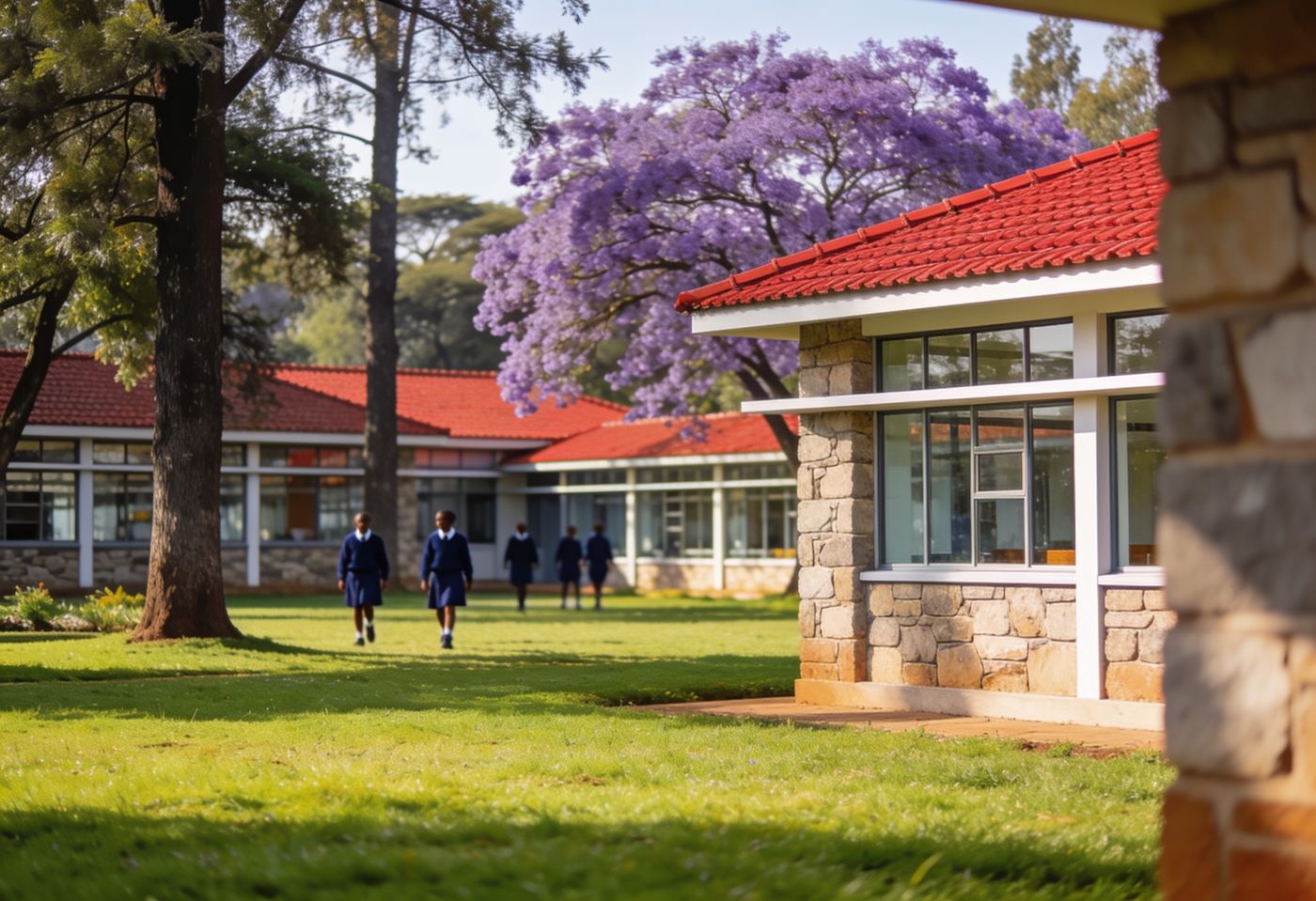
If you want your child to stay on the US track in Nairobi, two schools do most of the work: the International School of Kenya (ISK) in Gigiri and Rosslyn Academy in Runda. Both teach an American curriculum, both sit in the leafy northern suburbs where most expat families live, and between them they cover the two questions American parents ask first — will the credits transfer home, and what does it cost.
This guide is for US families who want the American system, the International Baccalaureate (IB), or a mix of the two. We’ll keep it honest. The schools are genuinely good, college placement is strong, and the fees at the top end rival a US private school. By the end you’ll know which school teaches what, how an American diploma and the IB Diploma differ, what 2026 fees actually look like, how admissions and waitlists work, and how to line up your home so the morning school run stays short.
For the wider view across every curriculum — British, French and German included — start with our international schools in Nairobi guide. If the British route is on your list too, see British curriculum schools in Nairobi.
Quick answer
For an American curriculum, ISK (Gigiri) and Rosslyn Academy (Runda) are the two established choices. ISK is the flagship — American program plus the IB Diploma option in the final years, K–12, beside the UN headquarters, and the most expensive school in the country. Rosslyn is a North American, Christian school with one of the largest Advanced Placement (AP) programs in Africa, and it costs noticeably less. For a full IB pathway from the early years, the Aga Khan Academy in Parklands runs the complete IB continuum. As of the 2026/27 year, plan for roughly $31,000–37,000 a year in tuition at ISK (plus a one-time $11,000 capital levy for new entrants) and about $6,000–17,000 at Rosslyn, before transport and extras. Best schools run waitlists, so enquire six to twelve months ahead.
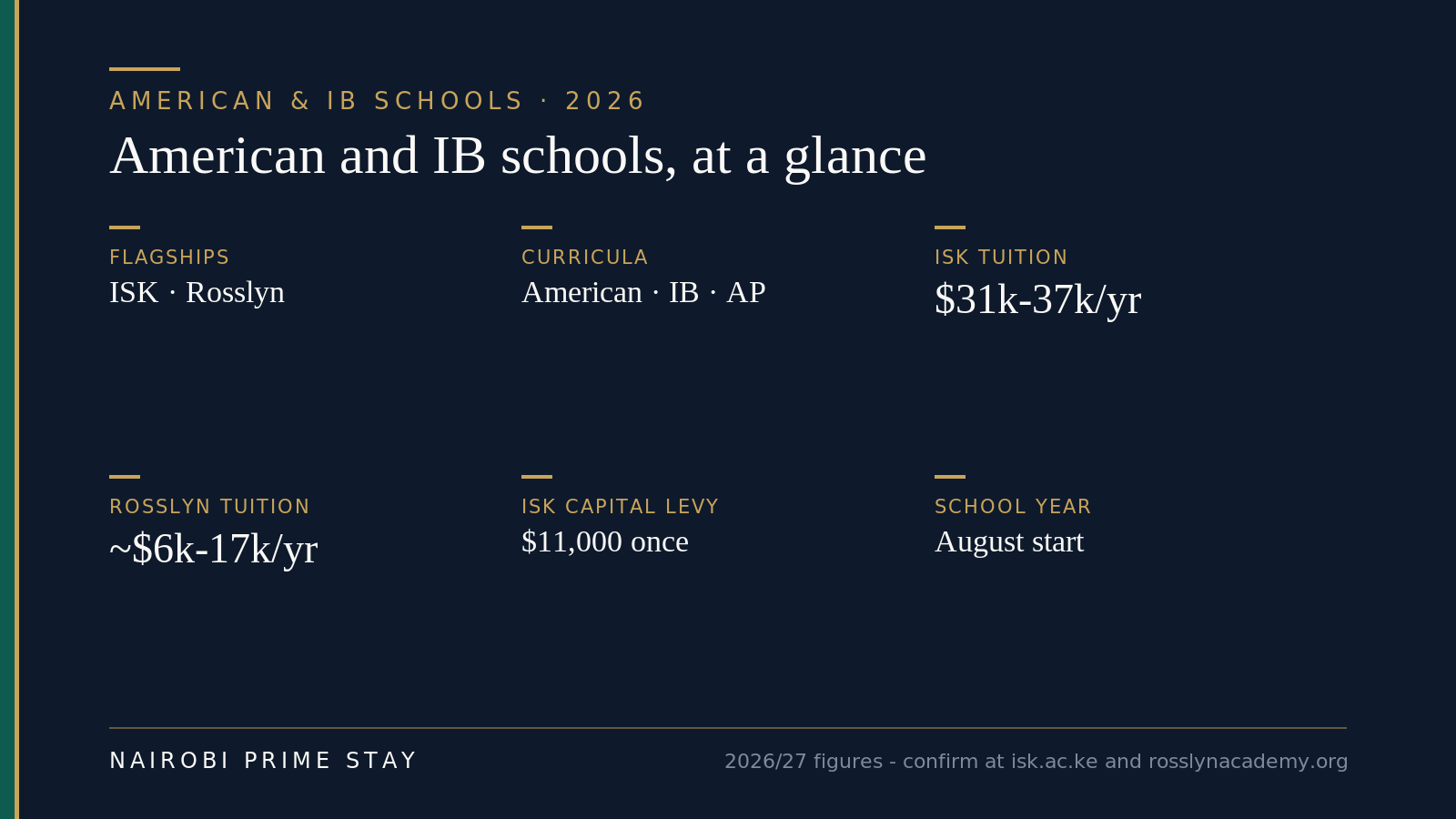 At a glance — 2026/27 figures. Always confirm current fees at isk.ac.ke and rosslynacademy.org.
Why this matters for your move
Schooling is usually the decision that anchors everything else about a Nairobi move. Pick the school first, and your home search narrows to two or three suburbs near it; pick the home first, and you can end up driving across the city twice a day in traffic that turns six kilometers into an hour.
For American families there’s a second layer: keeping your child’s education portable. If you’re posted here for two or three years and then head back to the US, the American or IB route keeps that door open most cleanly — familiar grade levels, a recognizable transcript, and college admissions that work the way you expect. That’s why so many US, UN and embassy families gravitate to ISK and Rosslyn. The good news is that the schools and the best family suburbs overlap almost perfectly, so one decision settles much of the other.
The two systems, explained for US parents
Before the schools, the curricula. “American” and “IB” are the two routes that keep your child closest to the US system, and they work differently from each other.
The American curriculum is the one you grew up with. A familiar K–12 structure, grade levels by age, a US high-school diploma earned through credits and a GPA, and the option to take Advanced Placement (AP) courses — college-level classes with an exam in May that can earn credit at US universities. The school year runs roughly August to June, like home. It is the easiest system to transfer into from a US school and back again, because the grade levels, transcript and diploma all map directly. ISK and Rosslyn lead here.
The International Baccalaureate (IB) is a globally portable program built around breadth. In the final two years, the IB Diploma asks students to study six subjects across the main disciplines, plus three “core” elements: an extended essay, a theory-of-knowledge course, and a creativity-activity-service requirement. It’s demanding and well respected; US universities recognize it and often grant credit for higher-level subjects. The IB suits families who move between countries, or who want maximum university options anywhere in the world. ISK offers the IB Diploma alongside its American track in the senior years, and the Aga Khan Academy runs the full IB from the early grades.
The honest version of the choice: if you might move back to the US partway through school, the American system is the smoothest ride. If your child thrives on a broad, structured load and you value portability, the IB is excellent. Neither closes the door to a US college — strong students from both routes go on to US universities every year.
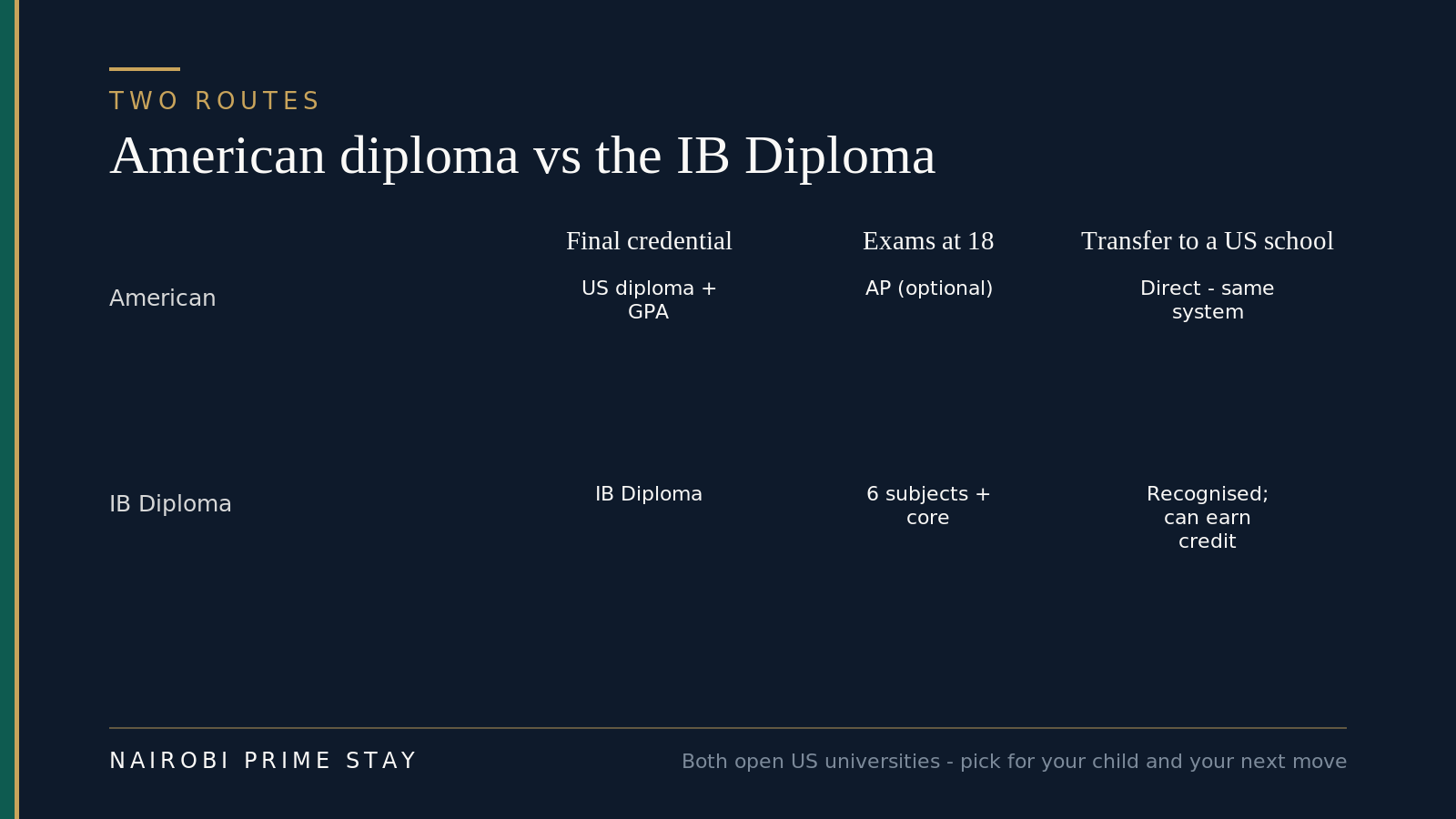 Two routes to the same destination. Both open US universities — the right one depends on your child and your next move.
The American and IB schools in Nairobi
A handful of schools cover the American and IB ground. Here are the ones that matter, what they teach, and who they suit.
International School of Kenya (ISK) — Gigiri
ISK is the best-known international school in the country, founded by the American and Canadian embassies and still the default for many diplomatic and UN families. It teaches an American curriculum from kindergarten through grade 12, and adds the IB Diploma as an option in the final two years — so a student can graduate with a US diploma, the IB Diploma, or both. The campus is large and green, minutes from the UN headquarters in Gigiri, with strong academics, sport, arts and a famously international student body. College counseling is well established and US university placement is a core strength. It is also the most expensive school in Kenya, and admission to popular grades can mean a waitlist.
Rosslyn Academy — Runda
Rosslyn Academy is a North American school run on Christian foundations, long established and known for a warm, close community. It teaches a US curriculum from preschool to grade 12 and runs one of the largest and most successful Advanced Placement (AP) programs in Africa, so college-bound students can rack up genuine college credit before they leave. Crucially for transferring families, Rosslyn is accredited by the Middle States Association (MSA) and the Association of Christian Schools International (ACSI), which keeps the transcript portable. It sits in Runda, beside the Rosslyn and Nyari suburbs, and it costs meaningfully less than ISK — which makes it a favorite for missionary, NGO and many American families who want the US system without the top-tier price tag.
Aga Khan Academy — Parklands
If you want a full IB pathway rather than the American track, the Aga Khan Academy in Parklands runs the complete IB continuum — the Primary Years and Middle Years programs leading to the IB Diploma at 18. It’s academically strong, more diverse in fees and intake than the priciest schools, and a solid choice for families committed to the IB from the start. Parklands sits closer to the city center and Westlands than the northern school cluster, which can suit families living on that side of town.
Other options worth a look
A few more schools touch the American or IB world. Brookhouse (Karen and Runda) is primarily British but offers the IB Diploma in the sixth form, so it’s worth a look if you’re weighing British-with-IB. Smaller and newer schools — among them Crawford, Nairobi Waldorf and a handful of others — offer alternative approaches that may fit a particular child or budget. And several British-curriculum schools sit alongside these; our British schools in Nairobi guide covers that side in full.
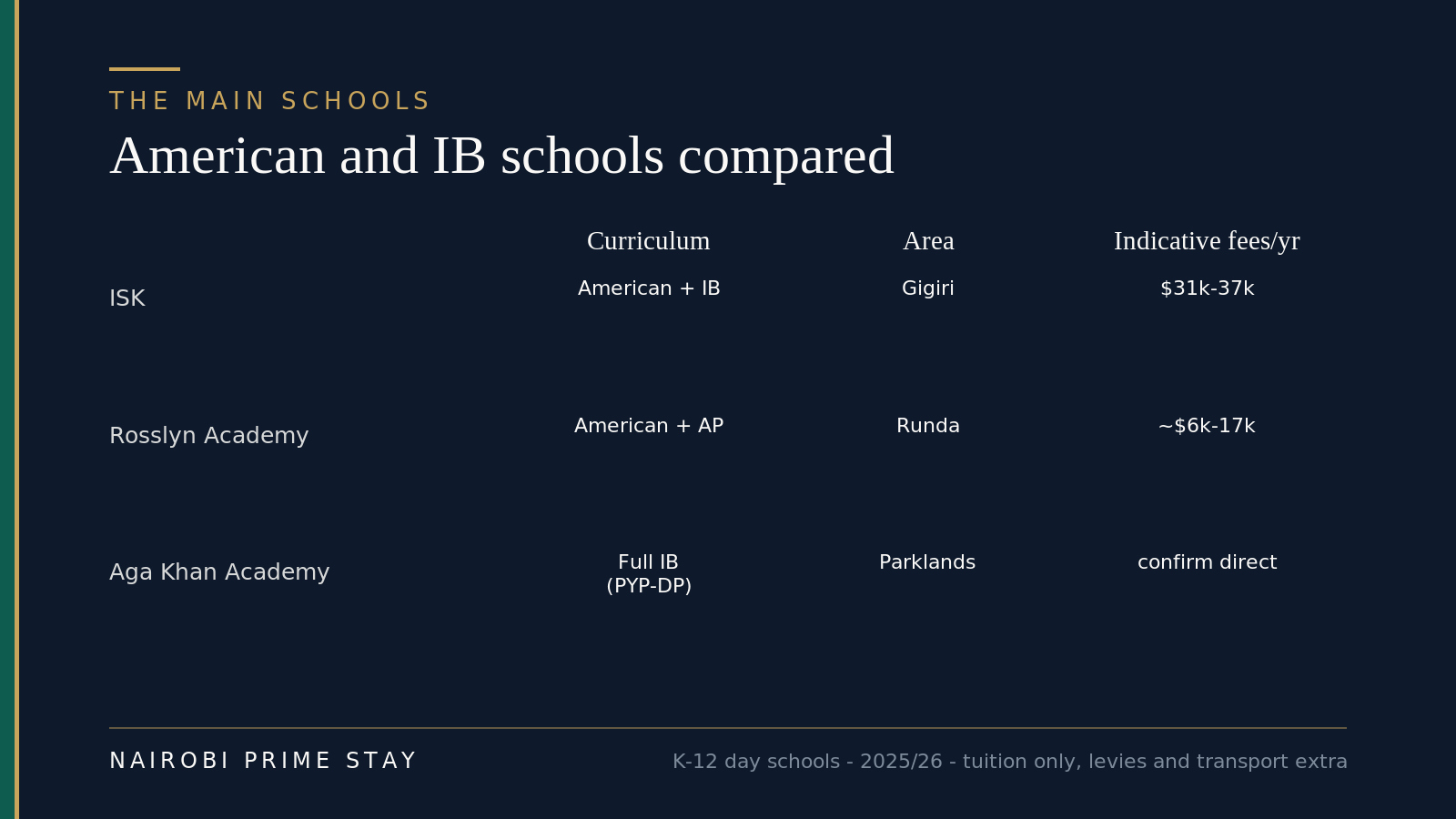 The three core American/IB schools. Tuition only — capital levies, registration and transport are extra.
So which should you choose? Start from your likely next move and your budget, then visit both. The grid below is a starting point, not a verdict.
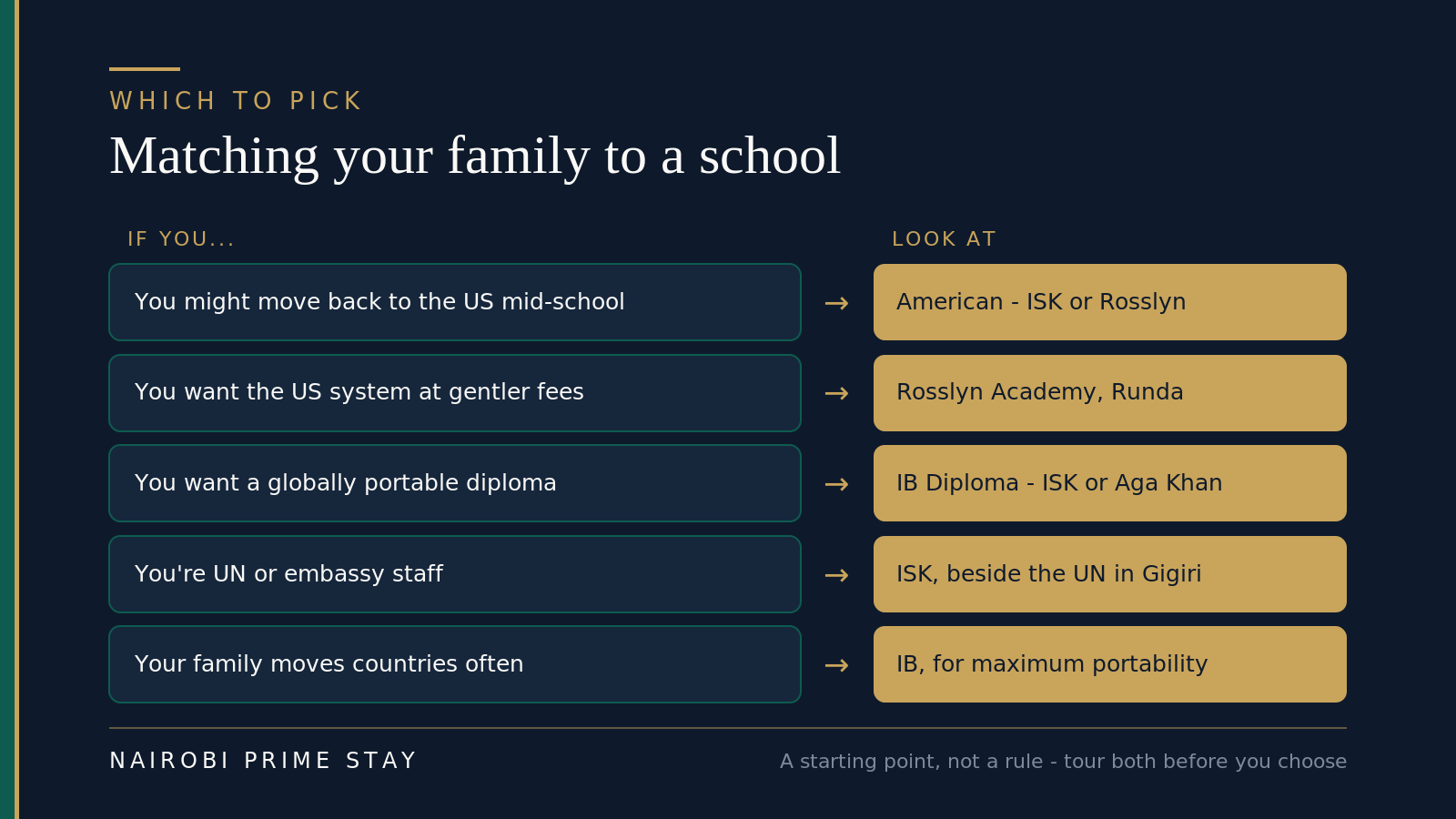 Which to pick — a quick gut-check. Tour both schools before you decide.
ISK vs Rosslyn: an honest head-to-head
Most American families end up choosing between these two, so here’s the straight comparison. Both teach a US curriculum, both send graduates to US universities every year, and both sit about ten minutes apart in the northern suburbs. The real differences are money, size, feel and final-year options.
ISK is bigger, pricier and more diplomatic — the flagship, with the IB Diploma option in the senior years, a large green campus and the deepest UN and embassy community. Rosslyn is smaller, warmer and openly Christian, with one of Africa’s strongest AP programs and fees that often land around half of ISK’s. Neither is “better.” A family posted for two or three years on a UN or embassy education allowance frequently ends up at ISK; a missionary, NGO or self-funding family who wants the US system without the top-tier price often chooses Rosslyn.
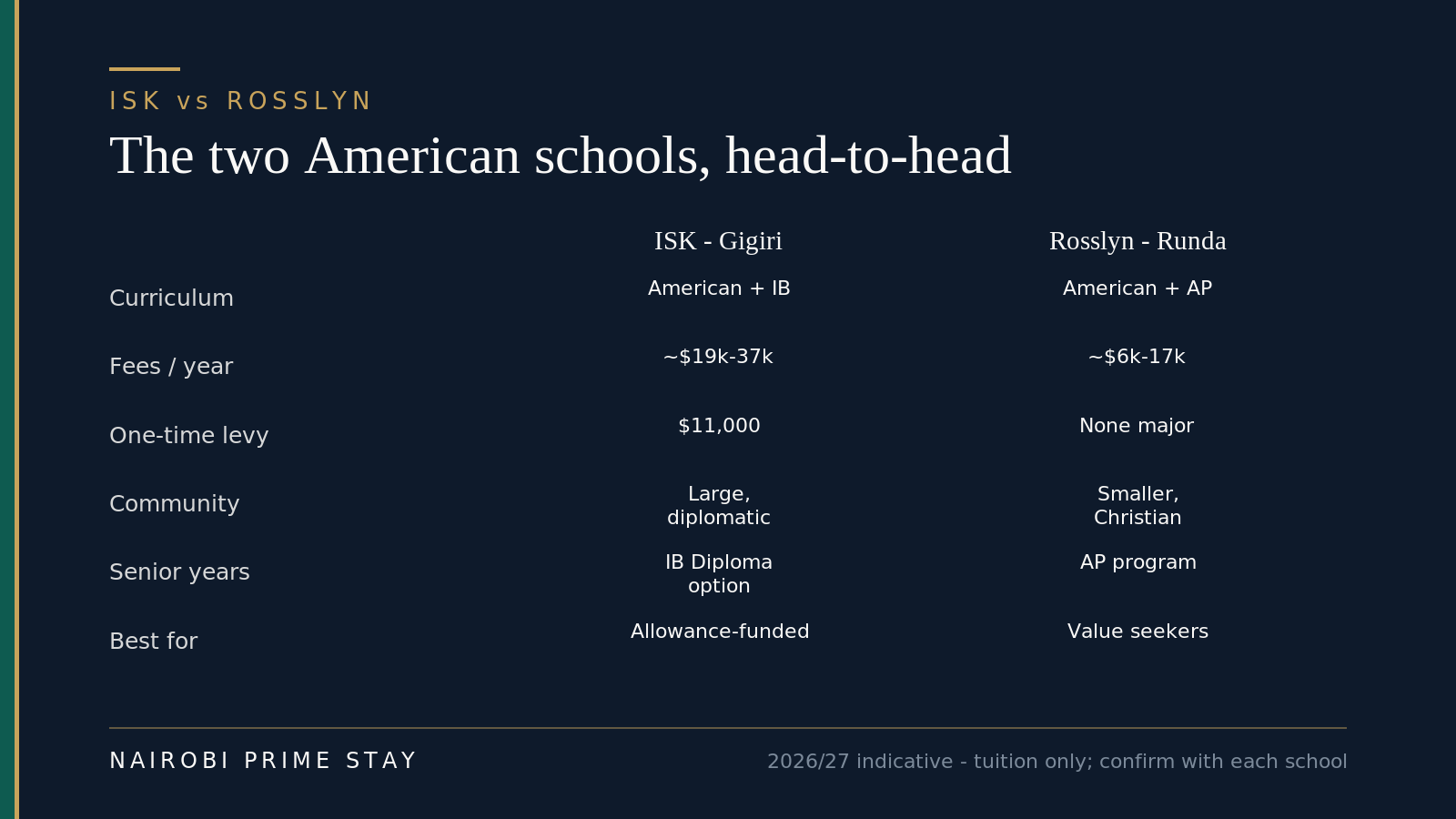 ISK vs Rosslyn at a glance. Both are strong — the right one depends on budget, final-year plans and the community you want.
The tie-breakers most families use: budget (Rosslyn is markedly cheaper), whether you want the IB Diploma option in the final years (ISK has it; Rosslyn is AP-only), campus size and feel (large and international versus smaller and close-knit), and faith (Rosslyn is Christian; ISK is secular). If you can, tour both on one scouting trip — an hour on each campus tells you more than any comparison table.
US-style transcripts, AP and college prep
This is where the American schools earn their keep for US families. Both ISK and Rosslyn produce a US high-school transcript with a GPA, the document American universities expect, and both run college counseling offices that know the US application calendar — the Common App, SAT and ACT testing, recommendation letters and essay timelines. Your child applies to US colleges the same way they would from a school in Ohio.
AP courses are the headline at Rosslyn and available at ISK: college-level classes graded by an exam each May, where a strong score can convert into college credit or advanced standing at a US university. The IB Diploma does similar work from the other direction — universities commonly award credit for higher-level IB subjects. Either way, a motivated student can arrive at a US college with credits already banked.
Accreditation matters more than parents expect. It’s what makes a transcript travel. ISK holds international accreditation recognized by US institutions, and Rosslyn is accredited by the Middle States Association — the same body that accredits schools across the US — alongside ACSI. When you’re comparing any school, ask which bodies accredit it and confirm the credits will be recognized by the kind of college your child is aiming at. Sports-minded families should also ask about NCAA eligibility, which depends on approved coursework.
Learning support and special educational needs
Be realistic here, and ask early. Nairobi’s international schools offer more learning support than they did a decade ago, but it’s generally lighter than a well-funded US public district with a full special-education department. Most of the American and IB schools have a learning-support or student-services team that helps with mild to moderate needs — extra reading help, some testing accommodations, a resource teacher — and ISK, as the largest school, has the deepest bench. Significant needs, one-to-one aides or specialized therapies are harder to guarantee, sometimes carry an extra fee, and occasionally aren’t available at all.
If your child has an IEP, a 504 plan or any diagnosed need, send the paperwork to the admissions team before you apply and ask plainly what they can and can’t provide. A good school would rather tell you honestly up front than enroll a child it can’t serve well. For therapies outside school — speech, occupational or behavioral — private providers do exist in Nairobi; the school’s counselor or our AI relocation assistant can point you toward them.
What American and IB schools cost in 2026
Plan for a wide range, because these two schools sit at opposite ends of the price ladder. The figures below are for the 2026/27 year; school fees rise most years, so confirm the current numbers on each school’s site before you budget.
ISK publishes tuition by grade. As of 2026/27 it runs from about $18,900 in pre-kindergarten up to roughly $30,800 in kindergarten, $32,500–34,000 through the elementary and middle grades, and $35,900–37,330 in high school (grades 9–12). On top of tuition, new K–12 entrants pay a one-time capital levy of $11,000 (reduced by $500 for each additional sibling), and returning students pay a smaller annual capital levy of about $1,550. The application fee is $400, non-refundable. ISK bills by semester, and paying a full year up front can earn a small discount. In practical terms, a family enrolling one new child faces a first-year bill of roughly $31,000–$50,000 depending on grade — tuition plus that one-time levy, application and the annual levy — then a steady $32,000–$39,000 a year after that. Confirm the current grade-by-grade schedule at isk.ac.ke or with the ISK business office.
Rosslyn Academy is the more affordable American option, with annual tuition in the region of $6,000–17,000 depending on grade (roughly KES 800,000–2.2M). Rosslyn doesn’t always publish a full fee table online, so the school asks families to confirm current tuition directly with the admissions office.
The Aga Khan Academy sits between the two on fees and publishes less openly; confirm directly with the school.
Budget for more than the headline tuition. A useful rule of thumb is to add 15–25% on top for the all-in first-year cost — registration, the capital levy where it applies, optional bus transport (ISK’s runs around $2,200 a year), lunches, uniforms, trips and, in the final years, exam-entry fees. Many schools offer sibling discounts.
| Cost item | Indicative 2026 range | Notes |
|---|---|---|
| Annual tuition (ISK) | ~$18,900 – $37,330 | Rises with grade; high school at the top |
| Annual tuition (Rosslyn) | ~$6,000 – $17,000 | Confirm current figures with the school |
| One-time capital levy (ISK) | $11,000 | New K–12 entrants; −$500 per extra sibling |
| Annual capital levy (ISK, returning) | ~$1,550 | For continuing students |
| Application / registration | ~$400 (ISK) | Non-refundable; others charge KES 26,000–45,000 |
| Optional bus transport | ~$1,500 – $2,500/yr | Worth it if you live across town |
For a full cost-of-living picture around school fees, see our cost of living in Nairobi guide.
Scholarships, financial aid and employer allowances
For most American families the biggest source of help isn’t a scholarship — it’s an employer. UN agencies, embassies, many NGOs and a lot of corporate postings include an education allowance that covers some or all of international-school fees for dependent children. If you’re moving for work, ask HR exactly what’s covered before you settle the package; at ISK-level fees, the allowance can be worth more than a raise, and diplomatic and UN packages often assume a school like ISK in the first place.
Direct financial aid is thinner. ISK offers limited need-based assistance, and Rosslyn runs need-based scholarships and tuition assistance, partly funded by its community — worth asking about if you’re self-funding and the fees are a stretch. Neither school is cheap without help, so budget the real all-in number: tuition, the one-time levy, registration, transport and extras. Our cost of living in Nairobi guide and family life in Nairobi guide put school fees in the context of a whole household budget.
Where the schools are, and where to live
The American and IB schools cluster in Nairobi’s northern suburbs, and so do the families who attend them. ISK sits in Gigiri, beside Runda, Muthaiga and Nyari — the heartland of UN, embassy and diplomatic families. Rosslyn Academy is in Runda too, by the Rosslyn and Nyari estates. The Aga Khan Academy, in Parklands, suits families living nearer Westlands and the city.
The practical upshot: if your child is at ISK or Rosslyn, living in Gigiri, Runda or Nyari gives you a five-to-fifteen-minute school run and, for UN and embassy staff, a short commute to work as well. Distances here are short; the traffic is not. A home ten minutes from the gate is worth far more than a bigger house across town. Our moving to Nairobi with kids guide goes deeper on family suburbs, and the best neighborhoods in Nairobi guide helps you match an area to your shortlist.
The school year and timing your move
American schools in Nairobi run on a familiar calendar: roughly August to June, with a long summer break. An August start is the clean entry point and the one most families aim for. That’s good news coming from the US — your child slots in at the natural start of the year, and summer gives you room to move.
It matters because Kenya’s own school system runs on a different clock. Local and Kenyan-curriculum (CBC) schools follow the calendar year, roughly January to November, while British-system schools run a September-start, three-term year. So the “school year” depends entirely on which system you pick — don’t assume your neighbor’s term dates match yours. Mid-year transfers into the American schools are usually possible if there’s space, but the smoothest move lines up with the August intake. Younger children are more flexible: nurseries and daycares take toddlers year-round, so the timing pressure really applies from kindergarten up (see our nursery and daycare guide).
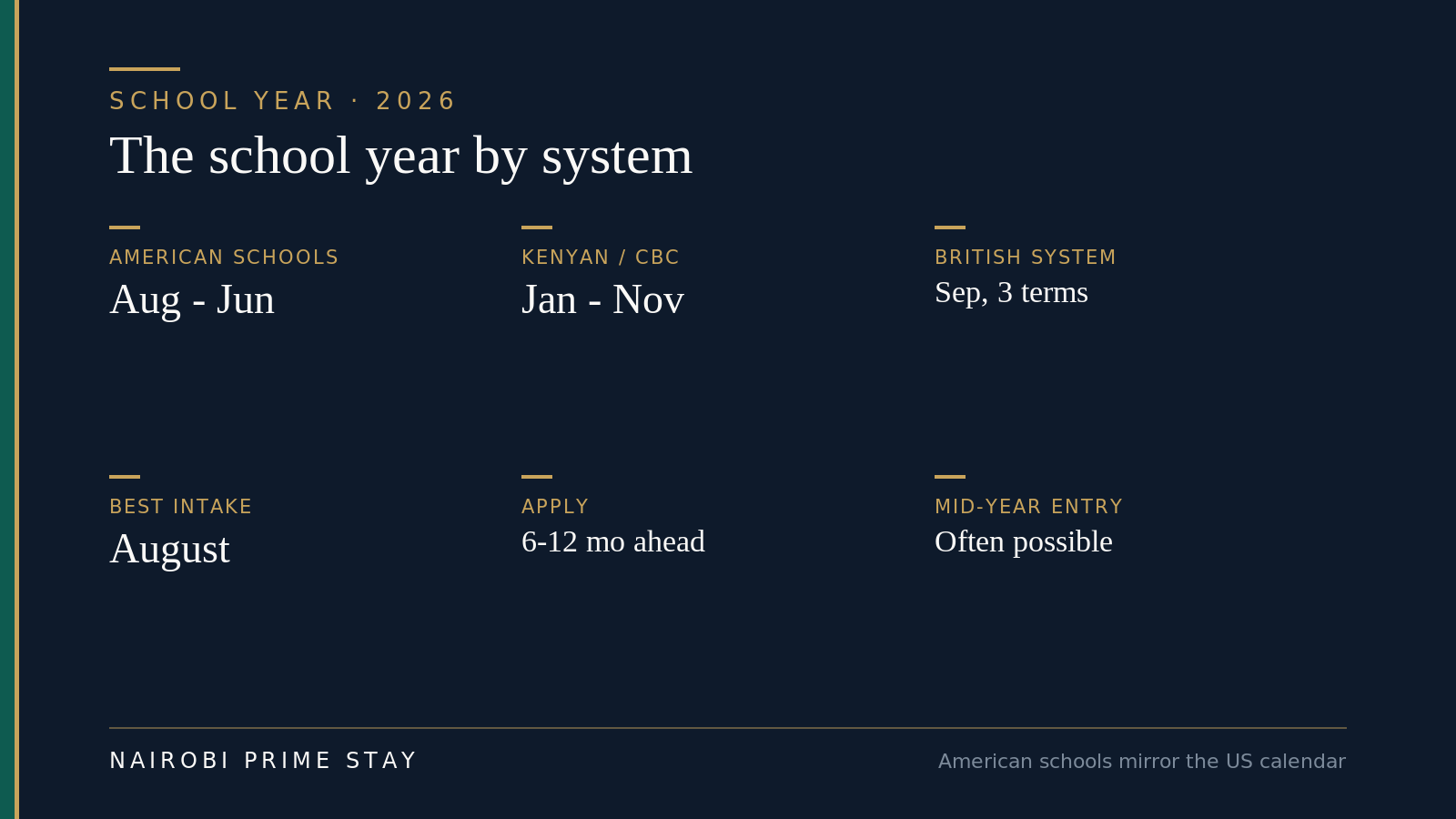 The academic year depends on the system. American schools mirror the US calendar — plan around the August start.
How admissions work
Start early. The best schools — ISK especially — run waitlists at popular entry points and mid-year, so six to twelve months ahead is sensible. If you’re moving for the August start, begin the term before. Admissions teams are used to relocating families and will work with your timeline, but you don’t want your whole move held hostage by a single school.
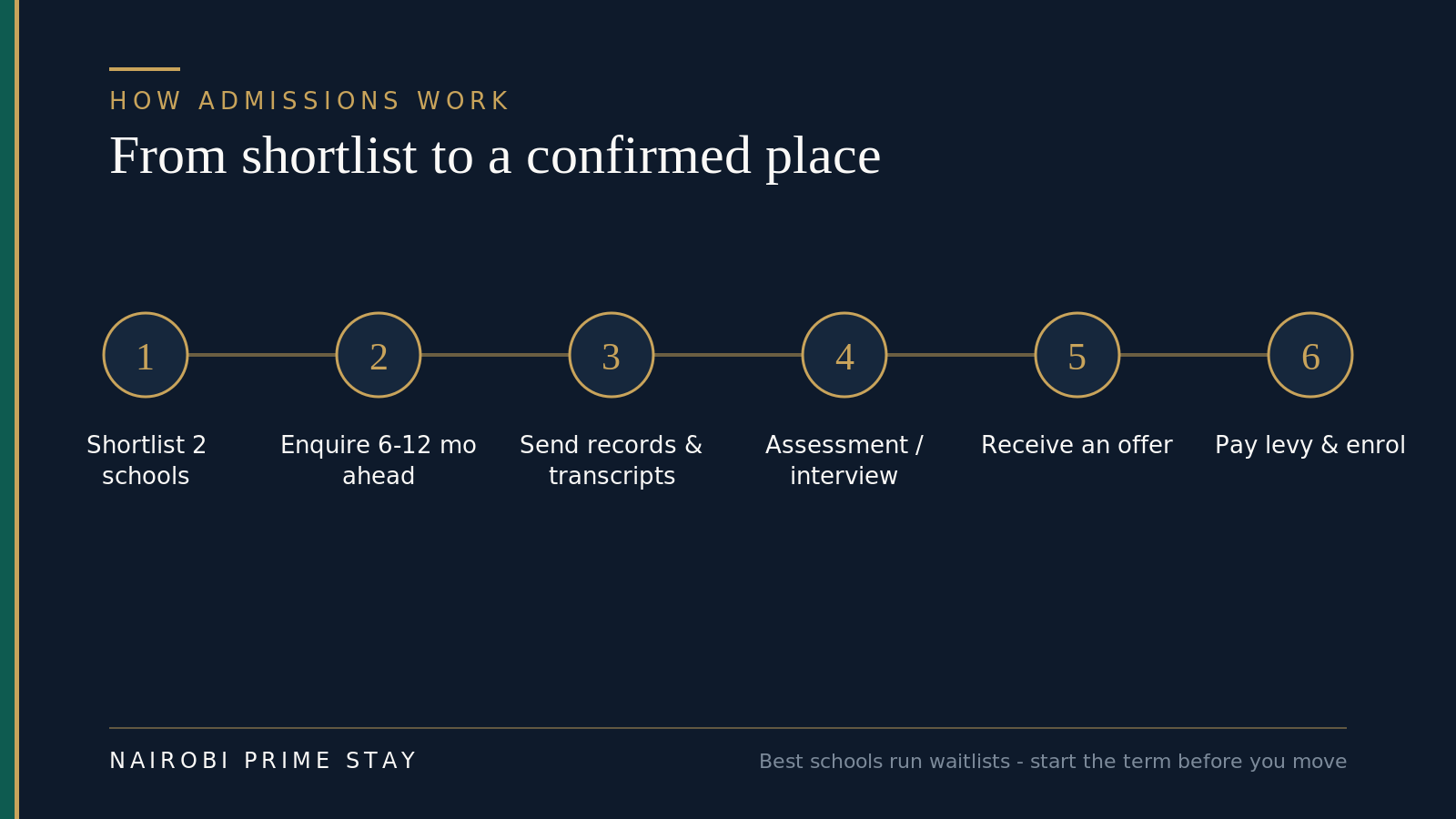 Apply to two schools, not one — and start the term before you plan to move.
You’ll typically submit an application with your child’s recent school reports and transcripts, any standardized test results, and sometimes a teacher reference. Younger children may have an informal assessment or a class visit; older students may sit a short assessment or interview. Once you have an offer, you secure the place with the registration fee and any deposit or capital levy — read carefully what’s refundable before you pay. Gather your records before you leave the US; chasing transcripts across time zones after you’ve landed is a headache you can avoid.
Applying from the US: securing a place before you fly
You can do almost all of this from home, and you should start before you land. Admissions teams at ISK and Rosslyn are used to families applying from another continent, and most of the process runs by email and video call.
Here’s the sequence that works. Shortlist two schools and email their admissions offices early — six to twelve months out for an August start. Ask for a virtual tour; both schools will walk you around by video and take questions live. Send your child’s records digitally: recent report cards, transcripts, any standardized-test results and a teacher reference, scanned as PDFs. Your child may sit a short online assessment or interview. When an offer comes, you hold the place with the registration fee and any deposit or levy — read what’s refundable first. Then time your flights to arrive a few weeks before term, ideally into a serviced apartment near the school, so you can finish the in-person paperwork, buy uniforms and drive the school run before day one.
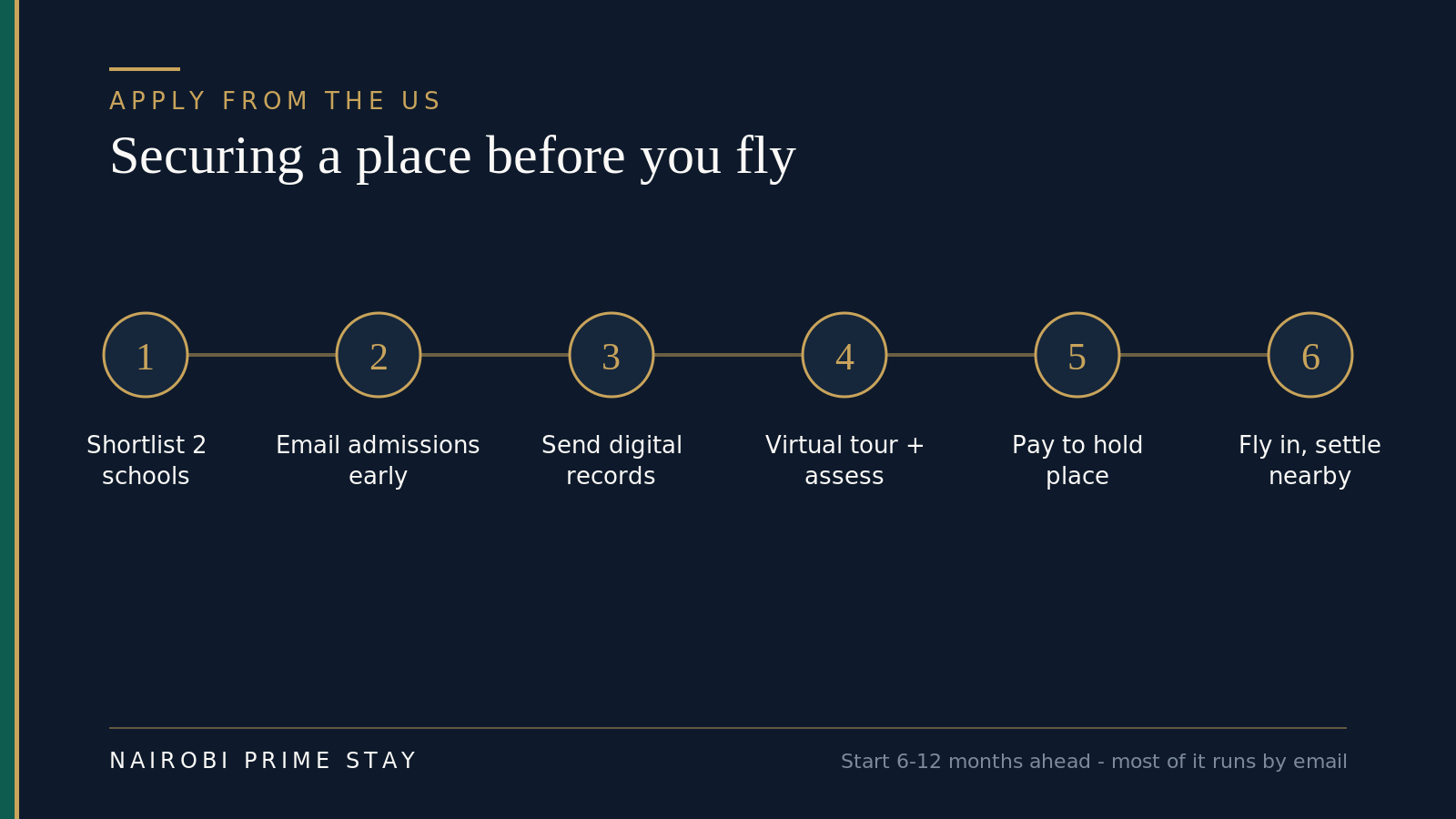 You can lock in a place from the US. Start six to twelve months ahead and keep digital copies of every record.
One honest caution: don’t sign a year-long housing lease until the school place is confirmed in writing. Families sometimes commit to a home near a school, then discover the grade is full. Keep housing flexible — a month in a serviced apartment — until the offer is signed.
A real-world example
The Mwangi-Petersens, an American-Kenyan family with a 9- and a 13-year-old, moved from Denver for a two-year posting. They shortlisted ISK and Rosslyn, toured both on a scouting trip while on the visa-free eTA, and chose Rosslyn — the community felt right, the fees were gentler, and the older child could still slot back into a US high school later on an MSA-accredited transcript. They booked a serviced apartment in Runda’s orbit for the first six weeks, drove the school run a few times in real morning traffic, and then signed a lease ten minutes from the gate. From landing to settled took about five weeks. Their advice to other families: apply to two schools, and live near the one you pick.
Pros and cons of the American/IB route
| What works well | What to weigh |
|---|---|
| Familiar US structure, transcript and GPA | Top-tier tuition at ISK rivals a US private college |
| Strong AP and IB options for college credit | One-time capital levies add a big first-year hit |
| Easy transfer in and out of the US system | Best schools have waitlists at popular grades |
| Established US-style college counseling | Fees rise most years — budget for increases |
| Schools cluster near the best family suburbs | A few schools don’t publish fees openly |
Your school-search checklist
- Decide on the route — American, IB, or a school that offers both
- Shortlist two schools (don’t pin everything on one)
- Enquire six to twelve months ahead, especially for an August start
- Ask which bodies accredit the school and confirm credits transfer
- Gather transcripts, reports and test scores before you leave the US
- Check AP or IB offerings against your child’s college plans
- Budget all-in: tuition plus levy, registration, bus and extras
- Tour both schools and drive the school run in morning traffic
- Choose your neighborhood to keep the commute short
- Book a serviced apartment for a soft landing while you decide
Frequently asked questions
These are the questions US families ask us most about American and IB schools in Nairobi.
Which schools in Nairobi follow the American curriculum? The two established American-curriculum schools are the International School of Kenya (ISK) in Gigiri and Rosslyn Academy in Runda. ISK teaches an American program from kindergarten through grade 12 and adds the IB Diploma option in the senior years; Rosslyn is a North American, Christian school with a large Advanced Placement program. Both produce a US high-school transcript and run college counseling geared to US university applications.
Does any school in Nairobi offer the IB Diploma? Yes. ISK offers the IB Diploma alongside its American track in the final two years, so students can graduate with a US diploma, the IB Diploma, or both. The Aga Khan Academy in Parklands runs the full IB continuum from the early grades, and Brookhouse offers the IB Diploma in its sixth form. The IB is demanding, globally portable and recognized by US universities, which often grant credit for higher-level subjects.
How much does ISK cost in 2026? For the 2026/27 year, ISK tuition ranges from about $18,900 in pre-kindergarten to roughly $37,330 in grades 11 and 12, with the elementary and middle grades in between. New K–12 entrants also pay a one-time capital levy of $11,000 (reduced by $500 for each additional sibling), plus a $400 application fee, and returning students pay an annual capital levy of about $1,550. Add transport, lunches and extras on top, and confirm current figures at isk.ac.ke.
Is Rosslyn Academy cheaper than ISK? Yes, noticeably. Rosslyn’s annual tuition runs in the region of $6,000–17,000 depending on grade, well below ISK’s $30,800–37,330 in the school-age years, and it has no capital levy on ISK’s scale. That gap is a big reason missionary, NGO and budget-conscious American families choose Rosslyn — you get the US system and a strong AP program at a friendlier price. Rosslyn doesn’t always publish fees online, so confirm the current numbers with the admissions office.
Will an American or IB transcript from Nairobi transfer back to a US school? Yes. Both ISK and Rosslyn are internationally accredited — Rosslyn by the Middle States Association, the same body that accredits many US schools — so the grade levels, transcript and diploma map cleanly onto the US system. The IB Diploma is recognized everywhere and US universities commonly grant credit for it. When comparing any school, ask which bodies accredit it and confirm the receiving school or college will recognize the credits.
What’s the difference between AP and the IB Diploma? AP (Advanced Placement) lets a student take individual college-level courses with an exam each May; you pick as many or as few as you like, and strong scores can earn US college credit. The IB Diploma is a full two-year program: six subjects across the disciplines plus an extended essay, theory of knowledge and a service requirement, earned as one qualification at 18. AP is flexible and very American; the IB is broader, more structured and more globally portable. Both are respected by US universities.
Can my child get into a US university from a Nairobi school? Yes — it happens every year from both ISK and Rosslyn. Their college counseling offices know the US application cycle, students sit the SAT or ACT here, and AP or IB results strengthen applications. The transcript is the US-style document admissions officers expect, so your child applies much as they would from a school back home. If a US college is the goal, mention it early so counseling can line up the right courses and tests.
When should I apply to international schools in Nairobi? Six to twelve months ahead is the safe window, and for an August start you should begin the term before. The best schools, ISK in particular, run waitlists at popular entry points and for mid-year arrivals. Apply to two schools rather than betting on one, gather your records before you leave the US, and don’t sign a year-long housing lease until your school place is confirmed — a serviced apartment bridges the gap.
When does the school year start in Nairobi? American schools such as ISK and Rosslyn run roughly August to June, mirroring the US calendar, so the August intake is the natural entry point and the one most relocating families target. Kenyan and CBC schools run the calendar year (about January to November), and British-system schools start in September — so term dates depend on which system you choose. Mid-year entry into the American schools is often possible if a grade has space, but the smoothest move lines up with August.
Are scholarships or financial aid available at these schools? Some, but the biggest help for most American families is an employer education allowance — UN, embassy, many NGO and corporate packages cover part or all of international-school fees, so ask HR what’s included. For direct aid, ISK offers limited need-based assistance and Rosslyn runs need-based scholarships and tuition assistance, partly community-funded. Neither school is inexpensive without help, so confirm any aid with the admissions office and budget the full all-in cost.
Can these schools support a child with learning needs or an IEP? To a point, and you should ask before you apply. The American and IB schools have learning-support teams that handle mild to moderate needs — extra help, some accommodations, a resource teacher — with ISK, the largest school, offering the most. Significant needs, one-to-one aides or specialized therapies are harder to guarantee and may not be available, so send your child’s IEP or 504 paperwork to admissions early and get a clear, honest answer in writing.
Final thoughts
For most American families, the school decision in Nairobi comes down to two questions: how closely do you need to track the US system, and what can you spend. ISK gives you the flagship campus, the IB option and the diplomatic-family community, at the highest price in the country. Rosslyn gives you the same US foundations and a strong AP program in a warmer, smaller setting for a good deal less. Both will get a motivated student to a US university. Tour both, drive the school run, and trust what your child responds to — the right fit matters more than the brochure.
Related reading
- Moving to Nairobi: the complete guide — the end-to-end overview that links to everything.
- International schools in Nairobi — the full survey across every curriculum.
- British curriculum schools in Nairobi — IGCSE and A-levels explained for US parents.
- Moving to Nairobi with kids — family suburbs, healthcare and settling in.
- Gigiri neighborhood guide and Runda neighborhood guide — the school cluster’s home suburbs.
- Cost of living in Nairobi — where school fees sit in a family budget.
- Serviced apartments in Nairobi — how a soft landing works while you tour schools.
- Universities and higher education in Kenya — applying to US colleges from Nairobi, plus local university options.
Find a home near your school
Once you’ve shortlisted a school, the next move is a home within a short, predictable commute of it. A serviced apartment in Gigiri or Runda for your first month lets you tour schools, drive the real morning traffic, and choose your area before you sign a year-long lease. Not sure which suburb fits your school run and budget? Our AI relocation assistant can shortlist apartments near ISK or Rosslyn in a couple of minutes, day or night.
Ready to look?
Find your apartment in Nairobi
Browse verified serviced apartments, or ask the AI concierge which area fits your life.