
Guides · Schools
Universities and Higher Education in Kenya: A 2026 Guide for Expat Families
Universities and Higher Education in Kenya: A 2026 Guide for Expat Families

If your teenager will reach college age while you’re in Nairobi, you have three real choices: apply to universities back in the US (or anywhere abroad) from here, enroll at a Nairobi university, or take a structured gap year. None of them is a compromise. Kenya has a genuine American-accredited university, a couple of strong private ones, a huge public flagship, and a free US-government advising center that helps students into American colleges every year.
This guide is for American families weighing higher education during or after a Nairobi posting. We’ll keep it honest. We’ll walk through the universities expat families actually ask about, what they cost next to a US sticker price, how to apply to American colleges without leaving Nairobi, and when a gap year makes sense. By the end you’ll know which path fits your teen and what to do first.
If you’re still sorting out the school years before college, start with our international schools in Nairobi guide and the American and IB schools guide. For the wider move, see moving to Nairobi with kids.

Quick answer
For most American teens on a two- or three-year posting, the simplest path is to apply to US colleges from Nairobi — the SAT, AP exams, the Common App and free EducationUSA advising at the US Embassy in Gigiri all work from here. If you’d rather your teen study locally on the American system, USIU-Africa is the standout: it’s accredited by the same US body that accredits California universities (WSCUC), so credits transfer cleanly. Strathmore University is the strongest private all-rounder for business, law and tech; the University of Nairobi is the big, affordable public flagship; and Aga Khan University leads for medicine and nursing. Local university fees run a fraction of US prices — roughly KES 400,000–1.2 million a year (about $3,000–9,000) at the private universities, far less at the public ones. Confirm current fees with each school, as they change yearly.
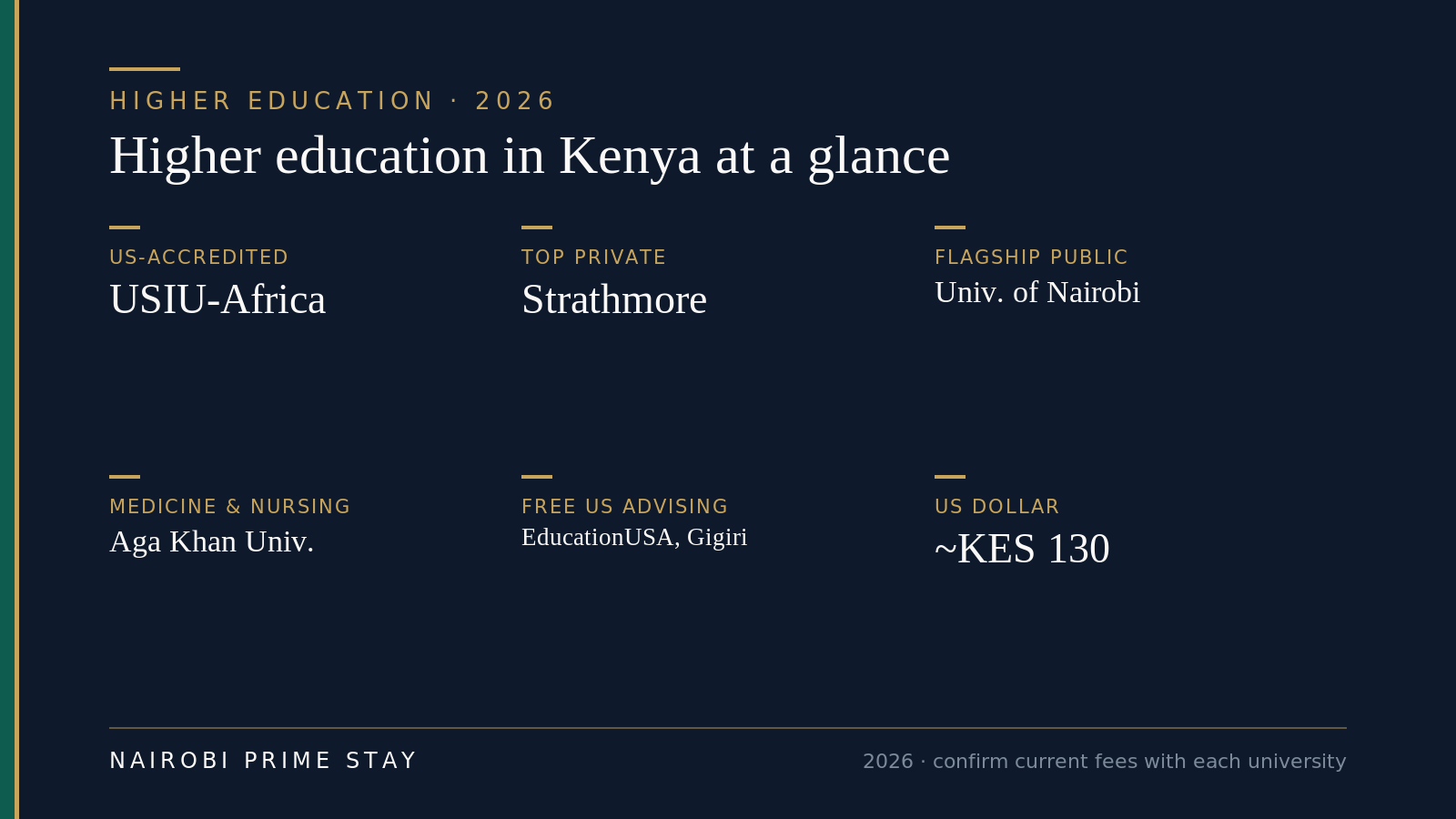 Higher education in Kenya at a glance. Fees are indicative for 2026; confirm with each university.
Why this matters for your move
College decisions ripple back into the rest of your move. If your teen will apply to US universities from Nairobi, the school they attend here matters — one with a real college-counseling office and AP or IB exams on site makes the whole process smoother. If they’ll study locally, the university’s location shapes where you’ll want to live, because Nairobi traffic punishes a long daily commute.
There’s also money. A year at a US private university can top $60,000. The same year at a good Nairobi university is a fraction of that. For some families, especially those staying on in Kenya, a respected local degree at a lower cost is a serious option, not a fallback. The trick is knowing which Kenyan universities travel well and which don’t — which is most of what this guide is about.
The three paths for an expat teen
Almost every expat family lands on one of three routes. They aren’t mutually exclusive — plenty of teens take a gap year, then start a degree — but it helps to name them.
1. Apply to universities abroad, from Nairobi. The most common choice for families heading back to the US. Your teen sits the SAT or ACT, takes AP exams if their school offers them, writes essays, and applies through the Common App while living in Nairobi. EducationUSA at the US Embassy makes this easier, and it’s free.
2. Study at a Nairobi university. A real option, not a consolation prize. USIU-Africa runs the American system locally; Strathmore and others are well regarded; the University of Nairobi is the affordable public giant. Good for families staying in Kenya, for budget-conscious families, or for teens who want to study close to home.
3. Take a gap year. A structured year — a language, a skill, an internship, a cause — before starting a degree. Kenya is a popular gap-year base, but choose programs carefully.
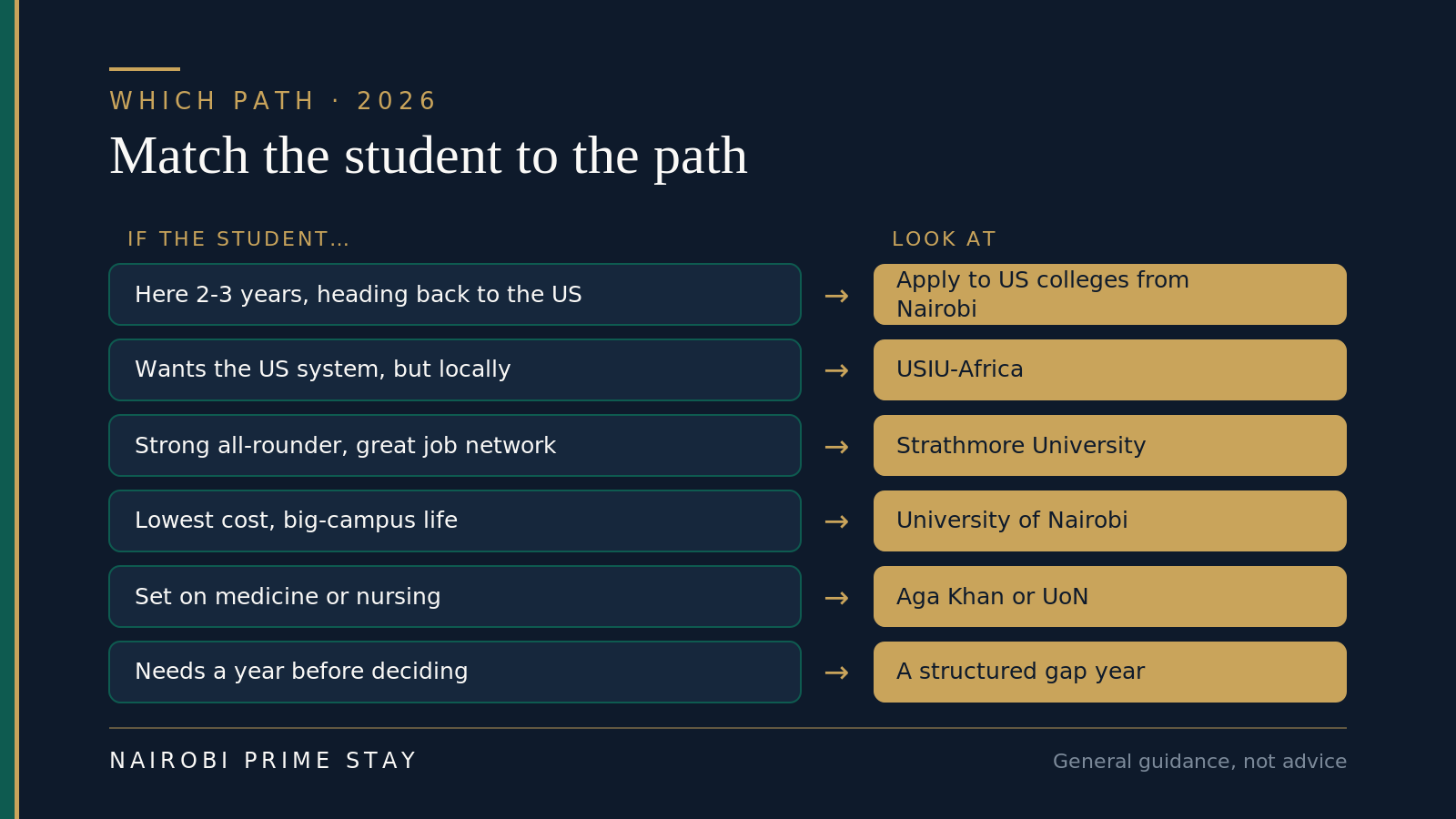 A rough match of student to path. General guidance only — every teen is different.
Nairobi’s universities, the ones expat families ask about
You’ll hear dozens of names. For an American family, four come up again and again. Here’s the honest version of each.
USIU-Africa — the American university in Nairobi
If you want the US system without leaving Nairobi, USIU-Africa is the answer. The United States International University–Africa sits off Thika Road in the city’s north, and it’s the only university in the region accredited by both Kenya’s Commission for University Education and the WASC Senior College and University Commission (WSCUC) — the same American accreditor that covers universities across California. That dual accreditation is the headline. It means an American-style degree, a semester-and-credit system you’ll recognize, and credits that transfer to and from US universities far more cleanly than from most local schools.
USIU-Africa teaches a broad range of bachelor’s degrees — business, international relations, psychology, journalism, IT and more — to a notably international student body. Class sizes are smaller than at the big public universities, and the campus culture feels closer to a mid-size American university than a traditional Kenyan one. For an expat teen who wants the familiar system, or who might transfer back to a US college after a year or two, it’s the natural fit.
Fees vary by program, and non-East African students pay roughly 30% above the local rate. As a rough guide for 2026, plan for the order of KES 300,000–800,000 a year for most undergraduate programs (about $2,300–6,200) — business and social-science degrees sit at the lower end, technology and health-sciences programs higher, and non-East-African students pay about 30% above the local rate. Still a fraction of a US private-university bill. Confirm the exact figure for your program at usiu.ac.ke.
Strathmore University — the strong private all-rounder
Strathmore is the private university Kenyans rate most highly, and often above the public flagship for employability. It began as an accountancy college and grew into a full university with strong faculties in business, law, computing and IT, plus a respected business school and law school. Its degrees carry weight with Kenyan and regional employers, and its campus in Madaraka, south of the city center, is modern and well run.
Strathmore follows the British-influenced Kenyan university model rather than the American one, so credit transfer to a US college is less automatic than from USIU. But for a teen who wants a rigorous, well-regarded local degree — especially in business, finance, law or tech — and who plans to work in the region, it’s an excellent choice. Undergraduate fees run roughly KES 400,000–620,000 a year all in (about $3,000–4,800), depending on the program; confirm at strathmore.edu.
The University of Nairobi — the flagship public university
The University of Nairobi (UoN) is Kenya’s oldest and largest public university and consistently the country’s top-ranked, sitting comfortably among the leading universities in Africa. It’s big, comprehensive and traditional — everything from medicine and engineering to law, the arts and the sciences, spread across several campuses, with the main one right in the city center. If your teen wants scale, research depth and the full big-campus experience, this is it.
Two honest caveats. First, public universities run on the Kenyan academic calendar and system, which differs from the US in structure and pace, and occasional disruptions to the academic year do happen. Second, while UoN is by far the cheapest of these options, international (non-citizen) students pay more than Kenyan nationals, and admission for a foreign teen runs through the international-students office rather than the national placement system. Even so, the all-in cost sits dramatically below a US or private-Kenyan equivalent. Check current international fees at uonbi.ac.ke.
Aga Khan University — medicine, nursing and media
If your teen is set on medicine, nursing or health sciences, Aga Khan University (AKU) is the name to know. Part of an international network spanning Pakistan, East Africa and the UK, AKU runs its Medical College, its School of Nursing and Midwifery, and a Graduate School of Media and Communications from its University Centre on 3rd Parklands Avenue, beside the Aga Khan University Hospital. It’s selective, internationally networked and academically serious.
AKU’s undergraduate offering in Kenya is focused — chiefly the MBChB medical degree and nursing programs — rather than the broad liberal-arts menu of USIU or UoN. Medical training is expensive everywhere, and AKU sits at the higher end of local fees, but still well below US medical-school costs. For a future doctor or nurse who wants to train in Nairobi at an internationally recognized institution, it’s the standout.
Other universities worth knowing
Beyond the big four, a cluster of universities rounds out the picture. Riara University and Daystar University are mid-size private schools with solid reputations; the Catholic University of Eastern Africa (CUEA) and KCA University are long-established; Mount Kenya University is one of the largest private universities by enrollment. On the public side, Kenyatta University (KU) and Jomo Kenyatta University of Agriculture and Technology (JKUAT) are strong, with JKUAT especially known for engineering and the sciences.
For an expat teen, the practical filter is simple: does the degree travel where you want it to, is the program accredited by the Commission for University Education, and is the campus somewhere you can reach without a brutal commute? When in doubt, EducationUSA and your school’s college counselor can help you read the landscape.
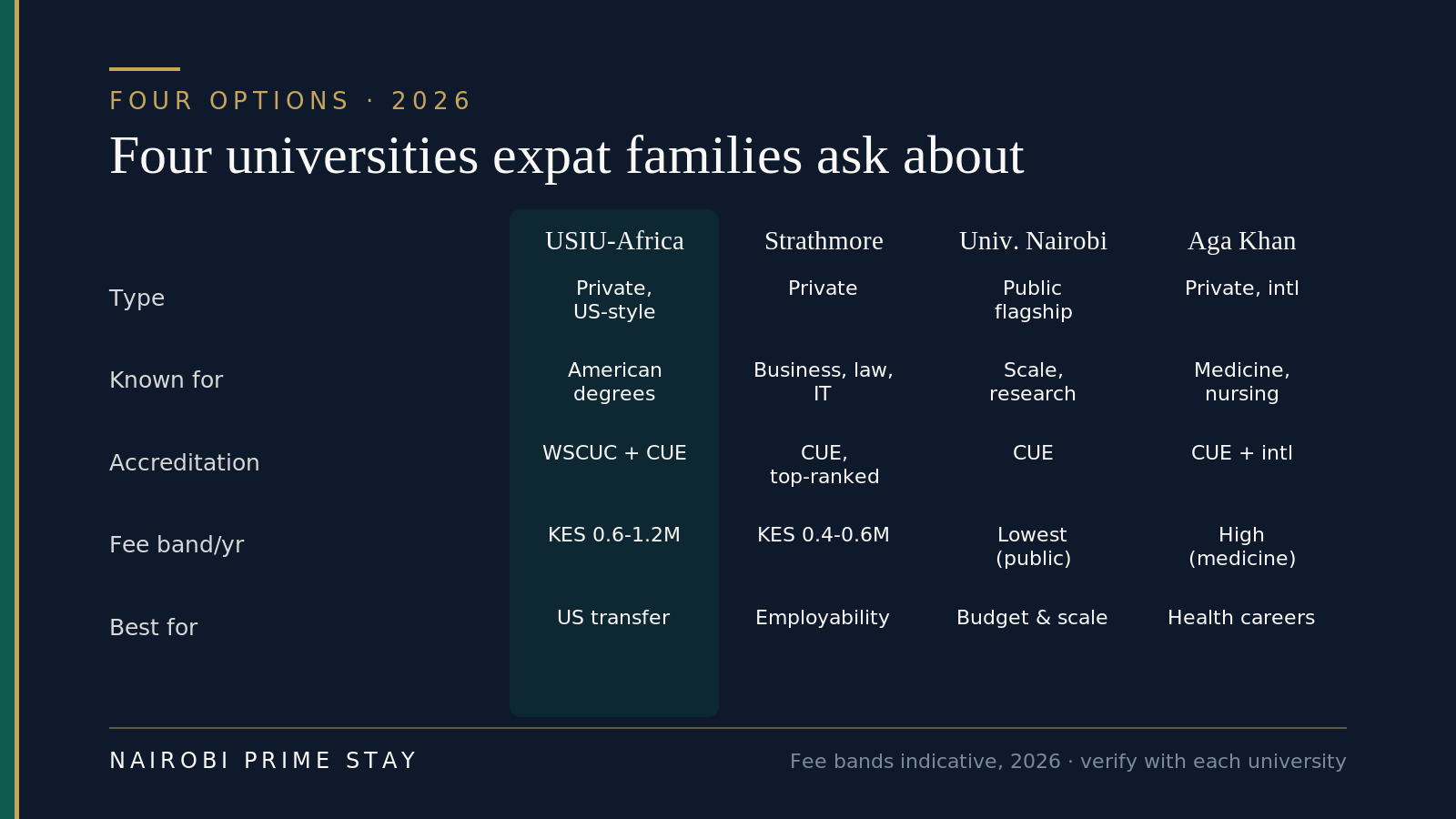 The four universities expat families ask about most. Fee bands are indicative for 2026 — verify with each university.
Can a non-Kenyan teen actually enroll here? The student pass
Yes, but there’s a paperwork step Americans don’t expect: a foreign student needs a student pass to study at a Kenyan university. It’s Kenya’s version of the F-1 — official permission to be here as a student — and the university walks you through it once your teen is admitted.
Here’s how it works. After acceptance, the university issues an admission letter and a signed, stamped Form 30. You then apply for the student pass online through the government’s eCitizen portal (the Foreign Nationals Services, or eFNS, system), uploading the passport, the admission letter, proof of funds, and a police clearance for applicants over 18. The government fee is about USD 100 a year for non-East-African nationals (students from EAC countries pay nothing). Processing usually takes two to four weeks, so apply about three months before term starts. Once it’s approved, your teen endorses the pass in their passport at Nyayo House, the immigration headquarters in central Nairobi.
Two honest notes. If your family is already in Kenya on a work permit, your teen may be on your dependant’s pass — check whether they can study on it or need to switch before enrolling; the admissions office will know. And keep the pass valid: it’s tied to the course and has to be renewed. For the wider immigration picture, see our Kenya visa guide for Americans. This is general guidance, not legal advice — confirm the current process and fee on ecitizen.go.ke.
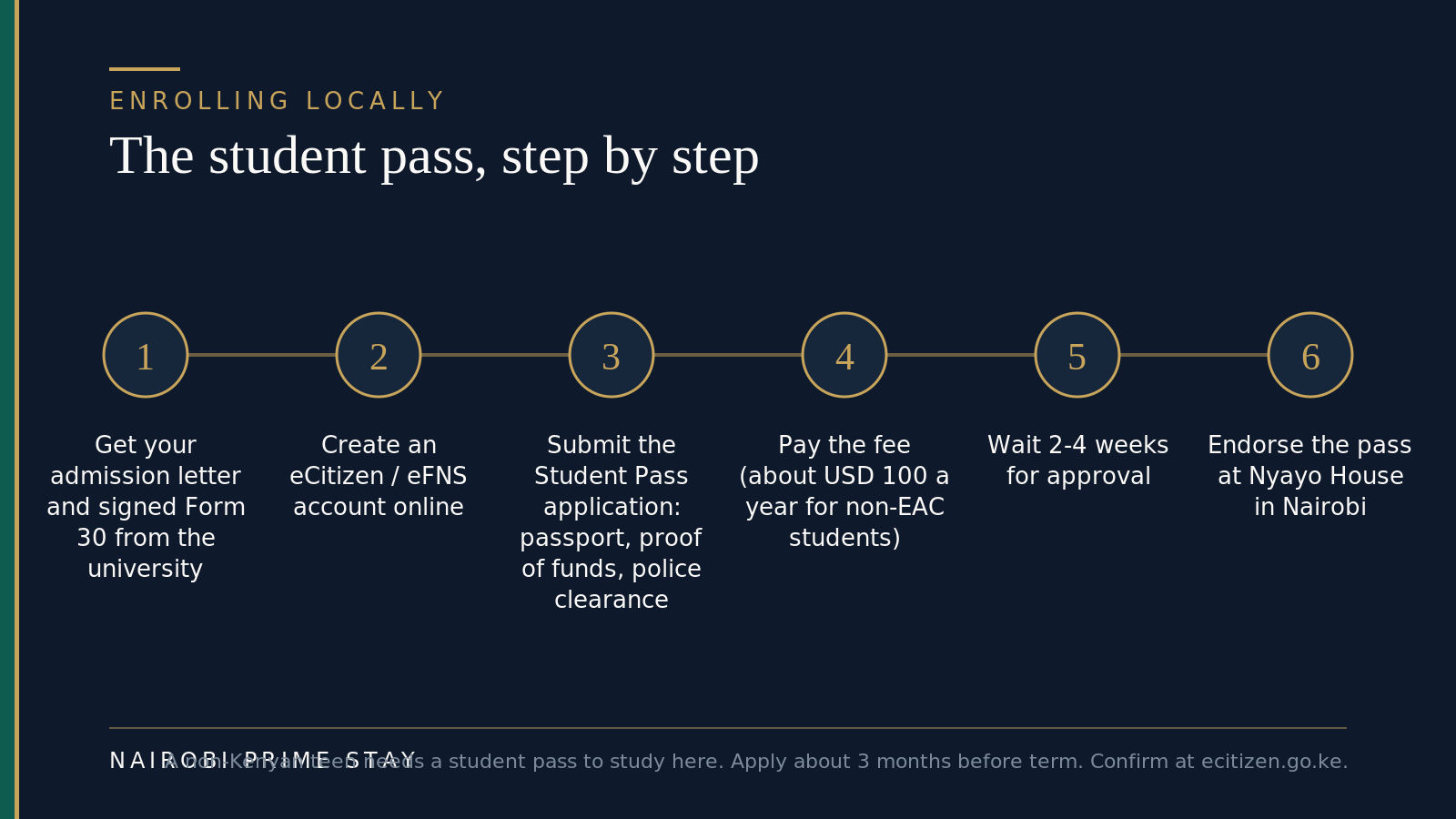 The student pass, step by step. A non-Kenyan teen needs one to study here; apply about three months ahead.
What it costs, and how it compares to the US
Here’s the part that surprises a lot of American parents: a university degree in Nairobi costs a fraction of the US price. A year at a US private university routinely runs $55,000–65,000 with room and board; a flagship public university charges out-of-state students $40,000-plus. In Nairobi, a year at a top private university like USIU or Strathmore lands in the low thousands of dollars, and the public University of Nairobi is cheaper still.
The table below gives indicative 2026 ranges. Treat them as orientation, not quotes — fees change yearly, vary by program, and non-citizen or non-East-African students often pay a premium. Always confirm the current figure with the university.
| University | Type | Indicative tuition/yr (2026) | In US dollars (~KES 129/$) | Best known for |
|---|---|---|---|---|
| USIU-Africa | Private, American system | ~KES 300,000–800,000 | ~$2,300–6,200 | US-style degrees, credit transfer |
| Strathmore University | Private | ~KES 400,000–620,000 | ~$3,000–4,800 | Business, law, computing |
| University of Nairobi | Public flagship | Lowest here (public rates; non-citizens pay more) | varies, far below US | Scale, research, breadth |
| Aga Khan University | Private, international | High end (medicine) | varies | Medicine, nursing, media |
| US private university | For comparison | — | ~$55,000–65,000 all-in | — |
Two things to budget beyond tuition: living costs (rent, food, transport — see our cost of living in Nairobi guide), and the USD/KES exchange rate, which sat near KES 129 to the dollar in mid-2026 and moves what any fee costs you in dollars and the fact that figures climb in later years and in professional programs. Even so, the math is striking. For families staying in Kenya, or weighing a gap year plus a local start, the savings are real.
Applying to US colleges from Nairobi
Plenty of expat teens apply to American universities while living in Nairobi, and the process works much as it would from Ohio — just with a little more planning around test dates and shipping. Here’s how it fits together.
EducationUSA — your free, official starting point
Start at EducationUSA, the US State Department’s official advising network. Its Nairobi center sits inside the US Embassy on United Nations Avenue in Gigiri, and the advising is free. They run a step-by-step program (“Your 5 Steps to U.S. Study”), quarterly workshops on choosing schools, financial aid, essays and tests, and individual counseling sessions once you’ve attended a general session. There’s even a competitive EducationUSA Scholars Program for a national cohort. If your teen is serious about US college, book in early — it’s the single best free resource in the country.
You can reach the Nairobi center at nairobi@educationusa.org, and the embassy’s Facebook page hosts monthly live information sessions.
Tests: SAT, ACT and AP
Most US universities still want the SAT or ACT, and both are offered in Nairobi — international schools like ISK and Rosslyn Academy often serve as test centers. The SAT is now fully digital, so check current dates and registration with the College Board well ahead. If your teen attends an American- or IB-curriculum school, AP exams and IB results strengthen the application and can earn college credit; our American and IB schools guide covers which Nairobi schools offer them, and the international schools guide maps the wider field.
One practical note: register for tests early. International test seats fill, and you don’t want a missed SAT date to derail an application cycle.
The application calendar
The US cycle runs on US time. For a fall start, most regular-decision deadlines fall around December to January of the preceding school year, with early-action and early-decision deadlines in November. Working backward, that means the SAT or ACT done by the fall of senior year, essays drafted over the preceding summer, and recommendation letters requested from teachers well ahead. Build in extra lead time for anything that has to cross borders, and keep digital copies of every transcript and record.
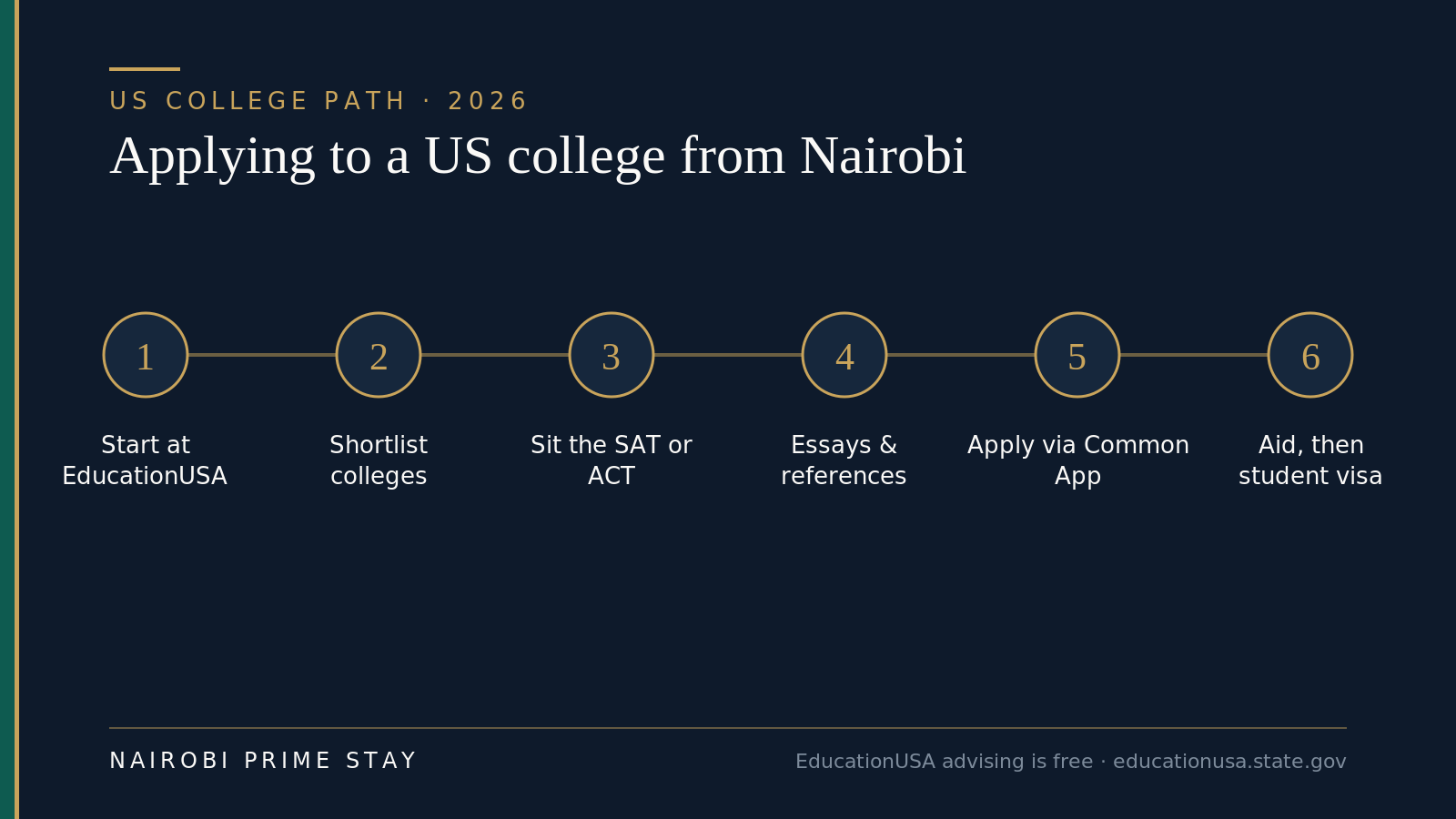 The US college application sequence, run from Nairobi. EducationUSA advising is free.
Staying on the US track: USIU and credit transfer
What if your teen starts college in Nairobi but wants to finish in the US, or the reverse? This is exactly where USIU-Africa’s dual WSCUC accreditation pays off. Because USIU is accredited by the same body that accredits many US universities, its credits are recognized by American institutions far more readily than credits from a typical local university. Some families use this on purpose — a year or two at USIU, then a transfer to a US school — to soften costs or ease the transition. It isn’t automatic (every US university sets its own transfer rules), but it’s a real, well-worn path. If keeping the US door open matters, USIU is the local university that does it best.
Financial aid and scholarships from Nairobi
Living abroad doesn’t cancel your teen’s US financial aid — but it changes what’s on the table, and the rules catch families out. Here’s the honest version.
If your teen is a US citizen with a valid Social Security number, they keep their eligibility for federal student loans even while living in Nairobi, and they still file the FAFSA. The catch: federal grants like the Pell Grant are never paid at a foreign school, and federal loans only apply if the school is on the US Department of Education’s Title IV list — a roster of 750-plus international institutions, most of them in Europe and Canada, with very few Kenyan universities on it. In practice, federal loan money usually follows your teen only if they attend a US college, or one of the handful of listed foreign schools. Check a school’s federal school code before you count on it.
What does travel well: merit scholarships from the US colleges that admit your teen (many offer them regardless of where the student applied from), outside scholarships your teen wins on their own, and a 529 college-savings plan, which can pay tuition at any Title IV-eligible school, US or foreign. EducationUSA runs a competitive Scholars program and can point you to scholarship databases at no cost.
One more reality: financial aid for a non-degree gap year is thin, so budget that year separately. If you’re weighing a lower-cost Nairobi university against a US college with aid, run both numbers fully — sometimes an affordable USIU or Strathmore degree beats a US school even after aid, and sometimes it doesn’t.
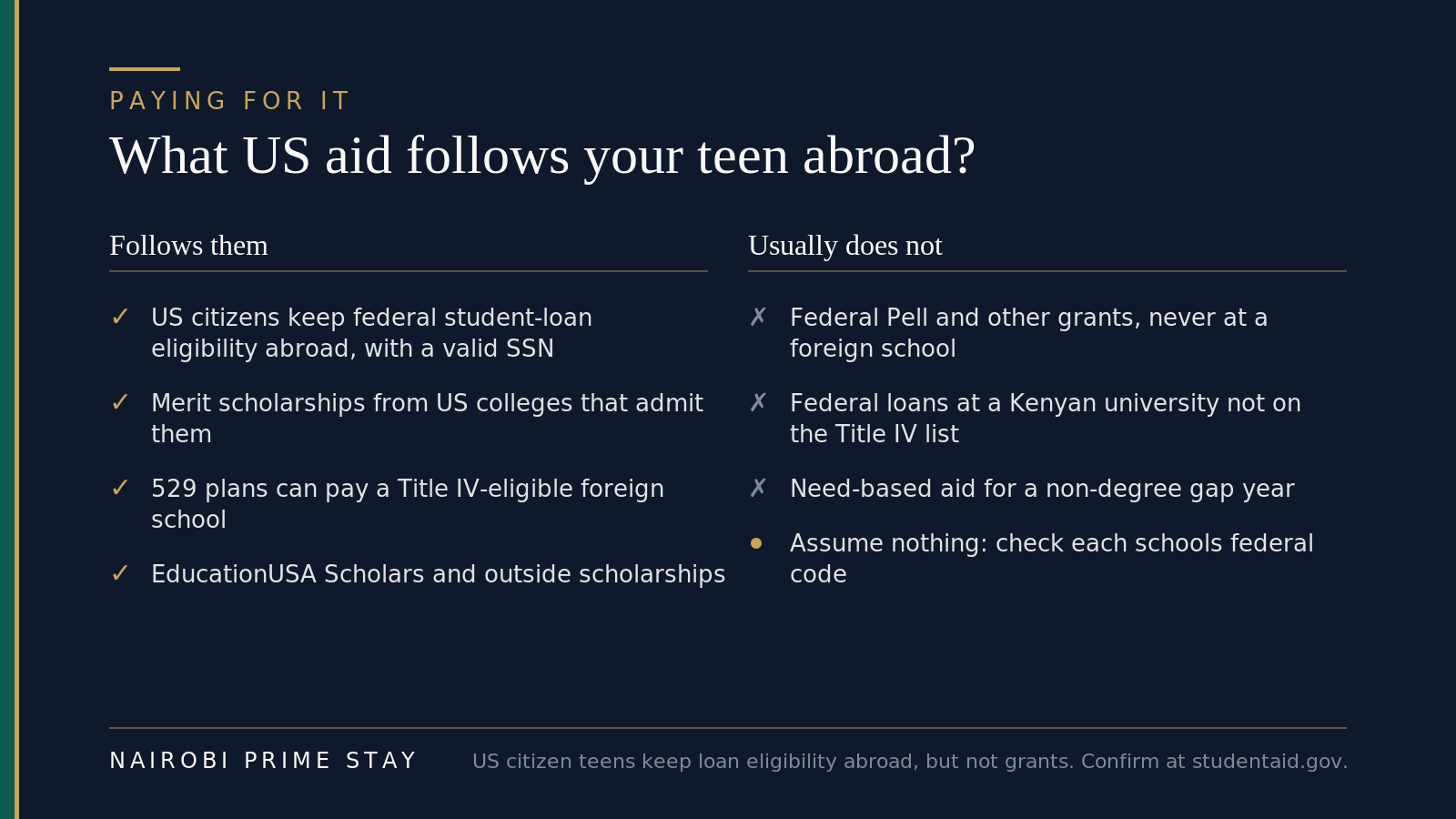 What US aid follows your teen abroad, and what doesn’t. US citizens keep loan eligibility but not grants; confirm at studentaid.gov.
The gap-year option
A gap year — a structured year between high school and university — is common among expat teens, and Kenya is a popular base for it. Done well, it’s a year of real growth: a language, a skill, an internship, or a cause your teen cares about. Done badly, it’s expensive tourism dressed up as service.
The honest guidance: choose ethical, well-run programs. Be wary of “voluntourism” that charges a lot for vague outcomes, and avoid orphanage-tourism programs entirely — the research is clear that short-term volunteers cycling through children’s homes does harm, not good. Look for organizations with real references, a genuine local benefit, a safety and insurance plan, and a clear purpose. Many US universities will defer admission for a year if your teen has already been accepted, so a gap year and a US college place aren’t either/or.
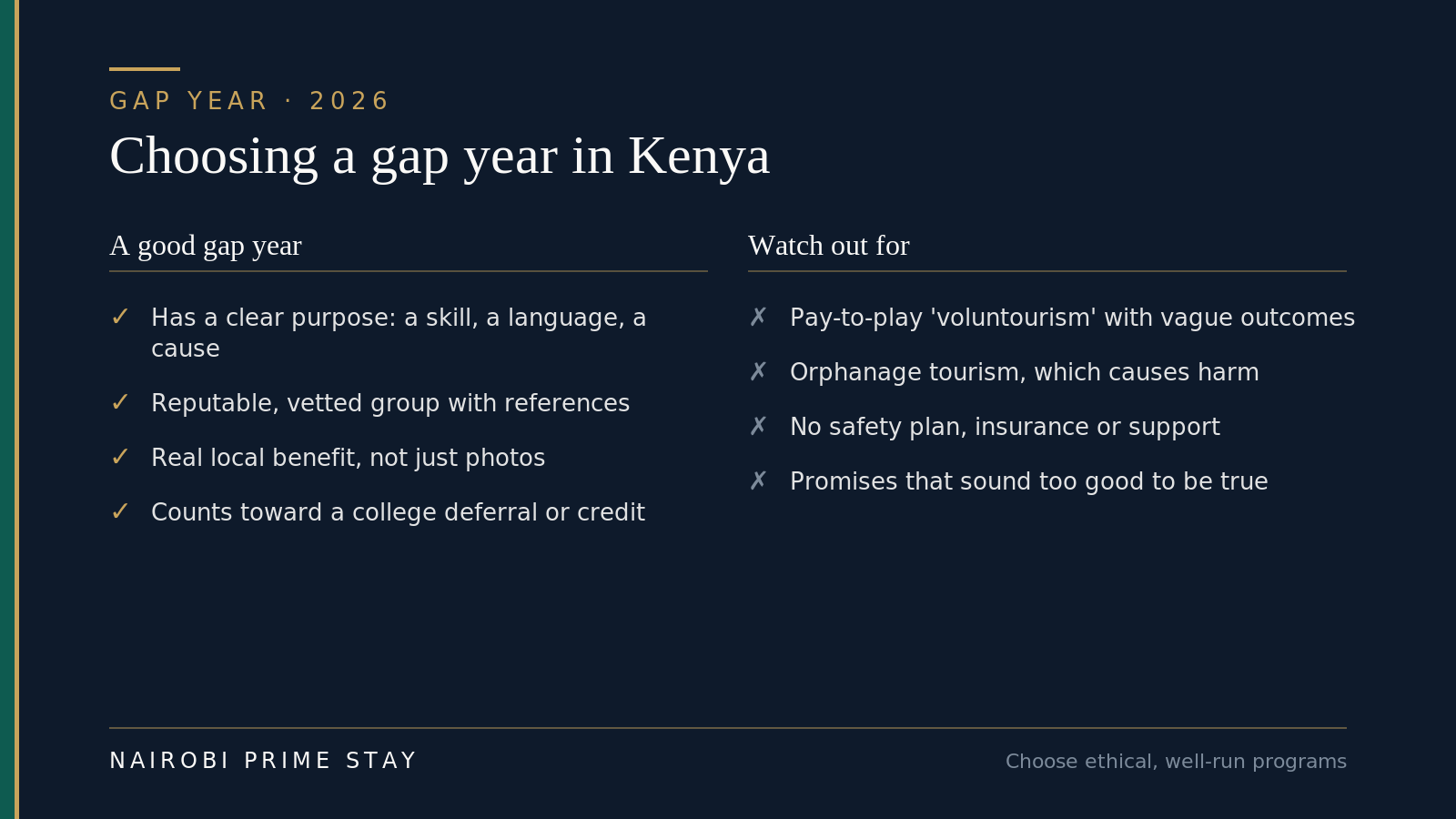 What separates a worthwhile gap year from a costly one. Choose programs that benefit the community, not just the resume.
Beyond the big four: online degrees, transfers and bootcamps
The four universities above aren’t the only routes to a career, and for some teens they aren’t the best one. A few alternatives are worth knowing.
An online US degree. Plenty of accredited US universities now teach full bachelor’s degrees online, so your teen can study from your Nairobi apartment on a US schedule. It keeps a US credential and US pace without the tuition-plus-dorm bill — though note that federal loans generally don’t fund a fully online or distance program at a foreign school, so this works best through a US home institution.
The community-college route. Two years at a US community college, then a transfer to a four-year university, is one of the biggest cost savers in American higher education. It’s usually done back in the US rather than from Nairobi, but it’s worth putting on the table for a budget-conscious family, and it pairs naturally with a gap year here first.
A local transfer via USIU. As covered above, a year or two at USIU-Africa, then a transfer to a US college, uses that shared WSCUC accreditation to soften costs and ease the jump home.
Tech bootcamps and TVET. For a teen drawn to software or a trade rather than a four-year degree, Nairobi has real options. Moringa School — the country’s TVETA-accredited coding bootcamp — runs roughly five-month full-stack software and data programs from about KES 200,000, with strong employer links; ALX delivers intensive virtual tech training, sometimes on an income-share basis. Kenya’s TVET (technical and vocational) colleges teach hands-on trades at low cost. None of these is a university degree, but for the right teen they lead to a job faster and cheaper.
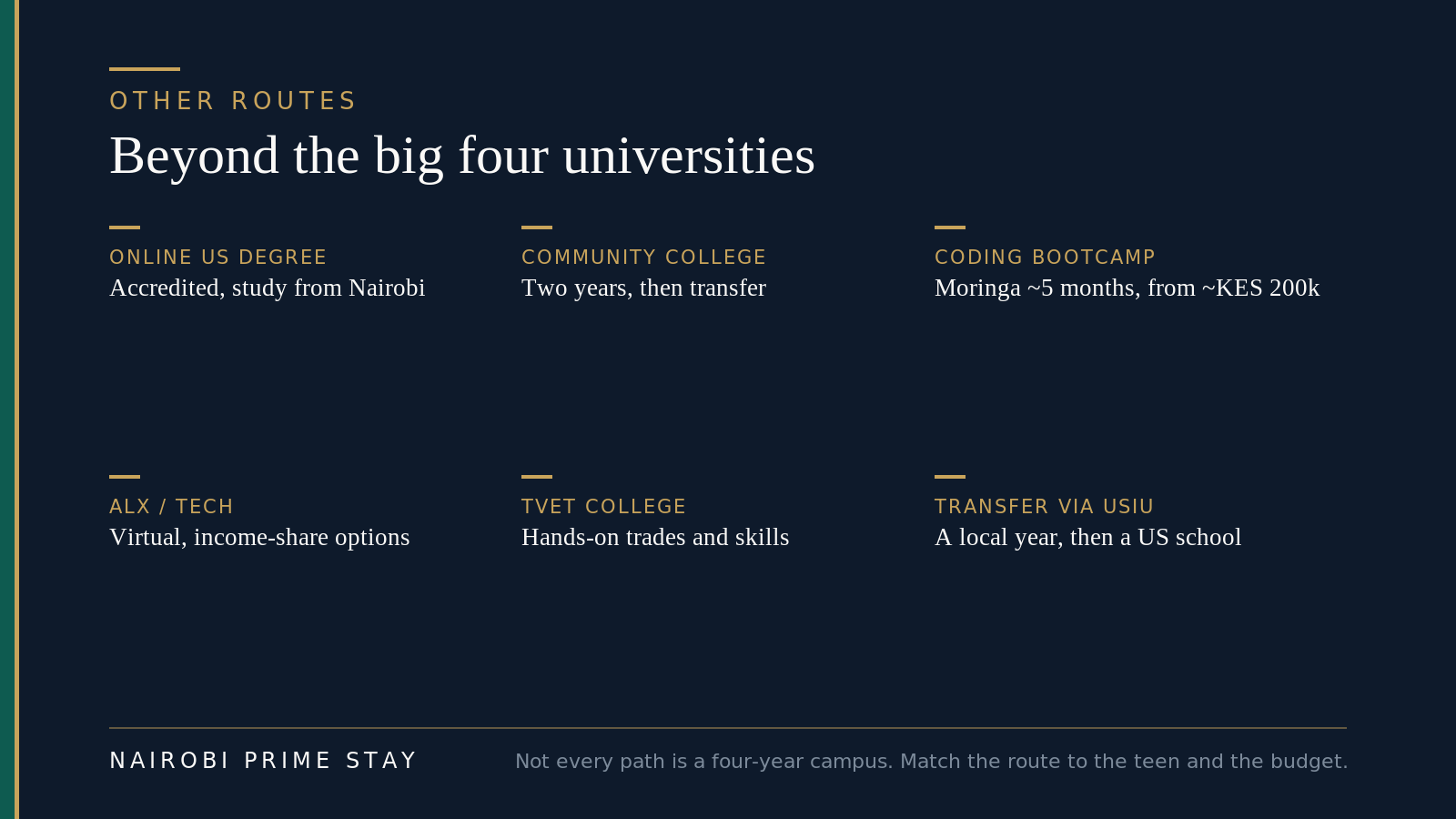 Not every path is a four-year campus. Match the route to the teen and the budget.
A realistic example
The Carters move to Nairobi for a three-year posting when their daughter, Maya, is in 10th grade. She enrolls at an American-curriculum school in the northern suburbs, where the college-counseling office knows the US system cold. In 11th grade she sits the SAT at school and takes two AP exams. The family books a session at EducationUSA in Gigiri, which helps Maya build a balanced college list and map the financial-aid forms.
She applies to eight US universities through the Common App in the fall of 12th grade, using teacher recommendations from her Nairobi school and an essay about adjusting to a new country. She’s accepted to several, picks one, and defers a semester to do a structured conservation internship outside Nairobi first. The extra cost of doing all this from Nairobi rather than the US came down to a few test fees and some careful calendar-watching. The posting didn’t derail her college plans — if anything, the international experience strengthened her application.
University in Kenya vs going abroad: an honest reckoning
| Studying in Kenya | Applying abroad (US/UK/global) | |
|---|---|---|
| Cost | Far lower — thousands, not tens of thousands | High, though aid can help |
| Familiar system | USIU is American; others differ | Fully familiar if returning to the US |
| Credit transfer | Cleanest from USIU (WSCUC) | Not needed — you’re already there |
| Staying near family | Yes — lives at or near home | No — the teen relocates |
| Global brand recognition | Strong regionally; varies globally | US/UK degrees travel widely |
| Independence & growth | Gentler transition | Bigger leap, big growth |
| Best for | Staying in Kenya, budget, regional careers | Returning to the US, global options |
There’s no universally right answer. A family staying in Kenya, or one watching the budget, may find a USIU or Strathmore degree an excellent deal. A family heading home, or one whose teen wants the widest global options, will usually apply abroad. Many split the difference — a gap year here, then a US degree.
A practical checklist
If college is on the horizon during your Nairobi years, work through this:
- Pick the school with the end in mind. If US college is the goal, choose a Nairobi high school with a real college-counseling office and AP or IB exams on site.
- Book EducationUSA early. Free, official, and the best starting point for US applications. Attend a general session, then get individual advising.
- Map the test calendar. Register for the SAT or ACT well ahead — international seats fill. Line up AP or IB exams through the school.
- Work backward from US deadlines. Early action and decision in November; regular decision around December to January. Essays over the summer; recommendations requested early.
- Keep every record. Transcripts, test scores, certificates — organized and backed up digitally. You’ll need them for any application or transfer.
- If studying locally, visit campuses. USIU, Strathmore and others welcome visits. Check the program’s CUE accreditation and the commute from where you’d live.
- For a gap year, vet the program. References, a safety plan, a real local benefit. Avoid voluntourism and orphanage tourism. Ask US colleges about deferral.
- Budget beyond tuition. Living costs, transport, and rising fees in the later years.
Final thoughts
Higher education is one of the areas where Nairobi quietly over-delivers. Your teen can apply to US colleges from here with free, official help; study locally on the American system at USIU; earn a respected, affordable degree at Strathmore or the University of Nairobi; or train for medicine at Aga Khan — all without leaving the city. The cost gap with the US is large enough to deserve a real conversation, not a reflex.
Whatever path fits, decide early enough to line up the school, the tests and the home that make it easy. A short commute to a good school or campus is worth more here than almost anywhere.
Related reading
- Moving to Nairobi: the complete guide — the end-to-end overview of your move.
- International schools in Nairobi — every curriculum, compared.
- American and IB schools in Nairobi — the US track, AP and the IB Diploma.
- British curriculum schools in Nairobi — IGCSE, A-levels and the UK route.
- Moving to Nairobi with kids — the family-relocation playbook.
- Cost of living in Nairobi — what a year here really costs.
- Gigiri neighborhood guide — the diplomatic suburb where the US Embassy and EducationUSA sit.
When you’re settling in
A college search is easier when your family isn’t living out of suitcases. A serviced apartment for your first month gives you a calm, all-inclusive base while you visit campuses, test commutes and choose a longer-term home. When you’re ready, browse our serviced apartments, or let our AI relocation assistant shortlist places near the schools and universities on your list — day or night.
Frequently asked questions
Is there an American university in Nairobi?
Yes. USIU-Africa (the United States International University-Africa) runs the American system in Nairobi and is accredited by both Kenya’s Commission for University Education and the US WASC Senior College and University Commission, the same body that accredits many California universities. That dual accreditation means an American-style degree and credits that transfer to and from US universities relatively cleanly. It is the closest thing to a US university experience in the city.
Can my teen apply to US colleges while living in Nairobi?
Yes, and many do. The SAT and ACT are offered in Nairobi, AP and IB exams are available at American- and IB-curriculum schools, and applications go through the Common App as usual. Free, official help is available from EducationUSA at the US Embassy in Gigiri. Plan around international test dates and US deadlines, and keep digital copies of all records.
How much does university cost in Kenya compared to the US?
A fraction of the US price. Top private universities like USIU-Africa and Strathmore run roughly KES 400,000 to 1.2 million a year (about $3,000 to $9,200), and the public University of Nairobi is cheaper still, versus $40,000 to $65,000 a year at many US universities. Fees change yearly, vary by program, and non-citizen students often pay a premium, so confirm the current figure with each university.
What is EducationUSA and is it free?
EducationUSA is the US State Department’s official network of advising centers for students applying to American universities, and its services are free. The Nairobi center is inside the US Embassy on United Nations Avenue in Gigiri. It offers step-by-step guidance, workshops on essays, tests and financial aid, and individual counseling. Email nairobi@educationusa.org to get started.
Where can my teen take the SAT or ACT in Nairobi?
Both tests are offered in Nairobi, often at international schools such as ISK and Rosslyn Academy, which serve as test centers. The SAT is now fully digital. Register early through the official College Board (SAT) or ACT websites, because international test seats can fill well before the date.
Which Nairobi university is best for medicine?
Aga Khan University is the standout for medicine and nursing. Its Medical College and School of Nursing and Midwifery are part of an international network and are internationally recognized. The public University of Nairobi also has a long-established, respected medical school at a lower cost. Both are selective, as medicine is competitive everywhere.
Do Kenyan university degrees transfer back to the US?
It depends on the university. Credits from USIU-Africa transfer most cleanly because it shares US (WSCUC) accreditation, and it is the local university families use when they want to keep the US door open. Degrees from other Kenyan universities are recognized but transfer less automatically, since every US institution sets its own rules. If transfer matters, favor USIU and keep detailed transcripts.
Is a gap year in Kenya a good idea?
It can be, if the program is well chosen. A structured year built around a skill, a language, an internship or a genuine cause can be a real growth experience, and many US colleges will defer admission for a year. Avoid pay-to-play voluntourism with vague outcomes, and steer clear of orphanage tourism, which research shows causes harm. Look for reputable programs with references, a safety plan and a real local benefit.
Does a foreign student need a visa to study in Kenya?
Yes. A non-Kenyan student needs a student pass to enroll at a Kenyan university. Once your teen is admitted, the university issues an admission letter and a signed Form 30, and you apply online through the eCitizen (eFNS) portal with the passport, proof of funds and a police clearance. The fee is about USD 100 a year for non-East-African students, processing takes two to four weeks, and the pass is endorsed at Nyayo House in Nairobi. Confirm the current process on ecitizen.go.ke.
Can my teen still get US financial aid while studying in Kenya?
Partly. A US citizen keeps eligibility for federal student loans abroad and still files the FAFSA, but federal grants like the Pell Grant are never paid at a foreign school, and federal loans only apply if the university is on the US Department of Education’s Title IV list — few Kenyan schools are. Merit scholarships from US colleges, outside scholarships and a 529 plan travel better. Check each school’s federal code at studentaid.gov before you rely on it.
Are there cheaper alternatives to a four-year university in Nairobi?
Yes. An accredited online US degree lets your teen study from Nairobi on a US schedule; a US community college followed by a transfer is a major cost saver; and a year or two at USIU-Africa can transfer to a US college. For software or a trade, Moringa School runs a TVETA-accredited coding bootcamp of about five months from roughly KES 200,000, ALX offers virtual tech training, and TVET colleges teach hands-on skills at low cost.
Ready to look?
Find your apartment in Nairobi
Browse verified serviced apartments, or ask the AI concierge which area fits your life.