
Guides · Transport
Buying a Car in Nairobi: A Safe, Practical Guide for 2026
Buying a Car in Nairobi: A Safe, Practical Guide for 2026
Most expats who buy a car in Nairobi buy a used Toyota, pay for it in cash or a bank transfer, and spend more time on the paperwork than the test drive. That’s the right instinct. The car itself is the easy part — yards are full of clean, reliable Japanese imports. The risk is everything around it: a forged logbook, a car still tied to a loan, a “verification” website that isn’t really the NTSA, or a deposit wired to someone you never meet again.
This guide walks you through buying a used car in Nairobi the safe way. Where people actually shop, what reliable models cost in 2026, how to verify a car is really for sale by the person selling it, the NTSA logbook transfer step by step, what insurance costs, and the scams that catch newcomers. It’s written for an American who has never registered a car in Kenya and wants to get it right the first time.
If you’re still deciding whether to own a car at all, start with our getting around Nairobi guide — for a lot of people, Uber and Bolt cover the first few months perfectly well. If you’ve decided to buy, read on.
TL;DR — buying a used car in Nairobi, fast
- What to buy: a used Japanese import, almost always a Toyota. Vitz, Passo and Note for a city runabout; Axio, Fielder and Premio for a comfortable saloon; Probox if you want something indestructible; RAV4, Harrier and Prado for a family SUV. Parts and mechanics are everywhere.
- What it costs: roughly KES 700,000–1.3M ($5,400–10,000) gets you a clean, well-kept used saloon in 2026. Small hatchbacks start around KES 400,000–700,000; family SUVs run KES 1.8M and up. Prices move with the exchange rate and the model year.
- Where to look: established car yards on Kiambu Road and Mombasa Road, the Sunday car bazaar at Jamhuri, ex-Japan import dealers, and online marketplaces (Jiji, Cars45, Magari Deals). Expat “leaving sales” are often the best value of all.
- Before you pay: verify the car on the official NTSA portal (Copy of Records and the new e-logbook QR code), check for any loan or caveat, cross-check the chassis and engine numbers, and pay for an independent pre-purchase inspection (about KES 1,500–3,500).
- The paperwork: ownership transfers online through NTSA TIMS on eCitizen — both seller and buyer approve from their own accounts. The fee runs about KES 2,200–6,500 depending on engine size, plus a small e-sticker fee. The digital logbook updates in a few working days.
- Insurance: third-party cover is the legal minimum and cheap; comprehensive is what you actually want, at roughly 3–7.5% of the car’s value per year. Sort it before you drive away.
Why getting this right matters
A car is probably the second-biggest purchase you’ll make in your first year in Nairobi, after your rent. Unlike rent, it’s almost always a private cash sale with no lawyer, no escrow and no agency standing behind it. That’s normal here, and the system works fine — but it puts the burden of checking on you.
The good news: Kenya has made that checking far easier than it used to be. The NTSA keeps a central record of every registered vehicle, you can pull a car’s history before you pay, and as of June 2026 the country has moved to a digital logbook with a scannable QR code that’s genuinely hard to fake. Do the checks and a used-car purchase in Nairobi is no scarier than one in the States. Skip them and you’re trusting a stranger with five figures. This guide is mostly about doing the checks.
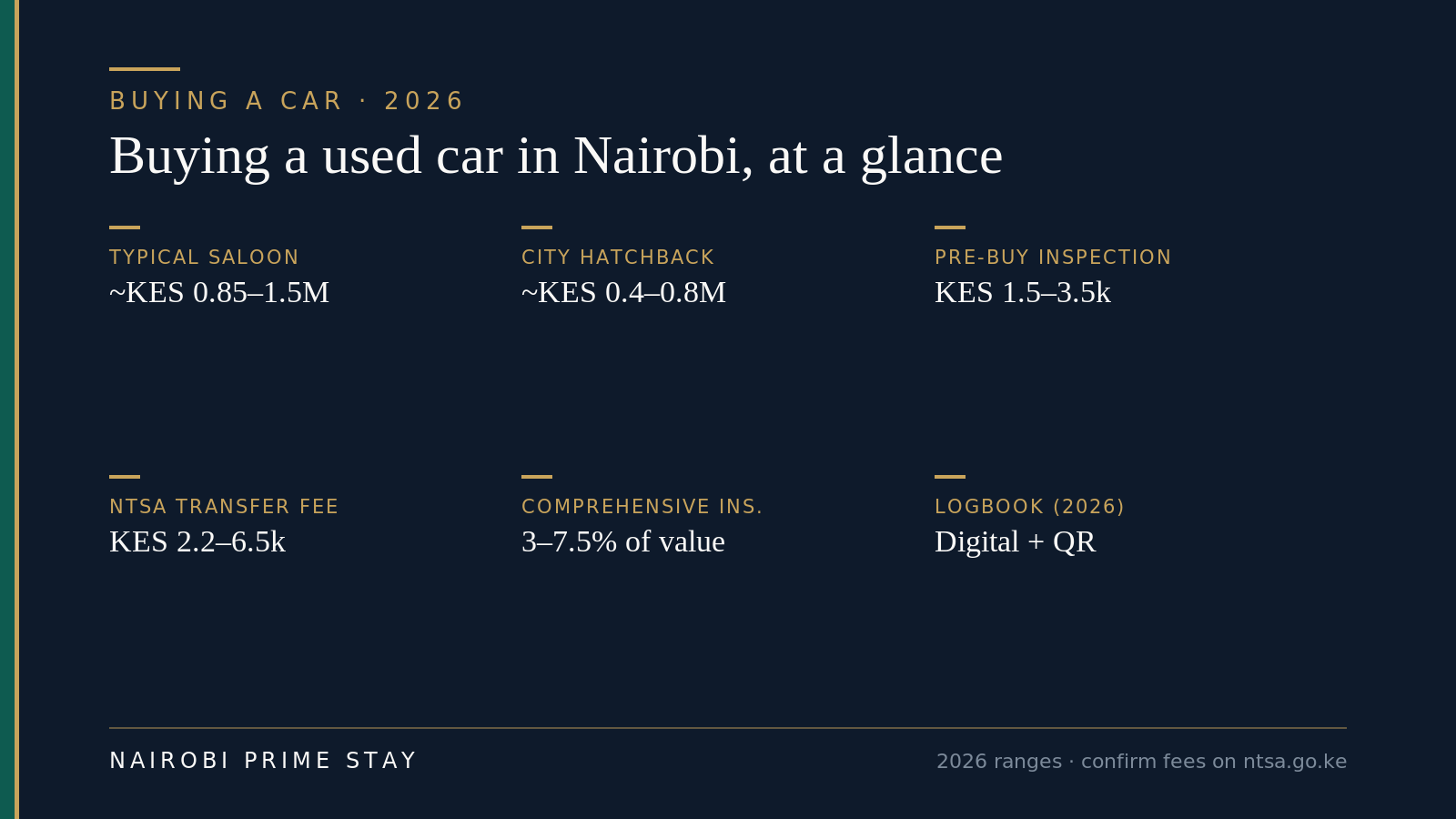 The numbers that shape a used-car purchase in Nairobi. Treat them as 2026 ranges and confirm fees on the NTSA portal.
First: do you actually need to own a car?
Be honest about this before you spend anything. For your first month or two, you almost certainly don’t. Uber, Bolt and the local app Little are cheap, safe and everywhere in the suburbs where expats live, and a typical cross-town trip costs a few dollars. Plenty of people go a year without buying — especially singles and couples in central areas like Westlands, Kilimani and Riverside. Our getting around Nairobi guide lays out the full picture.
You start to want your own car when ride-hailing stops adding up: the daily school run, a house out in Karen or Runda, weekend trips out of the city, or simply a family that doesn’t fit a one-car-at-a-time app. If you’re spending more than about $300–400 a month on rides, owning usually wins. A car also gives you freedom the apps don’t — car seats that stay installed, a boot full of shopping, a dawn airport run without surge pricing.
The middle path a lot of newcomers take: land, settle into a serviced apartment, use apps for a month or two while you learn the roads and the traffic, then buy once you know your commute and your area. There’s no rush, and rushing is how people overpay.
Buy locally or import one yourself?
You’ve got two ways to get a car: buy one that’s already here, or import one from Japan, the UK or Dubai. For most newcomers, buying locally is the simpler, faster and lower-risk path — you see the actual car, drive it, inspect it, and drive it home the same week.
Importing can be cheaper per spec and lets you pick the exact model and mileage, but it ties up your money for six to ten weeks, exposes you to taxes that often run 80–100%+ of the car’s value, and demands that you understand the rules before you commit. Kenya only allows right-hand-drive cars no more than eight years old (so 2019 or newer as of 2026), and the duties stack in a way that surprises people. If you’re tempted, read our importing a car to Kenya guide first — it has the full tax math and a worked example. The short version: import for a specific car you can’t find locally or a longer stay; otherwise buy here.
One thing worth knowing: most “used” cars in Nairobi yards are themselves recent ex-Japan imports — low-mileage cars shipped in and registered here. So buying locally often gets you the same Japanese-import quality without you handling the shipping, clearing or duties yourself. The dealer already did.
Where people actually buy used cars in Nairobi
There’s no single “used car lot” district. Cars change hands through several channels, each with its own trade-off between price, choice and safety.
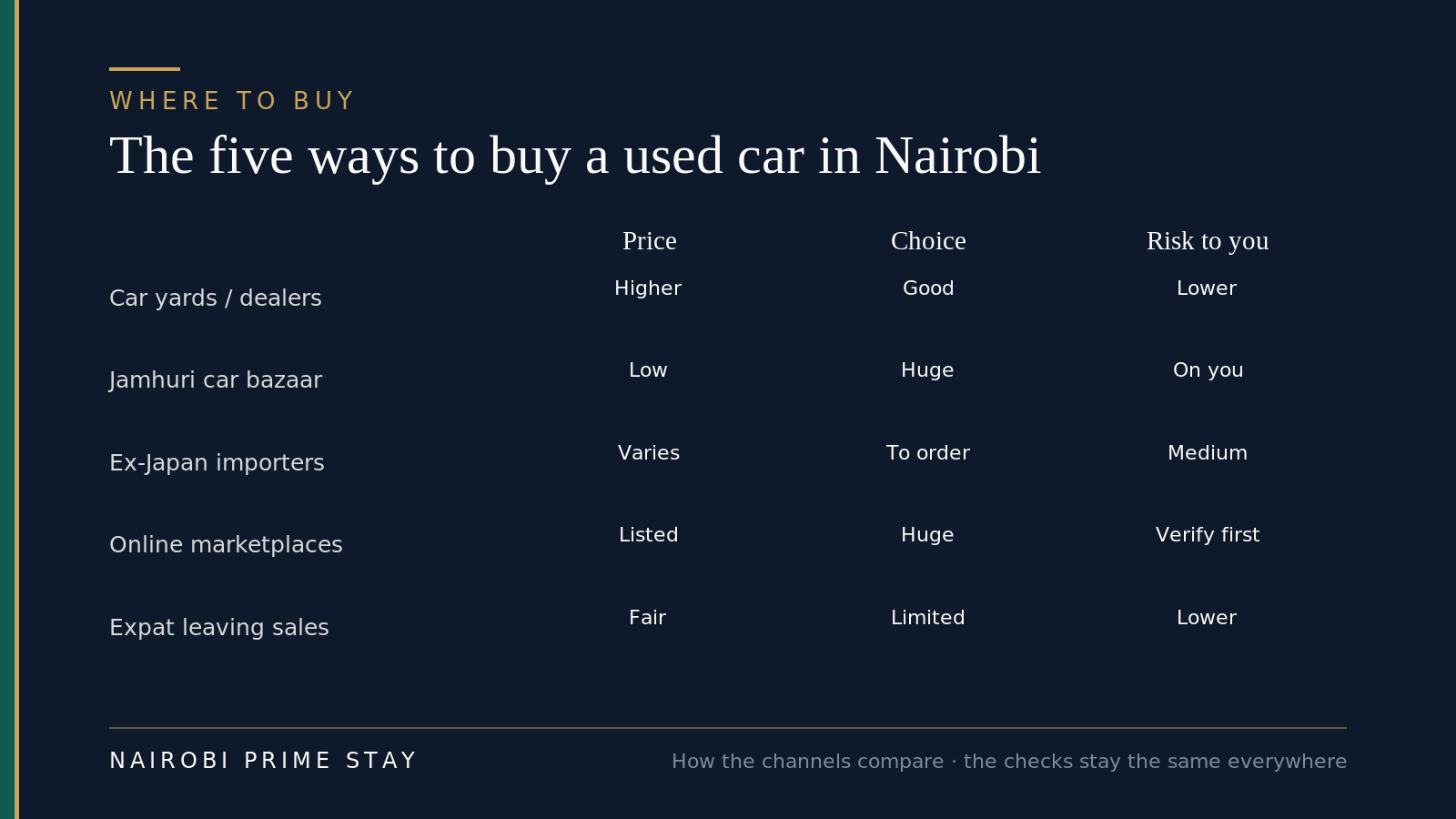 Five ways to buy a used car in Nairobi, compared. None is the “right” one — it depends on your budget and appetite for legwork.
Established car yards and dealers. The forecourts along Kiambu Road, Mombasa Road, Ngong Road and Langata Road are full of ready-to-drive used cars, mostly recent Japanese imports. You pay a little more than a private sale, but a reputable yard handles the logbook transfer, often gives a short warranty, and has a reputation to protect. This is the easiest, lowest-stress route for a newcomer. Stick to dealers with a real physical lot, a paper trail and reviews you can find.
The car bazaar (Jamhuri). The Kenya Auto Bazaar Association runs a long-standing Sunday car bazaar at the Jamhuri Park showground — hundreds of cars, owners and dealers in one place on a Sunday morning (it gets going early, from around 6:30am). Prices start low, the choice is enormous, and you can compare a dozen of the same model in an hour. The flip side: you’re on your own for checks, so never pay on the spot — note the details, verify with the NTSA, and arrange an inspection before any money moves.
Ex-Japan import dealers. Some firms specialize in importing to order or selling freshly landed stock from Japan, the UK and Dubai. Useful if you want a specific trim or a very low-mileage car, and they’ll often handle the whole import for you. Confirm what’s actually included — duties, clearing, registration — and get it in writing.
Online marketplaces. Jiji, Cars45, Magari Deals, AutosKenya and similar sites are where most people start browsing, with thousands of listings and filters by model, year, price and area. Treat them as a catalogue, not a checkout. Photos lie, “negotiable” prices are softer than they look, and a deposit request before you’ve seen the car is a red flag. Use them to shortlist, then go in person.
Private and expat “leaving sales.” Departing expats and diplomats sell well-maintained cars, often with full service history and at fair prices, through community WhatsApp groups, Facebook groups and embassy noticeboards. This is frequently the best value in the whole market — a known car, one careful owner, motivated to sell before a flight. The same verification rules apply, but the trust level is usually higher.
What a used car costs in Nairobi in 2026
Prices below are realistic 2026 ranges for clean, well-kept examples bought from a yard or a careful private seller. They move with the exchange rate (the dollar buys around 130 shillings in 2026), the model year, mileage and condition. Older or higher-mileage cars sit below these bands; very fresh, low-mileage imports sit above.
| Model | Type | Typical 2026 price (KES) | Roughly (USD) | Good for |
|---|---|---|---|---|
| Toyota Vitz / Passo | Small hatchback | 400,000–800,000 | $3,100–6,200 | Cheap, easy city runabout |
| Nissan Note / Mazda Demio | Hatchback | 550,000–950,000 | $4,200–7,300 | A little more space, still economical |
| Toyota Probox / Succeed | Estate / workhorse | 650,000–1.3M | $5,000–10,000 | Near-indestructible, huge boot |
| Toyota Axio / Corolla Fielder | Compact saloon / wagon | 850,000–1.5M | $6,500–11,500 | The default sensible family-of-three car |
| Toyota Premio / Allion | Mid-size saloon | 1.3M–2.2M | $10,000–17,000 | More comfort and presence |
| Toyota RAV4 / Honda CR-V | Compact SUV | 1.8M–3M | $14,000–23,000 | School runs, rougher roads, weekends |
| Toyota Harrier | Mid-size SUV | 2.5M–4M | $19,000–31,000 | Comfortable family SUV with road presence |
| Toyota Prado / Land Cruiser | Full SUV / 4x4 | 4M–9M+ | $31,000–70,000+ | Serious ground clearance, safari-ready |
A few honest notes on the table. Toyota dominates for a reason: parts are cheap and everywhere, every mechanic knows them, and they hold their resale value better than anything else. A Probox is the running joke of Kenyan motoring precisely because it never dies. SUVs cost more to buy, fuel and insure, but Nairobi’s speed bumps, potholes and the odd unpaved school driveway make the extra clearance genuinely useful — read our honest take on the roads in the driving in Nairobi guide.
Remember the sticker isn’t the whole cost. Budget for the transfer fee, insurance, an inspection, and a first service to fix whatever the previous owner was ignoring. For where a car sits in a wider monthly budget — fuel, parking, the lot — see our cost of living in Nairobi guide.
Budget versus reliability: how to choose
The cheapest car on the lot is rarely the cheapest car to own. A KES 400,000 hatchback with a tired engine and a mystery history can cost you the difference in repairs within a year. Aim for the boring middle: a popular model, a clean record, a recent year, and a price that’s in the normal band rather than suspiciously below it.
Three rules keep most people out of trouble. First, buy a common model — Toyota first, then Nissan, Mazda, Honda and Subaru — so parts and know-how are never a problem. Second, choose the newest year your budget allows over a flashier older model; an eight-year-old base car usually beats a twelve-year-old luxury one. And third, let an independent mechanic decide, not the seller’s smile or the showroom polish. A car that’s been loved shows it under the bonnet, and a pre-purchase inspection is the cheapest insurance you’ll ever buy.
Before you pay: verify the car (this is the important part)
Here’s the rule that protects you: never hand over money until you’ve confirmed, on the official NTSA system, that the car is what the seller says it is and that they’re the one who can sell it. Most used-car fraud in Kenya falls apart the moment you do this. Skipping it is how people buy a car that’s still under a bank loan, belongs to someone else, or doesn’t legally exist.
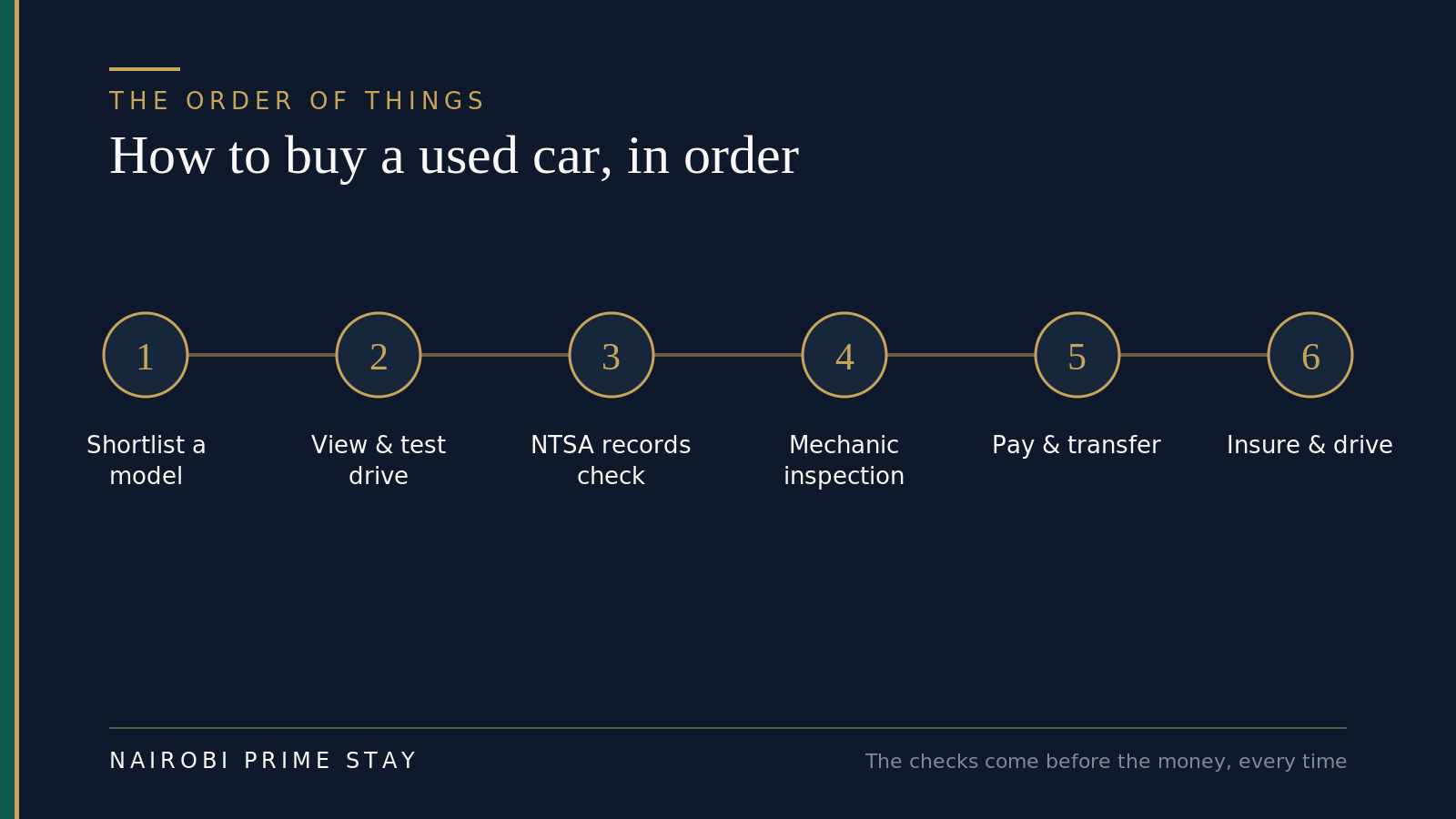 Do these in order. The checks come before the money, every time.
1. Pull the car’s NTSA record. The NTSA lets you request a “Copy of Records” (also called a vehicle search) through the official eCitizen / NTSA TIMS platform, using the registration number or chassis number. It shows the registered owner, the vehicle’s details, and — crucially — whether there’s any encumbrance on it, meaning a loan or court caveat. Match the owner’s name and ID to the person actually selling you the car. If the seller won’t share the registration number so you can check, walk away.
2. Use the new e-logbook to confirm authenticity. As of June 2026, Kenya has switched from paper logbooks to a digital e-logbook. Every registered vehicle now has an electronic registration certificate accessible through the owner’s NTSA TIMS and eCitizen account, and each e-logbook carries a dynamic QR code that anyone can scan to verify ownership and status instantly, at no cost, using the official NTSA Services app or portal. This is a big deal for buyers: a forged paper logbook used to be a real risk, but a QR code that resolves on the genuine NTSA system is very hard to fake. Ask to see the seller’s e-logbook and scan the code yourself.
3. Beware fake “verification” sites. Because everyone now wants to check a car, scam platforms have popped up promising instant NTSA records for a fee. The NTSA has publicly flagged at least one such site as having no affiliation with the authority. Use only the official NTSA portal (tims.ntsa.go.ke / eCitizen) and the official NTSA Services mobile app. If a site emails you “official records” the second you pay, it isn’t the NTSA.
4. Cross-check the numbers on the car. The chassis (VIN) and engine numbers stamped on the vehicle must match the logbook and the NTSA record exactly. Cloned plates and “ringer” cars — where a stolen or written-off car is given a clean car’s identity — show up as a mismatch here. Take five minutes to physically check the stamped numbers against the paperwork. Photograph everything.
5. Get an independent pre-purchase inspection. Pay a neutral expert to inspect the car before you buy — not the seller’s mechanic. An independent pre-purchase inspection in Nairobi typically costs about KES 1,500–3,500, and outfits like the AA of Kenya offer inspection and valuation services. They check the engine, transmission, suspension, brakes, accident history and whether the odometer’s been wound back. On a car costing a million shillings or more, this is the best few thousand shillings you’ll spend. A seller who refuses an independent inspection is telling you something.
Do these five things and you’ve closed off almost every common scam. The car might still have ordinary wear — that’s what the inspection and a test drive are for — but you won’t be buying someone else’s debt or a stolen vehicle.
Transferring the logbook: the NTSA TIMS process
Once you’ve verified the car and agreed a price, ownership transfers online through NTSA TIMS on the eCitizen platform. There’s no need to queue at an NTSA office for a standard transfer — both the seller and the buyer approve it from their own accounts.
Here’s how it goes. Both parties need an NTSA TIMS account, which uses the eCitizen login and a Kenyan ID or, for foreigners, your passport and alien/foreign national ID linked to your account. The seller logs in, selects the vehicle under “Transfer of Ownership,” and enters your details as the buyer. You, the buyer, log in, find the pending transfer and click to accept it, then pay the transfer fee. Once both sides have approved and the fee is paid, the system updates the digital logbook into your name.
The transfer fee depends on engine capacity — figure roughly KES 2,200 for a small car (up to 1,000cc) rising to about KES 6,500 for a large engine (over 3,000cc), plus a small one-off e-sticker fee of around KES 750. The exact figure shows on TIMS before you pay, because the NTSA sets it. The digital logbook typically reflects the new owner within a few working days. Confirm the current fees and steps on ntsa.go.ke, since the move to the e-logbook system in 2026 is still bedding in.
A practical tip: don’t pay the full price until the transfer is initiated and you can see it pending in your own TIMS account. A common, fair arrangement is to pay at the point the seller starts the transfer and you accept it, so the money and the paperwork move together. For a high-value car, doing the handover at the seller’s bank — payment confirmed, transfer initiated, keys handed over — keeps everyone honest.
Insurance: sort it before you drive away
Driving without at least third-party cover is illegal in Kenya, so arrange insurance the same day you take the keys. You’ve got two levels.
Third-party only (TPO) is the legal minimum. It covers damage and injury you cause to other people and their property, but nothing to your own car. It’s cheap — as of 2026, roughly KES 5,000–15,000 a year for a private car. It’s also the bare minimum, and on Nairobi’s roads “the bare minimum” leaves you exposed.
Comprehensive is what most expats actually buy. It covers your own car too — accidents, theft, fire, vandalism, the lot — and given the value of your car and the realities of city traffic, it’s the sensible choice. Comprehensive is priced as a percentage of the car’s insured value, typically around 3–7.5% per year, with a minimum premium (commonly about KES 37,500). On a KES 1.5M car, budget very roughly KES 50,000–90,000 a year. Rates vary by insurer, your claims history and add-ons like excess protection, a courtesy car or political-violence cover, so get two or three quotes.
Whichever you choose, ask what’s included: many policies bundle AA membership and roadside assistance, which is worth having. Pay for cover to start the moment you drive off, not the next morning.
The scams to know about (and how to dodge them)
Most sellers are honest. But used-car fraud is real in Kenya, and it tends to target newcomers who don’t know the system yet. The patterns are well known, which is exactly why the verification steps above work so well.
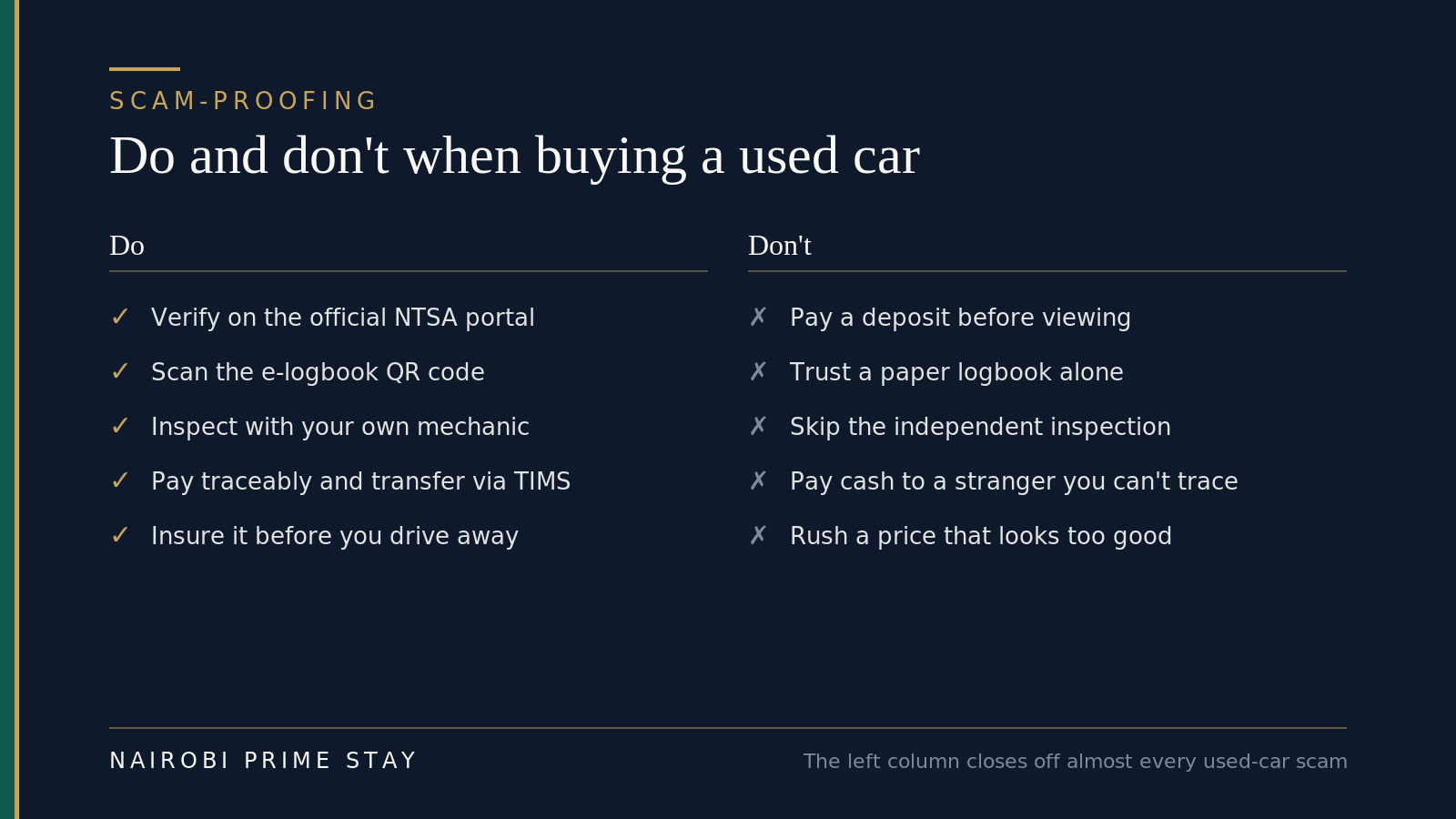 The habits on the left close off almost every used-car scam in Nairobi. The ones on the right are how people get burned.
Forged logbooks. Fraudsters print convincing fake logbooks for a car that isn’t theirs, or doesn’t exist. The fix is the new e-logbook QR code and an official NTSA records check — a fake won’t resolve on the genuine system.
Cars under a loan or caveat. A car can be collateral for a logbook loan or tied up in a court case. Buy it and you can lose it to the lender. The NTSA encumbrance check on the Copy of Records flags this before you pay.
Cloned plates and “ringers.” A stolen or written-off car gets the identity of a clean one. The chassis-and-engine-number cross-check catches the mismatch.
Deposit-and-vanish. A too-good listing online, a friendly seller, an urgent reason to pay a deposit now to “hold” the car — then silence. Never send money for a car you haven’t seen, inspected and verified in person.
Curbstoners and odometer fraud. Unlicensed dealers posing as private owners, or cars with the mileage wound back. An independent inspection and a service-history check are your defense.
The pressure play. “Another buyer is coming this afternoon.” Real sellers of fairly priced cars don’t need to rush you. Pressure is a reason to slow down, not speed up. The mindset that protects you here is the same one that protects property buyers — our guide to common scams in Kenya is worth a read for how these schemes are built and spotted.
A real-world example
Say you’re a remote worker who’s been in Nairobi two months, living in a serviced apartment in Lavington and tired of paying for rides out to Karen on weekends. You’ve got about KES 1.3M to spend.
You browse Jiji and a couple of yards for two weekends and learn the going rate for a 2017–2019 Toyota Axio. An expat in a community group is selling a 2018 Axio with full service history before relocating — KES 1.25M, one owner. You view it, drive it, and like it. You ask for the registration number and pull the NTSA Copy of Records: owner’s name matches her ID, no encumbrance, numbers all consistent. She shows you the e-logbook and you scan the QR code — it resolves on the official NTSA app. You pay KES 2,500 for an independent inspection, which finds nothing worse than tires due soon. You agree KES 1.22M, meet at her bank, she initiates the TIMS transfer, you accept it and pay the transfer fee, and the money moves once you can see the transfer pending in your account. You buy comprehensive insurance that afternoon. Total over the asking price: an inspection, the transfer fee, insurance and a set of tires — and a car you can trust. That’s the whole game.
Buying used locally: honest pros and cons
| Pros | Cons |
|---|---|
| See, drive and inspect the actual car before paying | Almost always a private cash sale — the checking is on you |
| Drive it home the same week, no waiting | Less choice than ordering a specific import to spec |
| Most stock is already low-mileage ex-Japan quality | Yard prices carry a markup over a private sale |
| NTSA records + the 2026 e-logbook make verification easy | Fraud exists and targets newcomers who skip the checks |
| Toyota parts and mechanics are cheap and everywhere | A bad car hides its problems until an inspection finds them |
| Resale is straightforward when you leave | Insurance, transfer and a first service add to the sticker |
Your used-car buying checklist
- Decide you actually need a car (try a month on apps first).
- Set a total budget that includes inspection, transfer, insurance and a first service.
- Shortlist a common, reliable model and learn its going 2026 price.
- View and test-drive in daylight; never buy sight-unseen.
- Get the registration number and pull the official NTSA Copy of Records.
- Confirm no encumbrance (loan or caveat) on the car.
- Ask for the e-logbook and scan its QR code on the official NTSA app.
- Cross-check chassis (VIN) and engine numbers against the paperwork and the car.
- Pay for an independent pre-purchase inspection (about KES 1,500–3,500).
- Agree the price in writing; keep a simple signed sale agreement.
- Pay traceably (bank transfer), ideally as the TIMS transfer is initiated and you accept it.
- Buy at least third-party insurance — comprehensive if you can — before you drive off.
- Confirm the digital logbook updates into your name within a few working days.
Final thoughts
Buying a car in Nairobi is genuinely easy once you accept that the work is in the checking, not the choosing. The market is deep, Toyotas are everywhere and reliable, and the country has just made verification far simpler with the move to a digital logbook. Pick a sensible model, do the NTSA checks, pay an independent mechanic, move the money and the paperwork together, and insure it before you drive away. Do that and you’ll have a car you can trust at a fair price — the boring, happy outcome.
And there’s no rush. Spend your first weeks on the apps, learn which way the traffic flows and where you actually need to be, and buy when you’re sure. The right car bought slowly beats the wrong one bought in a hurry.
Related reading
- Moving to Nairobi: the complete guide — the whole relocation, start to finish.
- Getting around Nairobi — ride-hailing, matatus, the Expressway and whether you need a car at all.
- Driving in Nairobi — using your US license, converting to a Kenyan one, insurance and the honest traffic reality.
- Importing a car to Kenya — the 8-year rule, how the duties stack, and import-versus-buy math.
- Cost of living in Nairobi — where a car fits into a realistic monthly budget.
- Common scams in Kenya and how to avoid them — how these schemes are built and the checks that stop them.
When you’re still finding your feet
You don’t need to own a car to land well. A serviced apartment for your first month gives you a secure, all-inclusive base — Wi-Fi, cleaning, generator and security included — while you learn the roads, test your commute and decide whether to buy at all. A $50 deposit reserves a place and the balance is paid on arrival. Browse what’s available, or let our AI relocation assistant shortlist apartments that fit your area and budget in a couple of minutes.
Frequently asked questions
How much does a used car cost in Nairobi in 2026? A clean, well-kept used saloon like a Toyota Axio or Corolla Fielder runs roughly KES 850,000–1.5M ($6,500–11,500) in 2026. Small hatchbacks like a Vitz start around KES 400,000–800,000, a tough Probox estate sits around KES 650,000–1.3M, and family SUVs like a RAV4 or Harrier begin near KES 1.8M and climb from there. Prices move with the exchange rate, the model year and mileage, so treat these as ranges and shop around.
How do I transfer a car logbook in Kenya? Ownership transfers online through NTSA TIMS on the eCitizen platform — no office visit for a standard transfer. Both the seller and the buyer need a TIMS account; the seller initiates the transfer and enters your details, and you log in to accept it and pay the fee. The fee depends on engine size, roughly KES 2,200–6,500 plus a small e-sticker fee, and the digital logbook updates into your name within a few working days. Confirm the current steps on ntsa.go.ke.
How do I check if a car is genuine before buying it in Kenya? Pull the official NTSA “Copy of Records” (a vehicle search) on the eCitizen/NTSA TIMS portal using the registration or chassis number. It shows the registered owner and whether the car has any loan or caveat against it. As of June 2026, also ask for the car’s digital e-logbook and scan its QR code on the official NTSA Services app to confirm ownership instantly. Cross-check the chassis and engine numbers on the car against the paperwork, and only use the official NTSA portal — not third-party “verification” sites.
Is it better to buy a car in Nairobi or import one? For most newcomers, buying locally is simpler, faster and lower-risk — you see and drive the actual car and can register it the same week. Importing can suit a specific model or a longer stay, but it ties up your money for six to ten weeks and the duties often add 80–100%+ to the car’s value. Since most local used cars are already recent ex-Japan imports, buying here usually gets you the same quality without handling the shipping and clearing yourself.
Do I need a Kenyan driver’s license to buy a car? No. You can buy and register a car as a foreigner using your passport and foreign national ID details linked to your eCitizen/TIMS account; ownership and a driving license are separate things. You do need a valid license to drive it — your US license works short-term (carry an International Driving Permit), and you convert to a Kenyan license for a longer stay. See our driving in Nairobi guide for the conversion steps.
How much is car insurance in Kenya? Third-party only cover, the legal minimum, runs roughly KES 5,000–15,000 a year for a private car as of 2026. Comprehensive cover, which most expats choose, is priced at around 3–7.5% of the car’s value per year with a minimum premium of about KES 37,500 — so figure KES 50,000–90,000 a year on a KES 1.5M car. Get two or three quotes, since rates vary by insurer and add-ons.
Where is the best place to buy a used car in Nairobi? There’s no single best place — it depends on your appetite for legwork. Established yards on Kiambu Road and Mombasa Road are the easiest and lowest-stress; the Sunday car bazaar at Jamhuri has the most choice and the keenest prices; online marketplaces like Jiji and Cars45 are best for browsing; and expat “leaving sales” are often the best value of all. Wherever you buy, the verification steps stay the same.
What’s the safest way to pay for a used car in Kenya? Pay traceably by bank transfer, not a bag of cash, and move the money at the same time as the paperwork. The cleanest approach is to pay as the seller initiates the NTSA TIMS transfer and you accept it in your own account, ideally meeting at the seller’s bank for a high-value car. Never send a deposit for a car you haven’t seen, inspected and verified on the official NTSA system.
Ready to look?
Find your apartment in Nairobi
Browse verified serviced apartments, or ask the AI concierge which area fits your life.