Guides · Healthcare
Dentists and Specialists in Nairobi: An Honest 2026 Guide for Americans
Dentists and Specialists in Nairobi: An Honest 2026 Guide for Americans
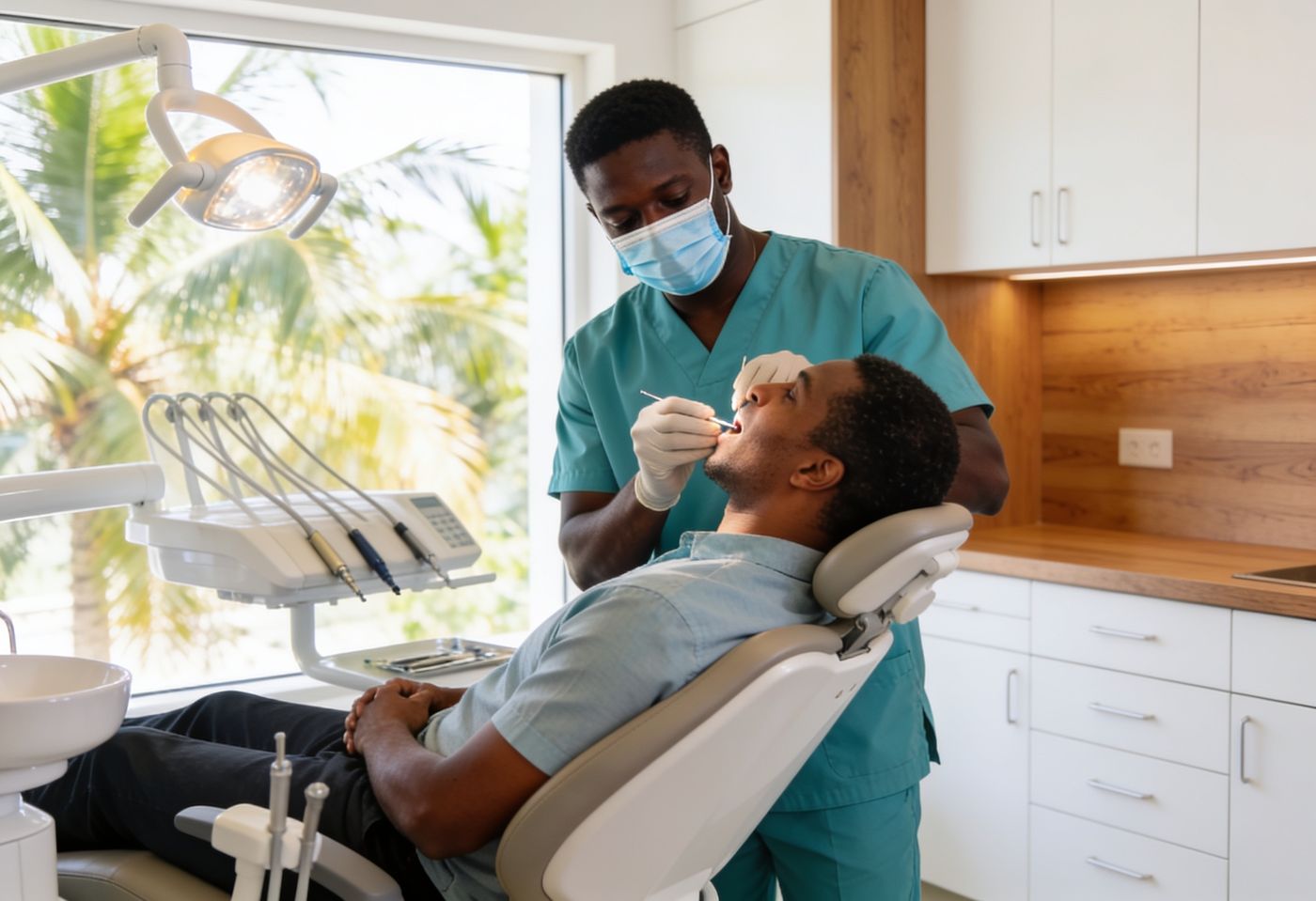
Good dental and specialist care in Nairobi is easy to find, genuinely high quality, and usually a fraction of what you’d pay at home. Most Americans who move here end up doing more dental and elective work, not less — because once a crown costs a couple of hundred dollars instead of two thousand, you stop putting it off.
This guide is for Americans who’ve landed in Nairobi and need a dentist, an eye doctor, a dermatologist, or any other specialist, and don’t know where to start. By the end you’ll know how to find good people, what things actually cost in 2026, where the clinics cluster, how insurance fits in, and the short list of things still worth flying home for.
One honest caveat up front, the same one that runs through all our healthcare in Nairobi writing: the quality lives in the private system. Use it, and you’ll be well looked after. The public clinics serve enormous numbers of people on tight budgets and aren’t built for what international residents expect. So this whole guide assumes you’re paying privately — which, given the prices, is very doable.
Quick answer
Nairobi’s private dentists and specialists are excellent and cheap by US standards, and many trained in the UK, US or Europe. A check-up and clean runs a few thousand shillings; a crown that might cost $1,000–2,500 in the US is roughly KES 10,000–30,000 (about $80–230); a single dental implant is KES 80,000–200,000; LASIK is around $1,000 an eye. You find good people the way locals do — referrals plus credentials — use private clinics that cluster in Westlands, Parklands, Karen and Upper Hill, and either pay cash (it’s affordable) or check whether the clinic direct-bills your insurer. Fly home only for a few ultra-specialized procedures, or to keep continuity on a complex case. Figures are indicative for 2026 at KES 129.4 to the dollar (1 July 2026 — see the dollar-to-shilling guide) — always get a written quote.
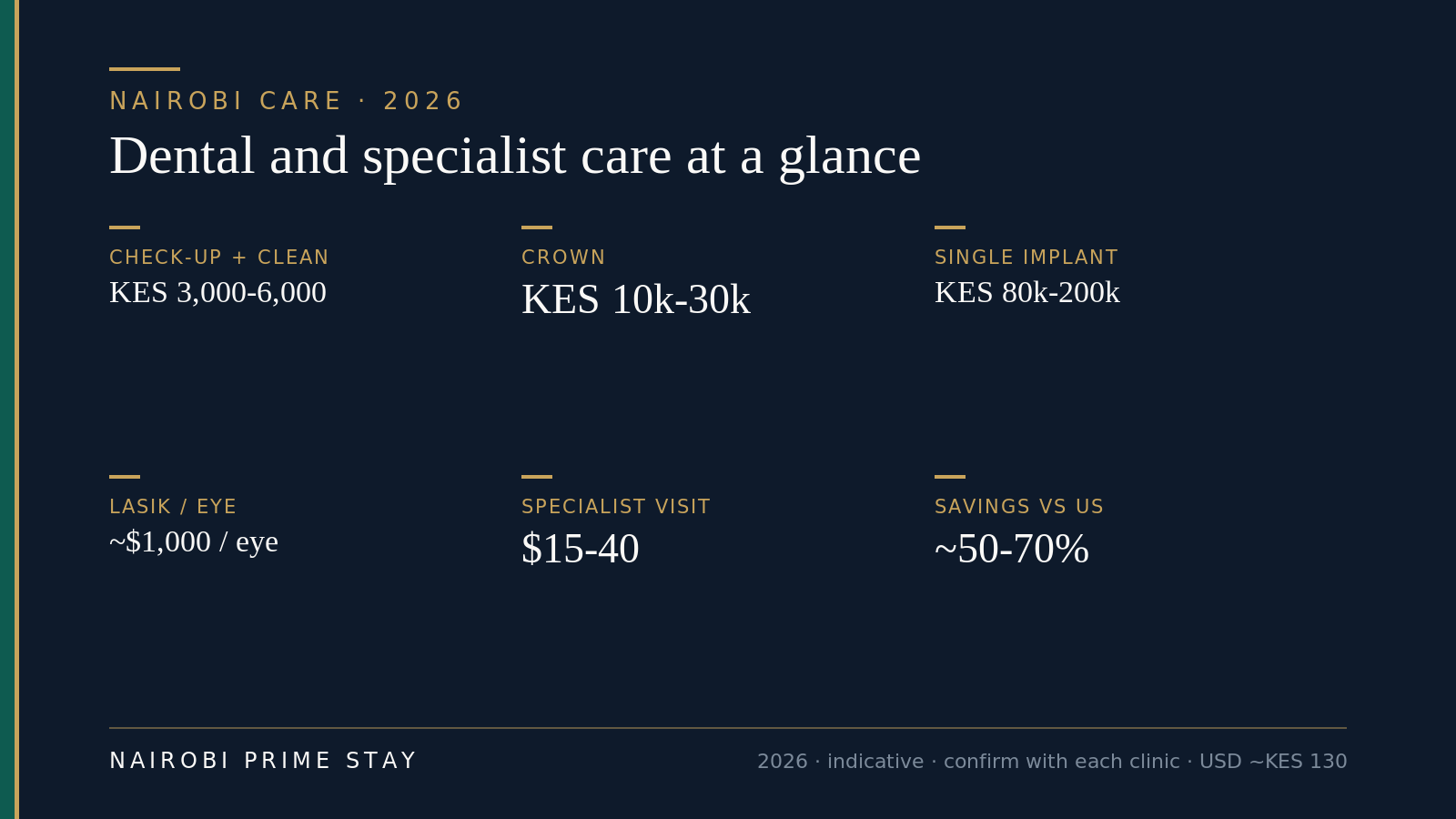 Indicative 2026 prices — get a written quote, and budget at KES 129.4 to the dollar (as of 1 July 2026).
Why this matters
Healthcare is one of the first systems you have to use in a new country, and dental and specialist care is where the day-to-day reality shows up. You’ll need a dentist within weeks, an optometrist when your glasses break, a dermatologist for that mole you’ve been meaning to check. Knowing where to go saves you real money and spares you the classic newcomer mistake: drifting into a crowded public clinic, or overpaying at the first flashy place you find, when a better and cheaper option is two suburbs over.
There’s an upside worth naming too. For many Americans, Nairobi is a chance to finally clear the dental and elective backlog — the crowns, the deep cleaning, the laser eye surgery — at prices that make it sensible rather than painful. People genuinely fly to Nairobi for dental work. As a resident, you get those prices as a matter of course.
Is dental and specialist care in Nairobi any good?
Yes — at the private end, it’s very good. Nairobi is East Africa’s medical hub, and the city draws specialists from across the region. Many dentists and doctors trained or did fellowships abroad, in the UK, the US, India, South Africa or Europe, and the better clinics run the same equipment you’d see at home: digital X-rays and 3D cone-beam scanners, intraoral cameras, laser dentistry, modern operating microscopes. English is the working language of medicine here, so there’s no translation gap.
The honest framing is the same as for hospitals. The gap between a top private clinic and a struggling public one is wide, and you’re choosing the private side. Within the private sector there’s still a range — a slick implant center in Westlands is not the same as a small neighborhood practice — so you vet individuals, not “Nairobi.” Do that, and the care holds up against what you’re used to.
For dental specifically, there’s a reason Nairobi has a small dental-tourism industry: patients fly in from Europe and the diaspora because they can save well over half on implants, crowns and orthodontics without dropping below the quality they’d accept at home. Some clinics will even sort an invitation letter, airport transfers and a hotel. You don’t need any of that as a resident — but it tells you something that outsiders pay to come here.
How to find a good dentist or specialist
Find people the way long-time residents do: ask, then verify. The single best source is a warm referral. Ask your neighbors, your colleagues, your kids’ school parents, your apartment’s management, and the international-community WhatsApp and Facebook groups (how expats find their people in Nairobi explains where those live). The same three or four names tend to come up, and that pattern is more reliable than any online rating.
From there, a few sensible checks separate a good clinic from a forgettable one.
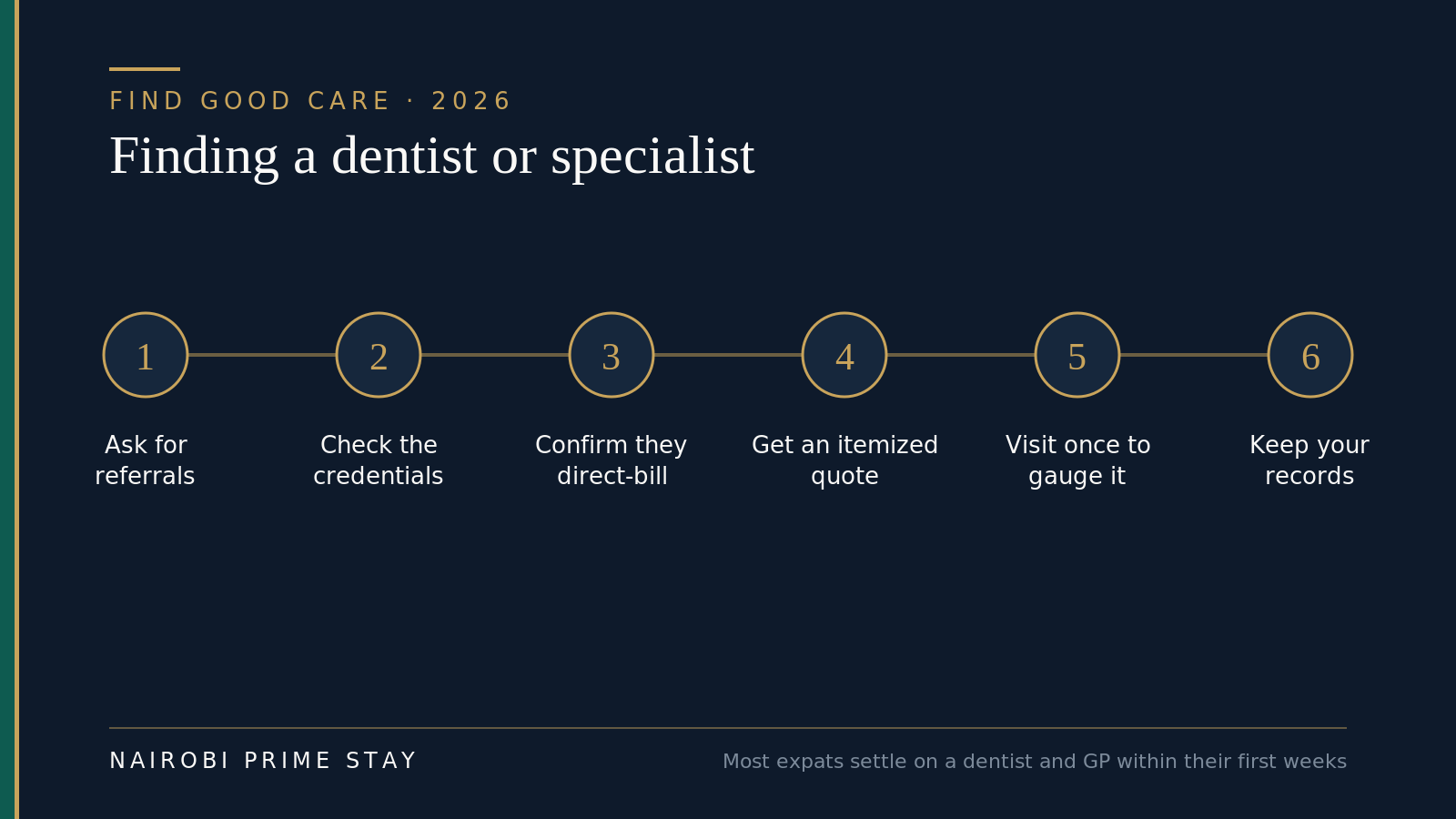 Most expats find a dentist and a regular GP they trust within their first few weeks.
What to check before you book
- Credentials and registration. Kenyan dentists and doctors register with their professional boards (the Kenya Medical Practitioners and Dentists Council for both). A good clinic is happy to tell you where its people trained and that they’re registered. Foreign training is common and a fair signal, but a well-run local-trained practice is just as valid — competence and hygiene matter more than the flag on the diploma.
- Hygiene and equipment. On your first visit, look at the basics: fresh gloves, sealed sterilized instruments, clean surfaces, modern imaging. Reputable clinics are visibly careful about infection control.
- A clear, itemized quote. Good clinics quote in writing, line by line, before they start. If someone is vague about price or pushes a big treatment plan on day one, slow down and get a second opinion — that’s cheap here too.
- Insurance handling. If you carry local cover, ask whether they direct-bill your insurer or whether you pay and claim back. More on this below.
- Continuity. You want somewhere you can keep going back to, with proper records. Ask how they store your history and X-rays, and get copies for yourself.
A practical tip: treat your first appointment as a trial. Book a routine clean or a consultation, see how the place feels, and only commit to bigger work once you trust them. Because routine visits are inexpensive, “shopping around” costs you very little.
What dental work costs in Nairobi (the real numbers)
Dental work is cheap by US standards and the quality at good clinics is high. A routine check-up with a scale and polish is a few thousand shillings. The bigger the procedure, the bigger the saving versus home — implants and orthodontics are where the gap becomes dramatic.
Here’s an indicative 2026 price guide. Prices vary a lot by clinic tier, the materials used, and how complex your case is, so treat these as orientation and always get a written quote.
| Treatment | Indicative price (KES) | Roughly (USD) |
|---|---|---|
| Consultation / check-up | 2,000–5,000 | $15–40 |
| Scale and polish (cleaning) | 3,000–6,000 | $25–50 |
| White (composite) filling | 3,000–8,000 | $25–65 |
| Root canal (per tooth) | 10,000–25,000 | $80–190 |
| Crown (porcelain/ceramic) | 10,000–30,000 | $80–230 |
| Tooth extraction | 3,000–10,000 | $25–80 |
| Single dental implant | 80,000–200,000 | $620–1,550 |
| Full-arch (All-on-4), per arch | 1.2M–2M | $9,000–15,000 |
| Metal braces (full treatment) | 60,000–150,000 | $460–1,150 |
| Clear aligners (Invisalign-type) | 150,000–450,000 | $1,150–3,500 |
Indicative 2026, at KES 129.4 per USD (1 July 2026). Confirm current pricing with the clinic; implant and orthodontic totals depend heavily on your specific case.
A few notes that catch newcomers out. Implant pricing is often quoted in parts — the titanium post, the abutment, and the crown on top — so ask whether the figure is all-in. Orthodontic and implant totals are paid over months as treatment progresses, not in one hit. And “whitening” and cosmetic veneers are widely available, but prices swing enough that you should get a specific quote rather than trust a headline number.
Nairobi vs the US: how big are the savings?
Big — generally 50 to 70 percent less than typical US prices, and more on major dental work. The everyday stuff is cheap enough that you’ll likely stop using insurance for it and just pay; the expensive stuff is where moving here quietly saves you thousands.
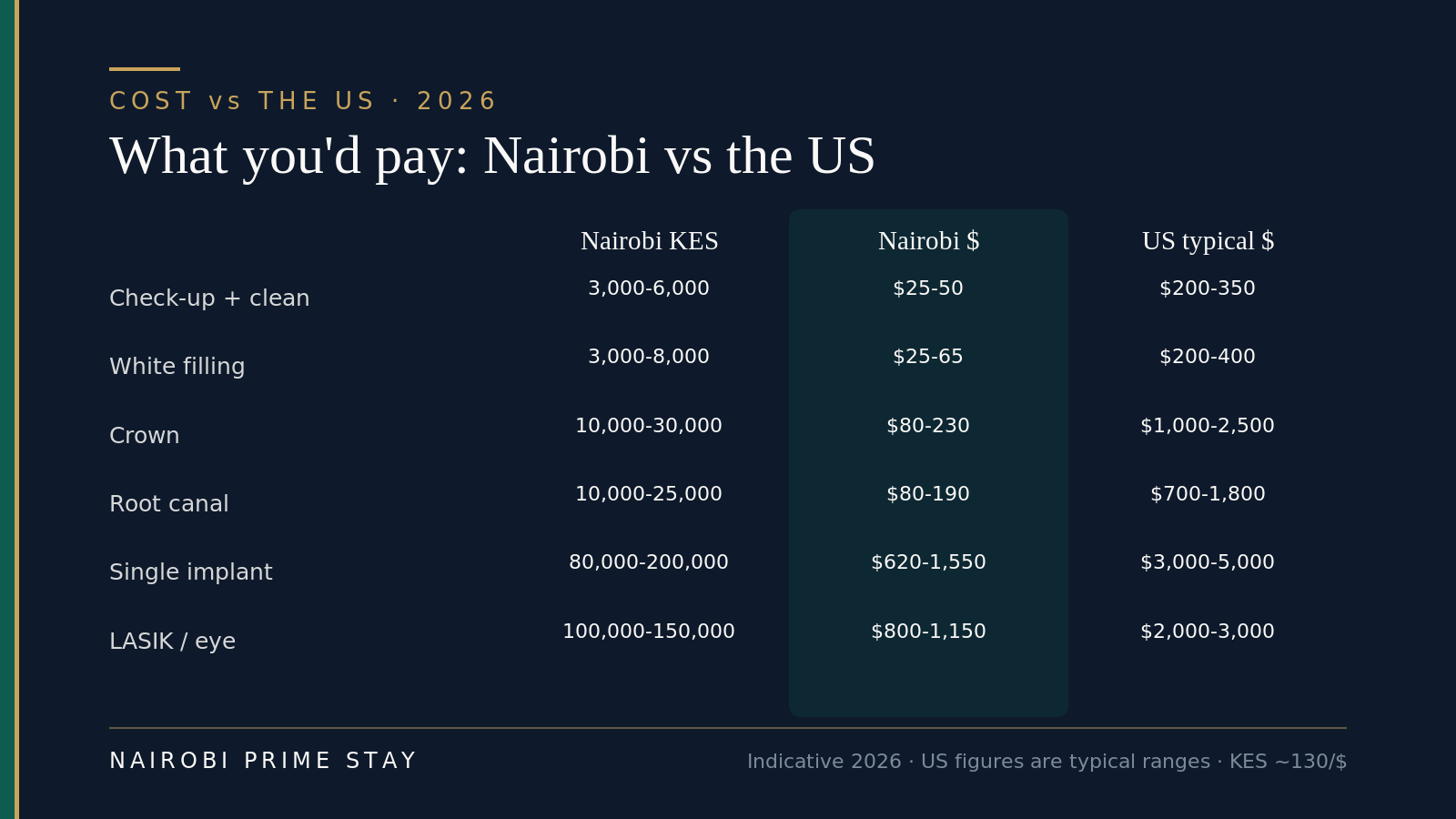 Nairobi prices are indicative 2026; US figures are typical ranges and vary widely by city and insurance.
| Treatment | Nairobi (USD) | US typical (USD) |
|---|---|---|
| Check-up + clean | $25–50 | $200–350 |
| White filling | $25–65 | $200–400 |
| Crown | $80–230 | $1,000–2,500 |
| Root canal | $80–190 | $700–1,800 |
| Single implant | $620–1,550 | $3,000–5,000 |
| LASIK (per eye) | $800–1,150 | $2,000–3,000 |
The catch is the obvious one: you’re paying out of pocket, because US dental and vision insurance won’t follow you here. But at these prices, paying cash is usually cheaper than a US plan’s copays and deductibles would have been. For how this fits your wider budget, see our Nairobi cost of living guide and the head-to-head in Nairobi vs the US cost of living.
Beyond the dentist: the specialists you’ll actually use
The same picture holds across specialties — strong private care, modest prices, English-speaking doctors. A private specialist consultation generally runs about $15–40, with subspecialists at the top hospitals charging a bit more. You reach specialists in two ways: through the big private hospitals’ outpatient clinics, or through standalone specialist practices. Both are fine; the hospital route is handy when you want everything (lab, imaging, pharmacy) under one roof.
The hospitals expat families lean on for specialist outpatient care are Aga Khan University Hospital in Parklands (JCI-accredited, the broadest specialist bench), The Nairobi Hospital in Upper Hill, MP Shah in Parklands, Karen Hospital for the southern suburbs, and Gertrude’s Children’s Hospital in Muthaiga for pediatrics. Each has clinics in the surrounding suburbs as well as the main campus.
Eye care and LASIK
Optometrists for eye tests and glasses are everywhere and cheap, often inside the malls. For medical eye care and surgery, Nairobi has dedicated eye hospitals (such as the Westlands and Laser Eye centers) plus strong ophthalmology at Aga Khan and MP Shah. LASIK runs roughly KES 100,000–150,000 per eye (about $800–1,150), and cataract surgery is well established. A new pair of glasses costs a fraction of US prices, so it’s a common thing to sort out soon after arriving.
Skin (dermatology)
Dermatology is well covered, with clinics concentrated in Westlands, Karen and Lavington. A first consultation is typically KES 3,000–7,000 (roughly $25–55), more for the higher-profile aesthetic clinics. Skin checks, acne and eczema management, minor mole removal and cosmetic treatments are all routine. One genuinely useful point at altitude near the equator: the UV is strong, so a dermatologist and good sunscreen are worth lining up early.
The other specialists
Most of what a family needs is here and easy to reach:
- Orthopedics, ENT, gastroenterology, cardiology and urology — all available, mostly through the big private hospitals’ outpatient clinics.
- Physiotherapy and sports medicine — plentiful and inexpensive; easy to book directly.
- OB-GYN and fertility — strong, with IVF offered at several private centers. For pregnancy specifically, see our having a baby in Nairobi guide.
- Mental health — private psychologists, counselors and psychiatrists practice across the western suburbs. Many international plans include mental-health cover, so check yours.
- Pediatric specialists — Gertrude’s Children’s Hospital is the go-to, with satellite clinics around the city.
Where the clinics cluster
Clinics are scattered across the city, but a few areas concentrate them — useful to know when you’re choosing where to live, since you’ll want care near home rather than across a traffic jam.
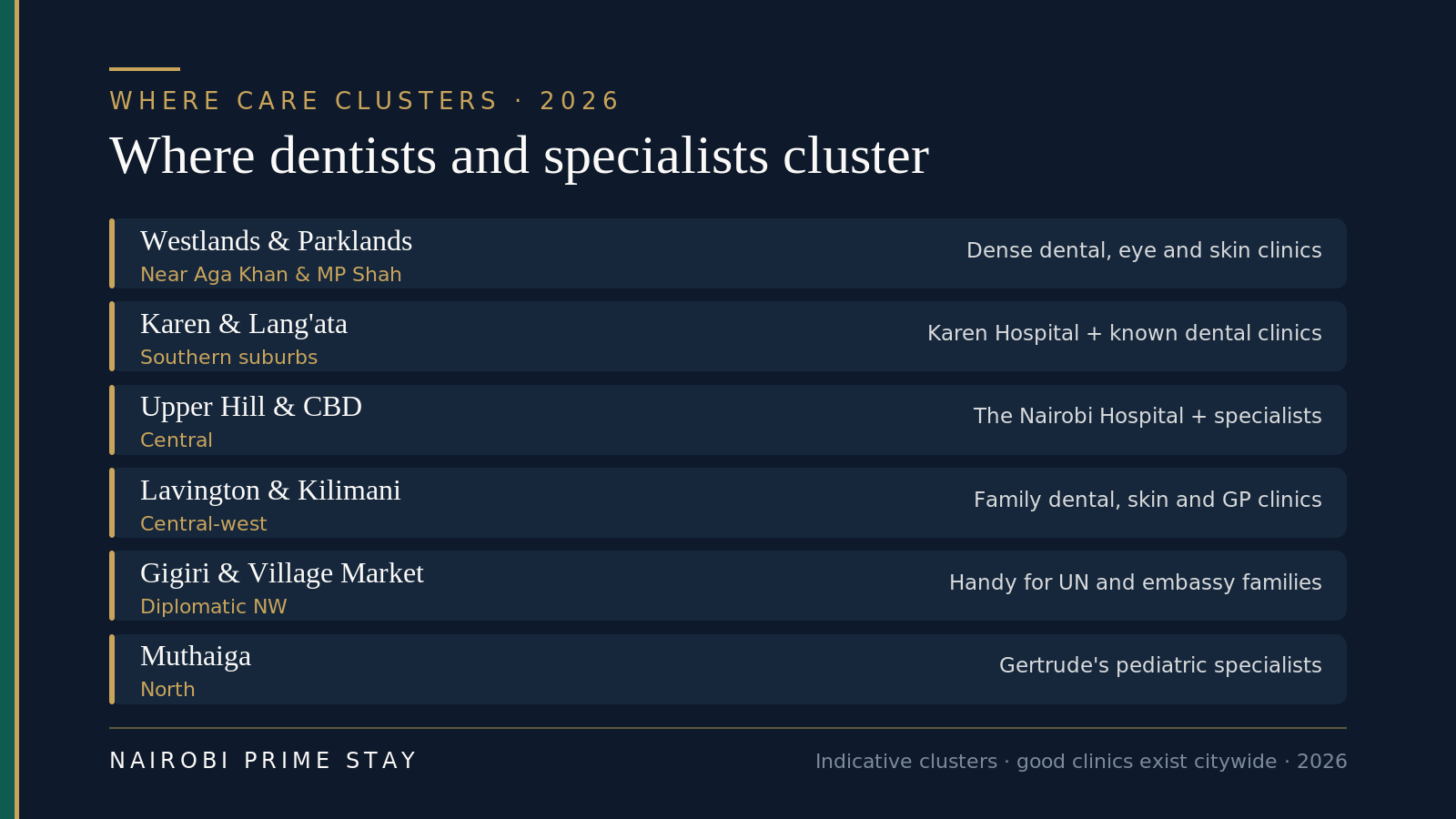 Indicative clusters — good clinics exist all over the city. 2026.
Westlands and Parklands are the densest for dentists and specialists, sitting next to Aga Khan and MP Shah. The southern suburbs around Karen have their own well-known dental clinics and Karen Hospital. Upper Hill and the CBD cluster around The Nairobi Hospital. Lavington and Kilimani are full of family dental, skin and GP practices. And Gigiri near the UN keeps a handful of clinics convenient for diplomatic families. Whichever suburb you choose, you’re rarely far from good care.
Does insurance cover dentists and specialists?
Sometimes — but for routine dental and optical, many expats simply pay cash because it’s so cheap. Here’s how the pieces fit.
Local and international health plans. Specialist consultations and procedures are usually covered under your outpatient benefit, often with direct (cashless) billing if the clinic is in your insurer’s network. Dental and optical, though, are typically optional add-ons with their own annual sub-limits — and those limits are low enough that a single implant can blow through them. So people often insure the medical specialists and self-pay the dentist. Decide this deliberately when you choose a plan; our health insurance for expats guide walks through the trade-offs.
Direct billing vs pay-and-claim. Big local insurers (Jubilee, AAR, Britam, APA, CIC, Old Mutual/UAP, Madison and others) have wide direct-billing networks, so you show a card and the clinic bills them. International plans more often work pay-and-claim: you pay, then submit receipts. Always ask the clinic which insurers they bill directly before you book.
SHA, the national scheme. SHA (which replaced NHIF in late 2024) includes some outpatient and dental benefits at empaneled facilities, but it’s a baseline built around public and contracted providers — not a way to fund a nice private dentist. Treat it as legal minimum cover, not your real plan.
The cash reality. Because prices are low, paying out of pocket for the dentist, optometrist and one-off specialist visits is normal and often cheaper than chasing claims. Keep itemized receipts anyway — some plans reimburse, and US flexible-spending or HSA accounts may accept foreign dental and medical receipts (check your administrator).
What to fly home for — the honest note
For the vast majority of dental and specialist care, there’s no reason to leave Nairobi. The short list of exceptions is genuinely short.
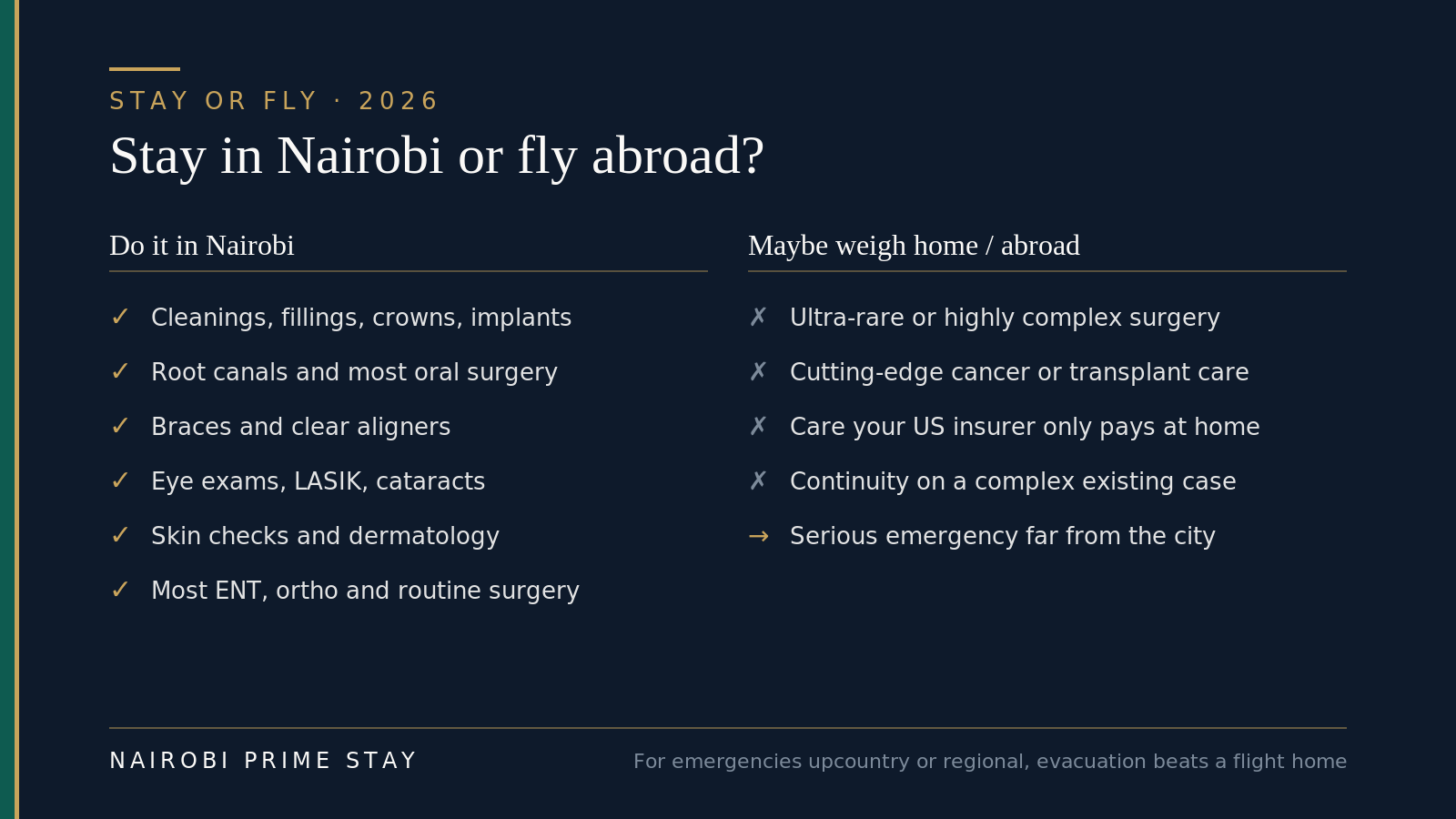 For emergencies upcountry or while traveling the region, medical evacuation — not a flight home — is the answer.
Handle in Nairobi: essentially all routine and most complex dental work, eye surgery including LASIK and cataracts, dermatology, ENT, orthopedics, physiotherapy, and the great majority of routine operations. The quality and price both favor staying.
Consider home or a regional center (South Africa and India are the usual ones) only for a handful of cases: ultra-rare or highly complex surgery that a subspecialist team does better elsewhere; cutting-edge oncology or organ transplant; situations where your US insurance will only pay if treatment happens at home; or continuity on a complicated case a US specialist already knows well. Some people also time elective work for a US trip they were taking anyway — that’s about logistics, not quality.
And for the true emergency far from a major hospital — a bad accident on the coast or upcountry — the answer isn’t a flight home, it’s medical evacuation to Nairobi. That’s exactly what an AMREF Flying Doctors-style membership buys, and why we treat evacuation cover as essential in the health insurance guide.
Can you get braces or Invisalign in Nairobi — and what about the kids’ dentist?
Yes — and orthodontics is one of the biggest savings in this whole guide. Nairobi’s private orthodontic practices use the same brackets, aligner systems and 3D scanning you’d see in the US. As of July 2026, conventional metal braces run roughly KES 80,000–350,000 for a full course of treatment, usually including the consultation, imaging and follow-up visits; ceramic and lingual braces sit higher in that range. Invisalign-style clear aligners cost about KES 150,000–350,000 and up, depending on how complex your case is and how long treatment runs. The initial orthodontic consultation is around KES 3,000–10,000, with X-rays and scans adding KES 5,000–15,000. Many clinics offer payment plans — commonly half down and the balance spread across the treatment period. Set that against a typical US bill of $3,000–7,000+ for braces and you can see why families deliberately time their kids’ orthodontics for their Nairobi years.
Two honest cautions. First, orthodontics is a two-to-three-year relationship, so choose an orthodontist you expect to still be visiting at the end — this is the one treatment where clinic-hopping genuinely costs you. Second, if your child is already mid-treatment in the US, get transfer notes and records from your US orthodontist before you move; picking up someone else’s half-finished case is routine for a good orthodontist, but only with the paperwork.
Pediatric dentistry more broadly is easy here. The private dental clinics in Westlands, Lavington and Karen see children daily, and Gertrude’s Children’s Hospital — the region’s dedicated pediatric hospital — covers the medical side for kids. Checkups, sealants and fillings for children cost the same few-thousand-shilling amounts as adult routine care. For the rest of settling in with kids, see our guide to family life in Nairobi.
How do you check a dentist or doctor is registered in Kenya?
Two minutes online. Every doctor, dentist and community oral health officer practising in Kenya must be registered with the Kenya Medical Practitioners and Dentists Council (KMPDC) and hold a current annual practice licence. The Council publishes searchable public registers at registers.kmpdc.go.ke — look the practitioner up by name and you’ll see their registration status and category. KMPDC keeps a register of licensed health facilities too, so you can verify the clinic as well as the person treating you.
Make it a habit for anyone doing significant work on you or your family: referral first, register second, then book. If a name isn’t on the register, walk away — there is no shortage of registered alternatives. And a clinic that bristles at being asked about registration has answered your real question. Reputable ones expect it, especially from newcomers.
Hand over your care properly: records, X-rays and receipts
The smoothest medical landings start before the flight. Ask your US dentist and doctors for complete copies of your records and recent X-rays — digital is fine, and Nairobi’s private clinics work with emailed imaging routinely. It matters most if anything is mid-course: finish the half-done root canal before you fly, or get proper transfer notes if you can’t. Starting fresh with a Nairobi dentist is easy; reconstructing your history from memory in the chair is not.
Once you’re here, keep every itemized receipt and treatment note. You’ll want them for insurance claims if you carry local or international cover, for continuity if you later change clinics, and for tax or reimbursement paperwork back home — some US HSA and FSA arrangements can reimburse qualifying dental and medical care abroad, though the rules vary, so confirm with your plan administrator before counting on it. Good Nairobi clinics store your history and hand over copies without fuss; it’s one of the checks worth making on your first visit.
A couple of real scenarios
The remote worker who’d been quietly avoiding the dentist. A 34-year-old developer arrives owing himself a crown and a deep clean he’d put off in the US, where the crown alone was quoted near $1,400. In Westlands he finds a UK-trained dentist through his building’s WhatsApp group, gets a written quote, and has the clean, two fillings and the crown done over three visits for well under what the single US crown would have cost. He pays cash and keeps the receipts.
The retiree couple doing a “catch-up.” A pair in their sixties use their first months to clear a backlog — cleanings, a crown each, new glasses for both, and a skin check at a Karen dermatology clinic after years in the Arizona sun. The whole lot comes to less than one of those crowns would have cost back home. They put the dermatologist and a GP on speed dial, and add an evacuation membership for the regional safaris they’re planning.
The honest balance
| What’s great | What to keep in mind |
|---|---|
| Excellent private dentists and specialists, many foreign-trained | Quality lives in the private sector — skip the public clinics for this |
| Prices roughly 50–70% below the US, more on major dental work | You pay out of pocket; US dental/vision insurance won’t follow you |
| English-speaking doctors and modern equipment | Within the private sector there’s still a range — vet the individual |
| Easy to find good people via referrals | Online reviews are thin; a warm recommendation beats a star rating |
| Care clusters near where expats live | Traffic, not distance, decides convenience — choose a clinic near home |
| You can finally clear the elective backlog affordably | A few ultra-specialized cases are still better handled abroad |
Your checklist
- Ask neighbors, colleagues, school parents and expat groups for two or three names.
- Check the dentist or doctor is registered and ask where they trained.
- Book a routine visit first to gauge hygiene, equipment and manner.
- Get an itemized written quote before any significant treatment.
- Confirm whether they direct-bill your insurer, or whether you pay and claim.
- Decide consciously whether to insure dental/optical or just self-pay.
- Keep copies of your records, X-rays and receipts.
- Line up a regular GP and dentist near home in your first few weeks.
- If you’ll travel the region, add medical evacuation cover.
- For anything ultra-specialized, get a second opinion before deciding where to treat it.
Final thoughts
Dental and specialist care is one of the easy wins of moving to Nairobi. The private system is good, the doctors speak your language, and the prices turn things you’ve been dreading into things you just get done. Find your people the way locals do — ask around, then verify — keep your records, and insure the big risks rather than the cheap visits. Do that, and you’ll likely look after your teeth and your health better here than you did at home.
Related reading
- Start with the overview: healthcare in Nairobi — hospitals, finding a doctor, and how the private system works.
- Get the cover right: health insurance for expats in Kenya — local vs international plans, dental/optical add-ons and why evacuation matters.
- Planning a family? Having a baby in Nairobi covers maternity hospitals, costs and registering the birth.
- Budget the rest: cost of living in Nairobi and Nairobi vs the US.
- New here? The hub: moving to Nairobi.
When you arrive
A soft landing makes the medical admin easier. A serviced apartment for your first month puts you near the clinics and hospitals while you choose a neighborhood and find your doctors — Wi-Fi, cleaning, generator and security included, so you can focus on settling in. When you’re ready, browse our apartments, or let our AI relocation assistant match you to a home near the care you need, day or night.
Frequently asked questions
How much does a dentist cost in Nairobi?
Far less than in the US. In 2026 a consultation runs about KES 2,000 to 5,000, a scale and polish about KES 3,000 to 6,000, a white filling KES 3,000 to 8,000, and a porcelain crown KES 10,000 to 30,000 (roughly $80 to $230). Bigger work saves you more: a single implant is KES 80,000 to 200,000. Prices vary by clinic tier and case, so always get a written, itemized quote. Budget at about KES 129.4 to the dollar (as of 1 July 2026).
Are dentists in Nairobi any good?
At the private end, yes. Nairobi is East Africa’s medical hub, English is the language of medicine, and many dentists trained or did fellowships abroad in the UK, US, India or Europe. The better clinics use the same digital X-rays, 3D scanners and laser equipment you would see at home. Quality varies within the private sector, so vet the individual clinic, but good dental care is easy to find. Nairobi even attracts dental tourists for this reason.
How much is a dental implant in Nairobi?
Roughly KES 80,000 to 200,000 for a single implant in 2026, depending on the implant brand, whether you need a bone graft, and the crown on top. A full-arch restoration such as All-on-4 is far more, around KES 1.2 million to 2 million per arch. Ask whether the quote is all-in, since implants are sometimes priced in parts (the post, the abutment and the crown). Even so, it is usually well under half the typical US price.
How much does LASIK cost in Nairobi?
About KES 100,000 to 150,000 per eye in 2026, roughly $800 to $1,150, which usually includes the pre-op assessment and follow-ups. Nairobi has dedicated eye hospitals and strong ophthalmology at hospitals like Aga Khan and MP Shah, and cataract surgery is well established too. That is well below typical US LASIK prices of $2,000 to $3,000 per eye. Confirm the exact package and what is included with the clinic.
Can I get braces or Invisalign in Nairobi?
Yes. As of July 2026, conventional braces cost roughly KES 80,000 to 350,000 for a full course and Invisalign-style clear aligners about KES 150,000 to 350,000 or more, depending on case complexity — well below typical US prices of $3,000 to $7,000 and up. The initial orthodontic consultation is about KES 3,000 to 10,000, and many clinics offer payment plans, commonly half down with the balance spread over treatment. If your child is mid-treatment when you move, get transfer notes from your US orthodontist first.
How do I verify a doctor or dentist is registered in Kenya?
Check the Kenya Medical Practitioners and Dentists Council (KMPDC) registers online at registers.kmpdc.go.ke. Every doctor, dentist and community oral health officer practising in Kenya must be registered with the Council and hold a current annual practice licence, and KMPDC also publishes a register of licensed health facilities so you can verify the clinic as well as the practitioner. It takes about two minutes, and a reputable clinic will never mind you asking.
How do I find a good dentist or specialist in Nairobi?
Ask, then verify. Warm referrals from neighbors, colleagues, school parents, your building’s management and expat WhatsApp or Facebook groups are the most reliable starting point, since the same trusted names tend to recur. Then check the practitioner on the KMPDC register, ask where they trained, look at hygiene and equipment on a first visit, and get an itemized written quote before any major work. Most expats settle on a dentist and a regular GP within their first few weeks.
Does health insurance cover dental and specialists in Kenya?
Specialist consultations are usually covered under your outpatient benefit, often with direct billing if the clinic is in your insurer’s network. Dental and optical, though, are typically optional add-ons with low annual sub-limits, which a single implant can use up, so many expats simply pay cash because prices are low. Ask each clinic which insurers they bill directly. SHA, the national scheme, offers only a basic baseline at empaneled facilities, not private-dentist cover.
Is it cheaper to get dental work done in Nairobi than the US?
Yes, usually 50 to 70 percent cheaper, and the gap is largest on major work like crowns, implants and orthodontics. A crown that might cost $1,000 to $2,500 in the US is about $80 to $230 here, and an implant that runs $3,000 to $5,000 in the US is roughly $620 to $1,550. The trade-off is that US dental and vision insurance will not follow you, so you pay out of pocket, but at these prices that is often still cheaper than US copays.
Should I bring my dental and medical records from the US?
Yes. Ask your US dentist and doctors for complete records and recent X-rays before you fly — digital copies are fine, and Nairobi’s private clinics work with them routinely. It matters most if you are mid-treatment: finish a half-done root canal or get orthodontic transfer notes before moving. Once here, keep every itemized receipt for insurance claims; some US HSA or FSA arrangements can reimburse qualifying care abroad, but confirm the rules with your plan administrator first.
What medical care should I still fly home for?
Very little. Handle routine and most complex dental work, eye surgery including LASIK and cataracts, dermatology, ENT, orthopedics and most routine operations in Nairobi. Consider home or a regional center like South Africa or India only for ultra-rare or highly complex surgery, cutting-edge cancer or transplant care, treatment your US insurer will only fund at home, or continuity on a complicated existing case. For a serious emergency far from the city, the answer is medical evacuation to Nairobi, not a flight home.
Ready to look?
Find your apartment in Nairobi
Browse verified serviced apartments, or ask the AI concierge which area fits your life.