
Guides · Property investment
New Developments & Satellite Cities Around Nairobi: The 2026 Guide
New Developments & Satellite Cities Around Nairobi: The 2026 Guide

Nairobi is growing outward, not just upward. Drive 20 to 60 minutes from the city center in almost any direction and you’ll hit a master-planned development with its own name, its own roads, and a big promise about the future. Tatu City. Konza. Tilisi. Northlands. Two Rivers. You’ll hear these names from agents, at dinner parties, and in every “where should I buy?” conversation.
This guide is an honest map of the big ones, as of 2026. What each is, where it sits, what’s actually built versus still on a billboard, who it suits, and the real risks of buying into a place that’s still being born. We’ve leaned on current developer figures and recent reporting, and we flag where a number is a moving target — because with new developments, the gap between the render and the reality is the whole story.
Most of these sit in the satellite belt — Ruiru, Limuru, Kitengela, Machakos — that the expressway, the bypasses and the railway are slowly knitting back into the city. So we’ll start with the infrastructure, because that’s what actually moves value, then walk through each development.
TL;DR — the short version
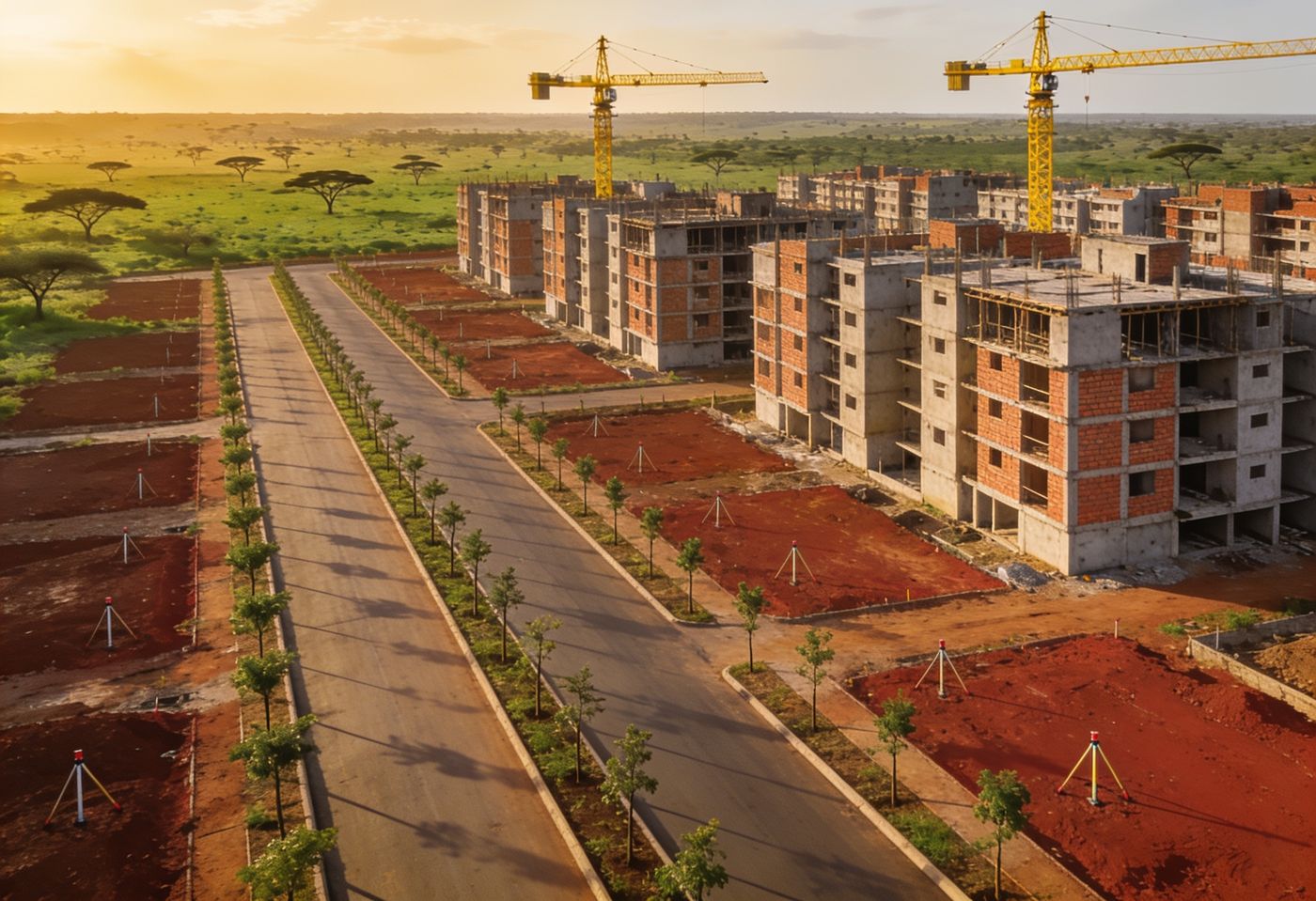
Nairobi’s headline new developments in 2026 fall into two camps. Already real and lived-in: Tatu City (Ruiru) is an operational special economic zone with thousands of residents, working schools and factories; Two Rivers (near Gigiri) is the most complete, with a giant mall and apartments being handed over. Big but early: Northlands City (Ruiru) is a 50-year, 11,500-acre Kenyatta-family project with its first apartments only now occupied; Tilisi (Limuru) is a fast-selling logistics-and-homes estate; Konza Technopolis (~60 km out) is the government’s “Silicon Savannah,” with Phase 1 infrastructure launched in 2025 and a long road ahead. They’re transforming the metro, but timelines slip — buy where infrastructure already exists, vet the developer, and never pay a premium for value that’s years away. The off-plan rules apply.
Why this matters if you’re moving or investing
Where the city expands is where tomorrow’s value, traffic and lifestyle get decided. If you’re relocating, these developments shape your real choices: a walkable live-work town like Tatu City is a genuinely different life from a leafy western suburb. If you’re investing, the satellite belt is where most new supply — and most of the marketing — is concentrated, so it’s where the best gains and the worst mistakes both happen.
The catch: a new development is a bet on delivery. You’re often buying a promise — a road that’s coming, a school that’s planned, a phase that’s “launching.” Some promises land. Some take a decade. Some never arrive. Knowing which is which is the difference between a smart early entry and money parked in a field. This guide, our property-investing pillar and the honest off-plan guide are built to keep you on the right side of that line.
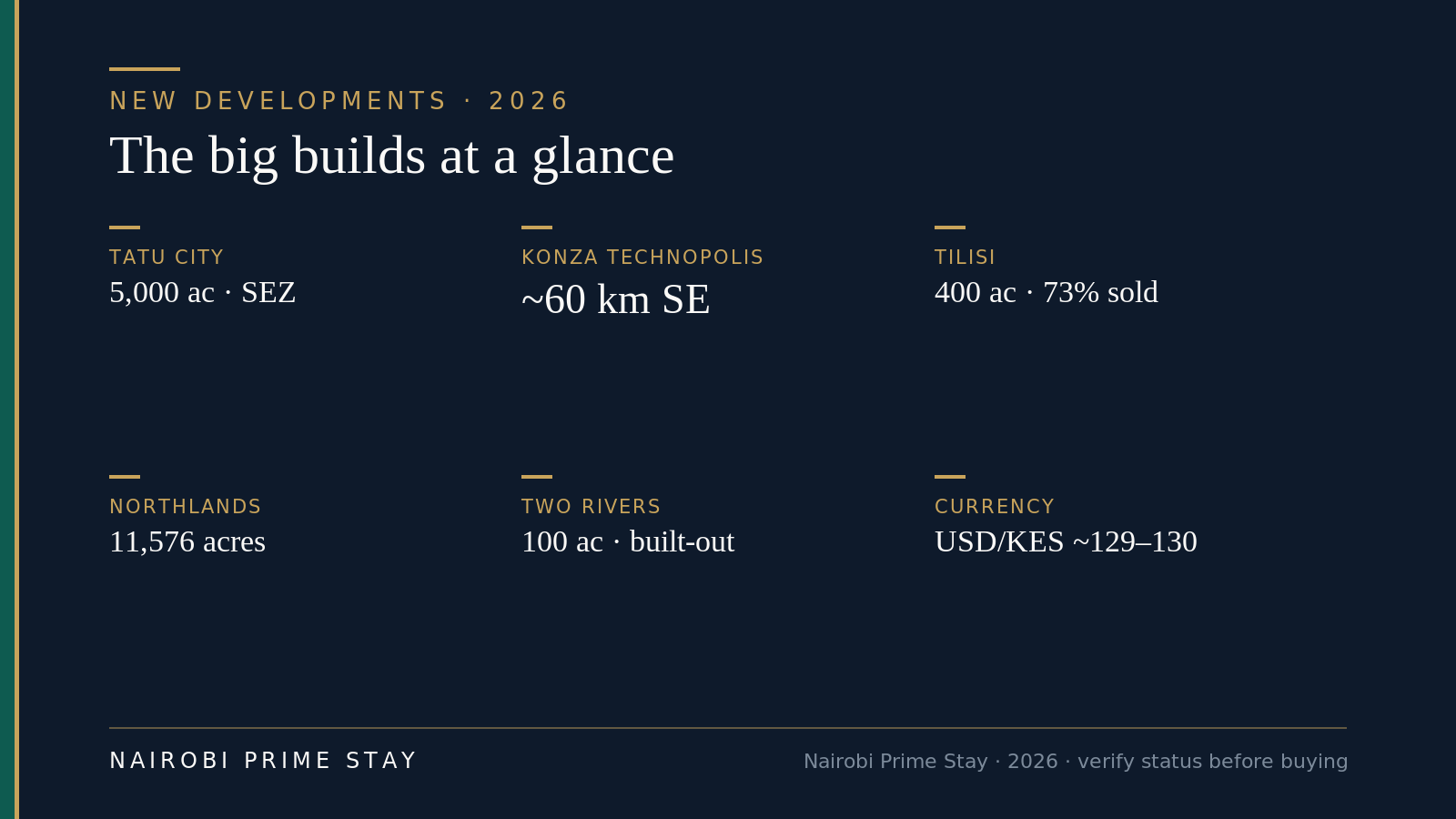 The big builds at a glance — verify each developer’s progress claims before you buy.
The infrastructure that’s actually moving the map
Roads and rail, not brochures, decide which satellite town wins. Three waves of infrastructure are reshaping where Nairobi’s value sits.
The Nairobi Expressway. The 27-km raised toll road, open since 2022, runs from JKIA airport through the city to Westlands. It turned a brutal, unpredictable commute into a reliable one and lifted demand along the Mombasa Road corridor — Mlolongo, Syokimau, Athi River.
The bypasses and Thika Superhighway. The Eastern, Northern, Southern and Western bypasses, plus the Thika Superhighway, opened up the northern and eastern satellite belt. The Northern Bypass in particular turned Ruaka, Ruiru and Kikuyu into hotspots — Ruaka land values have roughly tripled in under a decade. In 2026 the government approved widening the congested Ruaka–Ruiru stretch, which feeds straight into Tatu City and Northlands.
Rail. The Standard Gauge Railway (SGR) links Nairobi to Mombasa and Naivasha, with a funded spur to JKIA in the works. Closer to home, the Nairobi Commuter Rail and “Railway City” plans aim to revive commuter lines, and a new Riruta–Ngong line — launched in 2023, running through Karen and Ngong — is under construction. Commuter rail is the slow-burn story: when a line actually opens, the suburbs along it re-rate.
The honest version: in Kenya, infrastructure announcements run years ahead of ribbon-cuttings. Buy where the road already exists, not where it’s “planned.” A development sold on a future interchange is only as good as the budget behind it.
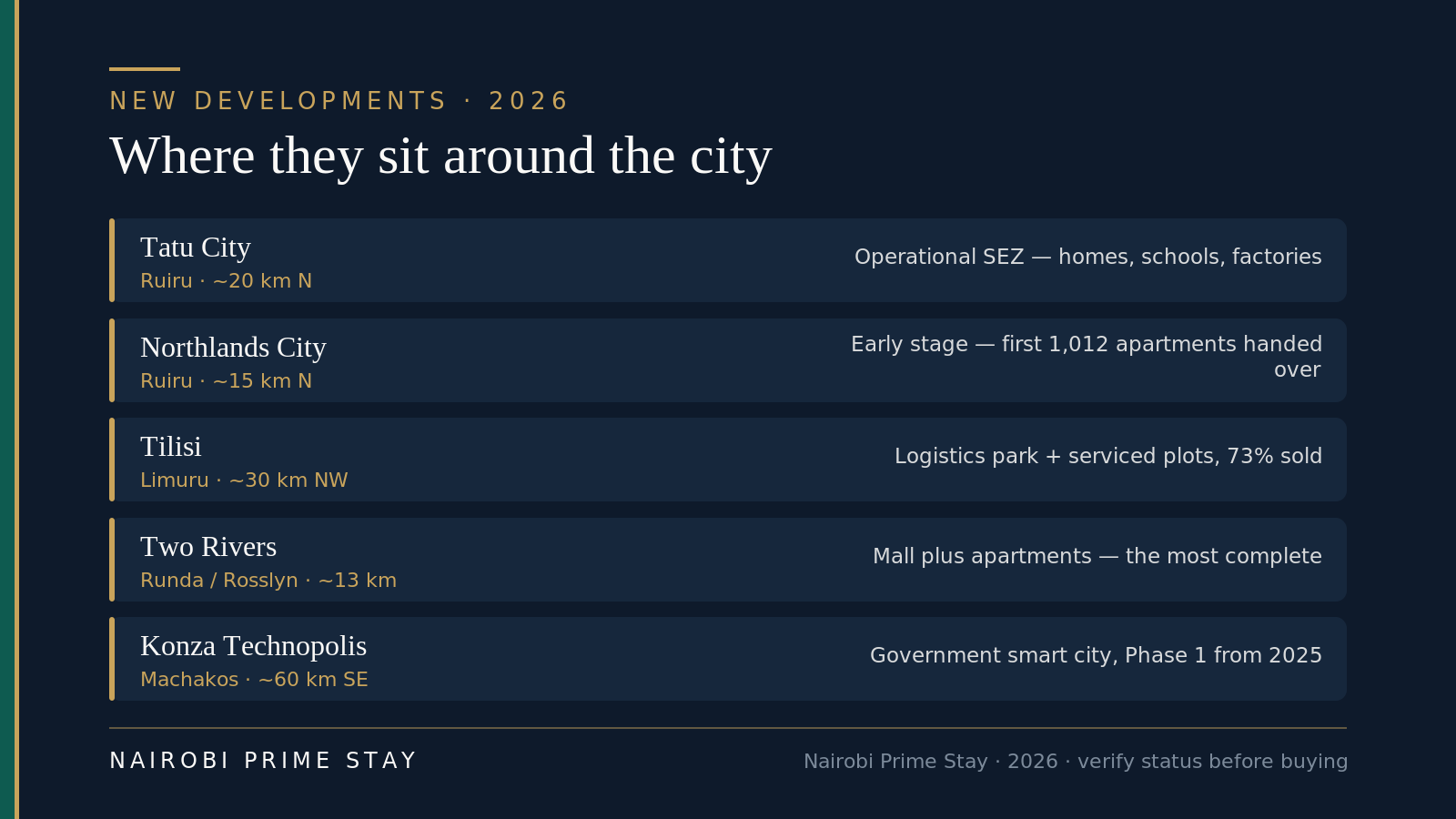 Where the big developments sit around the city — distances are approximate drive routes, not straight lines.
The big developments, one by one
Tatu City (Ruiru) — the one that’s actually a city
Tatu City is the most established new town around Nairobi, and the benchmark the others are measured against. It sits in Ruiru, about 20 km north of the CBD off Thika Road and the Northern Bypass, on roughly 5,000 acres. It’s Kenya’s first operational privately run special economic zone (SEZ) — companies there get reduced corporate taxes, VAT relief and import-duty exemptions, which is why the factories came.
And people actually live there. By 2026 Tatu City reported more than 25,000 jobs created across some 90-plus companies, with around 5,000 residents already living on site. There are working schools (Crawford International, Nova Pioneer), homes across price points — from Unity Homes’ more affordable apartments to the higher-end Kijani Ridge — plus offices, clinics and a shopping district. The masterplan targets more than 250,000 residents long-term, and developers have set aside 100 acres for a wildlife sanctuary.
Who it suits: people who want a planned, secure, walkable live-work environment with reliable power and water, and investors who like that it’s already delivering rather than promising. It’s popular with young families and professionals priced out of the western suburbs. It is not central — if your life is anchored to Gigiri, the UN or the CBD, the daily Thika Road commute is the trade-off.
Two Rivers (Runda / Rosslyn) — the most complete, the most premium
Two Rivers is the closest of these to “finished,” and the closest to town. It sits on about 100 acres in the diplomatic blue zone near Gigiri, Runda and Muthaiga, roughly 13 km from the CBD. Its anchor — the Two Rivers Mall — opened in 2017 and is one of the largest malls in the region, ringed by offices, a hotel and leisure.
The residential side, led by Centum Real Estate, is now delivering. The Cascadia and Riverbank apartment complexes in adjacent Rosslyn have been handing over units, with phases continuing through 2026. Because of the location, this is the premium end — you’re paying western-suburb-adjacent prices for a managed, amenity-rich enclave.
Who it suits: professionals, diplomats and families who want a new-build apartment near the UN, the embassies and the best schools, with a mall and security on the doorstep. If you’re weighing this against the established areas, compare it with our best neighborhoods guide.
Tilisi (Limuru) — logistics, plots and a fast sell-out
Tilisi is a 400-acre master-planned, mixed-use estate in Limuru, about 30 km northwest of the CBD on the Nairobi–Nakuru highway. It’s pitched at developers and businesses as much as homeowners: fully serviced land parcels for logistics, residential, retail, schools and medical. As of 2026 it reports being about 73% sold, home to 470-plus families, with total committed investment north of KES 60 billion.
Its standout is the logistics park — Africa Logistics Properties bought around 49 acres there, and Tilisi has cut its industrial plots down to one and two acres to pull in smaller businesses. For a homeowner, Tilisi is more “buy a serviced plot and build” than “buy a finished apartment,” so it leans toward people comfortable with building a house in Kenya and doing proper land due diligence.
Who it suits: investors and businesses wanting industrial or commercial land on a credible, well-serviced estate, and self-builders who want a plot with roads, power and water already in. See our commercial property guide for the logistics angle.
Northlands City (Ruiru) — huge, cheap to enter, and early
Northlands City is the most ambitious of the lot, and the earliest. It’s an 11,576-acre development in Ruiru, about 15 km from the CBD, owned by the Kenyatta family, with a reported price tag near KES 500 billion and a 50-year phased build targeting 250,000 residents. At that scale, “Northlands” today is a small fraction of what’s been drawn.
What exists in 2026: the first residential project, Northlands Heights, has handed over its first apartments — 1,012 units from studios to three-beds, with studios advertised from around KES 3.3 million to buy or KES 25,000/month to rent. Amref International University has opened a campus on the site along Thika Road. The rest is still masterplan.
Who it suits: patient buyers who want a low entry price and are comfortable owning early in a multi-decade project, betting that proximity to Thika Road and the Northern Bypass pays off. It is not for anyone who needs the surrounding “city” to exist now — most of it doesn’t yet.
Konza Technopolis (Machakos) — the government’s long game
Konza is the boldest promise and the longest horizon. It’s a government flagship under Kenya’s Vision 2030 — a planned “smart city” and tech hub (the “Silicon Savannah”) about 60 km southeast of Nairobi on the Mombasa Road and SGR corridor in Machakos County. The pitch: a built-from-scratch city for tech firms, researchers and 200,000-plus residents.
After years of slow progress, there’s real movement. Phase 1 infrastructure was officially launched in October 2025. In 2026 Konza brought its own private power grid online for high reliability, opened a water-reclamation facility, and began affordable housing through the Boma Yangu program — a first phase of 1,042 units, part of a masterplan targeting some 10,000 homes, plus schools and a hospital. The Kenya Advanced Institute of Science and Technology (KAIST) is taking shape there too, with more than 80% of Phase 1 plots already taken up and its academic launch slated for 2026.
Who it suits: honestly, very few individual relocators today — it’s far, and it’s early. It matters here as the clearest example of the new-development risk: a government megaproject can take 15-plus years to resemble its brochure. If you believe the long-term tech story and can wait, early land may reward you. If you need a home now, look elsewhere.
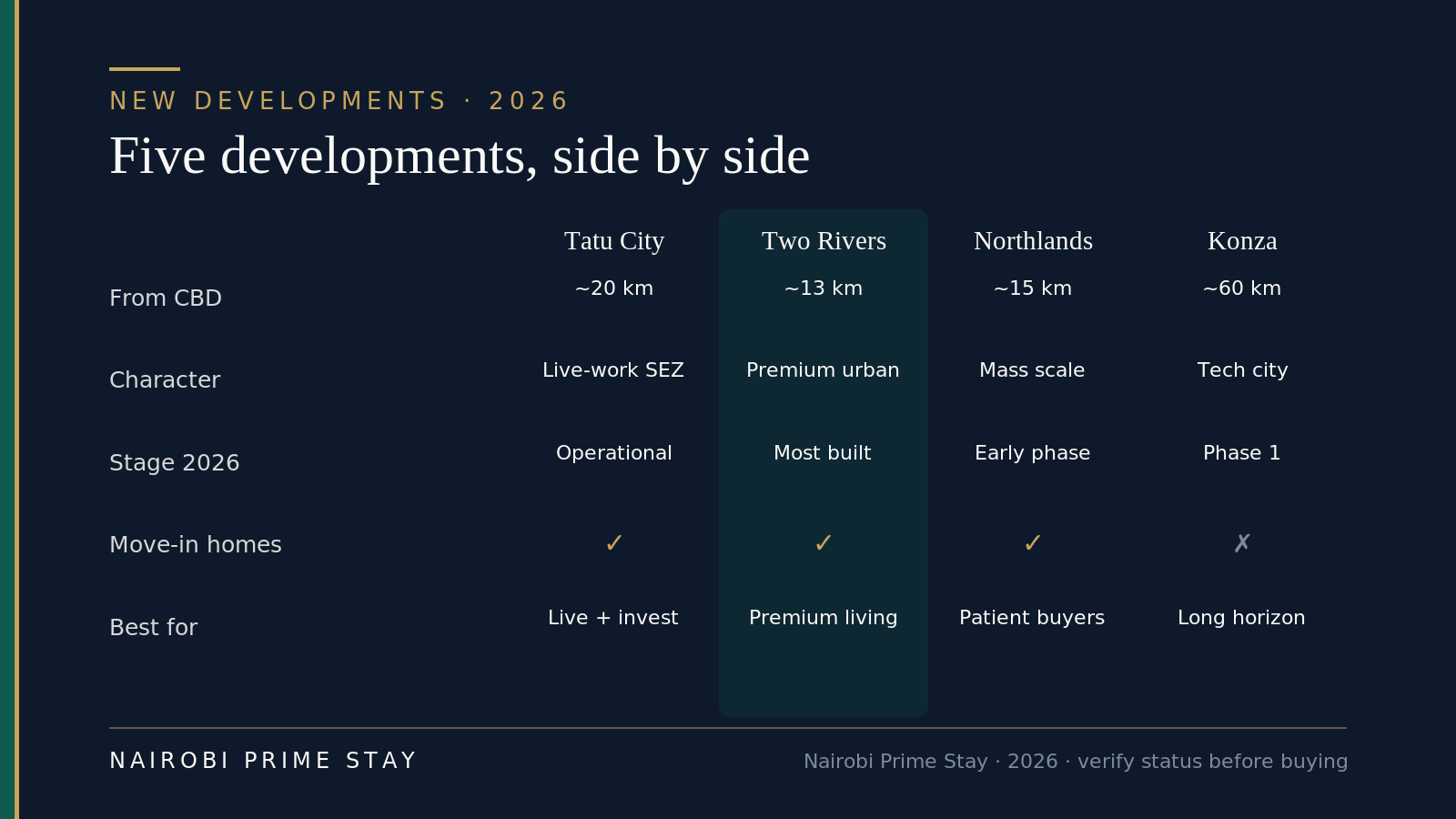 Two Rivers is highlighted as the most built-out and closest to town; Konza is the farthest and earliest.
How the five compare
Distances are approximate drive routes; status reflects mid-2026 and should be re-checked with each developer before you commit.
| Development | Where | ~Distance | Type | Status (2026) | Best for |
|---|---|---|---|---|---|
| Tatu City | Ruiru, off Thika Rd | ~20 km N | Mixed-use SEZ town | Operational — thousands already living there | Live-work now + investors |
| Two Rivers | Runda / Rosslyn, near Gigiri | ~13 km | Premium mixed-use | Most complete — mall open, apartments handing over | Premium new apartments |
| Tilisi | Limuru, Nakuru highway | ~30 km NW | Logistics + serviced plots | ~73% sold, under active development | Industrial / plots / self-build |
| Northlands City | Ruiru, Thika Rd | ~15 km | Mega mixed-use | Early — first 1,012 apartments handed over | Patient, low-entry buyers |
| Konza Technopolis | Machakos, Mombasa Rd / SGR | ~60 km SE | Government smart city | Phase 1 infrastructure from late 2025 | Long-horizon believers |
Who each one suits
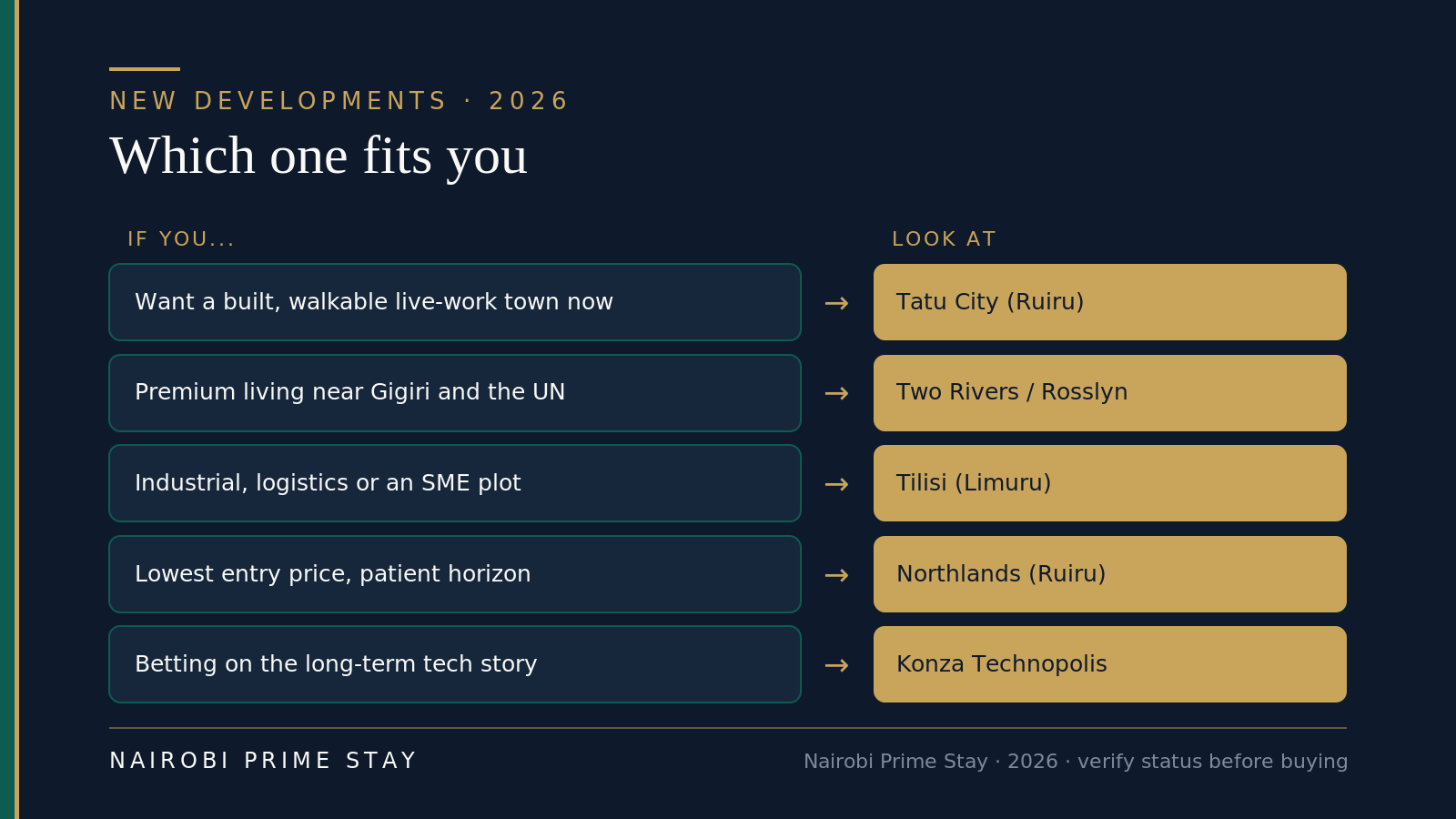 Match the development to your actual life, not the marketing.
Put plainly:
- Want a built, walkable, secure town you can move into now? Tatu City.
- Want premium new apartments near Gigiri, the UN and the top schools? Two Rivers / Rosslyn.
- Buying industrial, logistics or a serviced plot to build on? Tilisi.
- Want the lowest entry price, and you’re patient? Northlands.
- Betting on the long-term tech story and can wait years? Konza.
The honest risks of buying into a promise
Every new development sells the future. Your job is to buy only the parts that already exist. The recurring risks:
Delivery risk. Phases slip. The pool, the school, the second mall — they arrive late, or not at all. Kenya has no shortage of stalled estates where deposits went in and nothing came out. Buy from a master-developer with a track record and the balance sheet to finish.
Infrastructure lag. A development’s value often rests on a road, interchange or rail line that’s “coming.” Government timelines run years behind. If the access road isn’t built, treat it as a maybe, not a fact.
Premium for the future. Early-stage prices often bake in value that won’t materialize for years. You can pay tomorrow’s price today and then wait a decade for tomorrow. Compare against finished stock in established areas — see Nairobi property prices.
Liquidity. If you need to sell early, in a half-built estate full of competing new units, you may struggle. The apartment market in several prime and satellite pockets softened in 2025–26 on oversupply.
Master-developer dependence. In a private city, you’re tied to one developer for roads, water, power and the service charge. If they stumble, you feel it. Read the fine print on service charges and who maintains what.
The fix is the same discipline as any Kenyan purchase: an official title search, your own advocate, money into an escrow or stakeholder account (never cash, never an individual’s M-Pesa), and a contract with a firm completion date and penalties. Our off-plan guide and the broader property-investing pillar walk through each step.
Buying from the US? The tax the brochure won’t mention
Here’s the part no sales agent leads with. If you buy a unit in one of these developments and rent it out while you live in the US, Kenya taxes that rent at 30% of the gross — and it’s usually taken out before you ever see the money.
Kenya taxes rental income by your tax residency, not your passport. Live in Kenya and you’re a resident landlord, taxed under Monthly Rental Income (MRI) at 7.5% of gross rent — the Finance Bill 2026 proposes raising that to 10%, so confirm the current rate with KRA. Live in the US and you’re a non-resident landlord, and non-residents pay a flat 30% of gross rent. Your tenant or letting agent is legally required to withhold it and remit it to the Kenya Revenue Authority. It’s a final tax: no expense deductions, no separate return to file on that income.
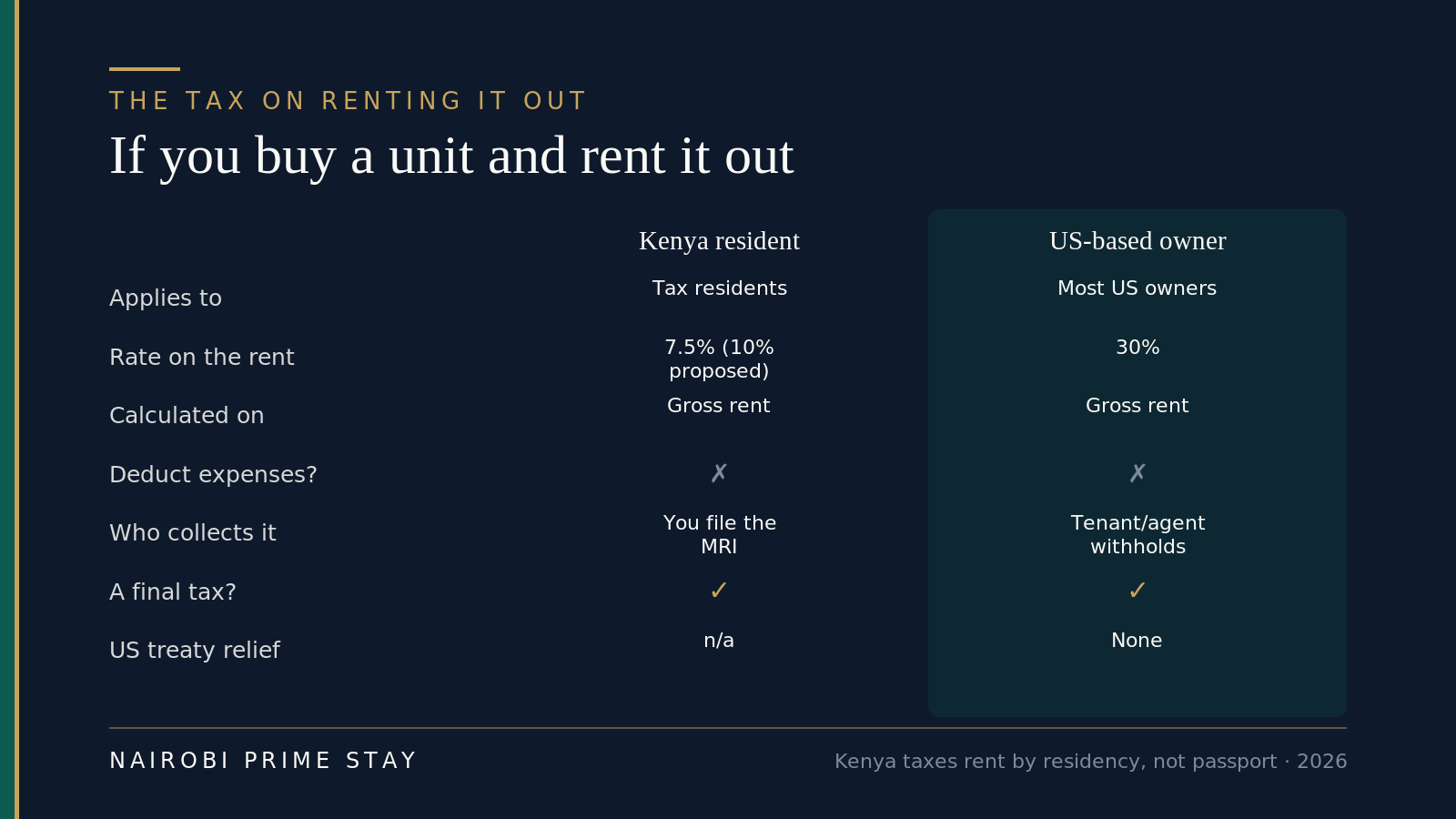 If you’ll rent the unit out from abroad, price the 30% in from day one — Kenya taxes rent by residency, not passport.
The sting for Americans specifically: Kenya has treaties that cap this rate for residents of the UK, Canada, Germany, France, the UAE, Mauritius and South Africa — but none with the United States. So a US-based owner pays the full 30%, with no treaty discount. You then report the same income on your US return and generally claim a foreign tax credit (Form 1116) so you’re not taxed twice. Get a cross-border accountant; this isn’t tax advice. The Finance Bill 2026 is also tightening enforcement on foreign landlords, so assume this gets stricter, not looser.
Put numbers on it. A Northlands studio advertised around KES 25,000/month in rent loses roughly KES 7,500 a month to the 30% before you’ve paid a shilling of service charge or management. That doesn’t sink the case for buying — but a yield quoted “gross” is not what lands in your account. Read it next to our expat tax guide, and if you’ll let it out remotely, a licensed property manager who handles the withholding correctly earns the fee.
Do you get the SEZ tax break? Almost certainly not
Tatu City and Konza are Special Economic Zones, and their tax perks are real — but they’re built for businesses, not for you buying an apartment.
A licensed SEZ enterprise gets an attractive deal: corporate tax of 10% for the first ten years and 15% after that, against the standard 30%, plus exemption from import duty, VAT, excise and stamp duty, and a reduced 5% withholding tax on payments abroad. That’s why the factories and call centers moved to Tatu City. If you’re relocating a company or setting up an operation, that’s a genuine reason to look hard at an SEZ — talk to the Special Economic Zones Authority and your advocate.
An individual buying a home to live in or rent does not get the corporate rate, and shouldn’t assume the stamp-duty exemption covers a private residential purchase — those reliefs attach to licensed enterprises, not to everyone who buys inside the zone. Confirm exactly what applies to your transaction with the developer and your own lawyer before a “tax-free zone” pitch talks the price up. As a homeowner, price an SEZ apartment the way you’d price any other: on location, delivery and rent, not on a corporate perk you won’t receive.
Paying for it from 8,000 miles away
You can buy and pay from the US, and get your money back out later, because Kenya has no exchange controls. Rent and eventual sale proceeds repatriate freely, in any currency, through the banking system. The one hard rule: declare physical cash of USD 10,000 or more in either direction. Wire transfers aren’t capped.
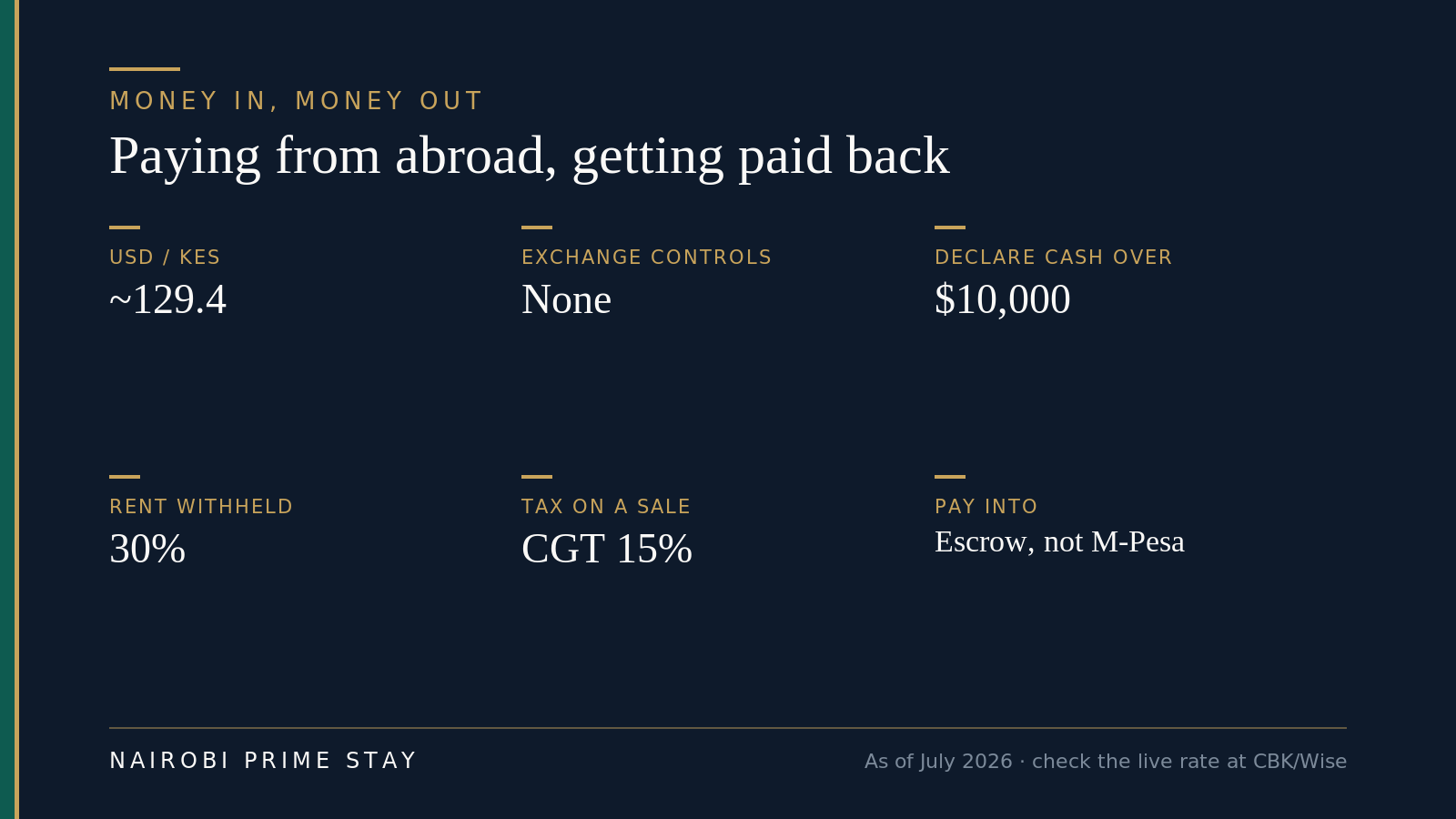 The money mechanics of buying a new-build from abroad — as of July 2026; check the live rate at the Central Bank of Kenya or Wise.
A few things to plan for:
- Currency drag. You earn and save in dollars but pay and get paid in shillings. At roughly 129.4 KES to the dollar in mid-2026 (it moves — see our USD/KES guide), the rate on the day matters over a multi-year off-plan build. Where a developer prices or leases in dollars, that’s a natural hedge.
- Move money the safe way. Wire into your advocate’s or the developer’s escrow or stakeholder account — never a personal bank account, and never an M-Pesa number, however normal the agent makes it sound. Our guide to sending money to Kenya has the cheapest reliable rails.
- Buying without flying in. You can sign through a power of attorney, but a US-executed PoA has to be notarized and then legalized at a Kenyan embassy or consulate — Kenya isn’t in the Apostille Convention, so an apostille alone won’t do. Our conveyancing guide walks through the paperwork.
- The exit. When you sell, capital gains tax is 15% of the net gain, settled before the proceeds leave the country. Budget it into your return rather than meeting it as a surprise at the end.
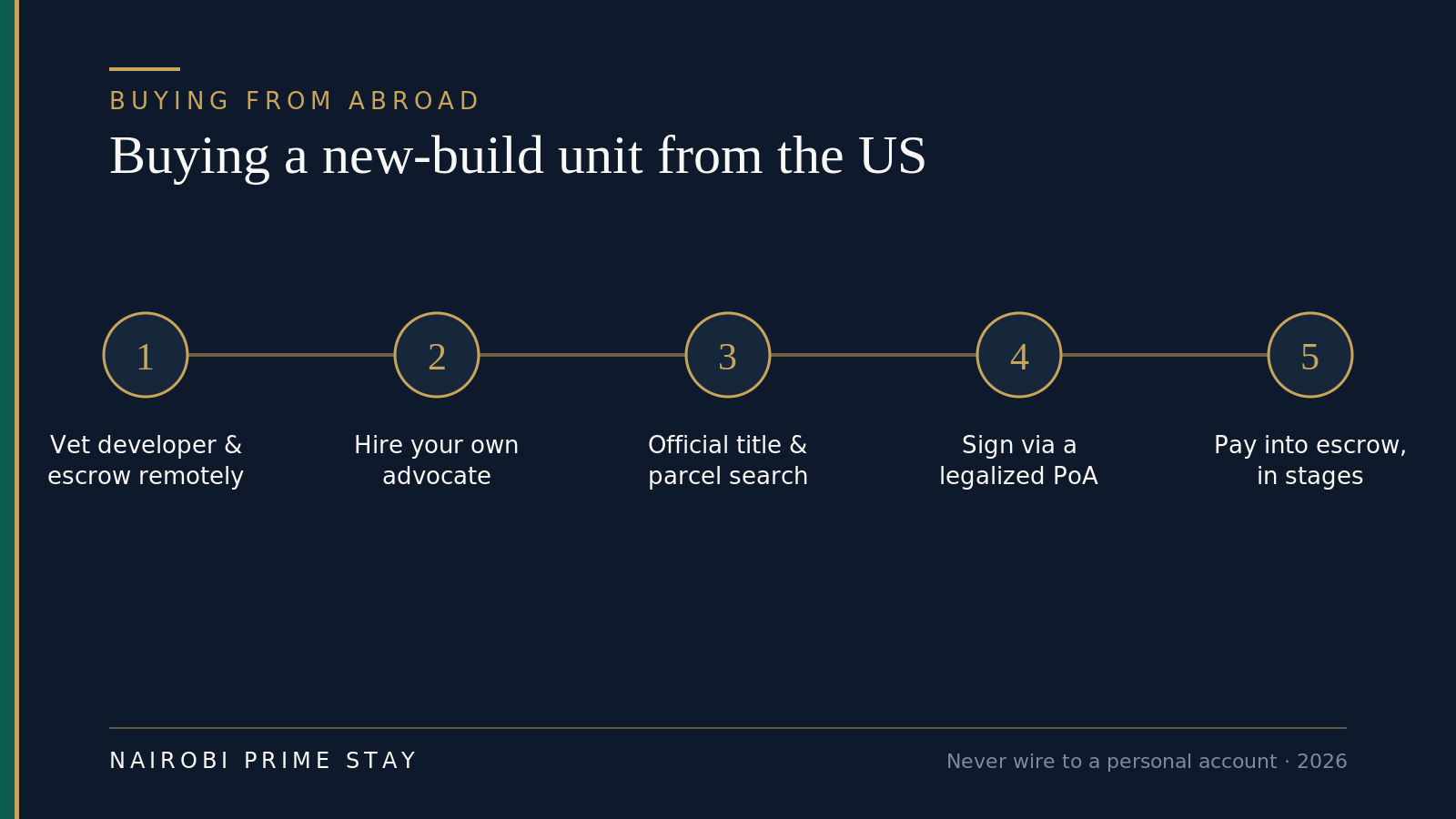 Buying remotely is normal here — keep every safeguard in place, and lean on our diaspora property guide for the full playbook.
None of this should scare you off. Diaspora buyers do it every week. It just means a “cheap off-plan unit” has to clear a higher bar once you’ve priced in the 30% on rent, the currency drag and the cost of doing everything remotely.
A realistic scenario
Say you’re a remote-working American couple, no kids yet, USD income, planning two to three years in Nairobi with maybe a longer horizon. You’re choosing between a finished two-bed in Kilimani and an off-plan two-bed in Tatu City at a lower price.
The Tatu City unit is cheaper and newer, in a secure, planned town with backup power and fibre. But it’s a 40-to-60-minute drive from the western suburbs where your friends, the good restaurants and the UN crowd are, and resale depends on Tatu maturing further. The Kilimani unit costs more and sits in an oversupplied apartment market, but it’s central, liquid and rentable today.
There’s no universal right answer — it depends on whether you value the live-work calm of a new town or the central convenience of an established suburb. What we’d push back on: buying off-plan in the newest, least-proven estate purely because the brochure promises a future you can’t be sure will arrive on time. If you do go new, choose the most delivered option you can afford, and treat any “phase two” amenity as a bonus, not a reason to buy.
For a soft landing while you decide, a serviced apartment lets you live in the western suburbs for a month and actually drive these commutes before you commit to anything.
Pros and cons of buying into a new development
| Pros | Cons |
|---|---|
| Newer build quality, modern layouts, utilities planned in (power, water, fibre) | You’re often buying a promise — phases and amenities can slip |
| Backup power, security and infrastructure designed in from day one | Usually far from the western suburbs, UN and CBD — longer commutes |
| Lower entry prices than equivalent space in established suburbs | Value can hinge on roads or rail that arrive late, if at all |
| Tax perks in SEZs (Tatu City, Konza) for businesses | Resale is harder in a half-built, oversupplied estate |
| Real momentum where infrastructure has already landed | You depend on one master-developer for roads, water and service |
A checklist before you buy in a new development
- Visit the site in person — compare what’s built against the masterplan and the renders.
- Confirm what infrastructure already exists (roads, power, water, fibre) versus what’s only “planned.”
- Research the master-developer’s track record and financial strength.
- Run an official title search (ardhisasa or the Ministry of Lands) on the specific parcel.
- Instruct your own advocate — never share the seller’s or developer’s lawyer.
- Confirm the tenure: foreigners hold a 99-year leasehold, and apartments come on sectional title.
- Get a written contract with a firm completion date and penalties for late delivery.
- Pay deposits into an escrow or stakeholder account — never cash, never a personal M-Pesa number.
- Read the service-charge terms and who maintains the estate’s shared infrastructure.
- Compare the price against finished stock in an established suburb before committing.
- If you’ll rent it out from abroad, price in the 30% non-resident tax withheld on gross rent.
Smart moves vs costly mistakes
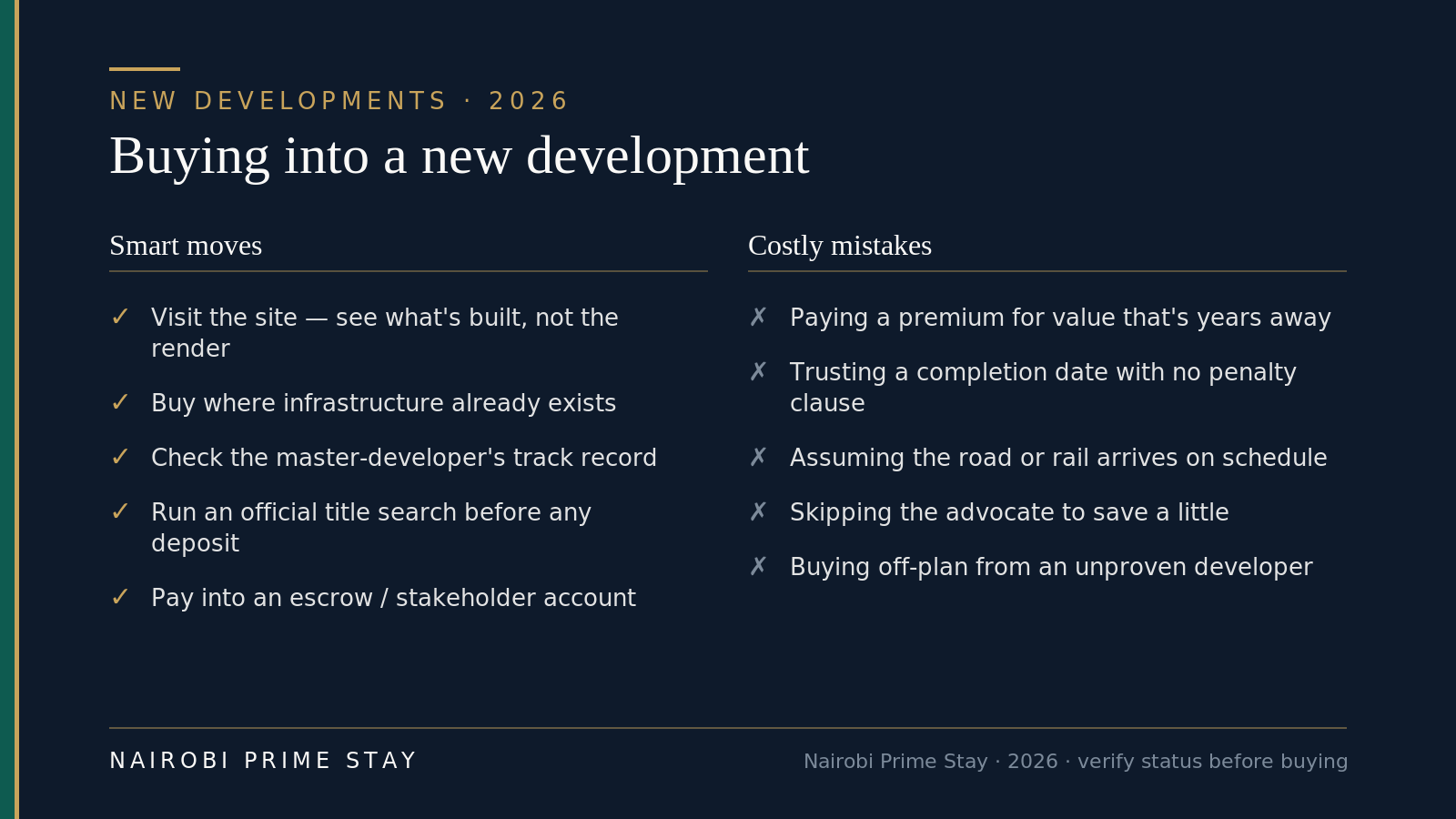 The discipline that separates a smart early entry from money parked in a field.
Frequently asked questions
What are the main new developments and satellite cities around Nairobi?
The headline ones in 2026 are Tatu City (Ruiru), Two Rivers (near Gigiri), Tilisi (Limuru), Northlands City (Ruiru) and Konza Technopolis (Machakos, about 60 km out). Tatu City and Two Rivers are the most built-out; Northlands and Konza are early-stage, decades-long projects. Each sits in the satellite belt that the expressway, bypasses and railway are connecting back to the city.
Is Tatu City actually built, or still just a plan?
It’s genuinely operational. By 2026 Tatu City reported around 5,000 residents and more than 25,000 jobs created across some 90-plus companies, with working schools, homes across price points, offices and factories on its roughly 5,000-acre special economic zone in Ruiru. It’s the most delivered of Nairobi’s new towns, though the full masterplan of 250,000-plus residents is still decades away.
What is Konza Technopolis and is it finished?
Konza is the Kenyan government’s flagship smart city and tech hub under Vision 2030, about 60 km southeast of Nairobi. It is not finished — it’s early. Phase 1 infrastructure was launched in October 2025, and through 2026 it brought a private power grid and a water-reclamation plant online and began affordable housing via the Boma Yangu program. It’s a multi-decade government project, so treat any purchase there as a long-term bet.
Can foreigners buy property in these developments?
Yes, within Kenya’s rules. Non-citizens can hold property on a 99-year leasehold, and apartments are sold on sectional title, which foreigners can own. You cannot own freehold or agricultural land as a non-citizen. A development being new doesn’t change the law — see our guides on whether foreigners can buy and how to buy property in Kenya.
Are satellite cities a good investment in 2026?
They can be, but they’re a bet on delivery. The upside is lower entry prices and growth as infrastructure lands; the downside is that phases slip, roads run late, and the apartment market is oversupplied in several areas. The safest approach is to buy where infrastructure already exists, choose a proven developer, and avoid paying a premium for value that’s still years away.
Which new development is closest to Nairobi and most complete?
Two Rivers, near Gigiri and Runda (about 13 km from the CBD), is both the closest and the most complete — its mall opened in 2017 and apartments are being handed over now. Tatu City (Ruiru, about 20 km) is the most complete as a full live-work town. Konza, at about 60 km, is the farthest out and the earliest.
What’s the biggest risk of buying off-plan in a new development?
That the development never delivers what was sold — the phase stalls, the developer runs out of money, or the promised infrastructure doesn’t arrive. Protect yourself with an official title search, your own advocate, a contract with a firm completion date and penalties, and deposits paid into an escrow account rather than cash. Our off-plan guide covers the details.
Should I buy in a new development or an established suburb?
It depends on what you value. New developments offer modern build, planned utilities and lower prices, but they’re farther out and less liquid. Established suburbs cost more and some are oversupplied, but they’re central, proven and easy to rent or resell. If you’re unsure, rent first — a serviced apartment lets you test the commutes before you commit.
How is my rental income taxed if I buy a unit and live in the US?
As a non-resident landlord, at 30% of the gross rent. Kenya taxes rental income by tax residency, not nationality, so a US-based owner pays a flat 30%, which the tenant or letting agent withholds and remits to KRA as a final tax with no expense deductions. Kenya has no tax treaty with the US to lower it, so you pay the full rate and generally claim a US foreign tax credit. A resident landlord instead pays 7.5% of gross rent, with a rise to 10% proposed for 2026.
Do I get Tatu City or Konza’s tax breaks if I buy an apartment there?
Almost certainly not. The Special Economic Zone perks — 10% corporate tax for the first ten years, plus VAT, duty and stamp-duty exemptions — are for licensed SEZ businesses that set up and operate in the zone, not for an individual buying a home to live in or rent. If you’re relocating a company they’re a real draw; if you’re a homeowner, price the apartment on location, delivery and rent like any other, and confirm what applies to your purchase with the developer and your own lawyer.
Can I buy in a new development from the US without flying to Kenya?
Yes. Kenya has no exchange controls, so you can wire funds in and repatriate rent and sale proceeds freely; just declare physical cash of USD 10,000 or more. You can sign through a power of attorney, but a US-executed PoA must be notarized and then legalized at a Kenyan embassy or consulate, because Kenya isn’t in the Apostille Convention. Use your own advocate, run an official title search, and pay only into an escrow or stakeholder account — never a personal account or M-Pesa number.
Final thoughts
Nairobi’s new developments are real, and some are genuinely impressive — Tatu City is a working city, Two Rivers is a polished enclave, and the expressway and bypasses have already redrawn the map. But the whole game is separating what exists from what’s promised. Buy the built parts. Treat the renders as ambition, not fact. Vet the developer like your money depends on it, because it does.
If you’re still deciding where to land, you don’t have to commit from a laptop overseas. Come, stay a month in the western suburbs, drive the Thika Road commute at 8am, and see these places with your own eyes before you sign anything.
This is general guidance, not legal, tax or investment advice. Figures reflect mid-2026 and change — confirm current status with each developer and the official land registry before you buy.
Related reading
- Property investing in Kenya: the complete guide — the cluster pillar, start here.
- The best areas to invest in Nairobi real estate
- Buying off-plan property in Nairobi — the risk playbook for unbuilt units.
- Nairobi property prices and market trends
- Commercial property in Nairobi — the office, retail and logistics angle.
- Buying land in Kenya safely — if you’re buying a serviced plot to build on.
- Moving to Nairobi: the complete guide — the relocation hub.
Ready to see the city for yourself?
The smartest way to judge a new development is to stand in it. Book a serviced apartment in a western suburb for your first month — all-inclusive, with Wi-Fi, cleaning, a backup generator and security — and use it as a base to tour Tatu City, Two Rivers and the rest before you buy. A $50 deposit reserves your place and the balance is paid on arrival, so nothing else is due before you travel.
Not sure which area or development fits your budget and commute? Our AI relocation assistant can talk it through and shortlist real options in a couple of minutes, any time of day.
Ready to look?
Find your apartment in Nairobi
Browse verified serviced apartments, or ask the AI concierge which area fits your life.