
Guides · Neighborhoods
Karen Neighborhood Guide: Space, Schools and Calm in Nairobi (2026)
Karen Neighborhood Guide: Space, Schools and Calm in Nairobi


Karen at a glance.
Karen is Nairobi’s leafy, low-density suburb to the southwest — all gardens, mature trees, walled compounds and a slower, almost rural calm. It’s the city’s favorite for families who want space and top schools, and for anyone happy to trade a longer commute for room to breathe. Named after the Danish writer Karen Blixen of Out of Africa fame, it has a settled, established character unlike anywhere else in the city.
This guide walks through what living in Karen is really like: the people who choose it, how safe it feels, what homes cost, the schools that draw families here, where you’ll shop and eat, and the all-important commute. It’s written for someone weighing Karen against the more central suburbs.

The quick version
Karen suits families and space-seekers above all. You get large plots, gardens, quiet streets and proximity to excellent international schools like Brookhouse and Hillcrest, plus easy weekend access to the Giraffe Centre, the elephant orphanage and Nairobi National Park. Furnished homes range from about $1,000 a month for an apartment or townhouse to roughly $4,600 for a large house on a big plot. The honest trade-off is distance: Karen is far from the city center and the UN, so commutes can be long in traffic. If your life centers on home and school rather than a downtown office, it’s one of the most pleasant places to live in Nairobi.
Who lives in Karen?
Karen draws families, established professionals and people who simply want space. The international community here is large and settled, with many families choosing Karen specifically for the schools and the room for kids and pets. You’ll find diplomats, business owners, NGO staff, long-term expats and Kenyans who value the gardens and calm. It’s an easy place to build a social life, and our expat community guide and family life in Nairobi guide cover how newcomers settle in.
It’s less suited to young singles chasing nightlife or to anyone who needs to be downtown daily. The pace is suburban and unhurried — the appeal is precisely that it doesn’t feel like a busy capital. If you picture weekends in the garden, school runs and horse paddocks rather than rooftop bars, Karen is your kind of place.
Is Karen safe?
Karen is one of Nairobi’s calm, secure suburbs, with homes set behind walls and hedges in gated compounds or on private plots with guards. The low density and residential character make it feel peaceful. As with all of Nairobi, you’ll want a home with the full security setup — 24/7 guards, gates, alarm and good lighting — and you’ll keep the usual city habits.
One practical note: Karen’s larger plots and quieter lanes mean security is very much about your specific compound, so check it carefully before signing. Choose a well-managed property with proper guarding and you’ll find day-to-day life relaxed. See our Nairobi safety guide for the building-by-building checklist.
Rent and homes in Karen
Karen is a houses-and-gardens neighborhood more than an apartment district, though modern apartments and gated townhouses have grown fast in the last few years. Prices are set in Kenyan shillings, so the dollar figures below move with the exchange rate (around KES 129.4 to the dollar on 1 July 2026 — check the current rate). Indicative 2026 figures for furnished homes:
| Home type | Furnished rent / mo (KES) | Approx. USD / mo |
|---|---|---|
| Cottage or garden annexe | 80,000–180,000 | $620–1,400 |
| Apartment or gated townhouse (1–2 bed) | 130,000–235,000 | $1,000–1,800 |
| 3-bed house or maisonette | 180,000–280,000 | $1,400–2,200 |
| Family house with garden (4 bed) | 200,000–350,000 | $1,550–2,700 |
| Executive / ambassadorial villa, big plot | 350,000–600,000 | $2,700–4,600 |
Unfurnished homes and longer leases cost noticeably less; serviced and short-let homes cost more per month but fold in utilities, internet, cleaning and security. What you pay tracks plot size, how new the build is, and the exact address — a walled acre with a borehole and a mature garden sits at the top, a smart two-bed townhouse near The Hub at the bottom. Because homes vary so much, Karen rewards seeing places in person. Run the “Nairobi Five” check on any home — backup generator, water supply and storage (boreholes are common here), 24/7 security, fibre internet already in the building, and responsive management. You can browse serviced apartments in Karen for vetted, all-inclusive options, see how the area stacks up in our cost of living guide, and read the full serviced apartments guide for exactly what’s included.
What a Karen house really costs to run
The rent is only part of the number. Karen’s appeal is space — big plots, gardens, sometimes a borehole and a pool — and all of that costs a little to keep up. It’s worth budgeting for before you fall for a walled acre, because these running costs surprise people used to an all-in US apartment.
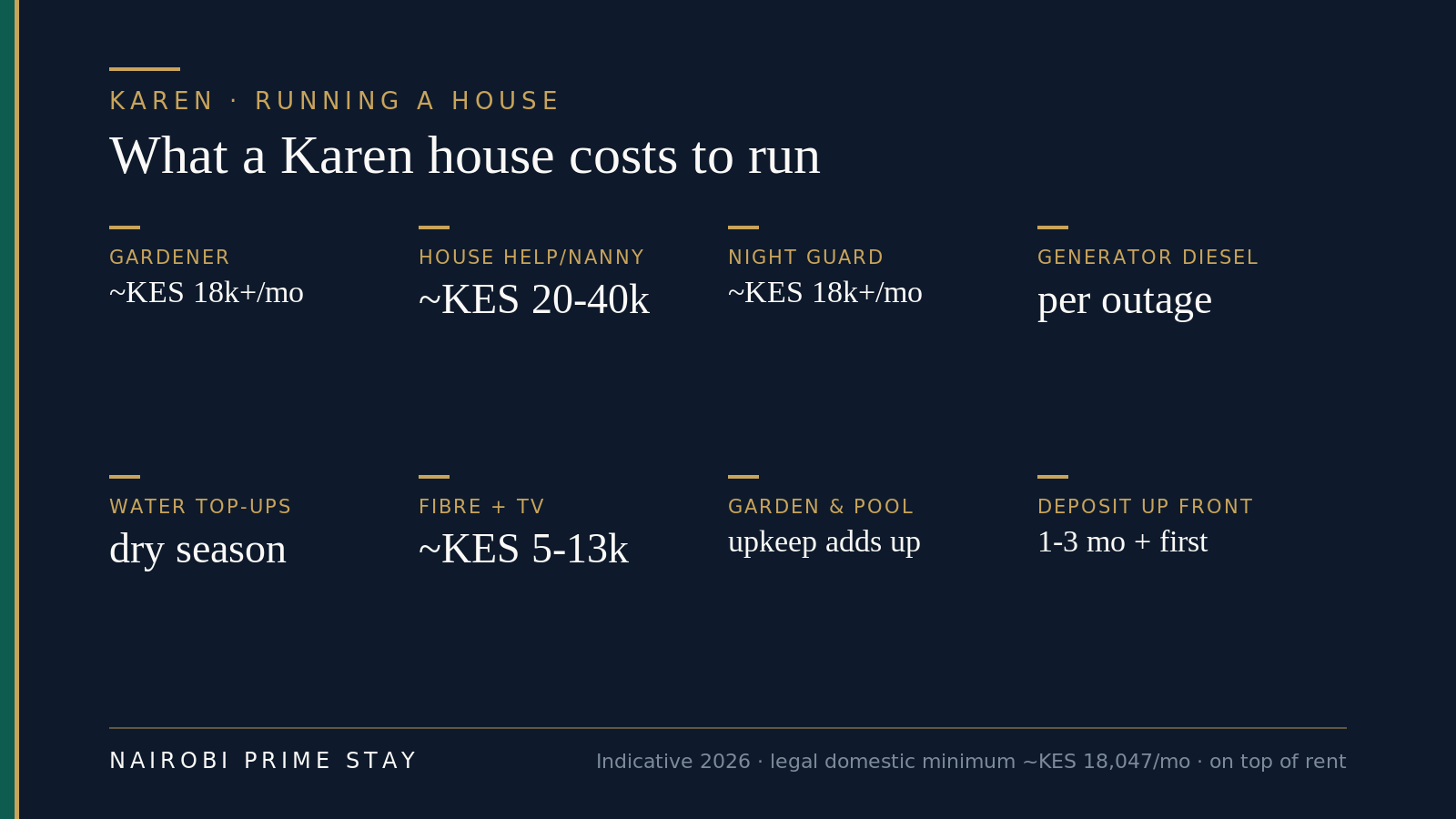 What a Karen house tends to cost to run, on top of the rent.
Staff are the biggest line, and Kenya sets a legal floor for them. As of 2026, the minimum wage for a domestic worker in Nairobi — a house help, gardener or day watchman — is about KES 18,047 a month, with a 15% housing allowance on top if you don’t provide a room; night guards sit around the same. In practice, experienced staff in Karen households are often paid more, and many homes employ more than one person: a gardener for the plot, someone to help in the house, and guards day and night if the compound isn’t already gated with shared security. Our domestic help in Nairobi guide covers fair pay, contracts and how to hire well.
Then there’s the plot itself. Bigger gardens and pools mean more upkeep; a borehole or water tank means the odd bowser top-up in the dry months; and because outages happen, a backup generator burns diesel when the grid dips (our utilities setup guide walks through power, water and internet). Add fibre and TV, then budget one to three months’ rent plus the first month as a deposit up front — see tenancy, leases and deposits in Kenya. None of it is huge on a Western income, but it’s real, and a serviced apartment or a gated townhouse folds most of it into one predictable monthly figure while you work out what a stand-alone house will actually cost you. Our cost of living guide sets Karen in the wider picture.
Where in Karen to live
Karen isn’t one place. It’s a big, spread-out suburb, and which pocket you choose changes your commute, your rent and how walkable daily life feels. Roughly, it breaks down like this.
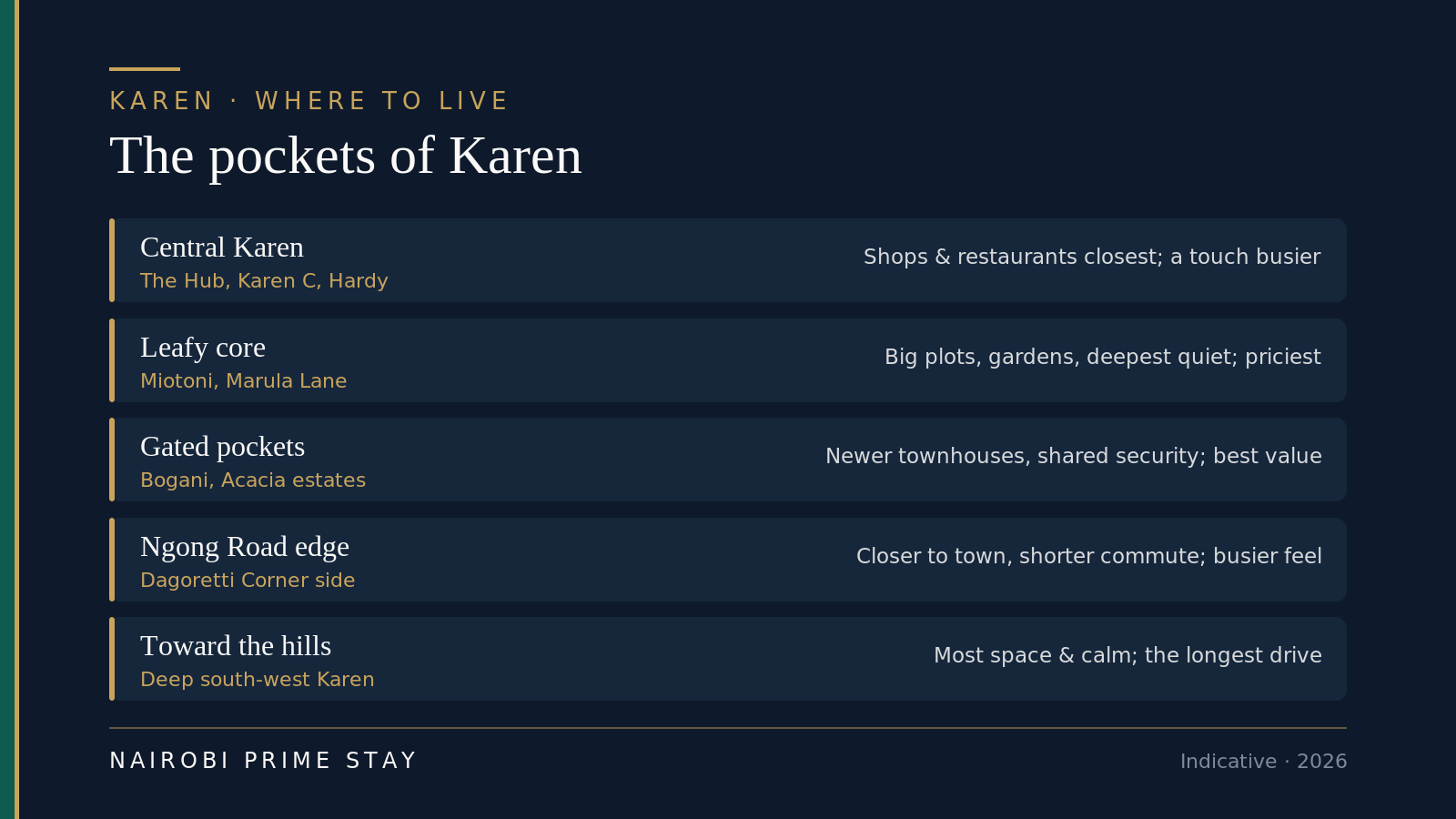 The pockets of Karen, from the central shops out to the Ngong Hills edge.
Central Karen (The Hub, Karen C, Hardy). The most convenient corner, with shops, supermarkets and restaurants a few minutes away. Streets are a little tighter and busier than deep Karen, but you trade some space for everyday ease. Good if you want the calm without driving for every errand.
The leafy core (Miotoni, Marula Lane). This is the Karen people picture: walled plots, mature gardens, horses behind some hedges, deep quiet. The most space and the most settled feel, at the top of the rent range.
The newer gated pockets (Bogani, Acacia). Modern gated townhouses and apartment compounds have grown fast here, offering much of Karen’s greenery with newer fittings, shared security and lower upkeep than a stand-alone house. The best value for couples and smaller families who still want a garden.
The Ngong Road and Dagoretti Corner edge. Closer to town and the better-connected roads, so the commute is shorter. The feel is busier and more mixed than deep Karen, which makes it a sensible compromise if you need to reach the center often.
Deep south-west, toward the Ngong Hills. The most space, the most calm and the longest drive. Lovely if your life is home- and school-centered and you rarely need to be downtown.
If you’re not sure which pocket fits, that’s what a serviced apartment soft landing is for. Base yourself centrally near The Hub for a few weeks and feel the difference before you commit.
Renting a Karen home from the US
Most Karen homes are houses on private plots, let through agents rather than posted on a big rental app — which makes it exactly the kind of market where renting sight-unseen from abroad goes wrong. The single rule: never send money for a home no one you trust has stood inside. The fake-listing scam is simple and common — real photos lifted from a genuine listing, a warm WhatsApp chat, then a “reservation deposit” to a personal M-Pesa number to hold it before you’ve confirmed anything. The home was never theirs to rent.
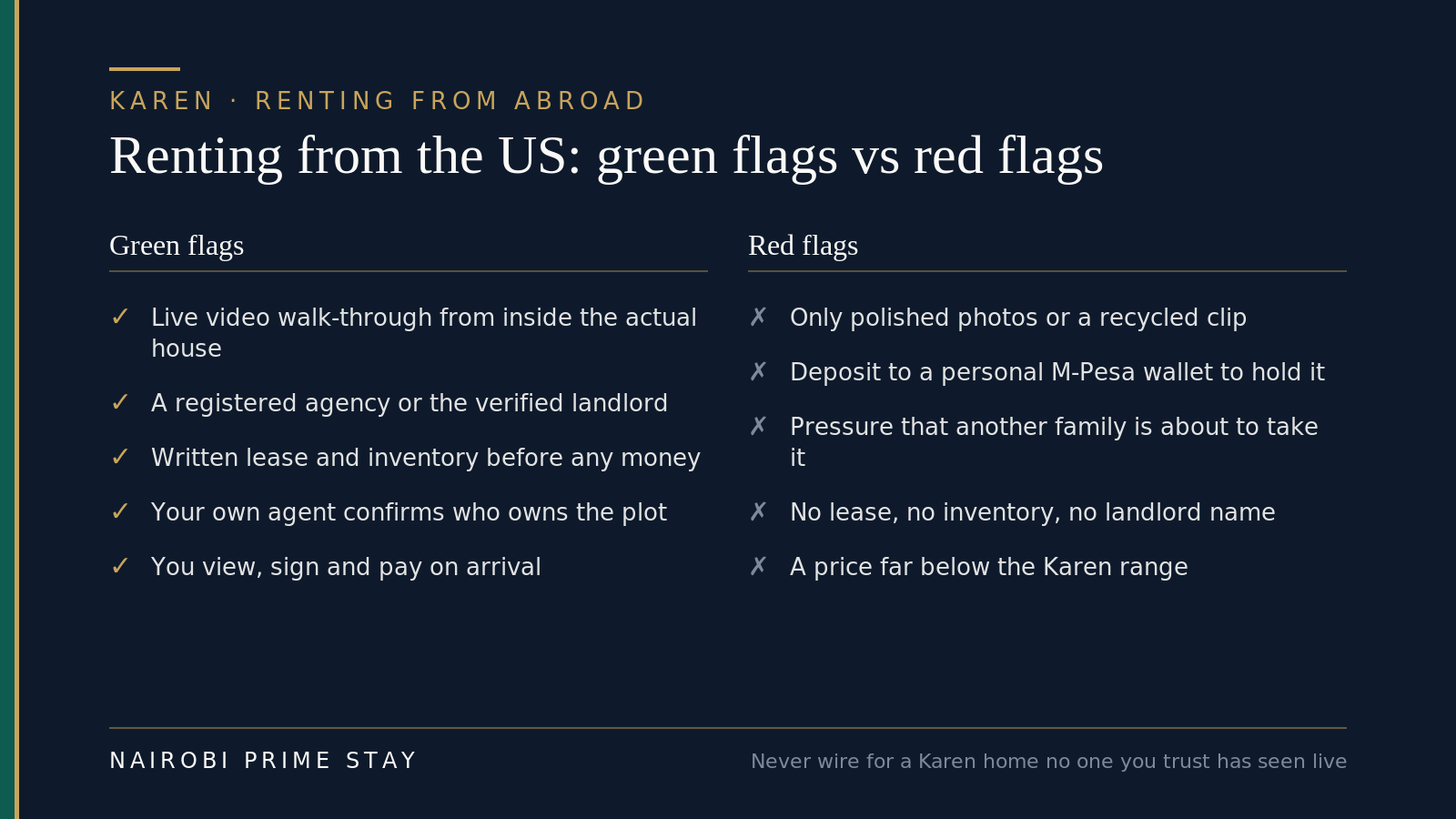 The signals worth trusting — and the ones to walk away from.
The safe way to line up a Karen home before you land is to slow the money down and speed the checking up. Insist on a live video walk-through from inside the actual house — a call where they move through the rooms and out to the garden on request, not a polished clip anyone could have filmed. Use your own agent, not just the one on the listing, to confirm the landlord controls the plot and to read the lease and inventory. Pay a registered agency or the verified owner, never a personal wallet, and do it on arrival wherever you can. If a price sits far below the Karen ranges above, treat it as a warning, not a bargain.
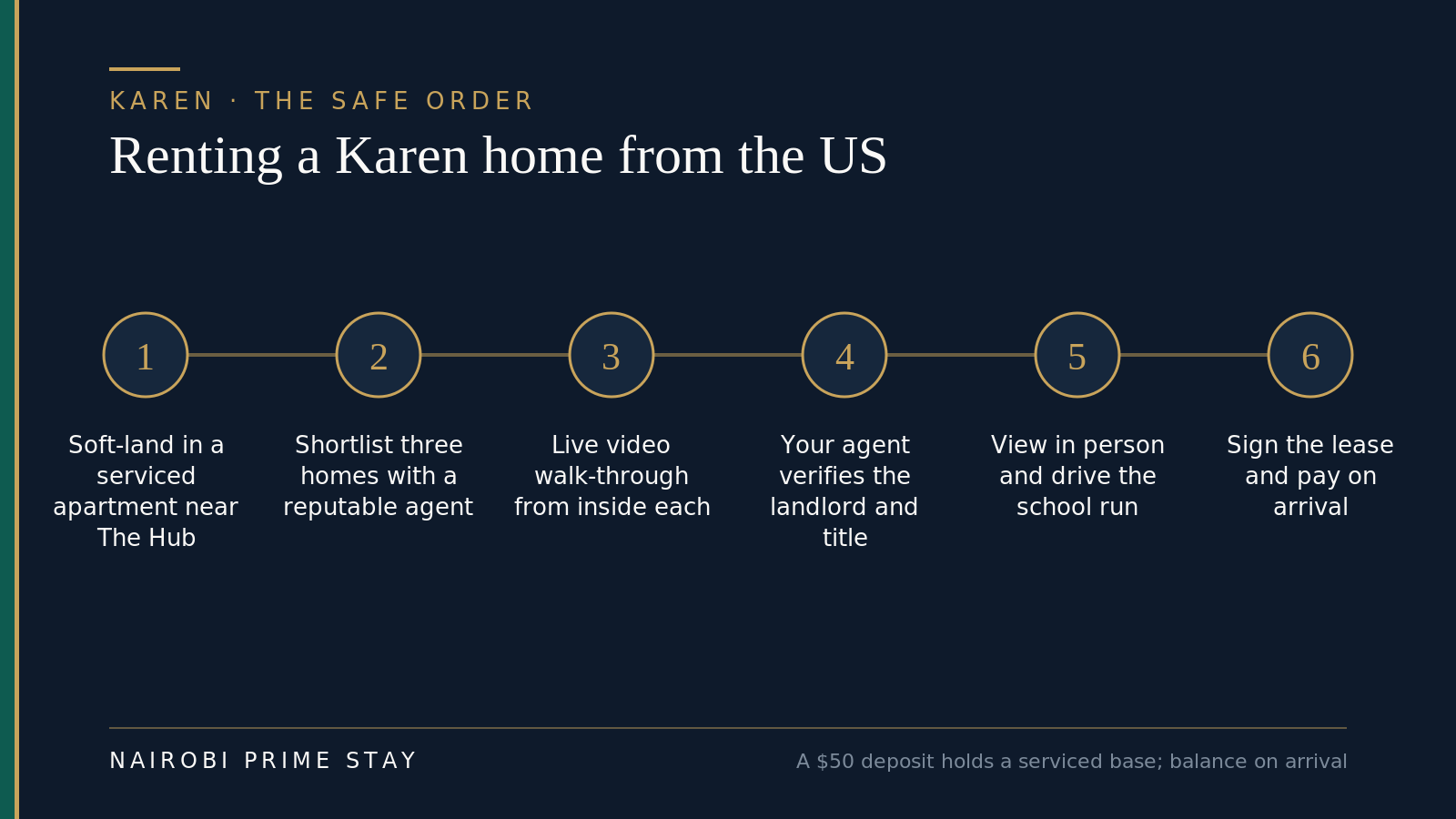 The order that keeps your deposit safe.
This is exactly what a serviced-apartment soft landing is for. Base yourself near The Hub for the first few weeks, view homes in person, drive the school run in real traffic, and only then sign — a $50 deposit reserves the serviced base and the balance is paid on arrival, so nothing large leaves your account before you’ve seen anything. Our guides to how to rent an apartment in Nairobi, furnished vs unfurnished homes and avoiding property and rental scams in Kenya go deeper on doing this safely.
Schools in Karen
Schools are Karen’s biggest draw for families. The area and its surrounds host several well-regarded international schools, and for many families the school decision comes first and the address follows — living close keeps the school run short in a city where traffic can stretch any journey.
Karen leans British. Two of the city’s best-known British-curriculum schools sit right here, with a cluster of prep schools covering the younger years. Indicative 2025/26 fees are below — always confirm the current figure with the school, as fees rise yearly and are billed per term in shillings:
| School | Curriculum | Indicative fees (2026) |
|---|---|---|
| Brookhouse School (Karen campus) | British (IGCSE / A-level), day + boarding | Senior day ≈ KES 840,000–940,000/term, roughly $19,500–21,900/yr; boarding adds substantially |
| Hillcrest International School | British (Early Years to A-level) | Senior years up to ≈ KES 3.08m/yr (about $24,000); younger years far less |
| The Banda School | British prep, to age 13 | Long-established; confirm current fees directly |
One money-and-sanity note on curriculum: because Karen is mostly British, families who specifically want an American curriculum should know the two best-known options — the International School of Kenya (ISK, American + IB) and Rosslyn Academy (American + AP) — sit over near Gigiri and Runda, a long cross-city drive from Karen in traffic. American families often choose to live nearer those schools instead; see our Gigiri neighborhood guide for that side of town. If you love Karen but want a particular school elsewhere, boarding (offered at Brookhouse’s Karen campus) is the other route.
Apply early — the best schools keep waitlists — gather transcripts and records ahead of time, and ask each school about its bus routes so you can fine-tune exactly where in Karen you settle. Our moving to Nairobi guide has more on choosing schools and aligning them with your neighborhood. For a deeper look, see our guides to American and IB schools, British schools in Nairobi and international schools overall; the youngest children are covered in our nurseries and daycare guide.
The commute from Karen
Here’s the honest trade-off. Karen sits on the southwestern edge of the city, so commuting to the central business district, Upper Hill or the UN in Gigiri can be long — often 45 minutes to well over an hour in rush-hour traffic, depending on where you’re headed and when you leave. The Southern Bypass has helped connect Karen to the airport and the east of the city, but distance and traffic are real. Our driving in Nairobi and getting around Nairobi guides cover the rush-hour realities and your options without a car.
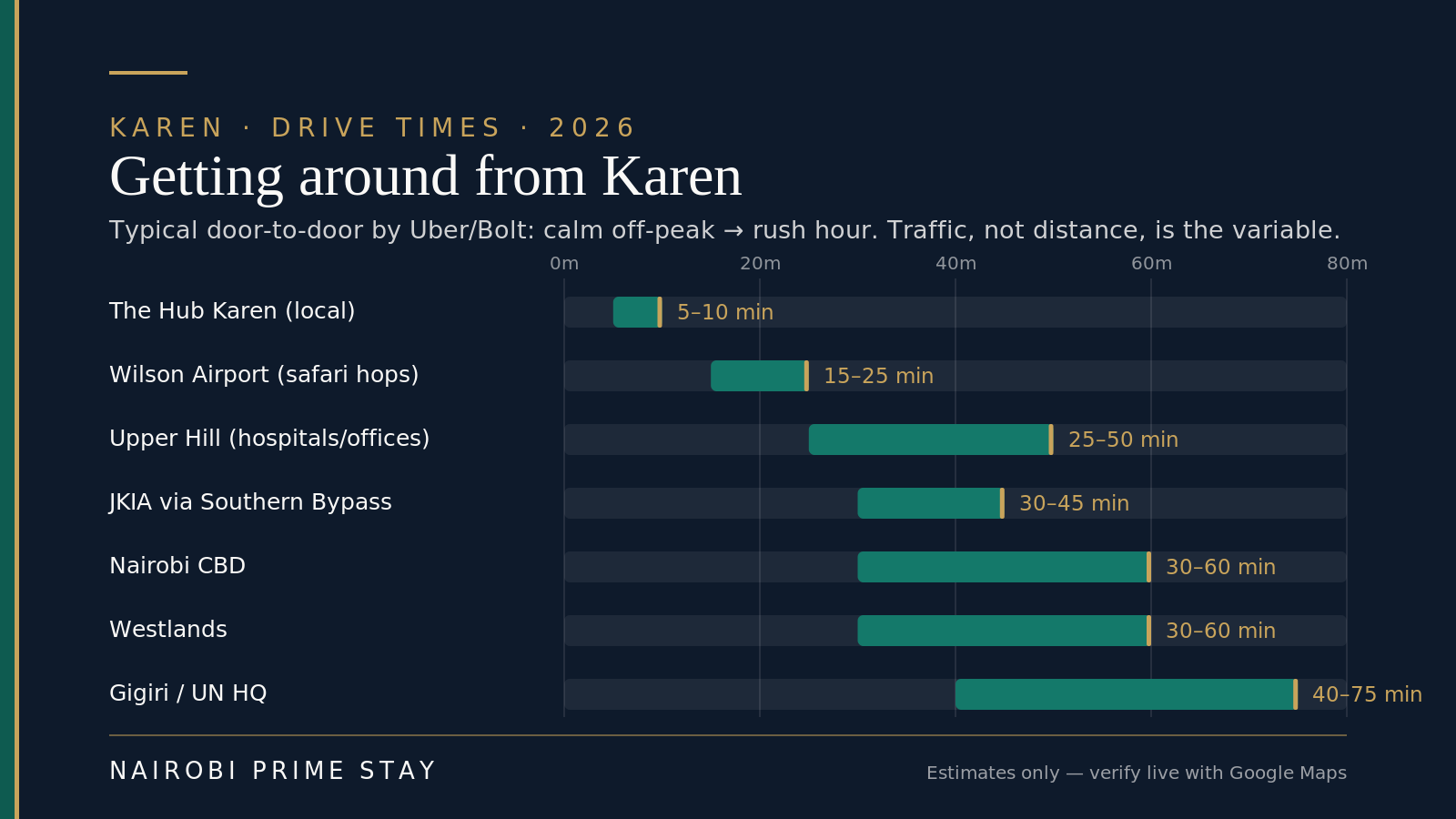 Typical door-to-door drive times from Karen by Uber or Bolt, calm off-peak to rush hour. Estimates only — check the live time before you travel.
| From Karen to… | Off-peak | Rush hour |
|---|---|---|
| The Hub Karen (local errands) | ~5 min | ~10 min |
| Wilson Airport (safari & coast flights) | ~15 min | ~25 min |
| Upper Hill (hospitals, offices) | ~25 min | ~50 min |
| JKIA international airport | ~30 min | ~45 min |
| Nairobi CBD | ~30 min | ~60 min |
| Westlands | ~30 min | ~60 min |
| Gigiri / UN HQ | ~40 min | ~75 min |
One underrated perk: Wilson Airport, the hub for light aircraft to the Maasai Mara, Diani and other safari and coast strips, is barely 15–25 minutes away. For weekend flying, Karen is one of the best-placed suburbs in the city.
The way Karen families make it work is by anchoring life locally: schools, shops, restaurants and friends are all close, so you simply don’t make the long downtown trip every day. If you work from home, run your own business locally, or have a school-centered family life, the commute rarely bites — good fibre plus a backup generator make working remotely from a Karen garden very doable (see our internet and remote work guide). If you must be in Upper Hill or the CBD at 8am daily, weigh it carefully against more central suburbs like Gigiri, Lavington or Kilimani.
Shopping, eating and weekends
Karen is well served for daily life despite its calm. The Hub Karen is the area’s modern shopping center, with supermarkets, shops, restaurants and a pleasant open-air feel; Galleria sits nearby toward Lang’ata, and Karen has long-standing local shopping at Karen Crossroads and beyond. For groceries you’ll find Carrefour and other supermarkets stocking local and imported goods.
The dining scene leans toward relaxed, leafy restaurants and cafés — Karen has some of the city’s best-loved garden eateries. And the weekends are a genuine perk: the Giraffe Centre, the Sheldrick elephant orphanage and the Karen Blixen Museum are all close, with Nairobi National Park and the Ngong Hills within easy reach for walks and day trips. It’s a neighborhood where family weekends are easy to fill without going far.
Karen’s lifestyle is part of the draw. This is Nairobi’s horse country, with riding stables, the golf course at Karen Country Club and the Ngong Hills for weekend walks. The Karen Blixen Coffee Garden and a string of leafy restaurants make easy long lunches, and weekend farmers’ markets sell local produce and crafts. For more, see our guides to restaurants and dining in Nairobi, shopping, malls and markets and weekend trips from Nairobi.
Pets are part of why families pick Karen. The big plots and gardens give dogs room to run, and the suburb is used to pet-owning households. If you’re bringing animals from the US, our bringing pets to Kenya guide walks through the permits and timing to start early.
Hospitals and healthcare in Karen
Karen has its own well-known private hospital — The Karen Hospital — which is convenient for the southern suburbs, along with private clinics and pharmacies for everyday needs. For specialist or major care, the city’s leading hospitals in Parklands and Upper Hill (Aga Khan, The Nairobi Hospital) are a drive away.
As everywhere in Nairobi, carry strong private or international insurance with medical evacuation and use the private system. Families especially value having Karen Hospital close for the routine bumps and fevers of family life. See our healthcare in Nairobi guide for the full picture, and our health insurance for expats guide for the cover to carry.
Can you buy a home in Karen?
Yes, foreigners can buy in Karen — but on a lease, not outright. Under Kenya’s constitution, a non-citizen can hold land only on leasehold tenure of up to 99 years, never freehold. If a title says freehold, the law treats your interest as a 99-year lease anyway, and you take on whatever term is left to run — a lease granted decades ago has fewer years remaining, which affects value. Buying through a company doesn’t dodge this: a company with even one foreign shareholder counts as non-citizen for land purposes.
There’s a Karen-specific wrinkle worth knowing. Some of Karen’s larger plots still sit on old agricultural titles, and transactions involving agricultural land and a non-citizen face extra restrictions and Land Control Board consent. It’s navigable, but it’s a reason to have a good lawyer read the title before you fall for the acre.
The safe process is the same one our property guides lay out. Use your own licensed advocate — found through the Law Society of Kenya, not handed to you by the seller — run an official land search to confirm the owner and any charges, and pay into the advocate’s client account, never a personal one. If you’re buying from the US, remember Kenya isn’t part of the Apostille Convention, so a US-signed power of attorney has to be notarized and then legalized at a Kenyan embassy or consulate to be valid here. For most people on a two- or three-year posting, renting first is the sensible move; buying makes more sense once you know you’re staying. Start with can foreigners buy property in Kenya, then conveyancing in Kenya, buying land in Kenya and, if you’re investing from abroad, diaspora property investment.
Serviced apartments and a soft landing in Karen
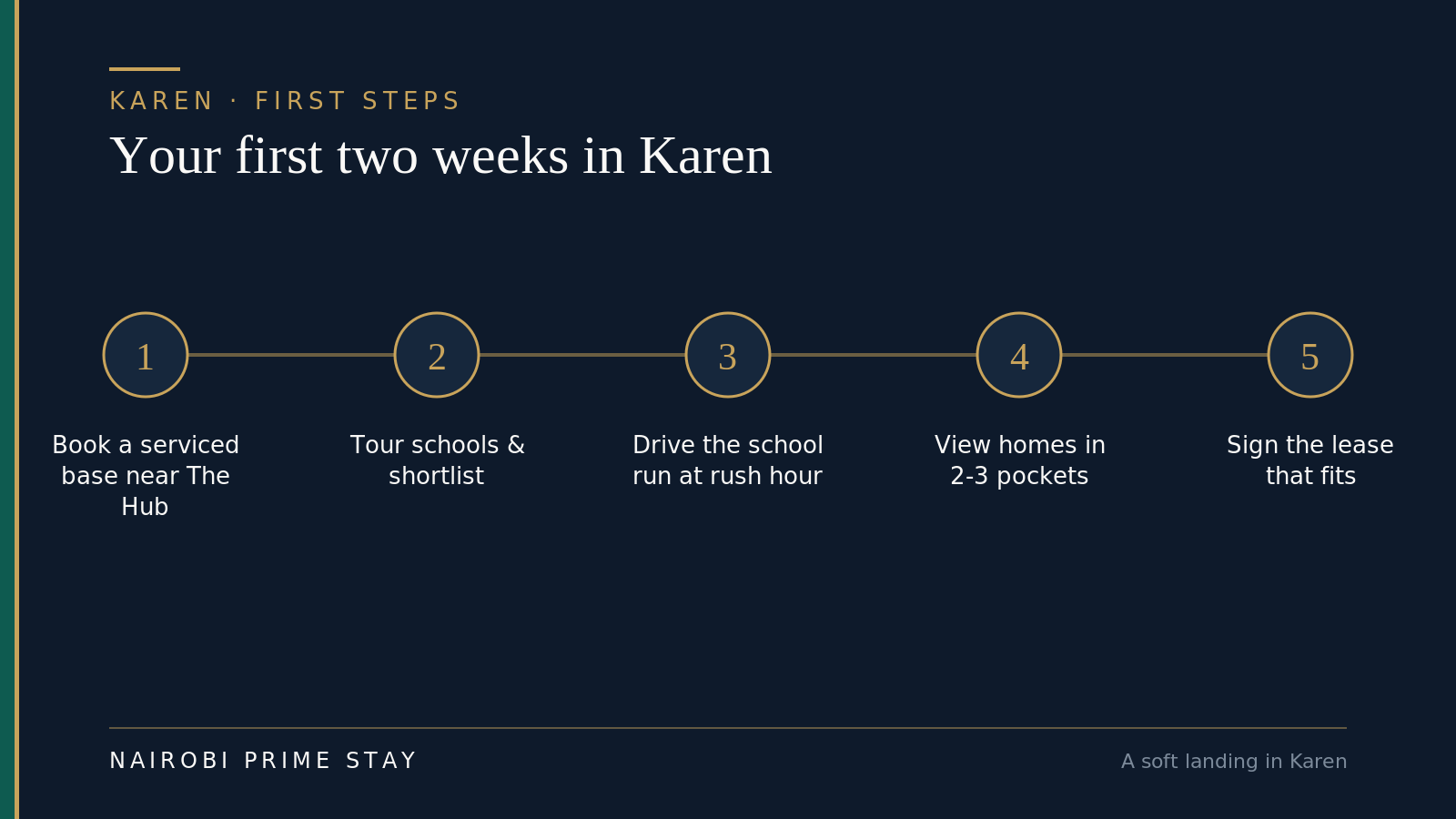 A soft landing, step by step.
Karen is a good place to land softly. Because the neighborhood is built around houses on big plots, signing a 12-month lease usually means committing to an area, a school run and a specific compound before you’ve felt any of them in daily life. A serviced apartment for your first four to eight weeks fixes that: you get a furnished, all-inclusive base — Wi-Fi, cleaning, a backup generator and 24/7 security included — while you view homes, test the school run in real traffic, and work out which corner of Karen actually fits.
It suits relocating families especially well. You can enroll the kids, drive the route a few mornings, and only then choose between a townhouse near The Hub and a garden house deeper toward the Ngong Hills. The booking itself is light: a $50 deposit reserves your dates and the balance is paid on arrival, so nothing big leaves your account before you travel.
When you’re ready, browse serviced apartments in Karen, read the full serviced apartments guide for what’s included and how it compares to a hotel or a long lease, or let our AI relocation assistant match your school shortlist and budget to the right home.
A week in the life: a Karen family
Picture a family of four on a two-year posting. The kids start at Brookhouse, a ten-minute drive from a gated townhouse near Bogani Road. Mornings are the school run, then a few hours of focused work from a home office on good fibre, with the generator covering the odd power cut. Lunch is sometimes a quick stop at The Hub. Afternoons overlap the US East Coast, so calls happen from the garden.
Weekends barely need a plan. Saturday is the Giraffe Centre or a walk in the Ngong Hills; Sunday a long lunch at a garden restaurant and the farmers’ market. Once a month they fly out of Wilson for a weekend in the Mara, fifteen minutes from the front door to the check-in desk. Nobody drives downtown all week. That’s the Karen bargain: trade the central commute for a life that mostly happens within a few green square miles.
Who Karen suits — and who it doesn’t
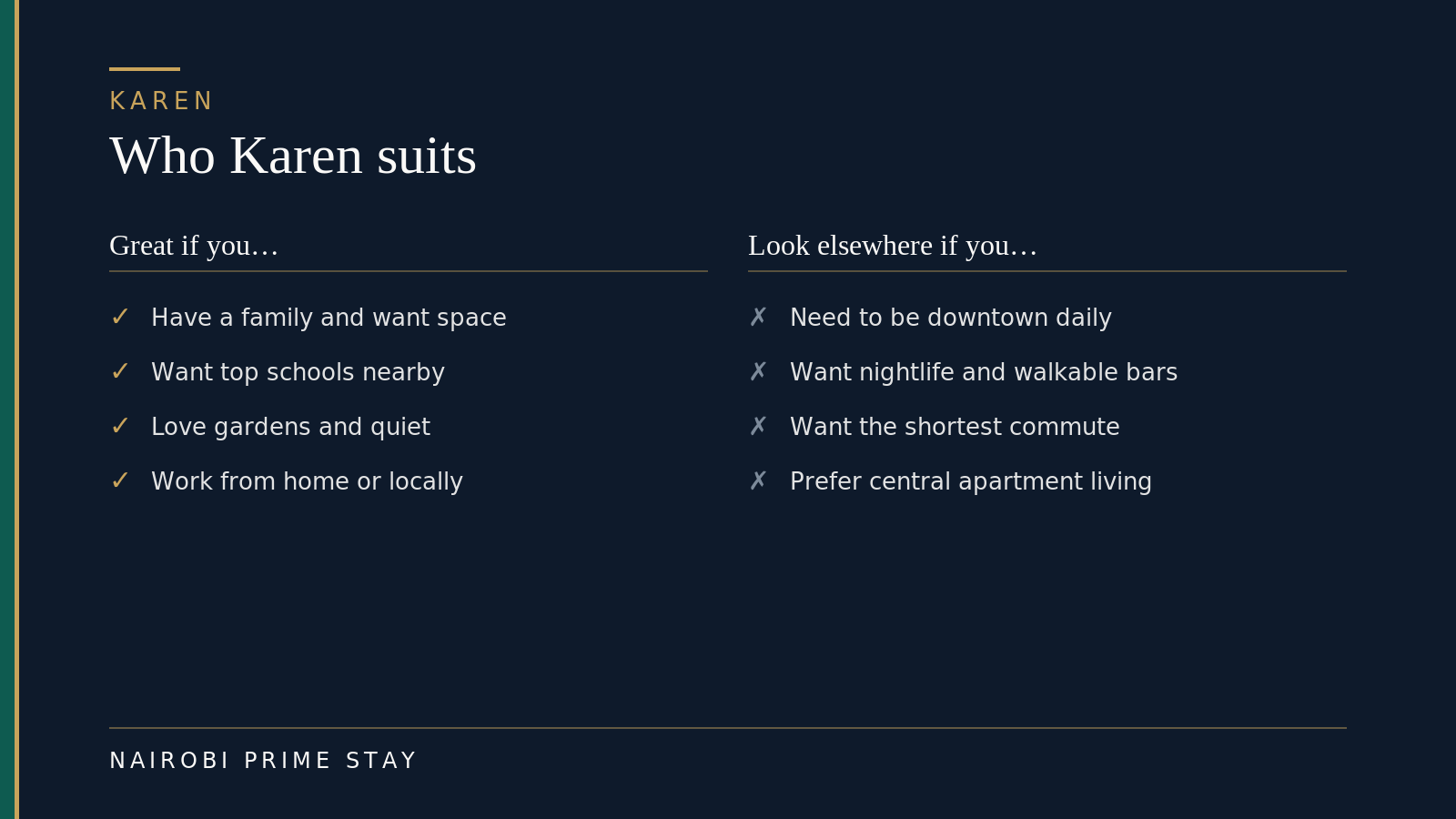
Is Karen your fit?
| Karen is great if you… | Look elsewhere if you… |
|---|---|
| Have a family and want space and gardens | Need to be downtown or in Upper Hill daily |
| Want top schools nearby | Want nightlife and walkable bars |
| Love quiet, greenery and weekends outdoors | Want the shortest possible commute |
| Work from home or locally | Prefer apartment living in a central area |
| Want room for kids and pets | Are on a tight budget for a central spot |
Karen vs other family suburbs
If you’ve narrowed it to the leafy, family-friendly side of Nairobi, here’s how Karen compares with the suburbs families usually weigh against it. Rents are indicative furnished 2026 ranges; see the best neighborhoods guide for the full picture.
| Suburb | Character | Furnished rent / mo | Best for |
|---|---|---|---|
| Karen | Most space and greenery; semi-rural calm; British schools | $1,000–4,600 | Families wanting room, gardens and pets; weekend flyers |
| Gigiri | Diplomatic heart by the UN; compact, heavily patrolled; ISK nearby | $1,500–4,000+ | UN / embassy staff; American-curriculum families |
| Runda | Large gated houses and gardens; very secure; near ISK & Rosslyn | $1,800–4,000+ | Families wanting a big house near top schools |
| Lavington | Cosmopolitan and central; gardens, embassies, good schools | $700–1,800 | Families wanting greenery closer to the center |
| Kileleshwa | Quieter, modern apartments and townhouses; central | $650–1,500 | Smaller families and couples wanting central calm |
Karen is the choice when space, gardens and the British-school cluster matter most; the other suburbs trade some of that room for a shorter run to the UN, the embassies or the center. Each has its own guide — Runda, Lavington, Kileleshwa and nearby Muthaiga — and our best neighborhoods guide lays the full map out side by side.
Frequently asked questions
Is Karen a good place to live in Nairobi? Yes, especially for families and anyone who wants space and greenery. Karen offers large plots, gardens, quiet streets and some of the city’s best international schools, plus easy weekend access to Nairobi National Park and the Giraffe Centre. The main trade-off is a longer commute to the city center and the UN.
How much is rent in Karen? Indicative 2026 furnished homes run from about $620 a month for a cottage to roughly $4,600 for an executive villa on a big plot, with most family houses between about $1,400 and $2,700. Unfurnished and longer leases cost less, while serviced apartments cost more per month but include utilities, internet, cleaning and security.
How much does it cost to run a house in Karen? Budget beyond the rent. As of 2026 the legal minimum for a house help, gardener or day watchman in Nairobi is about KES 18,047 a month plus a housing allowance, and many Karen homes employ more than one person. Add garden and pool upkeep, generator diesel during outages, occasional water top-ups, fibre and TV, and one to three months’ rent as a deposit up front. It’s manageable on a Western income, but a serviced apartment or gated townhouse folds most of it into one predictable figure.
Is Karen safe? Karen is one of Nairobi’s calmer, more secure suburbs, with homes set behind walls and hedges in gated compounds or on guarded plots. Because plots are large and lanes are quiet, security depends a lot on your specific compound, so choose a well-managed home with 24/7 guards, gates and good lighting, and keep the usual city habits.
What schools are in Karen? Karen leans British. Brookhouse School (Karen campus) and Hillcrest International are the best known, with prep schools like The Banda nearby. Families who want an American curriculum usually look at ISK or Rosslyn near Gigiri and Runda instead, since those are a long cross-city drive from Karen.
How long is the commute from Karen to the city center? Plan on roughly 30 to 60 minutes to the Nairobi CBD and 25 to 50 minutes to Upper Hill, depending on traffic and exactly where you start. Karen sits on the southwestern edge of the city, so it works best for people who anchor daily life locally rather than driving downtown every morning.
Can I work remotely from Karen? Yes. Home fibre is widely available and, paired with a backup generator or inverter, makes working from a Karen garden very doable. The quiet and space suit focused work, so just confirm a home already has fibre installed and reliable backup power before you sign.
Is Karen good for families? It’s one of the top family choices in Nairobi. The mix of space, gardens, room for pets, strong schools and weekend attractions like the Giraffe Centre and Nairobi National Park is hard to beat, and the large, settled international community makes it easy to find friends.
Can I rent a Karen home from the US before I arrive? Carefully, yes — but never pay for a home no one you trust has seen live. Most Karen houses are let through agents, so insist on a live video walk-through from inside the actual house, use your own agent to confirm the landlord controls the plot, read the lease and inventory, and pay a registered agency on arrival rather than a personal M-Pesa. The safest route is to soft-land in a serviced apartment near The Hub, view homes in person, then sign.
Should I book a serviced apartment before moving to Karen? It’s a smart soft landing. Because Karen is built around houses on big plots, a serviced apartment for your first four to eight weeks lets you enroll the kids, drive the school run in real traffic, and choose the right compound before committing to a 12-month lease. A $50 deposit reserves your dates and the balance is paid on arrival.
Can a foreigner buy a house in Karen? Yes, but only on leasehold — up to 99 years, not freehold, under Kenya’s constitution. Use your own licensed advocate (via the Law Society of Kenya), run an official land search, and pay into the advocate’s client account. Some larger Karen plots sit on old agricultural titles that carry extra restrictions, so have a lawyer check the title first. For most two- or three-year postings, renting first makes more sense than buying.
What is there to do in Karen on weekends? Plenty, without going far. The Giraffe Centre, the Sheldrick elephant orphanage, the Karen Blixen Museum and Nairobi National Park are all close, along with walks in the Ngong Hills, golf at Karen Country Club and horse riding. Wilson Airport is 15 to 25 minutes away for weekend flights to the Maasai Mara or the coast.
Which part of Karen is best to live in? It depends on your priorities. Central Karen near The Hub keeps shops and restaurants close, the leafy core around Miotoni and Marula has the biggest plots and the deepest quiet, newer gated pockets like Bogani and Acacia offer modern townhouses with shared security, and the Ngong Road edge is closer to town for an easier commute. Basing yourself centrally for a few weeks first is the easiest way to choose.
Final thoughts
Karen rewards a particular kind of move: family-centered, space-loving, happy to trade a downtown commute for a garden and a short school run. Sort the school first, let it guide exactly where in Karen you settle, and the rest of the suburb’s appeal, the calm, the greenery and the easy weekends, takes care of itself. For anyone whose daily anchor is home and school rather than a city-center desk, it’s one of the most livable corners of Nairobi.
When you’re ready to test it in real life, the easiest first step is a soft landing close to the schools you’re weighing.
Related reading
- Best neighborhoods in Nairobi for expats
- Gigiri neighborhood guide — the diplomatic side of town, near ISK and Rosslyn
- Karen vs Runda compared — how Karen’s space and British schools compare with Runda’s gated estate near the UN
- Runda, Lavington, Kileleshwa and Lang’ata — the suburbs families weigh against Karen
- American & IB schools and British schools in Nairobi
- Restaurants & dining and shopping, malls & markets
- Cost of living in Nairobi and Is Nairobi safe?
- Healthcare in Nairobi and internet & remote work
- Serviced apartments in Nairobi: a complete guide
- Moving to Nairobi: the complete guide
Planning a move to Karen? Browse serviced apartments in Karen for a secure, all-inclusive soft landing near the schools, or ask our AI relocation assistant to match your school shortlist and budget to the right home. A $50 deposit reserves your place; you pay the balance when you arrive.
Ready to look?
Find your apartment in Nairobi
Browse verified serviced apartments, or ask the AI concierge which area fits your life.