
Guides · Neighborhoods
Westlands Neighborhood Guide: Nairobi's Business & Nightlife Hub (2026)
Westlands Neighborhood Guide: Living in Nairobi’s Business and Nightlife Hub
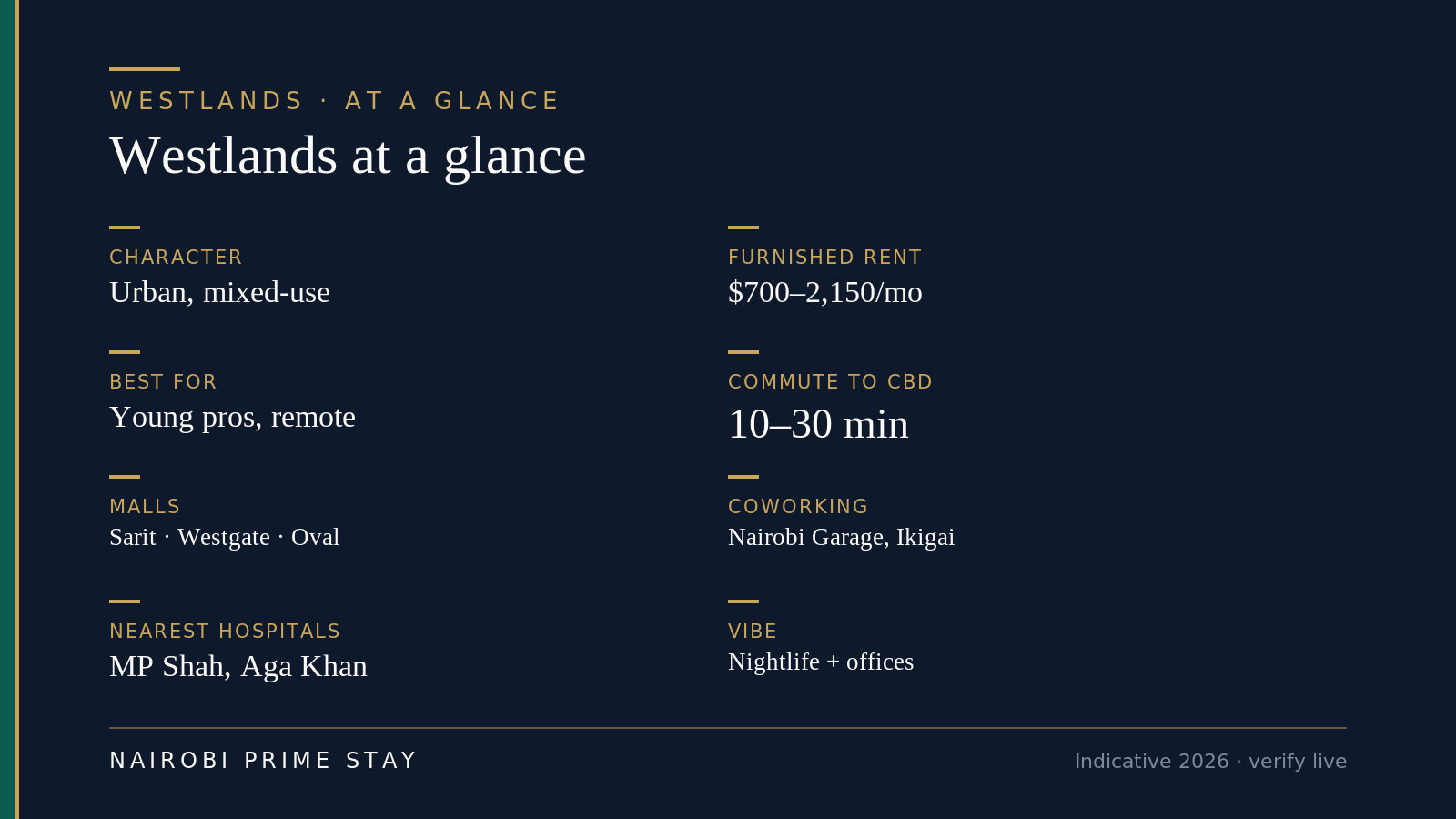
Westlands at a glance.
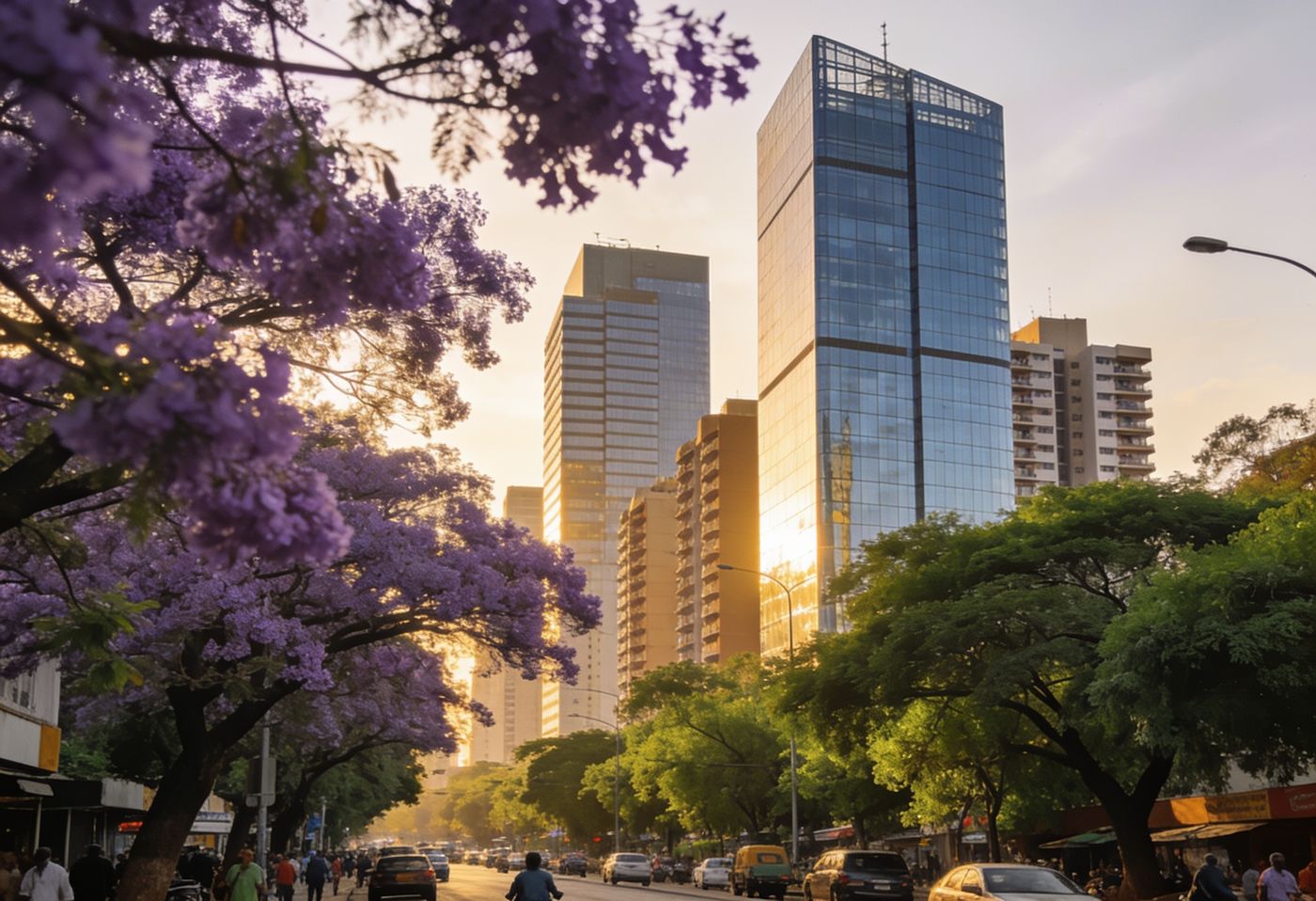
Westlands is where Nairobi works, shops and goes out. It’s the dense, mixed-use core just northwest of the city center — towers of offices and apartments, three big malls within a short walk of each other, and the busiest nightlife strip in the city. If you want to live where things happen and you don’t need a garden, few areas come close.
This guide is for someone deciding whether to live here. It covers who your neighbors will be, how safe it feels, what rent actually costs in 2026, the real story on traffic, where you’ll work and unwind, and the schools and hospitals nearby. It’s honest about the trade-offs, because that’s the only kind of neighborhood guide worth reading. For the wider map of where expats live, start with our best neighborhoods in Nairobi guide and the main moving to Nairobi hub.
The quick version
Westlands is Nairobi’s central hub for offices, shopping, dining and nightlife, about 5 km northwest of the CBD. It suits young professionals, couples and remote workers who want a walkable, urban life — cafés, coworking, gyms and bars on the doorstep. Furnished one-beds run roughly KES 90,000–200,000 a month (about $700–1,550) and furnished two-beds KES 130,000–280,000 (about $1,000–2,150); unfurnished costs less, and the newest serviced towers near the GTC and JW Marriott push higher still. The main downsides are traffic and noise: Waiyaki Way and Ring Road clog at rush hour, though the Nairobi Expressway now makes airport runs quick. It’s safe with normal city sense. Families wanting space and gardens usually prefer Lavington, Karen or Runda. (All figures are indicative for 2026 at about KES 129–130 to the dollar — verify current listings before you sign.)
Why Westlands matters when you’re new
When you’ve just arrived, the hardest part of Nairobi is the friction — finding good coffee, a gym, a SIM card, a desk to work from, somewhere to meet people. Westlands removes most of that friction in one place. You can land, settle into a serviced apartment, and have everything you need within a few blocks while you figure out the city. For a lot of remote workers and younger professionals, that soft landing alone makes it the right first base, even if they later move somewhere leafier.
Who lives in Westlands?
A mix of young Kenyan professionals, expats on shorter postings, remote workers, students and couples. The crowd skews younger and more social than Gigiri or Karen. Many people who work in Westlands’ banks, tech firms and law offices live within a few minutes of their desk, and digital nomads cluster here for the cafés and coworking. You’ll find fewer large families with young children — those households tend to choose the leafier suburbs for space and gardens — but plenty of singles and couples who want city life over a big plot. It’s cosmopolitan and easy to plug into — our expat community guide covers how to meet people fast.
Is Westlands safe?
Westlands is generally safe by day and lively at night, with one big-city caveat: keep your phone and bag close, especially in nightlife spots and in traffic. The real risk here is opportunistic petty theft — pickpocketing in crowds, phone-snatching at car windows in jams — not personal danger. The area is busy, well-lit and thick with private security: guarded buildings, gated parking, CCTV and mall screening are the norm.
A few habits keep you comfortable. Use Uber or Bolt at night rather than walking with valuables, keep car doors locked and windows up in traffic, and don’t flash a phone on the street after dark. On the question many newcomers ask: Westgate Mall was the site of a 2013 terror attack, but it was rebuilt, reopened in 2015 and operates normally today, and malls across Nairobi screen vehicles and bags at entry. For the full, balanced picture, read our honest take on whether Nairobi is safe.
Rent and apartments in Westlands
Westlands is an apartment area, not a houses-with-gardens area, and prices span a wide band depending on the building’s age, amenities and exact street. Here’s the 2026 picture, indicative and rounded; furnished and fully serviced units sit at the top, older unfurnished blocks at the bottom.
| Size | Unfurnished (KES/mo) | Furnished (KES/mo) | Furnished (USD, ~130) |
|---|---|---|---|
| Studio / 1-bed | 45,000–90,000 | 90,000–200,000 | ~$700–1,550 |
| 2-bed | 75,000–150,000 | 130,000–280,000 | ~$1,000–2,150 |
| 3-bed | 120,000–250,000 | 200,000–350,000+ | ~$1,540–2,700+ |
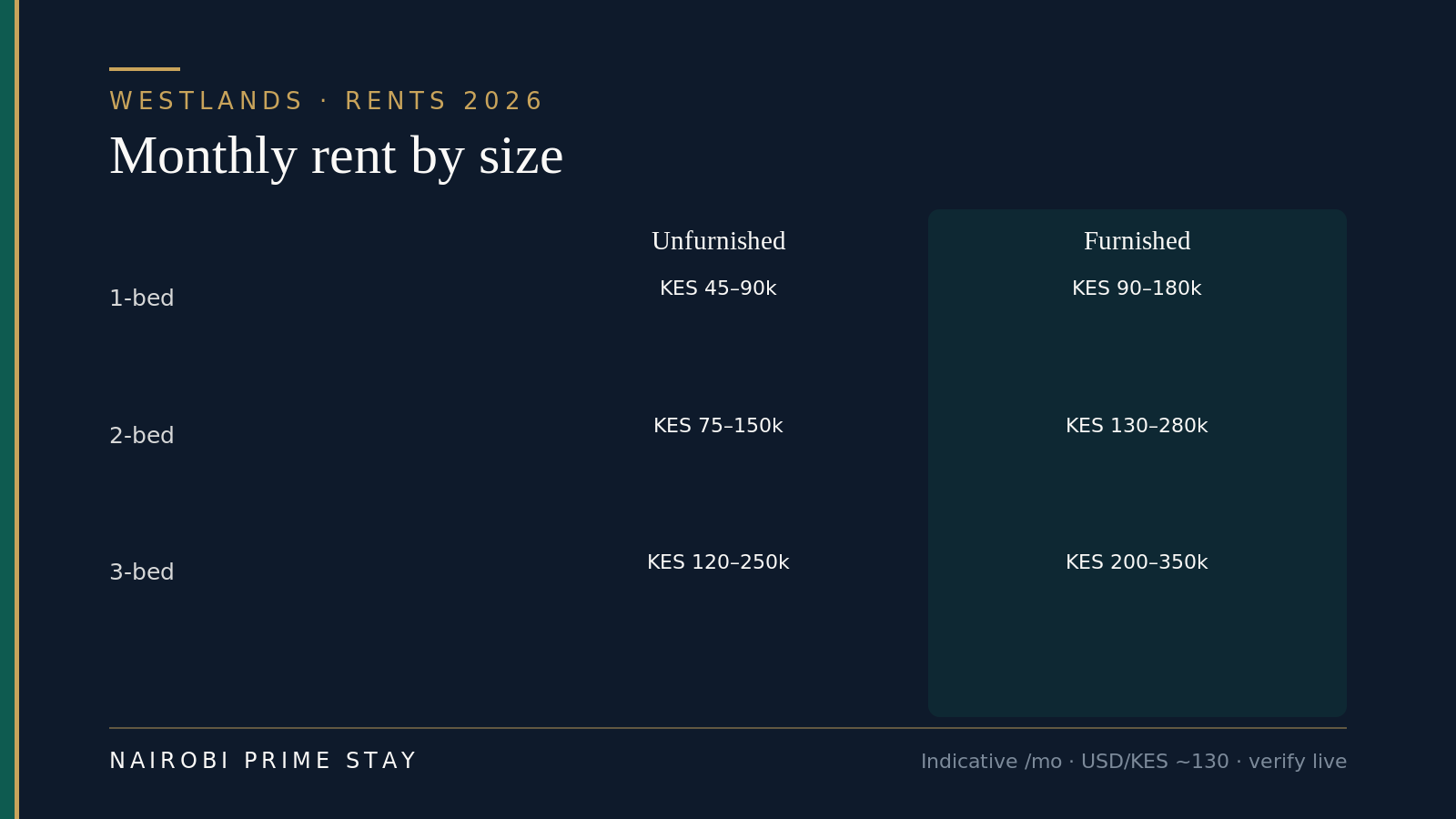
Indicative Westlands rents, 2026. Furnished and serviced units cost more but bundle utilities, internet and cleaning.
The priciest pockets are General Mathenge Drive, the Riverside Drive edge and the newer serviced towers — the cluster around the Global Trade Centre (GTC) and the JW Marriott commands the top of the market. You’ll find better value in older blocks around Ring Road Westlands and toward Parklands. On unfurnished places there’s usually a monthly service charge on top of rent — it covers security, water, common areas and sometimes a gym or pool, so always ask what’s included.
Before you sign anything, check what we call the “Nairobi Five”: a backup generator, reliable water supply and storage (tank or borehole), 24/7 security, fibre internet already serving the building, and responsive on-site management. These five separate a smooth month from a miserable one. If you’re weighing whether to take a place furnished or bare, our furnished vs unfurnished guide breaks down the math, and the how to rent an apartment in Nairobi guide walks the whole process — agents, deposits and the lease. For how Westlands fits your overall budget, see our cost of living in Nairobi guide, and never wire money for a place you haven’t viewed and verified.
Where in Westlands to live
Westlands isn’t one place — it’s a handful of pockets, and which street you pick changes the experience more than the postcode does. Here’s the honest lay of the land.
General Mathenge and Brookside are the priciest and leafiest. This is where the newer serviced towers and a few houses with gardens sit, on calmer streets a little removed from the noise. The Riverside edge (toward Riverside) is quieter and more upscale, embassy-adjacent and greener, while still a few minutes from the malls. Rhapta Road and the Ring Roads are the central core: you can walk to offices, malls and coworking, and you’ll see everything from older walk-ups to glassy new blocks. The Parklands side (toward Parklands) is the value play — cheaper rents and the two big hospitals on your doorstep. And Mpaka Road and Woodvale Grove are the nightlife core: liveliest by far, and loudest at the weekend, so it’s a great address if you’re out a lot and a tough one if you need early nights.
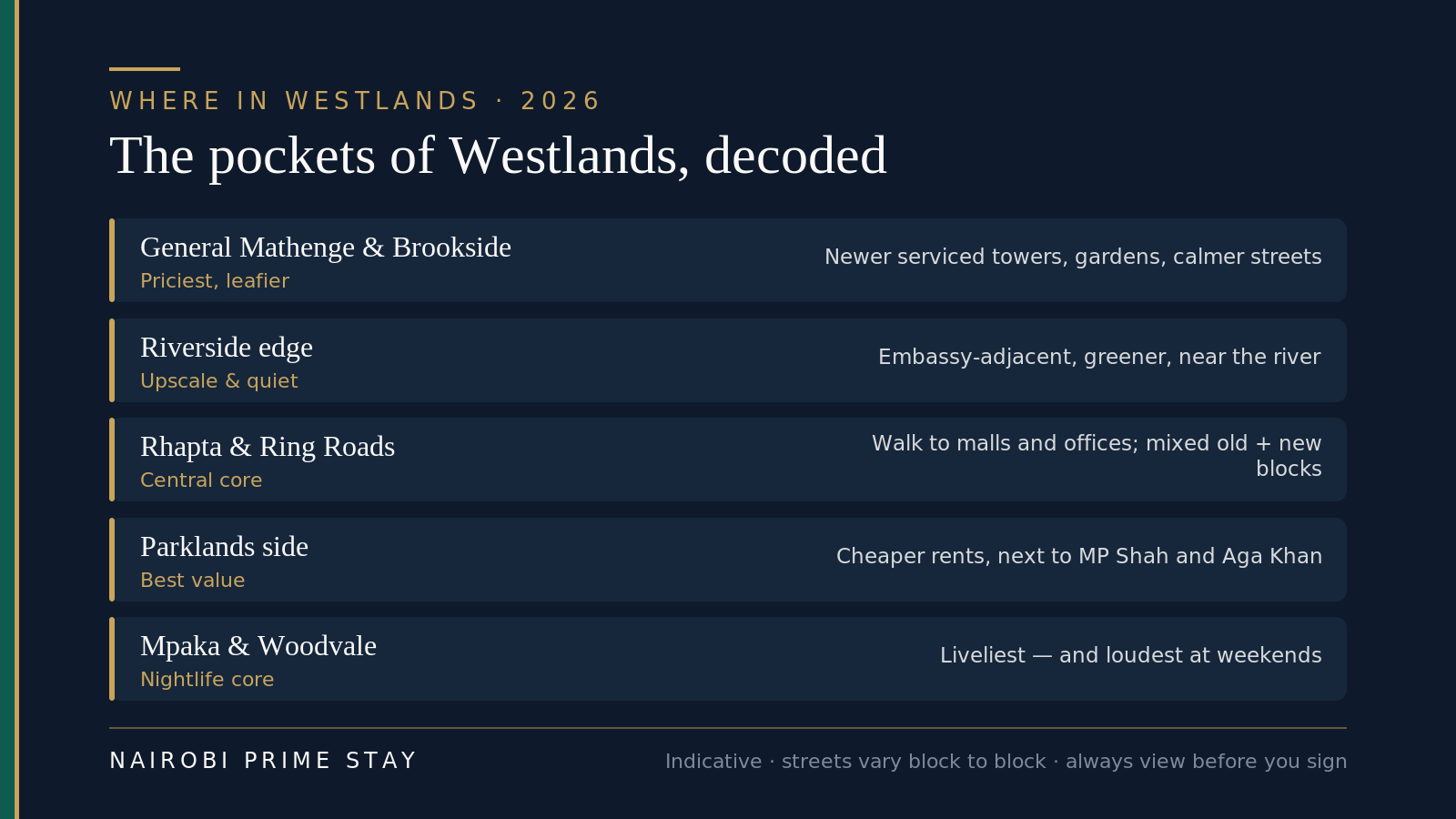
Where in Westlands to live — the pockets, decoded.
The rule of thumb: the closer you are to the bars, the more energy and the more noise. View at least two or three buildings in different pockets before you decide, and walk the block on a Friday night as well as a Tuesday morning.
Serviced apartments and a soft landing in Westlands
A serviced apartment is the easiest way to start in Westlands. You get a furnished, all-inclusive base — Wi-Fi, cleaning, a backup generator and 24/7 security included — on a flexible monthly term, so you can land, work and explore without committing to a 12-month lease on day one. It also lets you test the thing that matters most here: how the traffic and noise feel on your specific street, at rush hour and on a Friday night.
That’s the soft-landing strategy we recommend for most arrivals: stay serviced for the first four to eight weeks, use that time to view long-term homes and test commutes, then sign once you’re sure. With us, a $50 deposit reserves your dates and the balance is paid on arrival — nothing more before you travel. Browse serviced apartments in Nairobi for how it works, or go straight to apartments in Westlands.
What does it cost to live in Westlands each month?
Plan for roughly $1,700–2,600 a month for a comfortable solo professional life in Westlands in 2026, with rent driving most of the swing. The number climbs with a bigger apartment, a nightlife habit or a car, and drops if you take an unfurnished place and cook at home.
| Monthly item | Indicative cost (USD) |
|---|---|
| Furnished one-bed (all-in) | ~$900–1,300 |
| Coworking desk | ~$120–200 |
| Groceries | ~$250–400 |
| Getting around (Bolt/Uber) | ~$80–150 |
| Eating out and going out | ~$250–450 |
| Typical total | ~$1,700–2,600 |
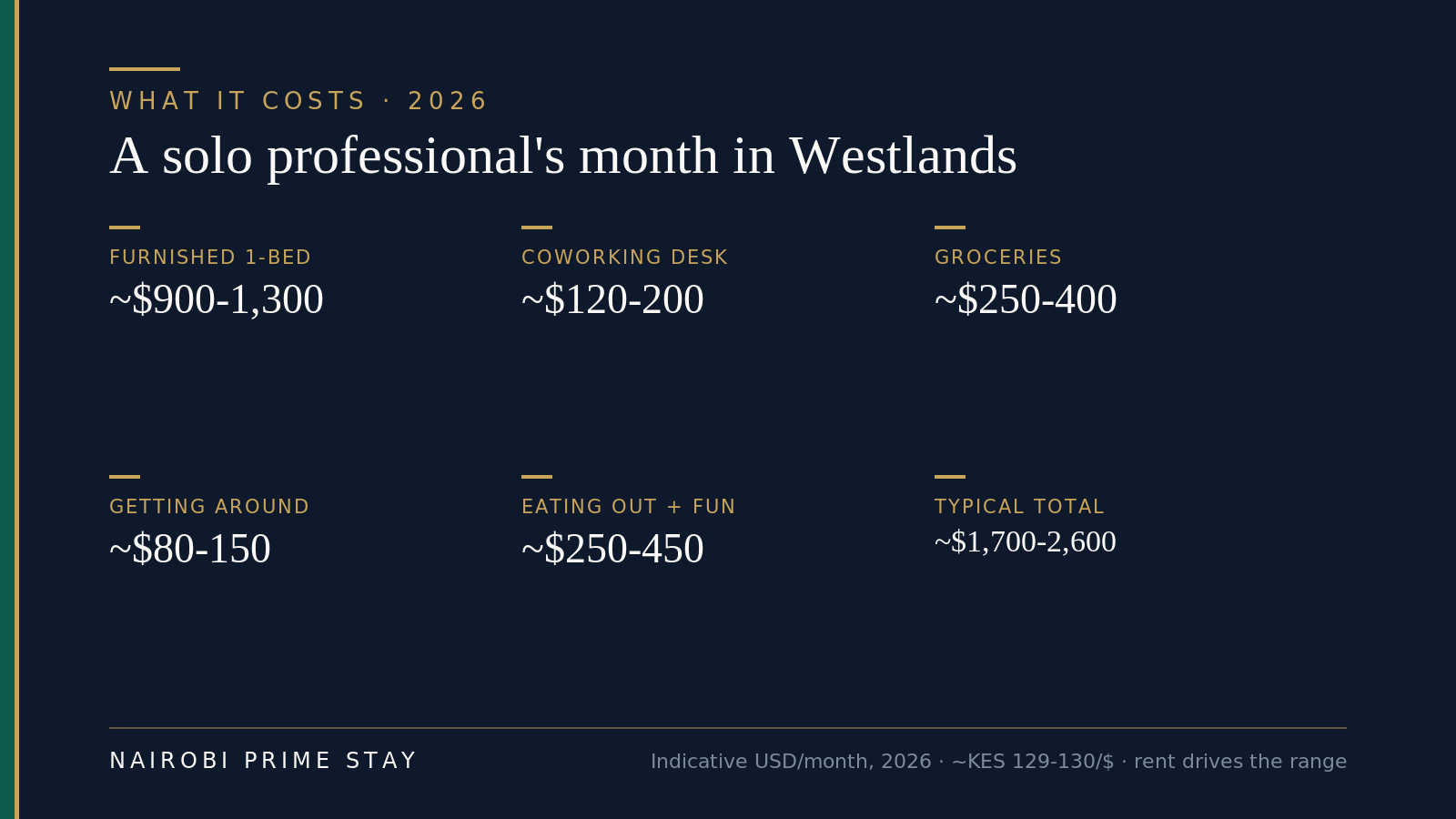
Indicative 2026 monthly costs for a single professional — rent drives the range.
These are honest ballparks, not quotes. A couple sharing a two-bed often lands near the same total per person or a little less, and families run higher once schools and a car enter the picture. For the full breakdown across the city — and how Westlands compares to leafier suburbs — see our cost of living in Nairobi guide, and our US dollar to shilling guide for moving money and the current rate.
Getting around: traffic, Waiyaki Way and the Expressway
Westlands is central, but traffic is the real tax on living here, so be honest with yourself about it. Waiyaki Way — the main artery to the CBD — and Ring Road Westlands clog at peak hours. The same 5 km trip to town can take 10 minutes off-peak or 40-plus in the thick of rush hour. Plan your day around the peaks and a lot of the pain disappears.
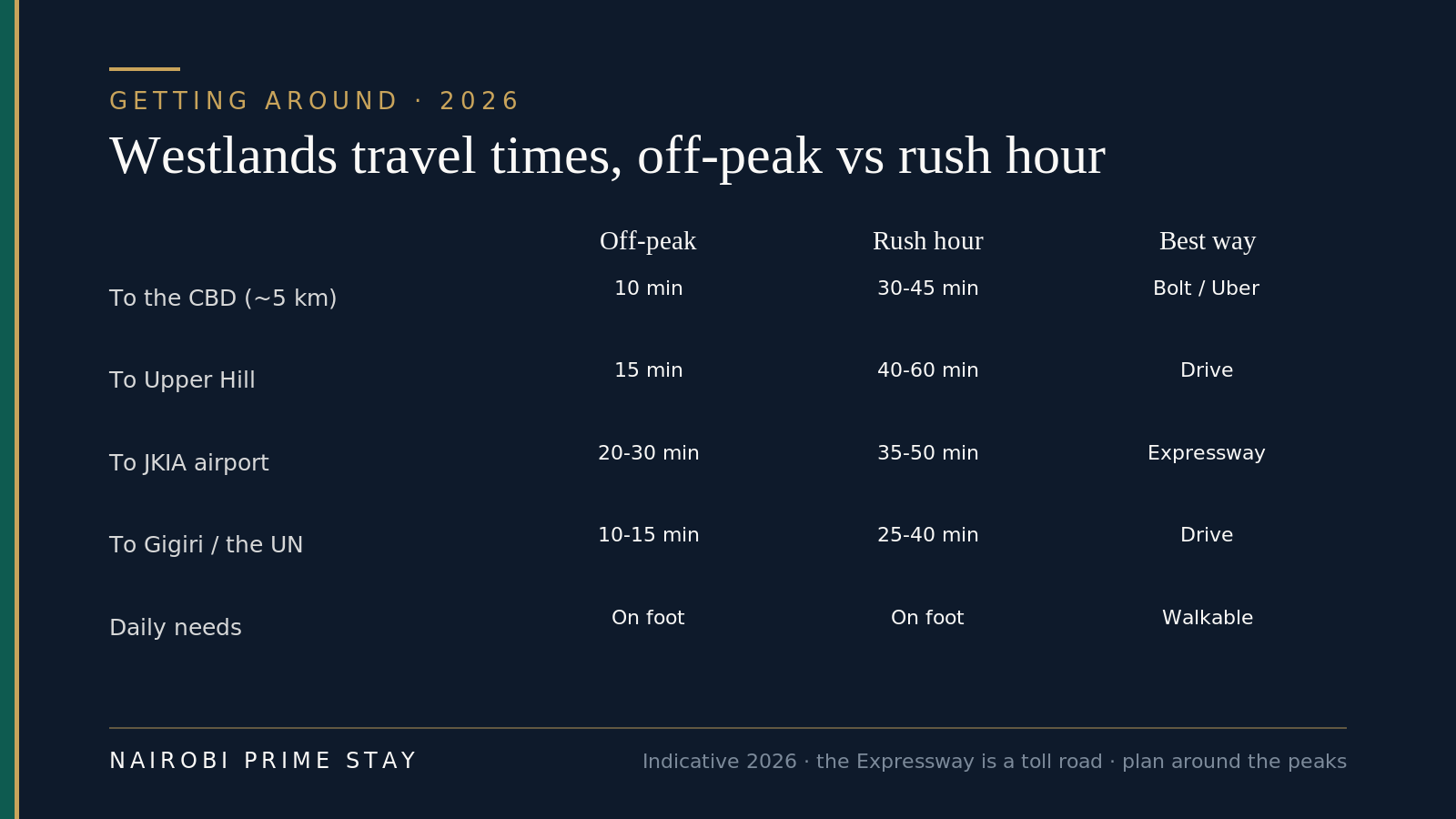
Indicative Westlands travel times — the peaks are the real tax on living here.
Two things make it manageable. First, Westlands is one of the few Nairobi neighborhoods where you can actually walk to daily things — malls, cafés, a gym, coworking — so many residents who work locally skip a car entirely. Second, the Nairobi Expressway (opened in 2022) runs elevated from JKIA through the city to a terminus near James Gichuru Road, on Westlands’ doorstep; it’s a toll road, but it cuts the airport run to roughly 20–30 minutes outside peak times. Uber and Bolt are everywhere, cheap and the expat default; matatus run the main roads if you want the local way. Our getting around Nairobi guide covers ride-hailing, matatus and the Expressway, and if you plan to drive yourself, read driving in Nairobi first. If you’ll commute daily to the CBD or Upper Hill, drive the route at rush hour before you sign. For the airport run itself, see our JKIA airport guide.
Work, coworking and remote work in Westlands
Westlands is Nairobi’s business heart, which makes it a top pick for remote workers and anyone who wants an office life without a long commute. Banks, tech companies, law firms and consultancies cluster here, and the coworking scene is the best in the city: Nairobi Garage, Ikigai, Workstyle and Regus all have space in or beside Westlands, from hot desks to private offices — our coworking and cafés guide maps the best spots and day rates. Cafés are laptop-friendly, and you’re never far from a good flat white. The gym scene is just as easy, with chains and boutique studios in the malls and towers; see our gyms, fitness and wellness guide for what’s around.
The practical side holds up too. Fibre is widely available — Safaricom, Zuku and Faiba all serve the area — but pick a building with a backup generator (or run your own UPS) so power cuts don’t drop your calls. Nairobi sits at UTC+3, so your afternoons overlap the US East-Coast morning, which is convenient if you work with American teams. Our internet and remote work in Nairobi guide covers providers, speeds and the backup-power reality in detail.
Shopping, eating and nightlife
Few areas in Nairobi pack more into walking distance. Three malls anchor daily life: Sarit Centre, one of the city’s oldest, now expanded with the Sarit Expo Centre and a newer wing of shops, a supermarket and event space; Westgate Mall, rebuilt and busy, with shops and restaurants; and The Oval and The Mall, which mix offices with cafés and a cinema. Carrefour and Naivas supermarkets sit inside the malls, so a full grocery run is a five-minute errand. For the wider picture — markets, supermarkets and where to find American brands — see our shopping, malls and markets guide.
The food is a highlight. Within a short radius you’ll find nyama choma (Kenyan grilled meat), Indian, Italian, Japanese and Ethiopian, plus cafés serving some of the best coffee in the country; our Nairobi restaurants and dining guide has the standouts. After dark, Westlands is the city’s nightlife center — bars, lounges and clubs cluster along Mpaka Road and Woodvale Grove, drawing people in from across Nairobi on weekends, as our nightlife and social scene guide lays out. The honest flip side: if you live right by the strip, expect weekend noise. Pick your street with your sleep in mind, and the energy becomes a feature rather than a nuisance.
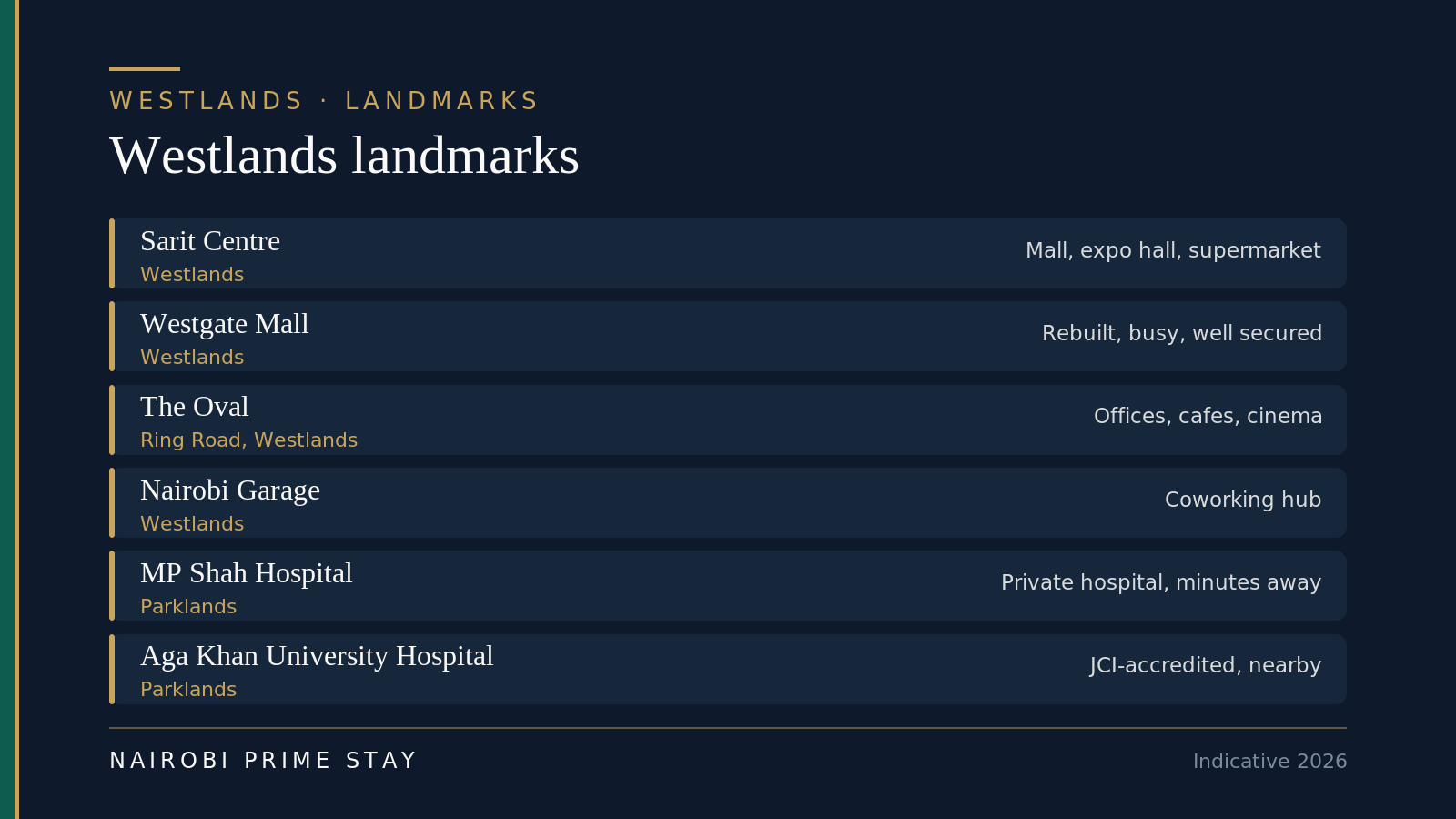
Key Westlands landmarks — malls, coworking and the nearby Parklands hospitals.
Schools near Westlands
Westlands itself is light on big international-school campuses — it’s a commercial core — but good schools sit minutes away in neighboring Parklands and the suburbs just south. Aga Khan Academy and Oshwal Academy are close by in Parklands, and several British- and international-curriculum schools are within a short drive in Lavington and toward Gitanga Road. Gigiri’s International School of Kenya (American and IB) is a 15–25 minute drive depending on traffic.
The practical takeaway: Westlands works well if your children are older or you don’t mind a school run, but families with young kids who want the shortest possible drive often base themselves in Lavington, Kileleshwa or Gigiri instead. Apply months ahead either way — the best schools keep waitlists. Our international schools guide compares the campuses, and the best neighborhoods guide lines up the family-friendly areas side by side.
Hospitals and healthcare near Westlands
Healthcare is one of Westlands’ quiet advantages: two of Nairobi’s best private hospitals are right next door in Parklands. MP Shah Hospital is minutes away, and Aga Khan University Hospital — JCI-accredited, with full specialist care — is close by as well. The Nairobi Hospital in Upper Hill is a longer drive but well within reach. Private clinics and well-stocked pharmacies are scattered throughout the area.
As anywhere in Kenya, use the private system and carry good international health insurance that includes medical evacuation. Our healthcare in Nairobi guide covers hospitals, costs and what your insurance should include.
Who Westlands suits — and who it doesn’t
Westlands is a strong fit for young professionals, couples and remote workers who want a walkable, social, urban life with offices, malls, gyms and nightlife on the doorstep. It’s also one of the easiest places to land first: plug into the cafés, coworking and community quickly, then decide where to settle long-term. If you like a high-rise, mixed-use feel and value convenience over a garden, you’ll be happy here.
It’s a weaker fit if you want space, quiet and greenery — a big garden, a low-density street, a calm school run. Families with young children, anyone sensitive to traffic noise, and people who want diplomatic-suburb calm tend to be happier in Karen, Runda, Lavington or Gigiri. None of that makes Westlands “worse”; it’s just a different kind of life.
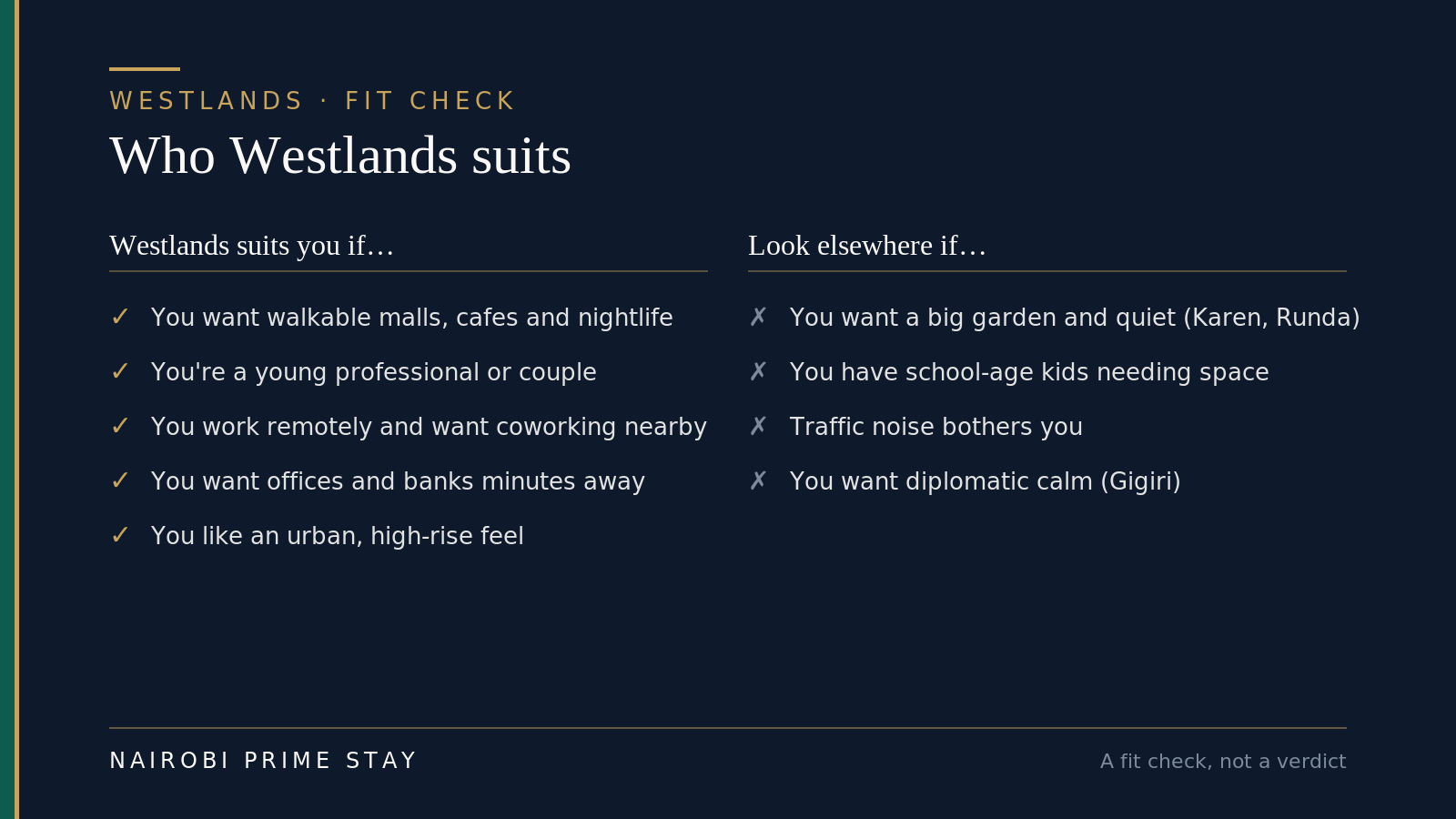
A fit check, not a verdict — plenty of people happily split the difference.
Westlands vs Kilimani vs Riverside
The three central apartment areas get compared a lot, because they overlap. Here’s the shorthand.
| Westlands | Kilimani | Riverside | |
|---|---|---|---|
| Character | Offices, malls, nightlife | Dense modern apartments, best value | Quieter, high-end, embassies |
| Furnished 2-bed (KES/mo) | 130k–280k | 110k–220k | 150k–300k |
| Best for | Social pros, remote workers | Value seekers, investors | Executives wanting calm |
| Nightlife | Highest | High | Low |
| Traffic & noise | High | High | Moderate |
Choose Westlands for the most amenities and the liveliest scene, Kilimani for modern apartments at better value, and Riverside for a quieter, more upscale address that’s still central. Parklands, just north, is another value option with the hospitals on your doorstep. For deeper head-to-heads, see Gigiri vs Westlands, Lavington vs Westlands and Kilimani vs Kileleshwa. Many newcomers view all three in a week before deciding.
A realistic example
Say you’re a remote worker in your early 30s, moving solo, working US hours part of the day. Westlands fits almost too well: a furnished one-bed near (but not on) Mpaka Road runs around KES 120,000 a month all-in, you walk to Nairobi Garage for a desk and to Sarit for groceries, and your afternoons sync with your team back home. You skip a car, use Bolt for nights out, and bank the savings. Six months in you know the city — and if you decide you want more quiet, you move to Kilimani or Riverside with your eyes open. That’s Westlands doing its job: the easiest on-ramp to Nairobi.
Is Westlands a good place to invest?
Short version: Westlands has some of the strongest rental demand in Nairobi, but it’s also one of the most built-up apartment markets, so it’s a yield play more than a quick capital-gains one. The walkability, offices and nightlife keep tenants — young professionals, expats on short postings, remote workers — coming, which makes one- and two-beds easy to let and a natural fit for furnished or short-let rentals.
The honest caveat is supply. So many apartment towers have gone up in and around Westlands that prices and rents have softened in places; HassConsult’s 2026 data has shown Westlands among the apartment submarkets under price pressure from oversupply. That’s good for renters and for buyers hunting value, but it means you should underwrite on rental income, not on the assumption that prices only rise. Studios and one-beds tend to deliver the best yields here; large units sit emptier.
If you’re buying to rent, do the homework: check our property investing in Kenya pillar, weigh the best areas to invest, and read up on buy-to-let and Airbnb and short-let returns. Our Nairobi property prices guide tracks where the market is heading. As always, the demand that makes Westlands a strong let is the same demand that fills our serviced apartments — proof the rental appetite is real.
Your Westlands move-in checklist
- Decide your street first — central and walkable, but a block or two off the nightlife strip if you value quiet.
- Visit shortlisted buildings at rush hour and at night to judge traffic and noise honestly.
- Confirm the “Nairobi Five”: generator, water storage, 24/7 security, fibre in the building, responsive management.
- Get a Safaricom SIM and M-Pesa at the airport on arrival — you’ll pay for nearly everything with it.
- Test the actual fibre speed in the unit, not just the provider’s brochure.
- Use a serviced apartment for your first month while you view long-term homes.
- Set up Uber and Bolt before you need them after dark.
- Save 999 / 112, note your nearest hospital (MP Shah or Aga Khan), and enroll in the US State Department’s STEP program.
Frequently asked questions
Is Westlands a good place to live in Nairobi? Yes, especially for young professionals, couples and remote workers who want an urban, walkable life. Westlands puts offices, malls, gyms, coworking and the city’s best nightlife within a short walk, and it’s an easy first base when you arrive. The trade-offs are traffic, noise and a lack of gardens, so families wanting space often prefer leafier suburbs.
How much is rent in Westlands? Indicative 2026 furnished rents run about KES 90,000–180,000 a month (roughly $700–1,400) for a one-bed and KES 130,000–280,000 (roughly $1,000–2,150) for a two-bed; unfurnished costs less, and three-beds run higher. The priciest pockets are General Mathenge and the Riverside edge. Furnished and serviced units cost more but include utilities, internet and cleaning. Verify current listings before you sign.
Is Westlands safe? Westlands is generally safe with normal big-city precautions. The main risk is opportunistic petty theft — pickpocketing in crowds and phone-snatching at car windows in traffic — rather than personal danger. The area is busy, well-lit and heavily covered by private security; use Uber or Bolt at night and keep valuables out of sight.
Is Westlands good for families? It can work, but it’s not the obvious family choice. Westlands is dense and apartment-based with limited gardens and few large school campuses inside the area, so families with young children often prefer Lavington, Kileleshwa, Karen, Runda or Gigiri for space and shorter school runs. Older kids and child-free households tend to love the convenience.
How bad is the traffic in Westlands? Traffic is the real downside. Waiyaki Way and Ring Road clog at peak hours, so a short trip to the CBD can take 10 minutes off-peak or 40-plus in rush hour. The upside is that Westlands is walkable for daily needs, and the Nairobi Expressway makes airport runs quick, so many residents who work locally skip a car.
Is Westlands good for remote work? It’s one of the best areas in Nairobi for remote work. The city’s top coworking spaces — Nairobi Garage, Ikigai, Workstyle and Regus — are in or beside Westlands, fibre is widely available, and cafés are laptop-friendly. Choose a building with a backup generator so power cuts don’t drop your calls, and you’ll find afternoons overlap US East-Coast mornings.
What are the best malls in Westlands? Sarit Centre (one of the oldest, now expanded with the Sarit Expo Centre), Westgate Mall (rebuilt and busy) and The Oval and The Mall anchor the area, all within a short distance of each other. They hold Carrefour and Naivas supermarkets, shops, restaurants and a cinema, so most errands are a five-minute trip.
How far is Westlands from JKIA airport? Using the Nairobi Expressway, Jomo Kenyatta International Airport is roughly 20–30 minutes from Westlands outside peak hours; the expressway’s city terminus sits near James Gichuru Road on Westlands’ doorstep. Without the toll road, or during heavy traffic, allow considerably longer.
Do I need a car in Westlands? Often not. Westlands is one of the few Nairobi neighborhoods where you can walk to malls, cafés, gyms and coworking, and Uber and Bolt are cheap and everywhere. If you’ll commute daily to a school or office across town, a car helps — but many residents who live and work locally manage well without one.
Where in Westlands should I live? It depends on your priority. General Mathenge and Brookside are the priciest and quietest, the Riverside edge is upscale and green, Rhapta and the Ring Roads are the walkable central core, the Parklands side is the best value with hospitals nearby, and Mpaka Road and Woodvale Grove are the nightlife core — liveliest but loudest at weekends. View a few buildings in different pockets, and walk the block at night before you sign.
Is Westlands a good place to invest in property? Westlands has strong, steady rental demand, which makes it good for income — one- and two-beds let easily to professionals and expats. But it’s a heavily built-up apartment market, and 2026 data has shown some submarkets under price pressure from oversupply, so treat it as a yield play rather than a fast capital-gains bet. Underwrite on realistic rent, favor smaller units for the best yields, and verify current numbers before you buy.
Final thoughts
Westlands is the most convenient address in Nairobi, and for the right person that’s the whole story. If you’re a professional, a couple or a remote worker who wants to walk to your coffee, your desk and your night out — and you’d rather have a balcony than a garden — you’ll settle in fast and rarely run out of things to do. The honest costs are traffic and weekend noise, both of which you can largely design around by choosing your street carefully. If you want quiet and space, look to the leafier suburbs; if you want the city at its most alive, this is it. Either way, line Westlands up against the rest of the map before you commit.
Related reading
- Best neighborhoods in Nairobi for expats — the full map, side by side.
- Moving to Nairobi: the complete guide — the end-to-end relocation hub.
- Cost of living in Nairobi — real monthly budgets.
- Is Nairobi safe? — an honest, balanced take.
- Internet and remote work in Nairobi — fibre, coworking and backup power.
- Gigiri vs Westlands compared — central energy vs diplomatic calm, head to head
- Lavington vs Westlands compared — leafy family calm vs central convenience, head to head
- Serviced apartments in Nairobi — what they include and who they suit.
- Kilimani and Riverside — the other central apartment areas.
- Coworking and cafés in Nairobi — the best desks and day rates.
- Restaurants, nightlife and shopping — eating, going out and stocking up.
- Getting around Nairobi — ride-hailing, matatus and the Expressway.
- International schools in Nairobi — the campuses near Westlands, compared.
- Property investing in Kenya — if you’re thinking of buying to let.
When you’re ready to see real options, browse our serviced apartments in Westlands — verified, all-inclusive, with honest monthly pricing — or see everything across the city on the apartments page. Not sure whether Westlands or somewhere quieter fits your commute and budget? Our AI relocation assistant can shortlist places in a couple of minutes, day or night.
Ready to look?
Find your apartment in Nairobi
Browse verified serviced apartments, or ask the AI concierge which area fits your life.