
Guides · Neighborhoods
Gigiri Neighborhood Guide: Living Near the UN in Nairobi (2026)
Gigiri Neighborhood Guide: Living Near the UN in Nairobi
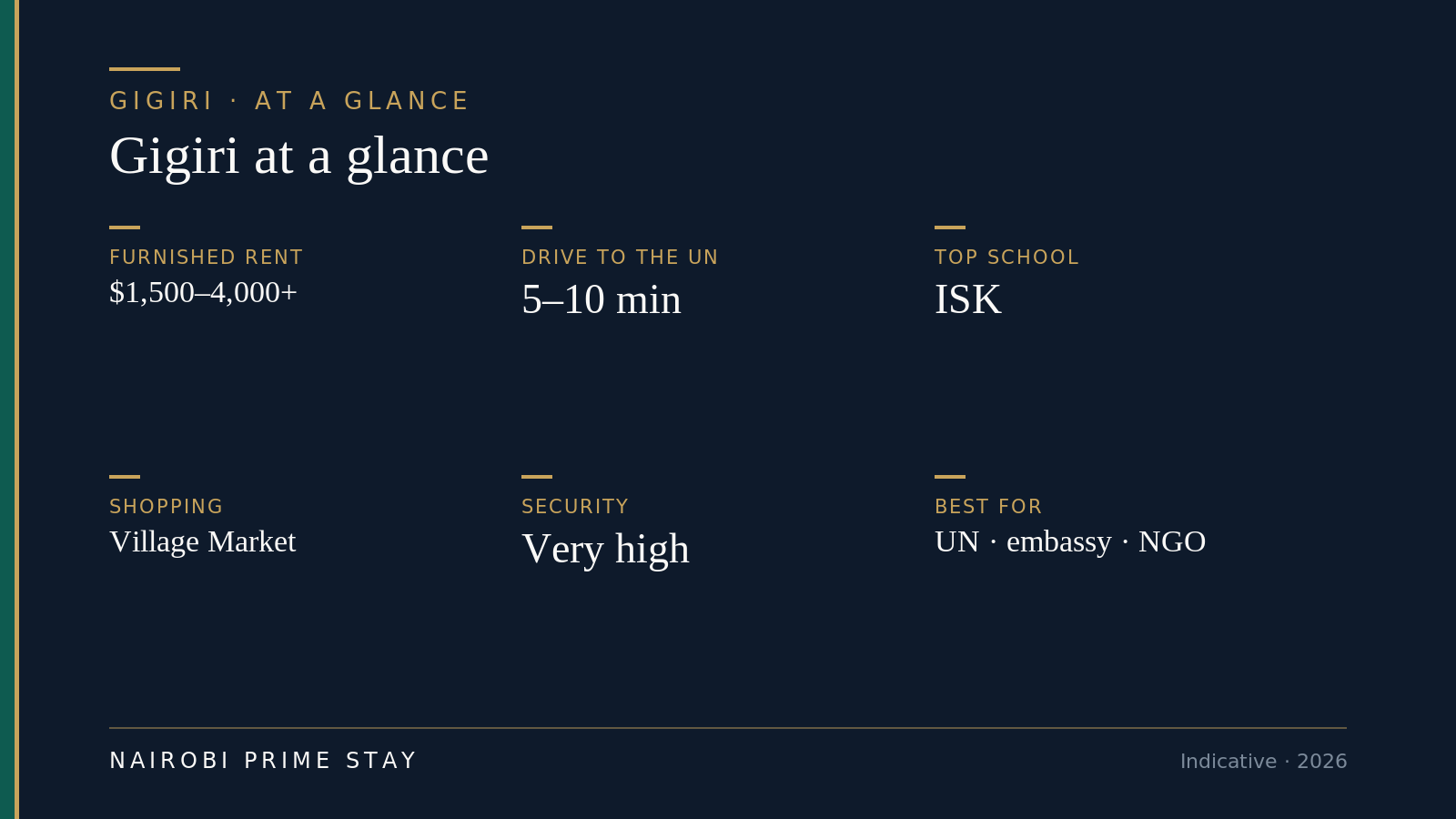
Gigiri at a glance.
Gigiri is Nairobi’s diplomatic heart — the green, heavily secured suburb that surrounds the UN headquarters and dozens of embassies, including the US Embassy. If you’re moving to Nairobi for the UN, an embassy or an NGO, this is almost certainly the first place to look. It’s calm, safe and leafy, with short commutes to the UN complex and the International School of Kenya right on its doorstep.
This guide covers what it’s actually like to live in Gigiri: who your neighbors are, how safe it feels, what rent costs, where you’ll shop and eat, the school and hospital picture, and the kind of apartments to look for. It’s written for someone who’s never been but may soon call it home.
The quick version
Gigiri is the top choice for UN, embassy and NGO staff because most homes are a 5–10 minute drive from the UN complex, and it’s one of the most secure parts of the city. It’s residential and quiet rather than buzzing, with Village Market as its social and shopping hub and ISK as its anchor school. Furnished homes run from about $1,500 to $4,000-plus a month. The trade-offs are price and a calm, low-key pace — you go to Westlands for nightlife. For diplomats and international staff who value security and a short commute, it’s hard to beat.
Who lives in Gigiri?
Gigiri’s population is unusually international. UN staff, embassy personnel, NGO and development workers, and their families make up much of the neighborhood, alongside senior professionals who value the security and calm. That gives it a ready-made expat community — your neighbors are often other recent arrivals from around the world, which makes settling in easier and social circles quick to form.
It skews toward families and established professionals more than young singles. If you want a quiet, safe, internationally minded base close to work and a top school, you’ll be among like-minded people. If you want to walk out the door into restaurants and bars, you’ll be driving to Westlands for that.
Is Gigiri safe?
Gigiri is among the most secure neighborhoods in Nairobi. The concentration of diplomatic missions means a visible, constant security presence and heavy patrols, and homes are almost universally in gated compounds or apartment blocks with 24/7 guards. Day-to-day, it feels calm and low-risk.
The usual Nairobi habits still apply — keep valuables out of sight, use Uber or Bolt at night, and choose a building with the full security setup. But the baseline here is reassuring, which is exactly why diplomats and families with kids gravitate to it. For the city-wide picture, see our Nairobi safety guide.
Rent and apartments in Gigiri
Gigiri sits at the higher end of Nairobi’s rental market, reflecting the location, security and demand from the diplomatic community. Indicative 2026 figures for furnished homes:
| Home type | Indicative furnished rent / mo |
|---|---|
| 1-bed apartment | $1,500–2,200 |
| 2-bed apartment | $2,000–3,500 |
| 3-bed apartment or townhouse | $2,800–4,000+ |
| Large house with garden | $3,500–4,000+ |
Unfurnished and longer leases cost less. The building stock ranges from modern serviced apartment blocks to gated townhouse compounds and standalone houses. As of mid-2026, current listings bear this range out: a simple furnished two-bed inside the UN zone can be found near $2,000 a month, while premium furnished two-beds close to United Nations Avenue run nearer $3,500–3,800. Pricing moves with the diplomatic posting cycle, so confirm live figures before you commit. Whatever you view, run the “Nairobi Five” check — backup generator, water storage, 24/7 security, fibre internet and responsive management — which most quality Gigiri buildings handle well. A typical good-fit apartment here looks like a two-bed in a secure block with a gym, backup generator and fibre, in the low-to-mid $2,000s a month. Landlords in the diplomatic areas often quote rent in US dollars, though some price in shillings, which traded near KES 129.4 to the dollar on 1 July 2026 — our USD/KES currency guide tracks the live rate.
You can browse serviced apartments in Gigiri for current, verified options with honest monthly pricing. For how Gigiri compares to other areas on price, see our cost of living guide.
Is your housing already arranged? Embassy, UN and NGO housing in Gigiri
Before you start browsing listings, check one thing: your employer may handle housing for you. A lot of people who move to Gigiri never rent on the open market at all — the mission or agency does it, or subsidizes it, and slots you into a home that already meets its security rules. Whether that’s you changes how much of the rest of this guide you need.
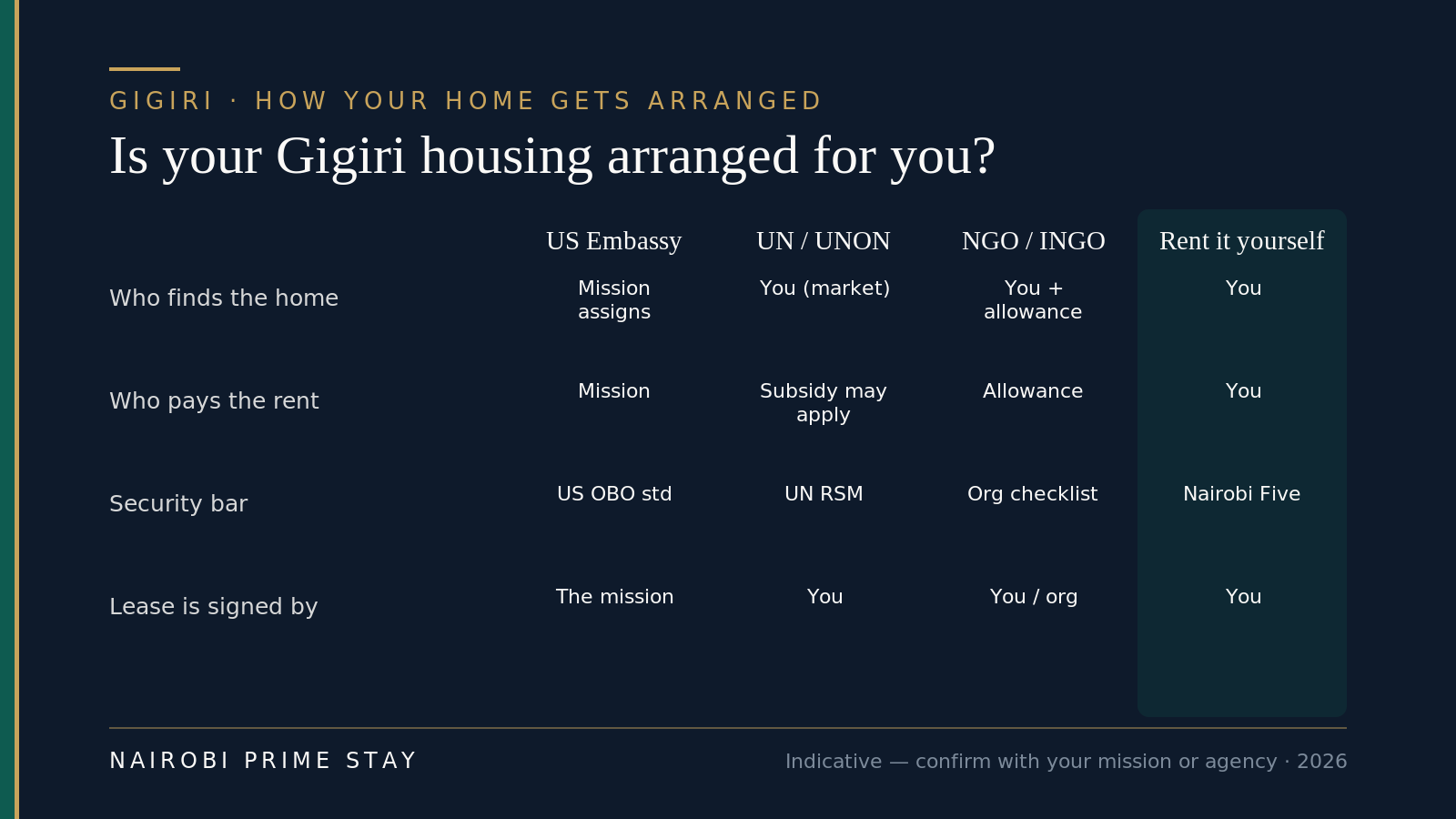
Four ways a Gigiri home gets arranged — confirm the specifics with your own mission or agency.
US embassy and other diplomatic missions. If you’re posted to the US Embassy on United Nations Avenue, housing is usually assigned, not chosen. An interagency housing board matches you to a residence sized to your rank and family, the property has to meet US State Department security standards, and the mission signs the lease and often furnishes the place from a pool. You get less say over the exact house, but far less to organize — and the security bar is handled for you.
UN and UNON staff. UN staff at the Nairobi complex usually find their own home on the open market, then have it cleared against the UN’s residential security measures before moving in. A rent subsidy may reimburse part of the cost above a salary threshold — the details depend on your grade and contract, so confirm them with your HR and security focal points. This is a big reason so many UN families cluster in Gigiri, Runda and Nyari: homes there clear residential security easily.
NGO and development staff. The most varied track. Larger international NGOs often give a housing allowance plus a security checklist your home must satisfy; smaller ones may leave it entirely to you. Either way you’re renting on the open market, so the rents, the “Nairobi Five” and the safe way to rent from abroad below all apply to you directly.
Renting it yourself. Remote workers, entrepreneurs, retirees and anyone whose employer doesn’t arrange a home rents like a local: you find the place, you check it against the “Nairobi Five”, and you sign and pay. That’s what the rest of this guide is for.
For the full picture of how organizational housing works — security compliance, allowances, timing and paperwork — see our guide to embassy, UN and NGO housing in Nairobi, and the where UN and diplomatic staff live map for how the diplomatic belt compares suburb by suburb.
Serviced apartments and a soft landing in Gigiri
A serviced apartment is the easiest way to start in Gigiri. Instead of wiring a deposit for a place you’ve only seen in photos, you land in a secure, fully furnished base — Wi-Fi, cleaning, a backup generator and 24/7 security all rolled into one monthly price — and use the first few weeks to view homes, test the school run and feel out the traffic before you sign a year-long lease. For UN and embassy staff arriving on a fixed start date, that soft landing takes a lot of pressure off the first month.
Serviced-apartment blocks cluster along and around United Nations Avenue and the roads near the UN complex, which is exactly where you want to be for a short commute. You’ll pay more per month than a bare long-let — you’re paying for flexibility and zero setup — but there’s nothing to furnish, no utility accounts to open, and no deposit lost on a place that turned out to be wrong. Most people stay four to eight weeks this way, then move once they’re sure of the area. Our full guide to serviced apartments in Nairobi explains what’s included, how the monthly pricing works, and how booking with a $50 deposit (balance on arrival) keeps your options open.
Renting a Gigiri home from the US
The single most important rule: don’t send money for a Gigiri home that no one you trust has seen in person. Gigiri’s rents are high and its arrivals are often relocating on a deadline, sight unseen — which is exactly the situation rental scammers look for. The classic setup is a beautiful listing at a slightly-too-good price, a warm, fast-moving “landlord” on WhatsApp, and a request to wire a deposit to a personal account or M-Pesa number to “hold” it before someone else does. The home is often real; the person collecting your deposit doesn’t own it.
The fix isn’t to distrust everyone — it’s to change the order you do things in.

Rent in this order and the deposit scam has nowhere to land.
Start with a serviced apartment for your first few weeks, not a year-long lease. That gives you a secure base in Gigiri while you view homes in daylight, test the commute and meet agents face to face — and it means you never have to wire a deposit from 8,000 miles away just to have somewhere to land. From there, shortlist two or three homes online, then ask for a live video walk-through: a real person walking through the actual rooms on a video call, not a polished clip that could be anyone’s apartment. Use your own agent — or a colleague already in Gigiri — to confirm the landlord actually controls the property before any money moves. View in person once you arrive, and pay a deposit only after you’ve signed a written lease with an inventory.
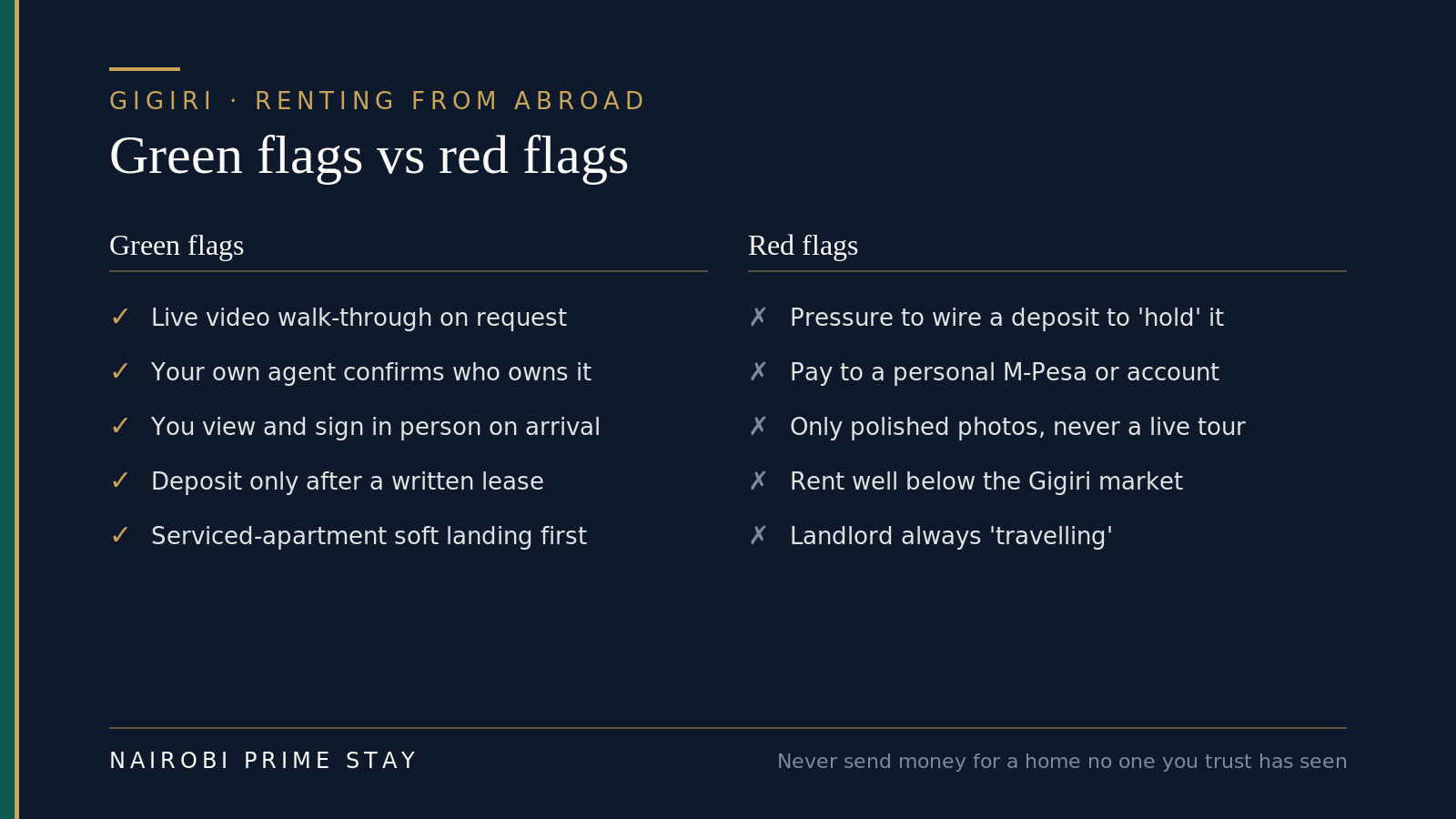
The tells are consistent — pressure, an odd payment channel, and a reason you can never see the place live.
A real Gigiri deal survives all of this easily; a scam falls apart the moment you ask for a live tour or independent verification. For the full playbook on deposits, leases and inventories, see our guides to how to rent an apartment in Nairobi and tenancy, leases and deposits in Kenya, and read up on common property and rental scams before you send a cent.
Can you buy property in Gigiri?
You can, but most Gigiri residents rent — and for good reason. Most people here are on two- or three-year diplomatic, UN or NGO postings, so buying rarely fits the timeline. If you’re staying long-term and want to buy, the key rule for foreigners is that non-citizens can own property on a leasehold basis of up to 99 years, but not freehold agricultural land. Gigiri homes are residential, so a long lease is the normal, legal route.
Do it properly. Hire your own conveyancing lawyer (not the seller’s), have them run an official land search to confirm the title and that the seller genuinely owns it, and pay into the lawyer’s client account against clear milestones — never cash to an individual. If you’re buying from the US, note that Kenya is not part of the Apostille Convention, so a power of attorney signed in the States has to be notarized and then legalized at a Kenyan embassy or consulate to be valid here. Our guides to whether foreigners can buy property in Kenya and diaspora property investment walk through the whole process.
The commute: Gigiri to the UN and beyond
The headline advantage is the commute to work for international staff. Most Gigiri homes are a 5–10 minute drive from the UN complex (UNON) and the embassies clustered along United Nations Avenue — in a city defined by traffic, that’s a genuine luxury. Many residents are at their desks before colleagues elsewhere have cleared the first roundabout.
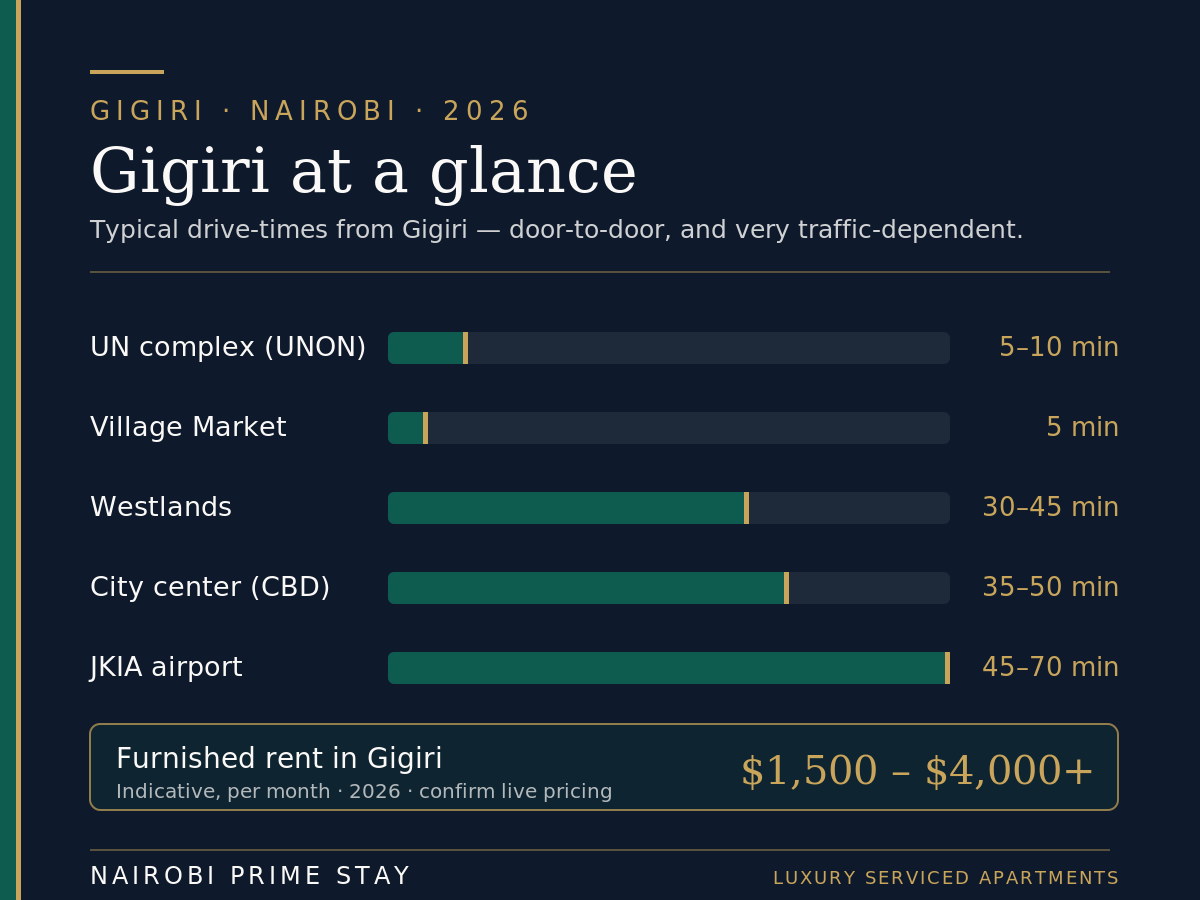
Typical door-to-door drive-times from Gigiri — they swing widely with rush-hour traffic. Gigiri’s strength is the UN and embassies, not downtown or the airport.
Getting to the city center or Westlands is a different story: budget 30–45 minutes or more in rush-hour traffic, since you’re on the northern edge of the city. The airport, JKIA, is a longer haul still — roughly 45 minutes to over an hour depending on traffic, which matters if you travel often for work. That’s the standard Gigiri trade — superb access to the UN and embassies, a longer haul to downtown and the airport. If your daily anchor is the UN complex, it’s the right side of that trade. Our moving to Nairobi guide explains why commute should drive your neighborhood choice.
Getting around Gigiri — and working from home
Gigiri works best with a car, but plenty of people manage without one. Uber and Bolt are the expat default here — reliable, cashless and a few dollars a hop — and most residents lean on them for evenings out and airport runs. Matatus (shared minibuses) work the main roads for under a dollar, though they take some learning and aren’t most newcomers’ first choice. If school runs or weekend escapes are in your week, a car earns its keep fast; if your life is the UN complex, Village Market and the odd night in Westlands, ride-hailing covers it. Kenya drives on the left, and a US licence is fine short-term with an International Driving Permit. See getting around Nairobi and our driving in Nairobi guide for the full picture.
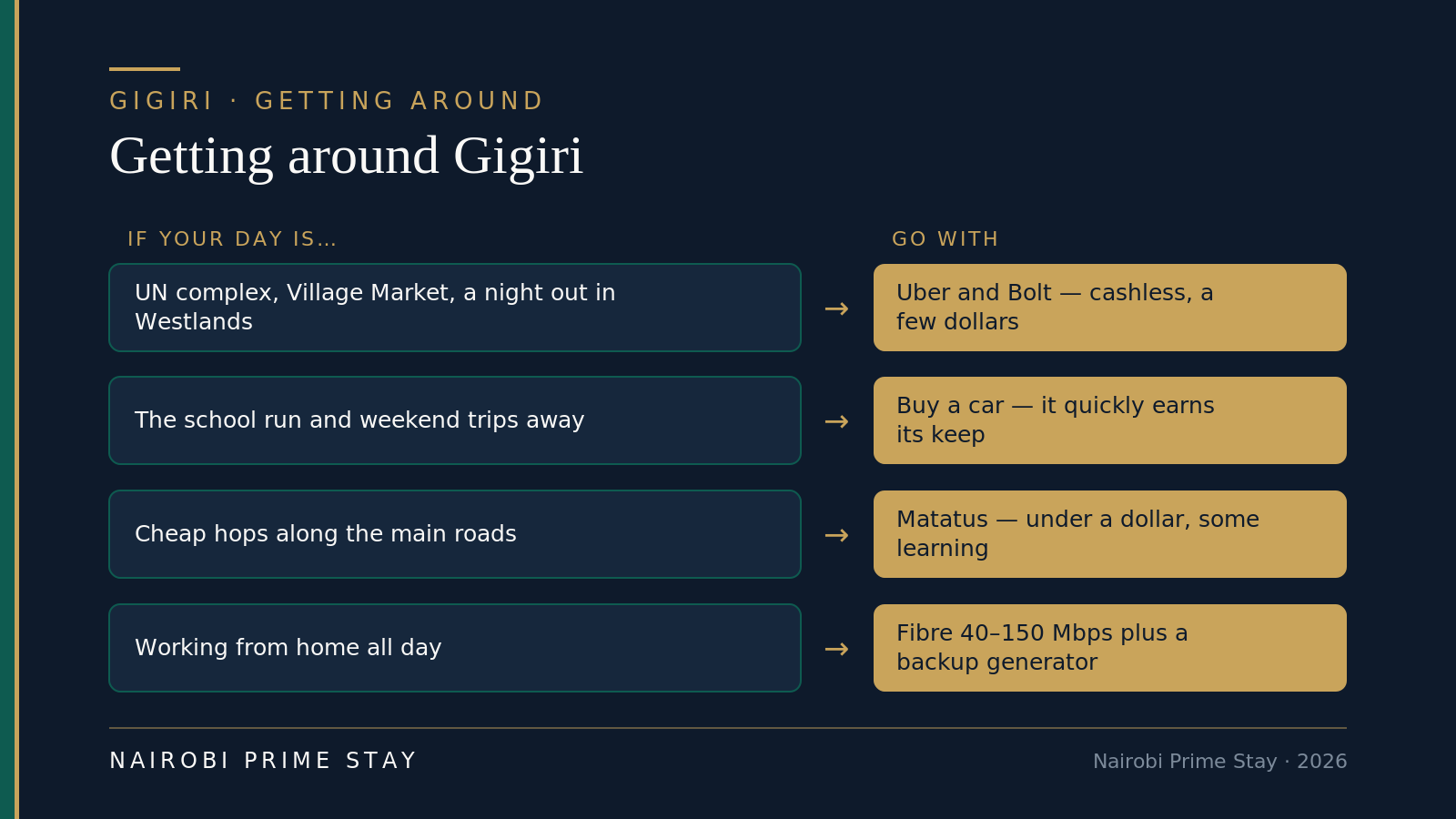
Match the way you get around to the kind of day you have in Gigiri.
Working from home in Gigiri is straightforward. Fibre reaches most apartment blocks — Safaricom, Zuku and Faiba all serve the area — so 40–150 Mbps plans are normal, and the UTC+3 time zone puts your afternoon over a US East-Coast morning. The one thing to check is power: outages happen citywide, so pick a building with a backup generator or run a small inverter to keep calls and Wi-Fi alive. If you’d rather work outside the apartment some days, Westlands and Lavington have the nearest coworking spaces and laptop-friendly cafés, a short drive south. Our internet and remote-work guide covers providers, speeds and backup power in depth.
Schools near Gigiri
Gigiri’s biggest draw for families is the International School of Kenya (ISK), which sits in the neighborhood and follows an American and IB curriculum. Living in Gigiri or neighboring Runda gives ISK families one of the shortest, most predictable school runs in the city — a major reason diplomats with children settle here.
ISK is a premium school, and the fees reflect it. As of the 2025/26 year, senior-grade (Grade 11–12) tuition runs about $37,300 a year, with younger grades lower (the K–12 range is roughly $19,900–$43,400), plus a one-time capital levy of around $11,000 per child on entry and a $400 application fee. Treat those as indicative and confirm the current schedule directly with ISK, since fees change yearly. Rosslyn Academy, with an American and AP program, is close by in Runda and costs roughly a third of ISK; Braeburn and other international schools are within reach too. Whatever you choose, apply early — the best schools keep waitlists — gather transcripts and records ahead of time, and let the school help fine-tune exactly where in or around Gigiri you settle. Families who prioritize space and gardens over the ISK school run sometimes choose Karen and its own cluster of schools instead, accepting the longer commute.
Shopping, eating and daily life
Village Market is the social and shopping anchor of Gigiri — a large mall with supermarkets, shops, restaurants, a food court, a curio and crafts market, and family attractions. For many residents it’s the default for groceries, errands and a casual meal. Nearby Two Rivers, just over in Ruaka, is one of the largest malls in the region, adding more retail, dining and cinema options a short drive away.
For everyday groceries you’ll find Carrefour and other supermarkets in these malls, stocking both local produce at local prices and the imported brands you might miss from home. Dining in Gigiri itself leans toward relaxed, family-friendly spots rather than a nightlife scene; for a bigger night out, Westlands is the destination. It’s a neighborhood built around comfortable daily life, not buzz — which is exactly what its residents want. For the full picture, see our guides to restaurants and dining in Nairobi and shopping, malls and markets.
Hospitals and healthcare near Gigiri
Gigiri is well placed for healthcare. Several of Nairobi’s leading private hospitals are a reasonable drive away in Parklands and Muthaiga — Aga Khan University Hospital (JCI-accredited) and MP Shah in Parklands, and Gertrude’s Children’s Hospital in Muthaiga for families. Private clinics and well-stocked pharmacies serve the area for everyday needs.
As anywhere in Nairobi, the plan is to carry strong private or international insurance with medical evacuation and use the private system. Our healthcare in Nairobi guide covers hospitals, insurance and costs in detail.
A week in the life: a UN family settling in Gigiri
Here’s how the first weeks tend to go for a family arriving in August for a UN posting — two parents, two kids, a dog and a fixed start date.
They land at JKIA and check into a serviced apartment near United Nations Avenue, booked before they flew, so a furnished, secure base is waiting — no hotel, no empty house to camp in. That first Monday, one parent reaches the UN complex in under ten minutes while the other finishes the ISK admissions paperwork they started months earlier. The kids tour the school that week; the dog clears its import paperwork and settles into a garden compound.
Weekends are Village Market for groceries and a haircut, a first nyama choma with neighbors who arrived a year ago, and a Sunday drive to the Giraffe Centre. By week four they’ve viewed five long-term homes, learned which roundabout to avoid at 8am, and signed a lease on a two-bed minutes from new friends. The serviced apartment did its job — it turned a high-stakes move into a soft landing, and the ready-made expat community did the rest.
Who Gigiri suits — and who it doesn’t
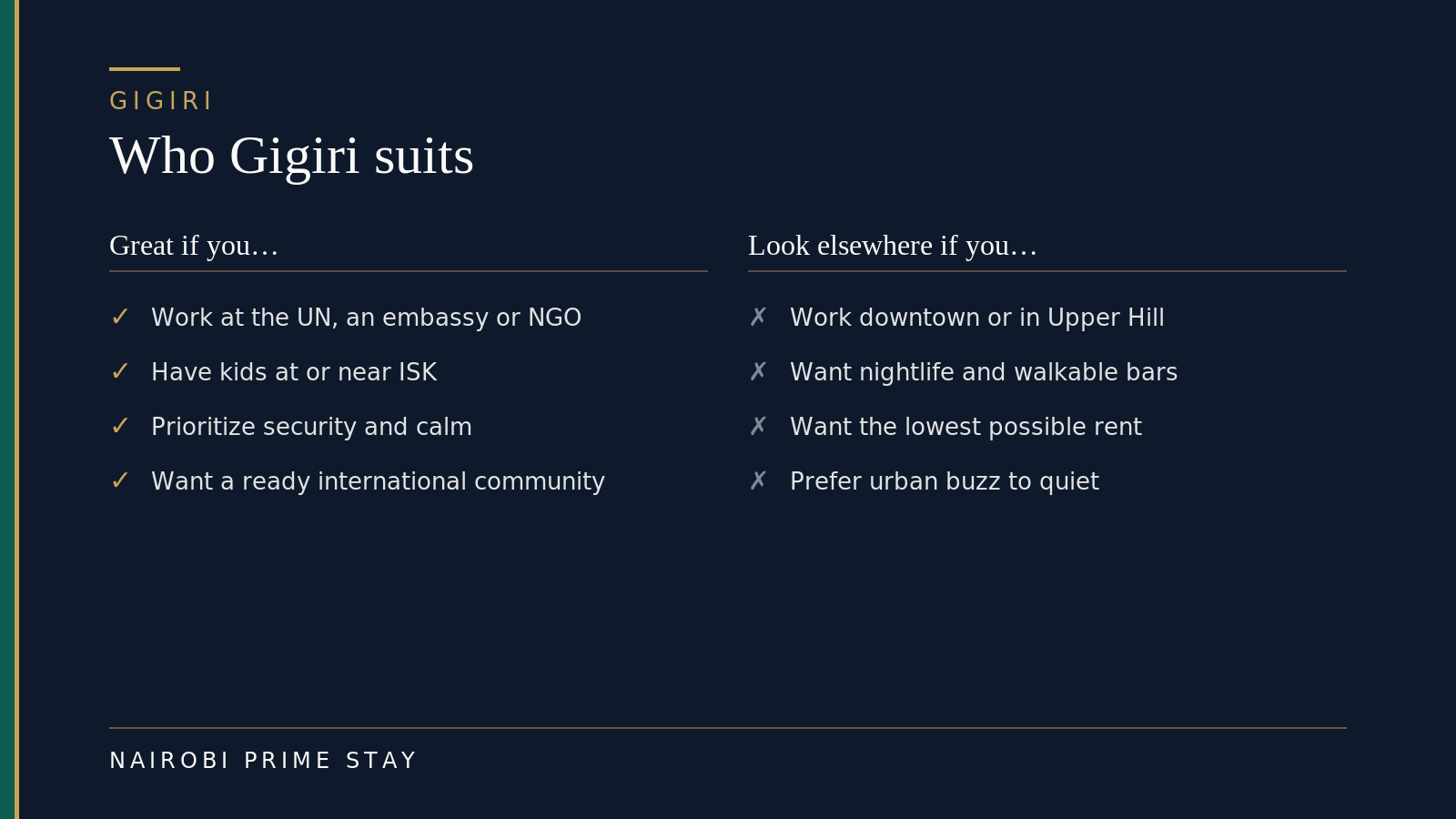
Is Gigiri your fit?
| Gigiri is great if you… | Look elsewhere if you… |
|---|---|
| Work at the UN, an embassy or an NGO | Work downtown or in Upper Hill |
| Have kids at or near ISK | Want nightlife and walkable bars |
| Prioritize security and calm | Want the lowest possible rent |
| Want a ready-made international community | Prefer urban buzz over suburban quiet |
| Value a short, predictable commute to the UN | Don’t mind a longer commute for a livelier area |
Gigiri, Runda or Muthaiga — the diplomatic cluster
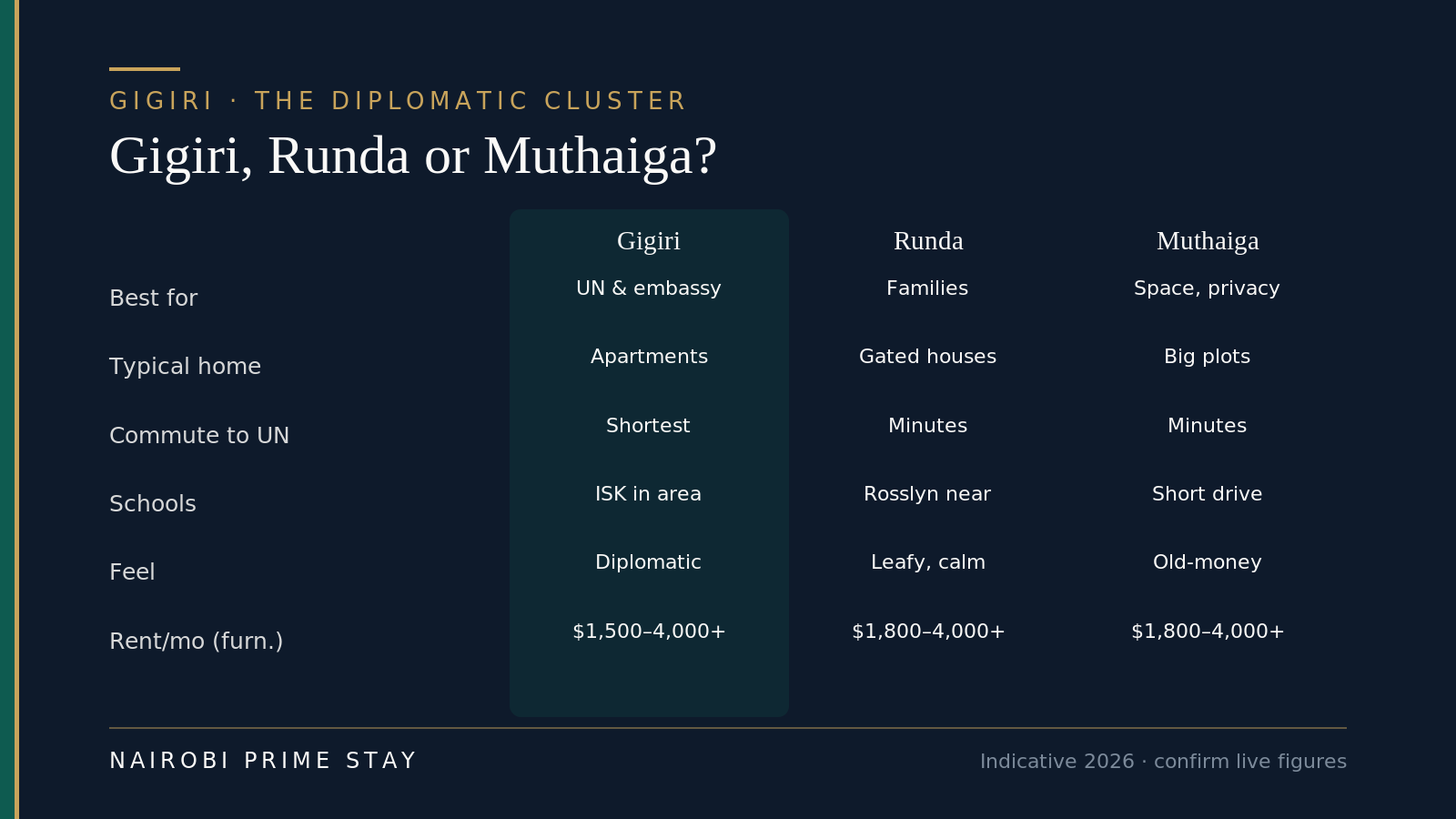
Gigiri, Runda or Muthaiga — the diplomatic cluster at a glance.
Gigiri rarely gets chosen in isolation. It sits in a tight cluster of three secure, leafy, diplomat-friendly suburbs on the city’s northern edge, and many arrivals weigh all three:
- Gigiri is closest to the UN complex and the embassies, and the most apartment-friendly of the three — the default for UN and embassy staff who want the shortest commute.
- Runda is mostly large gated houses with gardens, just north, and a favorite of families. Rosslyn Academy sits here and ISK is minutes away. Choose it for space; expect houses over apartments.
- Muthaiga is the old-money diplomatic address — big plots, mature gardens, very private, and home to Gertrude’s Children’s Hospital. Quiet and established.
All three rank among the city’s safest and most expensive areas, and all keep you close to ISK and the UN. The rule of thumb: Gigiri for the apartment and the commute, Runda for the family house, Muthaiga for space and privacy. Our best neighborhoods guide lays the wider map out side by side.
Your first two weeks in Gigiri: a checklist
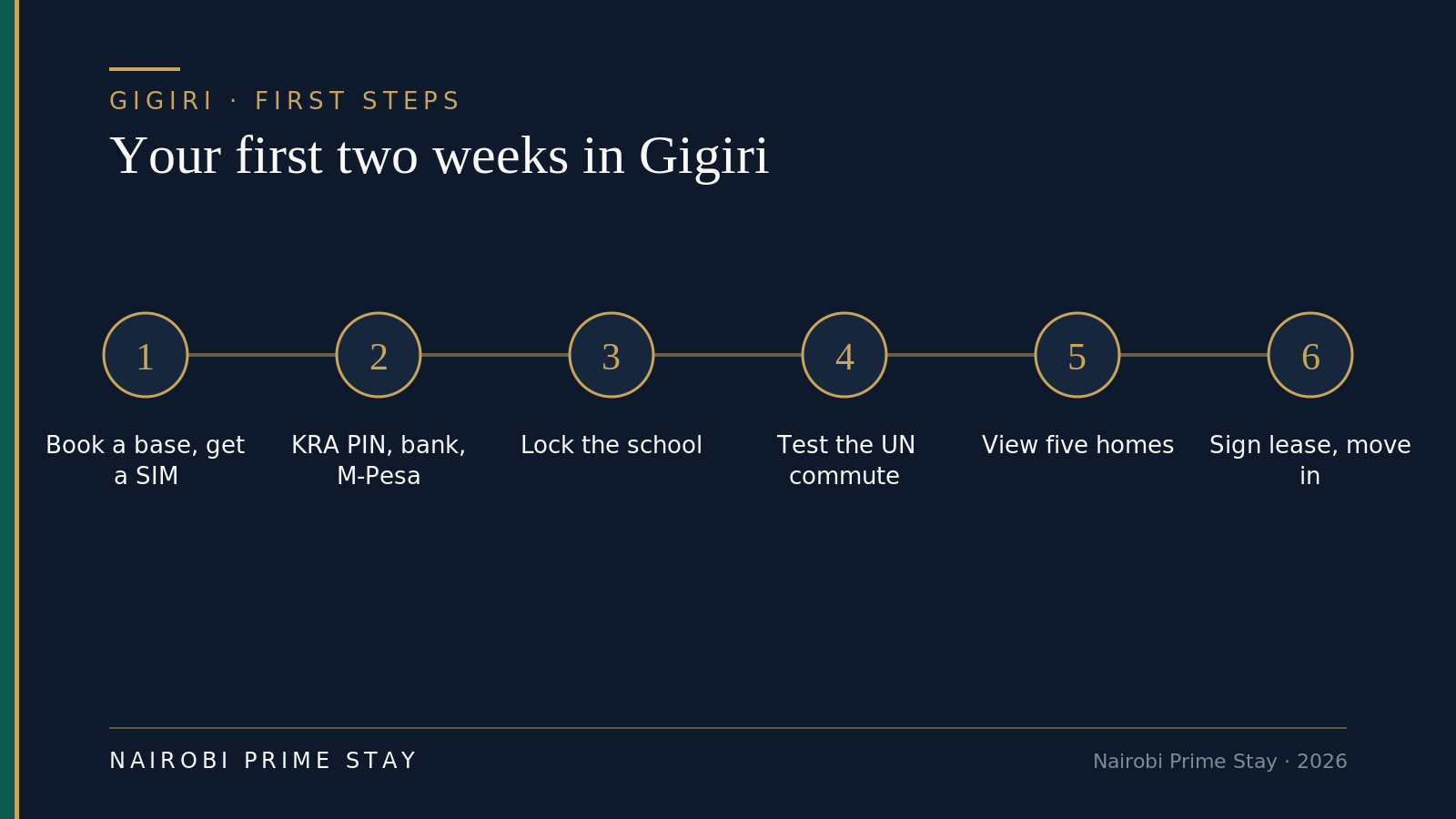
Your first two weeks in Gigiri, step by step.
Here’s the order that works for most people settling in.
- Land with a base booked. Arrive to a serviced apartment near United Nations Avenue, not a place you’ve only seen in photos. Grab a Safaricom SIM and M-Pesa at the airport.
- Sort the essentials. Register your KRA PIN once your permit is in hand, open a bank account, and load M-Pesa — it pays for almost everything in daily life.
- Lock the school. Confirm your ISK or Rosslyn place and start date early; the school run should shape where you settle.
- Map your commute. Drive Gigiri to the UN complex at 8am and again at 5pm before you fall for a particular house. Traffic, not distance, decides.
- View long-term homes. See five before you choose one, and run the Nairobi Five check — backup generator, water storage, 24/7 security, fibre and responsive management.
- Sign and move. Expect a 12-month lease, a written inventory and one to three months’ deposit plus the first month, then move from the serviced apartment into home.
Keep the moving to Nairobi hub open as your master list, and lean on the AI relocation assistant whenever a step stalls.
Frequently asked questions
Is Gigiri a good place to live in Nairobi? Yes, especially for UN, embassy and NGO staff and families. It’s one of the most secure, green and internationally minded neighborhoods in the city, with a short commute to the UN complex and the ISK school on its doorstep. The trade-offs are higher rents and a quiet, residential pace.
How much is rent in Gigiri? Indicative 2026 furnished rents run from about $1,500 a month for a one-bed apartment to $4,000-plus for a larger home or house with a garden. Unfurnished and longer leases cost less; serviced apartments cost more per month but include utilities, internet, cleaning and security.
Is Gigiri safe? It’s among the safest areas in Nairobi, thanks to the heavy security presence around the UN and embassies and the prevalence of gated, guarded homes. Standard city precautions still apply, but the day-to-day feel is calm and low-risk.
How far is Gigiri from the UN headquarters? Most Gigiri homes are a 5–10 minute drive from the UN complex (UNON) and the embassies along United Nations Avenue — one of the shortest commutes available to international staff in a traffic-heavy city.
What schools are near Gigiri? The International School of Kenya (ISK), with an American and IB curriculum, sits in Gigiri itself — one of the shortest school runs in the city for families who live here. As of the 2026/27 year, senior-grade tuition runs about $37,300 a year (younger grades cost less, with a roughly $19,900–$43,400 range across K–12), plus a one-time capital levy near $11,000 per child on entry and a $400 application fee; confirm the current schedule directly with ISK. Rosslyn Academy (American and AP) is close by in Runda at roughly a third of ISK’s senior tuition, and Braeburn and other international schools are within reach. Apply months ahead — the best schools keep waitlists.
What is there to do in Gigiri? Daily life centers on Village Market — a large mall with supermarkets, restaurants, a food court, a craft market and family attractions — with Two Rivers, one of the region’s biggest malls, a short drive away in Ruaka. Gigiri itself is relaxed and family-friendly rather than a nightlife hub; for bars and a livelier scene, people drive to Westlands. Nairobi National Park, the Giraffe Centre and the elephant orphanage make easy weekend trips.
Gigiri, Runda or Muthaiga — which should I choose? All three are secure, leafy and close to ISK and the UN, so it comes down to what you want. Choose Gigiri for the shortest commute to the UN and embassies and the widest choice of apartments; Runda for a large family house with a garden; Muthaiga for old-money space, big plots and privacy. Many arrivals view all three before deciding.
Should I book a serviced apartment before moving to Gigiri? It’s the easiest way to start. A serviced apartment for your first four to eight weeks gives you a secure, furnished base near the UN — Wi-Fi, cleaning, a backup generator and 24/7 security included — while you view homes, test the school run and feel out the traffic before signing a 12-month lease. A $50 deposit reserves your dates and the balance is paid on arrival.
Can you live in Gigiri without a car? You can, but many residents end up with one. Uber and Bolt are reliable and cheap, and they cover evenings out and airport runs; matatus work the main roads for under a dollar if you don’t mind learning the routes. The catch is the school run and weekend trips — if you have kids or like to explore, a car quickly earns its place. For a life centered on the UN complex and Village Market, ride-hailing is plenty.
Is Gigiri good for remote work and home internet? Yes. Fibre from Safaricom, Zuku and Faiba reaches most apartment blocks, so 40–150 Mbps plans are normal, and Nairobi’s UTC+3 time zone puts your afternoon over a US East-Coast morning. The one thing to confirm is a backup generator or inverter, since power cuts happen citywide. Westlands and Lavington have the nearest coworking spaces if you want a change of scene.
Can I rent a home in Gigiri from abroad before I arrive? You can line one up, but don’t pay a deposit for a home no one you trust has seen in person. Gigiri’s high rents and deadline-driven arrivals make it a target for rental scams, where a fake ‘landlord’ collects a deposit for a property they don’t own. The safe order is to soft-land in a serviced apartment, get a live video walk-through, have your own agent confirm the landlord controls the property, then view, sign a written lease and pay only once you’re there.
Does the UN or my embassy arrange housing in Gigiri? Often, yes. US Embassy staff are usually assigned a home by an interagency housing board, built to State Department security standards, with the mission signing the lease. UN staff typically find their own home on the open market but must clear it against UN residential security rules, sometimes with a rent subsidy. NGO staff usually get a housing allowance plus a security checklist. Confirm the specifics with your own mission or agency.
Can foreigners buy property in Gigiri? Yes, but most residents rent because postings are short. Non-citizens can own on a leasehold basis of up to 99 years (not freehold agricultural land), and Gigiri homes are residential, so a long lease is the normal route. Use your own conveyancing lawyer, insist on an official land search to confirm the title, and pay into the lawyer’s client account — never cash to an individual.
Final thoughts
Gigiri is the most straightforward neighborhood call in Nairobi. If your work anchors at the UN, an embassy or an NGO, you’ll be hard pressed to beat the security, the short commute and the ready-made international community — and ISK on the doorstep settles it for many families. The trade-offs are honest ones: you’ll pay a premium, and you’ll drive to Westlands for a big night out. For most diplomats and international staff, that’s a trade worth making. If you’re still weighing areas, line Gigiri up against the rest of the city before you commit.
Related reading
- Best neighborhoods in Nairobi · Karen neighborhood guide · Thigiri · Runda · Muthaiga neighborhood guides
- Gigiri vs Westlands compared — diplomatic calm vs central buzz, head to head
- Where UN & diplomatic staff live in Nairobi — Gigiri vs Nyari, Rosslyn, Runda and Muthaiga, ranked for the diplomatic community
- Is Nairobi safe? · Cost of living in Nairobi
- Healthcare in Nairobi · Serviced apartments in Nairobi
- Embassy, UN & NGO housing in Nairobi · How to rent in Nairobi · Tenancy, leases & deposits · Common property & rental scams
- Moving to Nairobi: the complete guide
Moving to Nairobi for the UN, an embassy or an NGO? Browse serviced apartments in Gigiri for a secure, all-inclusive soft landing minutes from the UN complex, or see the full apartment catalogue across the city. Not sure which area or building fits your commute and budget? Our AI relocation assistant can shortlist homes in a couple of minutes. A $50 deposit reserves your place; you pay the balance when you arrive.
Ready to look?
Find your apartment in Nairobi
Browse verified serviced apartments, or ask the AI concierge which area fits your life.