
Guides · Neighborhoods
Nyari Nairobi Neighborhood Guide: The Diplomats' Secure Gated Estate (2026)
Nyari Nairobi Neighborhood Guide: The Diplomats’ Secure Gated Estate

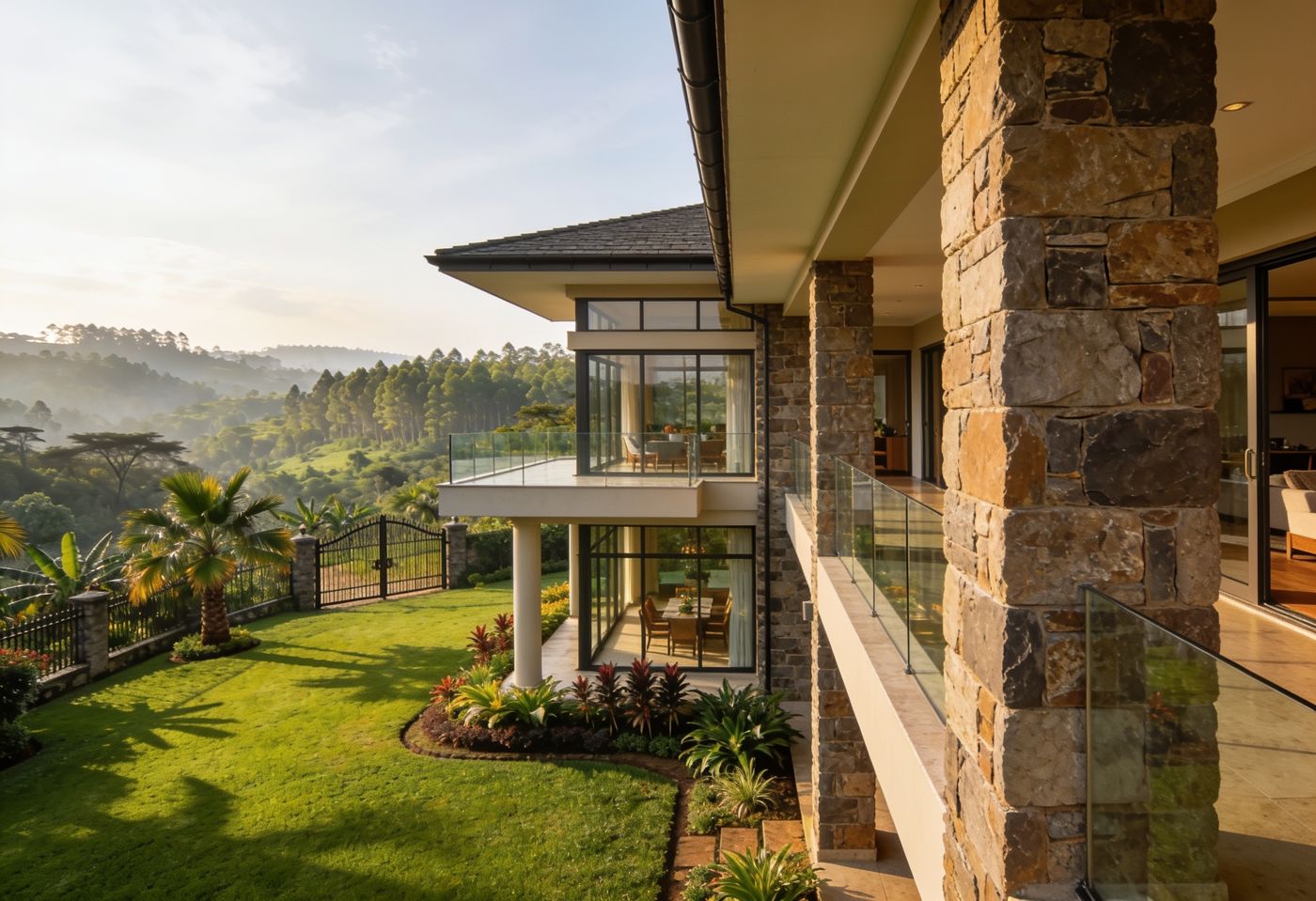
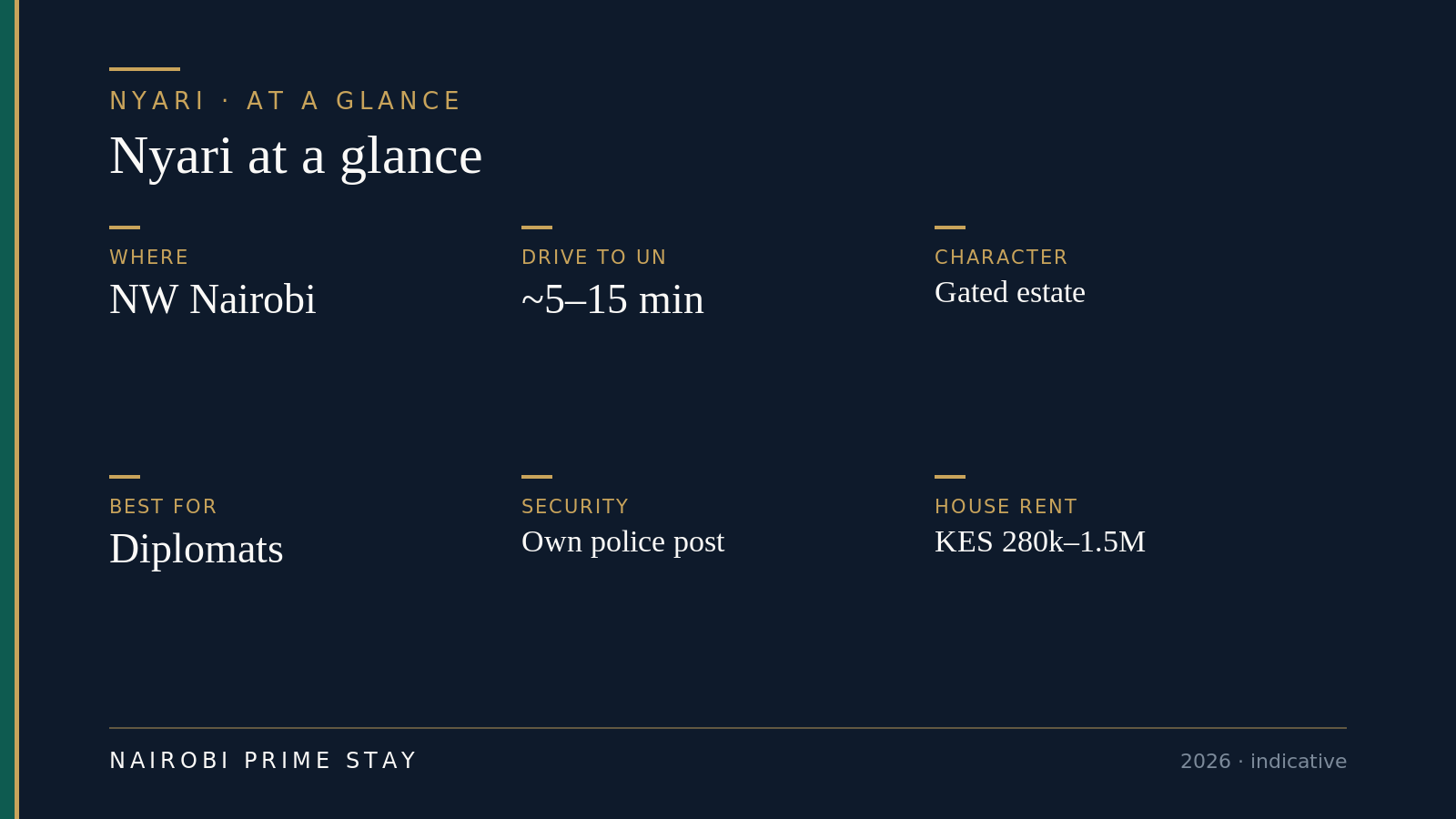 Nyari at a glance — a small, heavily secured estate built around diplomats, families and privacy.
The quick version
Nyari is a small, gated, upscale estate in north-west Nairobi, tucked between Gigiri, Runda and Kitisuru, about 10 km from the city centre. It’s one of the most secure residential pockets in the city — it has its own police post at the entrance and 24-hour patrols — which is exactly why diplomats, UN and NGO families, and senior executives keep choosing it.
Most homes are large standalone villas and townhouses on generous compounds, many of them ambassadorial residences. There’s a small but growing cluster of modern apartments around Enaki Town on the Nyari–Rosslyn edge, but Nyari is mostly a house neighborhood. As of 2026, furnished houses run roughly KES 280,000 to over KES 1.5 million a month (about $2,150 to $11,500+), with apartments from around KES 90,000. The big draw is the short, secure run to the UN and to the International School of Kenya. The trade-offs are price, near-total reliance on a car, and very little street life.
If you want a private, well-guarded base near the UN and the top schools — and budget isn’t your first worry — Nyari is one of the best fits in Nairobi. If you want value, walkability, or nightlife, Nyari is not your area, and we’ll cover who it suits and who it doesn’t in detail below.
Why Nyari matters when you’re new
For most Americans moving to Nairobi, the housing decision comes down to one question: where do you feel safe, and how far is it from work and school? Nyari answers both cleanly. It sits in the diplomatic belt around Gigiri, so the commute to the UN headquarters and the embassies is short, and its security is a notch above almost anywhere else in the city.
That’s why you’ll meet so many UN staff, embassy families, NGO country directors and corporate executives here. It’s not a flashy address in the way a glossy new tower is flashy. It’s the quiet, walled, slightly hidden kind of address — the sort of place where you don’t notice the houses from the road because they’re behind tall hedges and gates. For a certain kind of newcomer, that’s the whole appeal.
This guide gives you the honest picture: where Nyari is, who lives there, how safe it really is, what you’ll pay, how you’ll get around, and how it stacks up against its neighbors. For the bigger picture, start with our complete guide to moving to Nairobi and our best neighborhoods in Nairobi overview, then come back here when Nyari is on your shortlist.
Where exactly is Nyari?
Nyari is in north-west Nairobi, roughly 10 km from the central business district, set between Red Hill Road, Thigiri Ridge Road and Ngecha Road. It borders Kitisuru to the south-west, sits just below Runda and the Gigiri diplomatic zone to the north and east, and is close to New Muthaiga and the ridge-top enclave of Thigiri. Administratively it falls within the larger Westlands area, but day to day it lives and feels like part of the Gigiri–Runda–Kitisuru cluster.
The estate is usually split in conversation into Nyari West and Nyari East, divided by the valley and the access roads. Both are gated and patrolled. The main controlled entrance is the police post on Ngecha Road, which checks vehicles in and out — one of the features that makes Nyari feel more locked-down than a typical Nairobi suburb.
Practically, that location is the point. You’re minutes from the UN complex and the embassies in Gigiri, a short drive from the International School of Kenya, and close to Village Market and Two Rivers for shopping. You’re also close to Karura Forest, the big protected green space on Limuru Road, for weekend walks and runs. What you’re not close to is the city centre or the nightlife of Westlands — those are a traffic-dependent drive away.
Who lives in Nyari?
Nyari is, more than almost any other Nairobi suburb, a diplomats’ estate. Its proximity to the UN and the embassies in Gigiri, combined with its security, has made it a long-standing favourite with ambassadorial staff, UN and NGO families, and senior executives — both expat and Kenyan. Several homes are official residences or are leased long-term by missions and international organisations.
The result is a quiet, international, family-heavy community. Your neighbors are as likely to be a country director, a diplomat, or a regional head of an aid agency as a local business owner. People keep to themselves — this isn’t a block-party neighborhood — but it’s safe, settled, and used to newcomers arriving on two- and three-year postings. If you’re moving with an organisation that already houses people here, you’ll find a ready-made network of colleagues nearby.
It also means demand is steady and leases tend to be long. Landlords are used to dealing with missions, relocation agents and corporate tenants, which can make the rental process more formal — and the rents firmer — than in a buzzier, more churn-heavy area like Kilimani or Westlands. For a sense of how missions and agencies spread their people across the western suburbs, see our guide to where UN staff live in Nairobi.
Is Nyari safe?
Nyari is one of the most secure residential areas in Nairobi. That’s not marketing — it’s the single biggest reason people choose it. The estate has its own police post at the controlled entrance on Ngecha Road, where vehicles are checked in and out, plus 24-hour patrols that include diplomatic police thanks to the embassy presence nearby. On top of that, almost every individual home sits behind a wall, a gate, an electric fence and often a private guard, with alarms and CCTV as standard.
In practice, that layered security — estate-level access control, area patrols, and per-home defences — makes Nyari feel about as locked-down as residential Nairobi gets. The realistic risk for residents is opportunistic property crime, not violence, and serious incidents inside the estate are uncommon. The usual big-city sense still applies: keep your gate habits tight, don’t leave valuables visible in a parked car, and use Uber or Bolt rather than walking after dark, since there are no busy, well-lit streets to walk along anyway.
For the full national picture — what’s genuinely a concern, what’s overblown, and how expat life actually feels day to day — read our honest take on whether Nairobi is safe. The short version for Nyari: if security is your top priority, few addresses in the city beat it.
Rent and homes in Nyari
Nyari is an expensive, house-dominant neighborhood, and you should budget accordingly. As of 2026, the average house here rents for somewhere around KES 430,000 a month, with most four-bedroom family homes falling between roughly KES 280,000 and KES 1.5 million depending on size, plot, finish, and extras like a pool, staff quarters or a guest wing. At about 129 shillings to the dollar (the shilling traded near KES 129.4 on 1 July 2026 — see our USD/KES currency guide for the live rate), that’s roughly $2,150 to $11,500+ a month — a wide range, because Nyari spans comfortable family townhouses up to sprawling ambassadorial villas.
Apartments are the exception, not the rule. A small but growing cluster of modern flats has appeared around Enaki Town, on the Nyari–Rosslyn border, bringing gyms, pools and lock-up-and-go convenience to an area built around big houses. Apartments start from around KES 90,000 a month and average near KES 200,000 for a two- or three-bed in a smart development, with furnished two-beds often in the KES 150,000 to 260,000 range. If you specifically want an apartment, you’ll have far more choice — and lower prices — in nearby Westlands, Kitisuru’s newer blocks, or Kileleshwa.
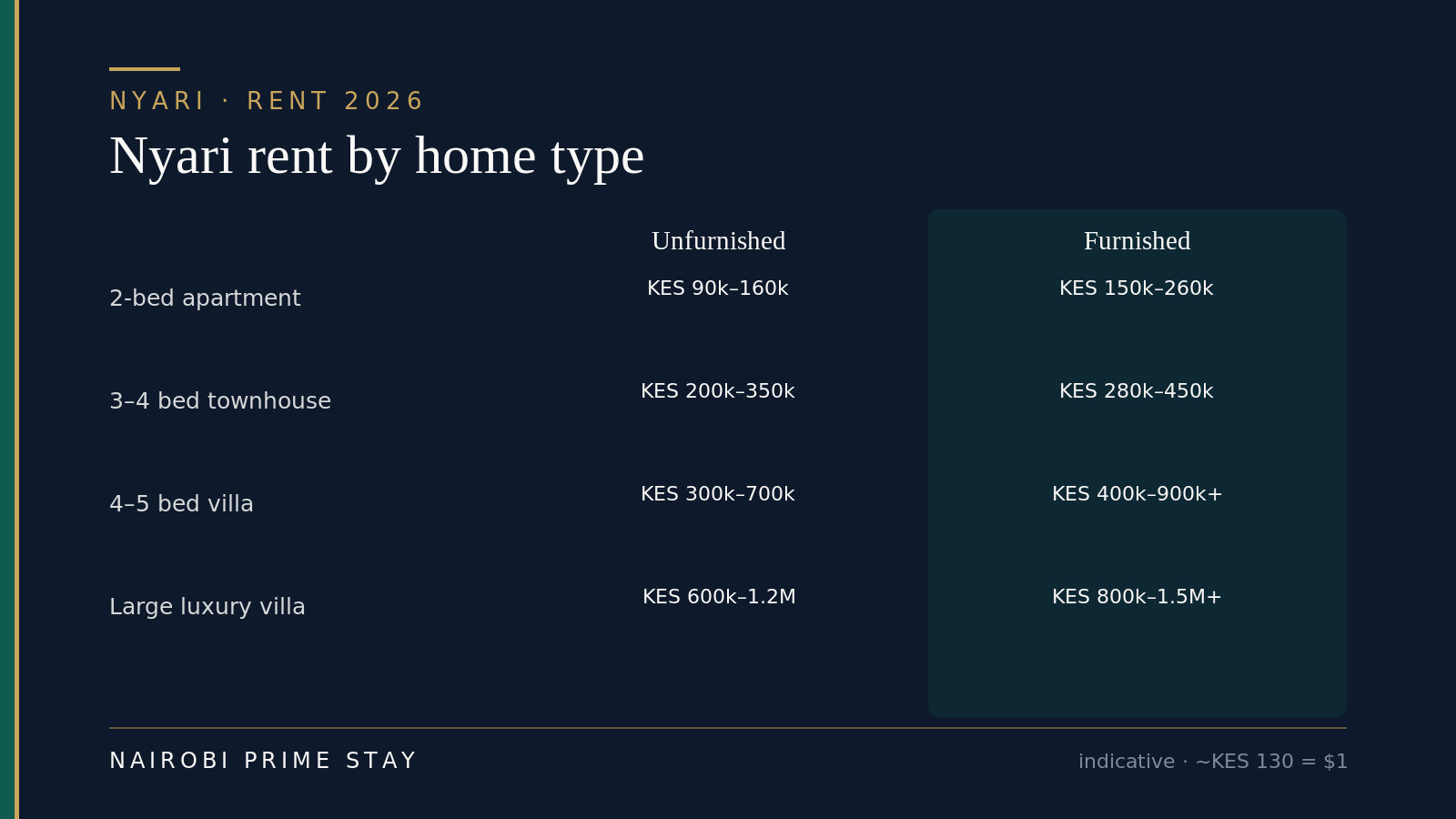 Indicative 2026 ranges. Furnished costs more; longer leases and unfurnished homes cost less. Always confirm the current figure with the agent and see the place in person.
These are indicative ranges to orient you, not quotes. Actual rent depends heavily on the specific estate, the plot size, the age and finish of the house, and what’s included — service charge, security, water, and whether the garden and pool come with a gardener. Get the full picture in writing before you sign, and read our Nairobi cost of living guide to slot rent into a realistic monthly budget for groceries, transport, domestic help and schooling.
A few practical notes specific to Nyari homes. Most run on a borehole or tanked water with a backup generator, which you want — confirm both. Fibre internet is widely available (more on that below). And because so many homes are leased by missions and companies, expect a formal process: a written lease, an inventory, a deposit of one to three months plus the first month up front, and a KRA PIN and valid permit required to sign. Never wire money for a home you haven’t seen; arrange viewings once you’re on the ground.
Serviced apartments and a soft landing near Nyari
Here’s the honest advice we give everyone eyeing Nyari: don’t sign a year-long lease on a big house before you’ve spent time in the area. Nyari homes are expensive and let on long leases, the process is formal, and the estate’s quiet, walled character is something you really need to feel before you commit. The smart move is a soft landing.
A serviced apartment for your first four to eight weeks gives you a secure, fully equipped base — Wi-Fi, cleaning, a backup generator and security all included — while you view homes in person, drive the school run and the UN commute at rush hour, and decide whether Nyari or a neighbor like Runda or Gigiri fits you better. It’s all-inclusive and flexible, with none of the furniture, utility and setup headaches of an empty house. You move once you’re sure.
Because Nyari itself is mostly large houses, your serviced-apartment options will often sit in the surrounding cluster — Gigiri, Westlands and the newer developments nearby — all a short drive away. We can place you within easy reach of the UN and the schools while you search. When you’re ready, browse our serviced apartments near Nyari and Gigiri, or let our AI relocation assistant shortlist options around your commute and budget in a couple of minutes.
Renting a Nyari home from the US
Plenty of people rent a Nyari house before they ever set foot in Nairobi — a posting starts, the family flies in, and the home is waiting. It can be done safely, but Nyari’s houses are let almost entirely through agents, and that’s exactly where remote renters get burned. The rule that keeps you safe is short: never send money for a home no one you trust has seen live.
The common scam is simple. A “landlord” or “agent” posts a real-looking villa with photos lifted from an old listing, says it’s in demand, and asks for a deposit to hold it — by M-Pesa or wire, before any viewing. You pay, and the listing vanishes. The defense is just as simple. Treat every unseen home as unverified until proven otherwise, and insist on a live video walkthrough: a real person walking through the actual house on a video call, showing the road, the gate and the generator, not a polished clip that could be anyone’s. Use your own agent rather than only the one attached to the listing, and have them confirm the landlord genuinely owns or controls the property before a shilling moves.
The clean way to do it is a soft landing. Book a serviced apartment near Gigiri for your first few weeks, then view Nyari houses in person and pay your deposit only once you’re on the ground and the home checks out. Our walkthrough of how to rent an apartment in Nairobi covers agents, viewings and paperwork; our guide to tenancy, leases and deposits in Kenya explains the one-to-three-months-plus-first-month norm and what a proper lease and inventory should include; and if you’re torn between a furnished or empty house, furnished vs unfurnished in Nairobi lays out the math. For the wider picture, spend ten minutes with our guide to property and rental scams in Kenya before you pay anyone.
 The safe sequence for renting from abroad. If anyone asks you to pay before a live viewing, walk away.
The honest downside: pricey, car-dependent and very quiet
Nyari’s strengths are also its limits, and it’s only fair to be blunt about them.
It’s expensive. You’re paying a premium for security, space and the diplomatic location, and there’s very little budget housing. If rent is your main constraint, your money goes much further in Kilimani, Kileleshwa or parts of Westlands.
It’s car-dependent. Nyari is low-density, gated and spread across a valley, with no walkable high street, no row of shops, and no café you can stroll to. Daily life without a car is genuinely hard. Uber and Bolt cover the area well and are a fine substitute if you don’t drive, but most residents keep a car for school runs, shopping and weekends.
It’s quiet — sometimes too quiet. The same hedges and gates that make it private also make it sleepy. There’s no street life, no buzz, and nothing happening within walking distance. For families and people who value calm, that’s the appeal. For singles, young professionals, or anyone who wants to walk out the door into a city, it can feel isolating.
And apartment choice is thin. If you want a modern flat with a gym and a pool and lots of options to compare, Nyari has a handful around Enaki Town and not much else. The buzzier apartment markets are a short drive away in Westlands and Kilimani.
None of this is a knock if you came for security and space. It’s only a problem if you wanted something Nyari was never trying to be.
Getting around Nyari
You’ll get around Nyari mostly by car, and the headline is good: the places that matter to this community are close. The UN headquarters and the Gigiri embassies are roughly a 5 to 15 minute drive depending on which gate you use and the time of day. The International School of Kenya is similarly close. Village Market in Gigiri, for groceries and errands, is minutes away.
Further out, Westlands is about 10 to 20 minutes off-peak, and the central business district is roughly 25 to 40 minutes, traffic depending. Those numbers balloon at rush hour — Limuru Road and the approaches to town clog between about 7 and 9 in the morning and 5 and 7 in the evening, so a 15-minute off-peak hop can easily double. The single most important thing you can do before signing a lease anywhere in this part of Nairobi is to drive your actual commute at 8am on a weekday. Distances here are short; traffic is not.
For the airport, budget 45 minutes to well over an hour to JKIA depending on traffic, since you’re crossing the city to reach it. There are two ways down once you clear Westlands: the surface roads via Uhuru Highway and Mombasa Road, or the tolled Nairobi Expressway, which skips the worst of the crawl for a toll you pay by card, M-Pesa or cash. Off-peak either is about 45 minutes; in rush hour the surface route can push past 75. Wilson Airport, on the south side, handles light aircraft for safari and regional hops. Uber and Bolt are the expat default for getting around — safe, cheap and payable by card or M-Pesa — and they serve Nyari and the surrounding cluster reliably. Many residents still buy a car, especially families doing daily school runs. For the bigger picture on driving, ride-hailing and traffic, see our getting around Nairobi guide, the JKIA airport guide and our moving to Nairobi guide.
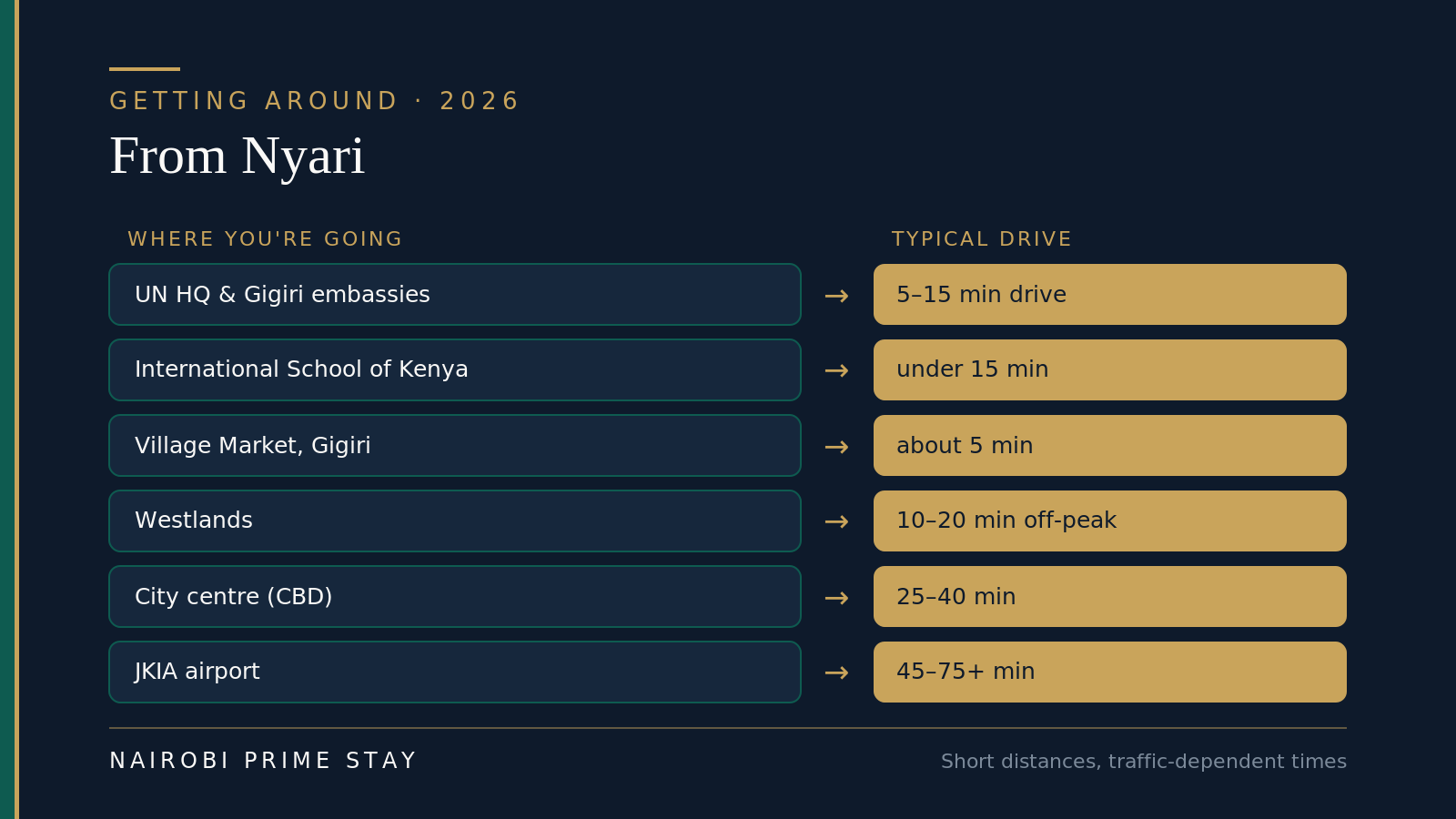 How far Nyari really is from the places you’ll go — short distances, traffic-dependent times. Drive your own commute at 8am before you sign.
Work and remote work in Nyari
Nyari works well for remote workers who want a calm, secure home office, with one caveat: set up your power and internet properly. Fibre is widely available across the Gigiri–Runda–Nyari belt — Safaricom Home Fibre, Zuku and Faiba all serve the area — so fast, reliable home broadband is straightforward to arrange. Confirm a provider already reaches your specific house or estate before you sign, as coverage can vary street to street.
Power cuts do happen in Nairobi, so the thing that keeps your workday alive is a backup generator or your own inverter or UPS. Many Nyari homes already have a generator; check it’s there and working. With fibre and backup power sorted, the quiet is an asset — this is a genuinely good place to take calls and focus. Kenya runs on UTC+3, so your mornings are heads-down and your afternoons overlap the US East Coast’s start, which suits a lot of remote roles. Our internet and remote work guide covers fibre tiers, backup power and coworking in more detail.
For days you want to get out of the house, the coworking spaces and laptop-friendly cafés of Westlands are a short drive away — handy, since Nyari itself has nothing walkable.
Shopping, eating and the outdoors
Nyari has no high street of its own, but it’s wrapped by some of the best amenities in this part of the city. Village Market in Gigiri is the closest hub — a large mall with supermarkets, restaurants, a food court, banks and a weekend craft market, all a few minutes away. Two Rivers, one of the biggest malls in East Africa, is a short drive north in Ruaka and adds more shopping, dining and entertainment. Between them you’re well covered for groceries (Carrefour and others), pharmacies, and everyday errands.
For eating out, the cluster around Gigiri and Runda has plenty of good restaurants and cafés, and Westlands — Nairobi’s dining and nightlife heartland — is close when you want more range. The point is that while Nyari is quiet, you’re never far from a full menu of options; you just drive to them.
The outdoor draw is Karura Forest, the large protected urban forest on Limuru Road, minutes away. It’s a Nairobi favourite for walking, running and cycling on safe, well-kept trails, with a waterfall and cafés inside. Entry is a small cashless fee — around KES 174 for resident adults and KES 850 for non-residents as of 2026, paid via eCitizen or M-Pesa (the old annual passes are currently suspended) — so carry your phone and confirm the current rate at the gate. For families and anyone who likes the outdoors, having Karura on your doorstep is one of the quiet pleasures of living up here.
Schools near Nyari
Schools are a major reason families choose Nyari, because the best international schools in Nairobi are right next door. The International School of Kenya (ISK), which offers an American curriculum and the IB on the Gigiri border, is a short drive — for many Nyari homes the school run is well under 15 minutes. Rosslyn Academy, an American-curriculum school in neighboring Rosslyn, is similarly close, as is the German School Nairobi in Gigiri. Braeburn and other international options are within reach across the western suburbs.
That cluster of top schools, paired with the security and the UN proximity, is exactly why so many posting families land here. If you’re moving with children, this is one of the shortest school runs you’ll find in the city — a real quality-of-life factor when the alternative is an hour in traffic each way. Plan ahead, though: the best schools have waitlists, so enquire months before you arrive and gather transcripts and records early. Our guide to international schools in Nairobi covers curricula, fees and admissions in depth.
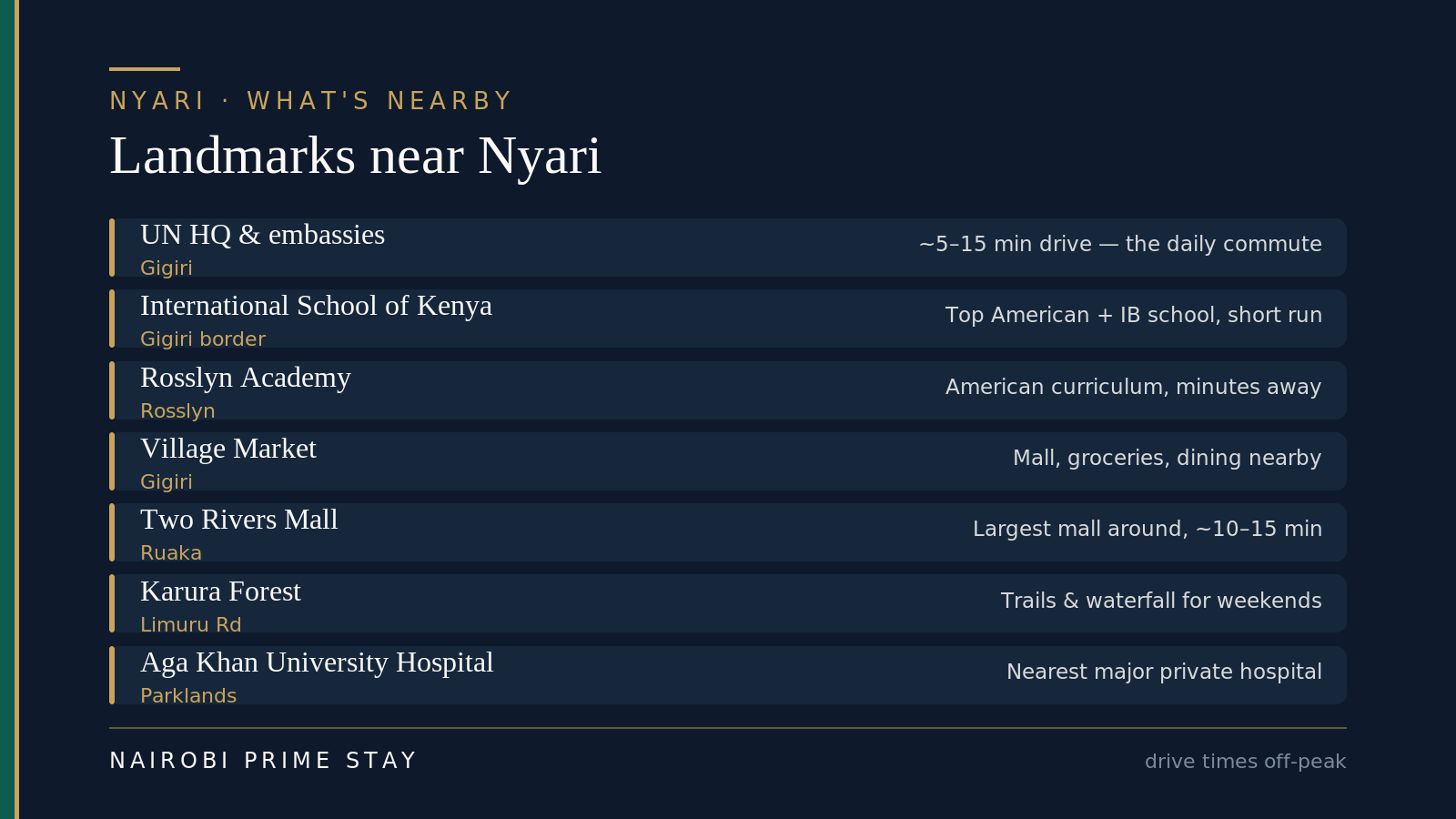 What’s around Nyari — the UN, top schools, two big malls, Karura Forest and a leading hospital, all a short drive away.
Hospitals and healthcare near Nyari
Nyari is well placed for healthcare, which matters when you’re moving a family across the world. The nearest major private hospital is Aga Khan University Hospital in Parklands, a JCI-accredited facility known for cardiac, cancer and full specialist care, roughly 15 to 25 minutes away depending on traffic. MP Shah Hospital, also in Parklands, is another well-regarded private general hospital nearby, and Gertrude’s Children’s Hospital in Muthaiga is the go-to paediatric specialist for families — both an easy drive.
Nairobi’s private hospitals are among the best in Africa, with English-speaking specialists and far lower costs than the US for consultations and procedures. The strong advice for any expat is to carry good private insurance with regional or international cover and medical evacuation, and to know your nearest hospital before you need it. Our healthcare in Nairobi guide walks through the main hospitals, insurance and what to set up first.
Nyari for property investors
Nyari is more of a place to live than a place to chase yield, but it has a clear investment logic. Demand from diplomats, UN and NGO organisations and corporates is steady and relatively recession-proof, leases are long, and tenants are reliable — missions and companies pay on time and stay for years. That makes a well-located Nyari home a stable, low-drama asset, especially the kind of large, secure family villa that missions lease.
The trade-off is that entry prices are high and rental yields on prime houses tend to be modest — you’re buying security and prestige, not a high cash-on-cash return. The newer apartments around Enaki Town are the more accessible entry point and can let more easily to the area’s professional tenants. As always in Kenya, the fundamentals matter more than the postcode: clean title, proper due diligence and conveyancing, and a realistic read of demand. If you’re weighing where to put money across the city, our broader neighborhood and investment guides via the moving to Nairobi hub are the place to start, and foreign buyers should get qualified local legal advice before committing.
Can you buy a home in Nyari?
You can, with one important caveat: as a non-Kenyan you can own the house, but not the land under it outright. Kenya’s constitution limits foreigners to leasehold title — commonly a 99-year lease — rather than the freehold a citizen can hold. That’s normal for expat buyers and works fine in practice, but it’s the first thing to understand before anyone sells you a “freehold villa.” Nyari is blue-chip, house-dominant and expensive, so the sums are large and the paperwork matters even more than usual.
If you’re set on buying, do it the slow, boring, safe way. Engage a licensed conveyancing lawyer — not the seller’s — to run an official land search, confirm the title is clean and matches the seller, and hold your money in a client account rather than paying the seller directly. Kenya’s land records are being digitized through the Ardhisasa and eCitizen portals, but an independent search and a proper conveyancing process stay non-negotiable. Because you’ll likely arrange this from the US, note that a power of attorney signed in America must be notarized and then legalized at a Kenyan embassy — Kenya isn’t part of the Apostille Convention — so start that early. Our guides to whether foreigners can buy property in Kenya and diaspora property investment cover the leasehold rules, taxes and remote-buying safeguards in full.
Honestly, though, most people posted to Nyari for two or three years are better off renting. Prices are high, yields on prime houses are modest, and a lease keeps you flexible if the posting moves. Buying makes sense if Nairobi is a long-term home or a deliberate investment — in which case get qualified local legal and tax advice before you commit.
Who Nyari suits — and who it doesn’t
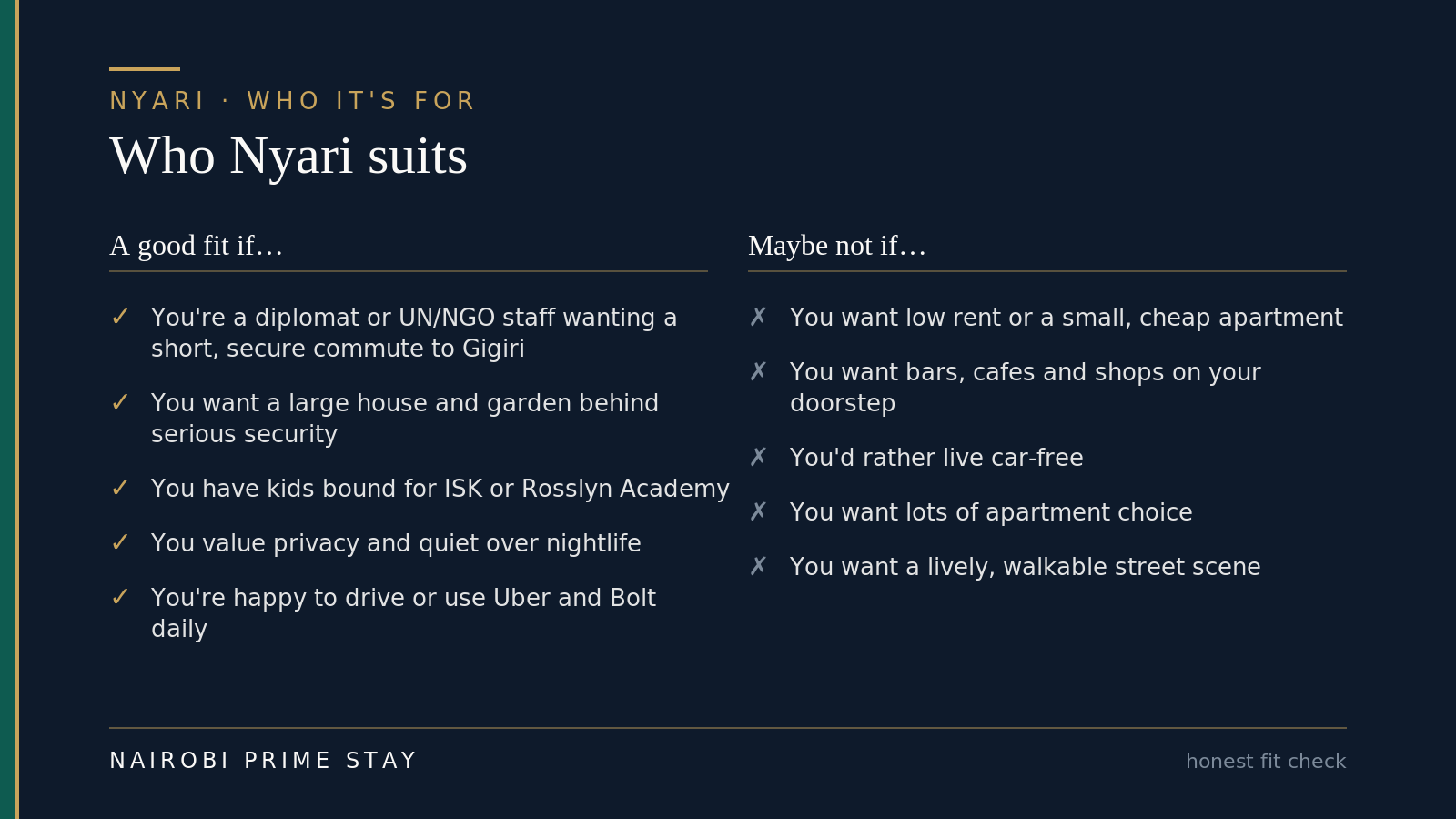 The honest fit test — Nyari rewards people who came for security, space and the UN commute.
Nyari is close to ideal if you’re a diplomat, UN or NGO staffer, or executive who wants a short, secure commute to Gigiri and a large, private home behind serious security. It’s excellent for families with children headed to ISK or Rosslyn Academy, who’ll prize the short school run, the space and the safety. And it suits anyone who values quiet and privacy over a buzzing street scene and is happy to drive everywhere.
It’s a poor fit if rent is your main constraint, if you want a small or cheap apartment, if you’d rather live car-free, or if you want nightlife, cafés and shops within walking distance. Those people are far happier in Westlands, Kilimani or Kileleshwa. There’s no shame in that — it just means Nyari isn’t your match.
Nyari vs Runda vs Kitisuru vs Gigiri
These four western neighbors get shortlisted together constantly, because they share the same DNA: secure, leafy, house-dominant, popular with the diplomatic and expat community, and close to the UN and ISK. Here’s how they differ in practice.
| Nyari | Runda | Kitisuru | Gigiri | |
|---|---|---|---|---|
| Character | Small, ultra-secure gated estate | Large classic diplomatic estate | Hilly, exclusive, very private | The diplomatic heart itself |
| Best for | Diplomats, UN/NGO families | Diplomats, families wanting estate living | Executives wanting privacy | UN/embassy staff who want to be next door |
| Homes | Villas, townhouses; a few flats | Mostly large villas | Big walled villas; scarce flats | Mix of villas and apartments |
| Security | Own police post, top-tier | Gated, very secure | Per-home, very secure | Heavily patrolled diplomatic zone |
| Commute to UN | ~5–15 min | ~5–15 min | ~10–20 min | Minutes / walkable |
| Furnished rent | ~KES 150k–1.5M+ | ~$1,800–4,000+ | ~KES 200k–1.5M+ | ~$1,500–4,000+ |
| Vibe | Quiet, private, locked-down | Quiet, settled, family | Quiet, hilly, exclusive | Calm but closest to amenities |
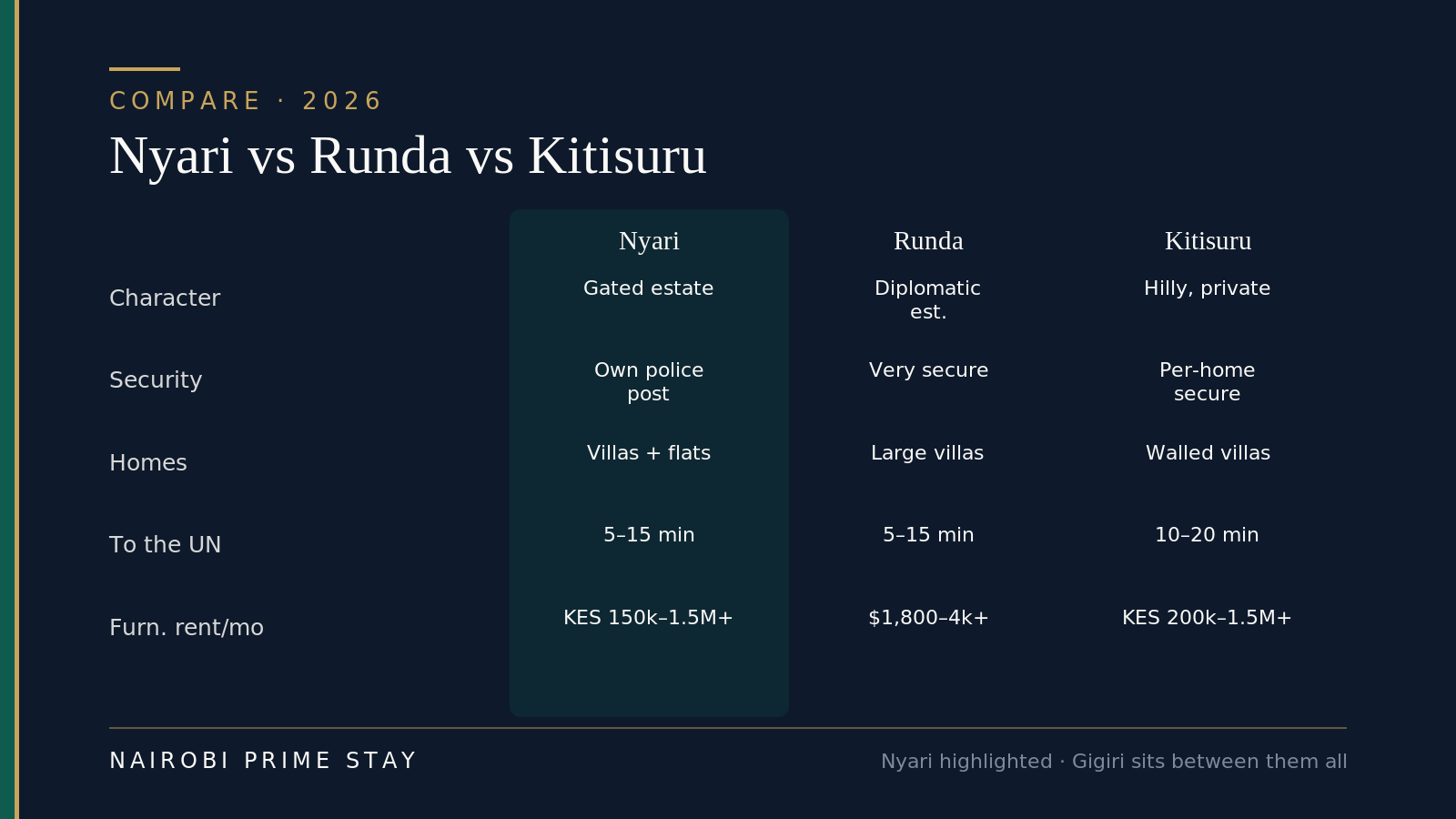 Nyari (highlighted) against its two closest rivals. Gigiri sits between them all, closest to the UN itself.
Read across the row that matters most to you. Choose Nyari for that estate-level access control and police post; Runda for classic, slightly larger-scale diplomatic estate living; Kitisuru for hilly, top-end privacy; and Gigiri if being right next to the UN, the embassies and Village Market beats everything else. Honestly, the best way to choose is to spend a few weeks nearby and drive between them. For old-money calm a little to the east, Muthaiga is worth a look too.
A realistic example
Say you’re a UN staffer moving from Washington with a spouse and two kids who’ll start at ISK in August. Your priorities, in order, are security, a short school run, and space for the family. Nyari fits that brief almost perfectly.
You’d start with a serviced apartment near Gigiri for your first month — a secure, all-inclusive base while you settle the kids, sort your KRA PIN and permit, and look at homes. Over those weeks you view four-bedroom houses in Nyari and Runda, drive the ISK run and the UN commute at 8am to feel the traffic, and compare the estates’ entrances and security. You land on a furnished four-bed villa in Nyari at, say, KES 550,000 a month — confirm the generator, the borehole and the fibre, sign a 12-month lease with an inventory and a deposit, and move in once you’re sure. School is a ten-minute drive, the office is fifteen, and the kids have a garden. That’s the Nyari case in a sentence: you pay well for it, but the daily life is calm, secure and close to everything that matters to a posting family.
Your Nyari move-in checklist
Use this to keep the move orderly. It’s the same sensible order we’d walk any newcomer through.
- Scout first. Visit on an eTA or book a serviced apartment for four to eight weeks; don’t lease a house sight-unseen.
- Drive the commute and school run at rush hour. Do it on a weekday morning before you commit — traffic, not distance, decides your day.
- Sort your paperwork. Get your KRA PIN and the right permit in hand; you’ll need them (plus ID) to sign a lease.
- Check the “Nairobi Five” in any home. Backup generator, water supply and storage (borehole or tanks), 24/7 security, fibre already serving the house, and responsive management.
- Read the lease and inventory carefully. Confirm who covers service charge, security, water and the garden; expect one to three months’ deposit plus first month.
- Never wire for an unseen home. View in person and verify the landlord or agent before any payment.
- Set up the essentials. M-Pesa on arrival, fibre booked, a bank account once your permit and KRA PIN are ready, and your nearest hospital saved.
- Line up schools early. Enquire months ahead and gather transcripts; the best schools near Nyari have waitlists.
Frequently asked questions
Is Nyari a good place to live in Nairobi?
Yes, if you want security, space and a short commute to the UN, and budget isn’t your first concern. Nyari is a small, gated, upscale estate in north-west Nairobi, about 10 km from the centre, tucked between Gigiri, Runda and Kitisuru. It’s made up mostly of large villas and townhouses, has its own police post, and is a strong fit for diplomats, UN and NGO families, and executives. The main trade-offs are that it’s expensive, car-dependent and very quiet.
How much is rent in Nyari?
As of 2026, the average house in Nyari rents for around KES 430,000 a month, with most four-bedroom family homes between roughly KES 280,000 and KES 1.5 million depending on size, finish and amenities — about $2,150 to $11,500-plus at around 129 shillings to the dollar (the shilling traded near KES 129.4 on 1 July 2026). Apartments are scarcer and cheaper, starting near KES 90,000 and with furnished two-beds often KES 150,000 to 260,000, mostly in the newer Enaki Town cluster. These are indicative ranges; the actual figure depends on the specific estate, plot and what’s included.
Is Nyari safe?
Nyari is one of the most secure residential areas in Nairobi. It has its own police post at the controlled entrance on Ngecha Road, where vehicles are checked in and out, plus 24-hour patrols that include diplomatic police, and almost every home sits behind a wall, gate, electric fence and CCTV. The realistic risk for residents is opportunistic property crime, not violence, and serious incidents inside the estate are uncommon.
Where is Nyari, and how far is it from the UN?
Nyari is in north-west Nairobi, roughly 10 km from the central business district, set between Red Hill, Thigiri Ridge and Ngecha roads and bordering Kitisuru, Runda and the Gigiri diplomatic zone. The UN headquarters and the Gigiri embassies are about a 5 to 15 minute drive depending on the gate and the time of day. That short, secure commute is the single biggest reason people choose it.
Who lives in Nyari?
Nyari is, more than almost any other Nairobi suburb, a diplomats’ estate. Its residents are largely diplomats, UN and NGO families, and senior executives, both expat and Kenyan, and many homes are official residences or leased long-term by missions and organisations. The result is a quiet, international, family-heavy community that’s safe, settled and used to newcomers arriving on two- and three-year postings.
Are there apartments in Nyari, or mostly houses?
Nyari is mostly houses — large standalone villas and gated townhouses on generous compounds. There’s a small but growing cluster of modern apartments around Enaki Town on the Nyari-Rosslyn border, bringing gyms and pools to the area, but apartment choice is thin overall. If you specifically want a flat with lots of options, you’ll do better in nearby Westlands, Kilimani or Kileleshwa.
Do I need a car to live in Nyari?
Practically, yes. Nyari is low-density and gated, with no walkable high street, shops or cafes, so daily life without a car is genuinely hard. Uber and Bolt serve the area well and are a fine alternative for those who don’t drive, but most residents keep a car for school runs, shopping and weekends.
Which schools are near Nyari?
Some of the best international schools in Nairobi are right next door. The International School of Kenya (American curriculum and IB) on the Gigiri border, Rosslyn Academy (American) in neighboring Rosslyn, and the German School Nairobi in Gigiri are all a short drive — often under 15 minutes from a Nyari home. The best schools keep waitlists, so enquire months ahead and gather transcripts early.
Nyari or Runda — which is better?
Both are secure, leafy, house-dominant western estates popular with diplomats and families, and both are minutes from the UN and the International School of Kenya. Nyari is smaller and arguably even more locked-down, with its own police post and tight access control; Runda is the larger, classic diplomatic estate. Choose Nyari for top-tier estate-level security, and Runda for slightly larger-scale estate living — and ideally visit both before deciding.
How do I rent a home in Nyari from the US without getting scammed?
Never send money for a home no one you trust has seen live. Nyari’s houses are let almost entirely through agents, and the common scam is a real-looking villa with stolen photos and a request for a deposit before any viewing. Insist on a live video walkthrough — a real person walking through the actual house on a call — use your own agent to confirm the landlord genuinely controls the property, and pay your deposit only once you’re on the ground and the home checks out. The safest route is a serviced apartment near Gigiri for your first few weeks while you view Nyari houses in person.
Can a foreigner buy a home in Nyari?
Yes, but not the land outright. Kenya limits non-citizens to leasehold title, commonly a 99-year lease, rather than the freehold a citizen can hold — normal for expat buyers and workable, but be wary of any ‘freehold villa’ pitch. Use a licensed conveyancing lawyer (not the seller’s) to run an official land search, confirm clean title and hold your money in a client account. A power of attorney signed in the US must be notarized and then legalized at a Kenyan embassy, since Kenya isn’t in the Apostille Convention. For most two- or three-year postings, renting is the smarter, more flexible choice.
How far is Nyari from JKIA airport?
Budget about 45 minutes to well over an hour to Jomo Kenyatta International (JKIA), because you cross the whole city to reach it. Off-peak it’s around 45 minutes; in rush hour the surface roads via Uhuru Highway and Mombasa Road can push past 75, so many residents use the tolled Nairobi Expressway to skip the worst of it. Wilson Airport, on the south side, handles light aircraft for safari and regional hops.
Final thoughts
Nyari is for people who want their home to be a quiet, secure, private world a short drive from the UN and the city’s best schools. It trades value, walkability and street life for space, security and one of the calmest, most locked-down settings in Nairobi — and for diplomats, UN and NGO families and executives, that’s exactly the right trade. The honest test is simple: picture your Nairobi life. If it’s behind a gate, around a garden and a school run, with a guard at the estate entrance, Nyari is one of the best places in the city to find it. If it’s out on a lively street with cafés below your window, you’ll be happier — and richer — somewhere more central.
Whatever you decide, don’t sign a year-long lease on an expensive house sight-unseen. Spend a few weeks on the ground first, drive the school run and the UN commute at rush hour, and let the area prove itself before you commit.
Related reading
- Moving to Nairobi: the complete guide — the relocation hub that ties visas, money, healthcare and housing together.
- Best neighborhoods in Nairobi — compare Nyari against every other area in one place.
- Gigiri neighborhood guide — the diplomatic heart next door, closest to the UN and Village Market.
- Runda neighborhood guide — the classic secure diplomatic estate, Nyari’s main rival.
- Kitisuru neighborhood guide — hilly, exclusive and private, just to the south.
- Serviced apartments in Nairobi — how a soft landing works and why it’s the smart first month.
- Is Nairobi safe? — an honest, balanced look at safety for expats.
- Cost of living in Nairobi — slot Nyari rent into a realistic monthly budget.
Find your place near Nyari
When you’re ready to see real options, browse our serviced apartments near Nyari and Gigiri — verified, all-inclusive, with honest monthly pricing — or our full apartment catalogue across the western suburbs. A serviced apartment for your first month gives you a secure base while you view houses and test the traffic before signing a year-long lease. A $50 deposit reserves your place and the balance is paid on arrival, so there’s nothing more to pay before you travel.
Not sure whether Nyari, Runda or Gigiri fits your commute and budget? Our AI relocation assistant can shortlist apartments around your priorities in a couple of minutes, any time of day.
Ready to look?
Find your apartment in Nairobi
Browse verified serviced apartments, or ask the AI concierge which area fits your life.