
Guides · Property investment
Nairobi Property Prices in 2026: What Homes Really Cost
Nairobi Property Prices in 2026: What Homes Really Cost

A decent two-bedroom apartment in a prime Nairobi suburb sells for roughly KES 10–25 million in 2026 — about $77,000 to $190,000. A family house in Karen or Runda runs far more. Land is the priciest asset of all. But the honest answer to “what does property cost in Nairobi?” is: it depends, more than in almost any market you’ve seen.
This guide gives you real 2026 price bands — by area and by type — plus what’s actually happening to the market right now. We use the two indices locals trust (HassConsult and Cytonn), quote ranges instead of false precision, and date everything. Prices move, portals lag, and asking is not the same as achieved. Treat every number here as a starting point to check, not gospel.
It’s written for Americans buying a home or weighing an investment, and for anyone who just wants to know whether Nairobi is cheap, expensive, or somewhere in between. Short version: cheaper than a US coastal city, dearer than you’d guess, and very location-driven.
TL;DR — Nairobi prices in 2026
Prime-suburb apartments run about KES 10–25M for a two-bed and KES 15–45M for a three-bed — roughly $75k–$350k. The average Nairobi apartment asking price is around KES 18M (~$140k). Standalone houses in Karen, Runda and Muthaiga commonly run KES 40–150M and up. Land in the top suburbs averages around KES 229M an acre. The market in early 2026 is slow but still rising gently: suburb house prices grew about 1.1% in Q1 2026 and roughly 7.7% over the year (HassConsult), while some apartment pockets and satellite towns softened on oversupply. Rental yields are the best in years — about 7.4% city-wide. Quote any figure as “as of 2026,” and confirm against HassConsult, Cytonn and live listings before you act.
Why this matters
Property is the biggest cheque you’ll write in Kenya, and the market is less transparent than the US. There’s no MLS, no Zillow with sold-price history, and asking prices on portals can sit 10–20% above what a deal actually closes at. Knowing the real bands protects you from two mistakes: overpaying because you have no benchmark, and walking away from a fair price because it sounded high in dollars. It also helps you decide whether to buy at all — versus renting a serviced apartment while you watch the market and learn the city.
The Nairobi market right now (2026)
Nairobi’s market in early 2026 is best described as slow but still climbing. According to HassConsult’s Q1 2026 index, sale prices in the city’s prime suburbs rose 1.1% in the quarter — up from 0.8% the quarter before — and house-price inflation ran near 7.7% over the year, led by demand for detached and semi-detached homes. Satellite-town house prices actually slipped 0.9% in the quarter, the weaker end of the market.
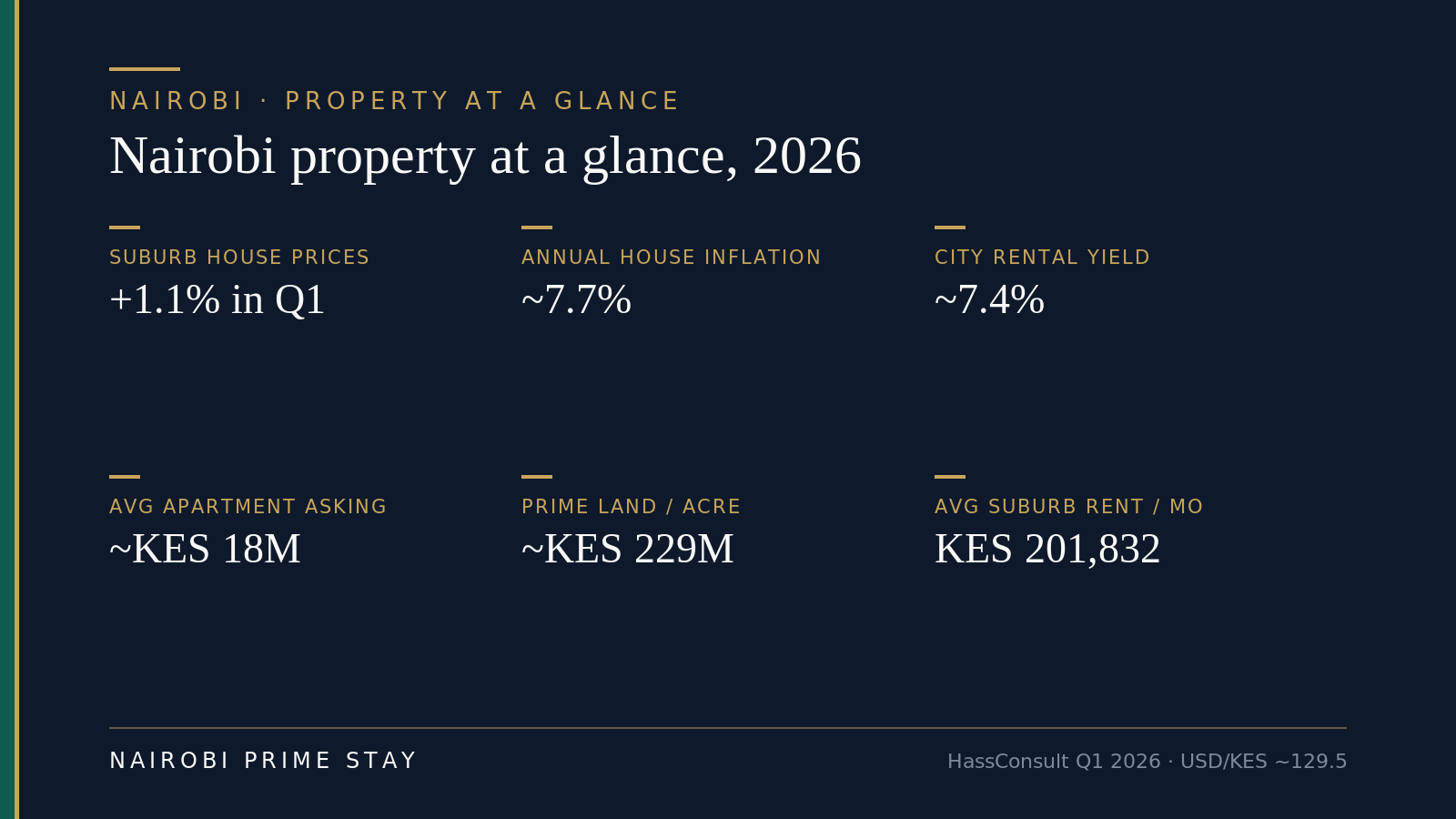 Nairobi property at a glance, 2026 — figures from HassConsult’s Q1 2026 index; USD/KES ~129.5.
Land, long Nairobi’s runaway asset, has cooled. Suburb land prices rose just 0.8% in Q1 2026 (about 5.0% over the year), and satellite-town land grew 0.5% — the slowest pace in five years. HassConsult put the slowdown down to tighter household budgets and uncertainty over building approvals at Nairobi County. The average suburb acre now sits around KES 228.8 million.
Rents, meanwhile, hit records. Average suburb rent crossed KES 200,000 a month for the first time (KES 201,832), and satellite-town rent reached about KES 64,765. Strong rents alongside flat-ish prices is exactly why yields are climbing — more on that below.
How property is priced in Nairobi
Prices are quoted per unit, not per square foot. Unlike the US, Nairobi listings almost never show a price per square metre — you’ll see a lump sum for “a 3-bed in Kileleshwa.” It’s worth doing the per-square-metre math yourself: a good prime apartment works out to around $1,000–1,500 per square metre in 2026, with budget stock nearer $500 and top-end finishes pushing past $2,000.
Three things to keep front of mind:
Asking is not achieved. Portal prices are wish prices. In a slow market, sellers often take 5–15% less. Always ask what nearby units actually sold for — a good agent and your lawyer can help you find out.
Everything’s in shillings, but big deals get dollar-quoted. High-end homes and land are sometimes priced in USD. At about KES 129–130 to the dollar in mid-2026 (around 129.5; check the Central Bank of Kenya or Wise for the live rate), a KES 18M apartment is roughly $140,000. If you earn dollars, currency swings change your real price between offer and completion.
New-build versus resale. Off-plan and brand-new units carry a premium and come with developer payment plans; older blocks are cheaper but watch the service charge and maintenance. See our guide to how to buy property in Kenya for the full process.
How much do apartments cost by area? (2026)
Here are indicative asking-price bands for apartments in Nairobi’s prime suburbs, mid-2026. They’re drawn from current listings on Kenyan portals and the HassConsult index — treat them as a starting range, not a quote. Smaller, older or unfurnished units sit at the low end; new, large, high-spec units in gated blocks sit at the top.
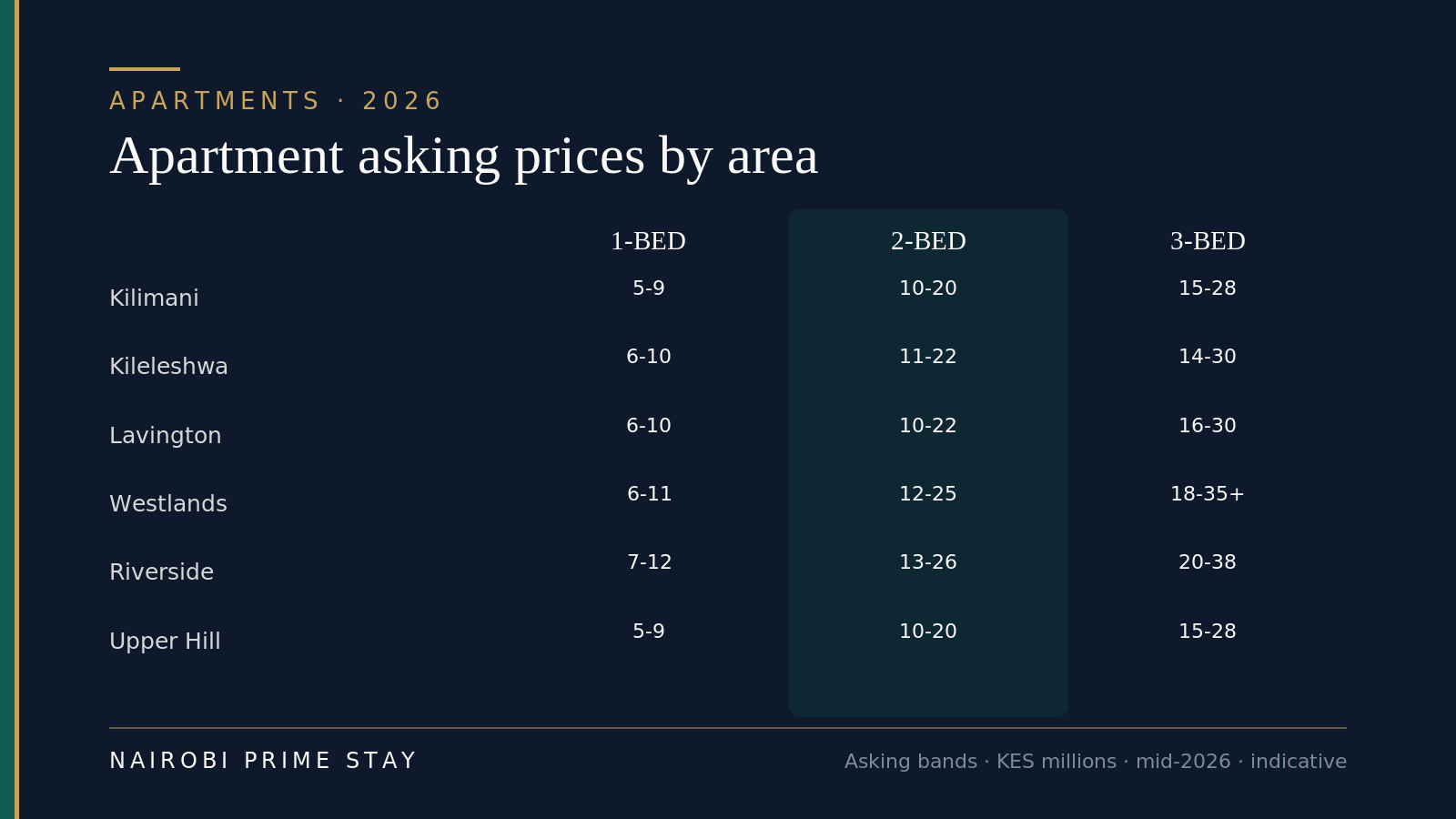 Apartment asking-price bands by area, mid-2026 (KES millions, indicative). Actual sale prices are often lower.
| Area | 1-bed | 2-bed | 3-bed | Character |
|---|---|---|---|---|
| Kilimani | KES 5–9M | KES 10–20M | KES 15–28M | Central, modern, busy; the most affordable prime apartments |
| Kileleshwa | KES 6–10M | KES 11–22M | KES 14–30M | Quieter, leafy, central |
| Lavington | KES 6–10M | KES 10–22M | KES 16–30M | Family-friendly, gardens, embassies |
| Westlands | KES 6–11M | KES 12–25M | KES 18–35M+ | Urban energy, offices, nightlife |
| Riverside | KES 7–12M | KES 13–26M | KES 20–38M | High-end, embassies, along the river |
| Upper Hill | KES 5–9M | KES 10–20M | KES 15–28M | Business district, hospitals nearby |
In dollars, that’s roughly $38k–$95k for a one-bed, $75k–$190k for a two-bed, and $115k–$290k+ for a three-bed. The average apartment asking price across Nairobi is about KES 18M (~$140k), though that blends everything from micro-studios to penthouses.
A few anchors from the 2026 listings: Kilimani apartments average around KES 15M and start near KES 5.8M; Kileleshwa three-beds average about KES 14.9M for a generous ~195 m²; Lavington apartments average near KES 8.9M, with larger three-beds at KES 16–30M; Westlands three-beds run KES 18M to KES 35M+ for the best stock. For the full picture on any of these areas, browse our neighborhood guides.
Houses, town houses and land
Standalone houses cost a lot more than apartments — and Karen, Runda and Muthaiga are the priciest addresses. A four- or five-bedroom family house in these leafy suburbs commonly runs KES 40–150 million and up ($310k–$1.15M+), depending on plot size, age and finish. Town houses — think gated rows of three- to four-bed maisonettes in Lavington, Kileleshwa or Kitisuru — typically land between a big apartment and a standalone house, often KES 25–60M.
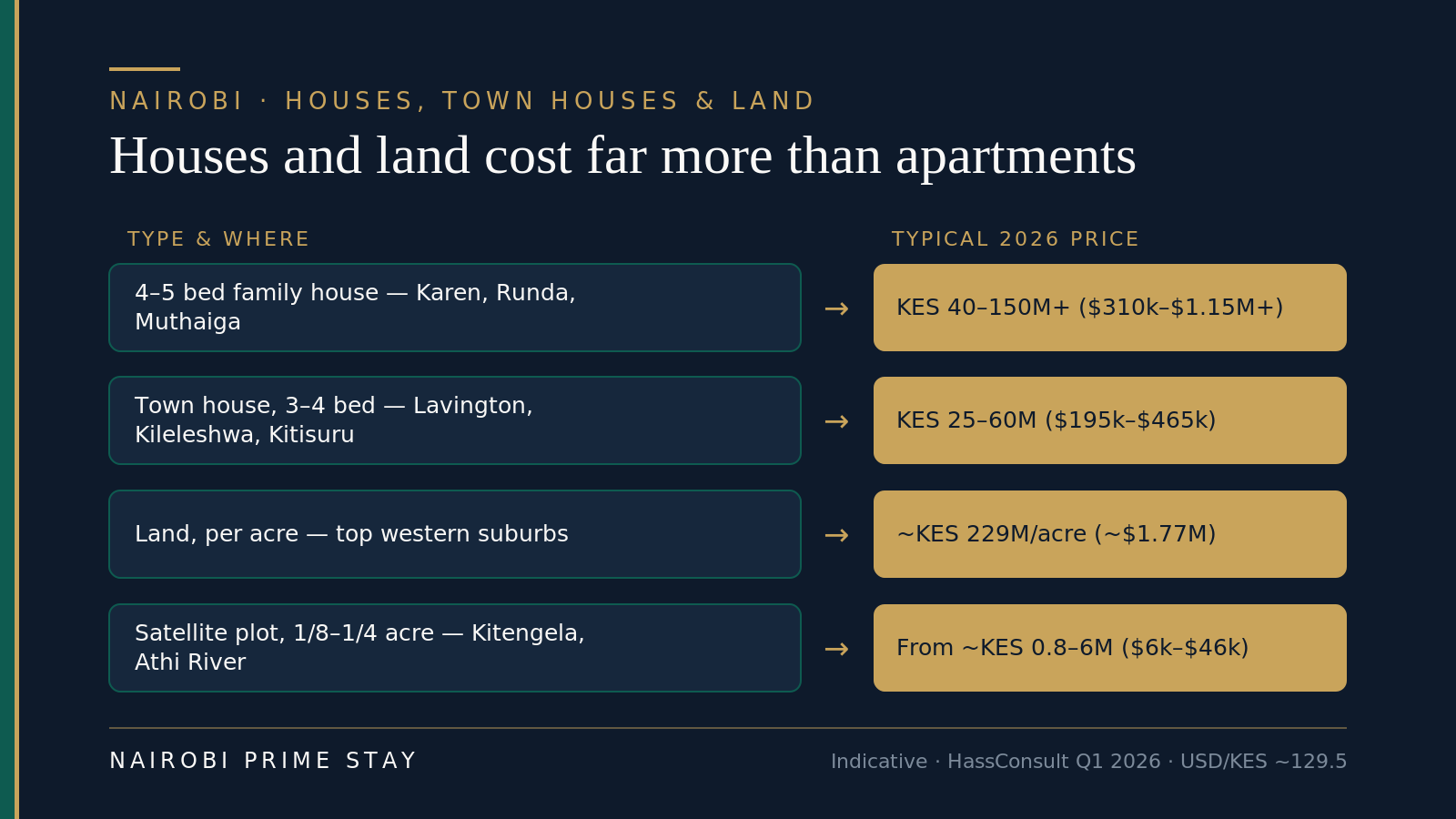 Houses, town houses and land, 2026 (indicative). Plot size, finish and exact location move these a lot.
| Type | Typical price (2026) | In USD | Where |
|---|---|---|---|
| 4–5 bed family house | KES 40–150M+ | $310k–$1.15M+ | Karen, Runda, Muthaiga |
| Town house (3–4 bed) | KES 25–60M | $195k–$465k | Lavington, Kileleshwa, Kitisuru |
| Land, per acre | ~KES 229M | ~$1.77M | Top western suburbs |
| Satellite plot (⅛–¼ acre) | From ~KES 0.8–6M | $6k–$46k | Kitengela, Athi River |
Detached and semi-detached homes are the part of the market holding up best in 2026: HassConsult notes the ~7.7% annual house-price inflation is led by exactly this demand. Historically Karen and the western suburbs set the pace; in Q1 2026 the quarterly house-price risers were Lavington (+4.2%), Spring Valley (+4.0%) and Kilimani (+3.9%), with Karen, Loresho and Westlands houses each up about 3.8%. The split personality of some suburbs is worth seeing: Westlands houses rose about 3.8% while Westlands apartments fell about 2.8% in the same quarter — one postcode, two markets.
Land is Nairobi’s blue-chip asset and its priciest by the acre. Suburb land averages around KES 228.8M an acre in 2026 (~$1.77M), but that per-acre figure hides huge variation — a quarter- or eighth-acre plot in a satellite town is a small fraction of it. Land growth has stalled this year; some prime pockets even fell (Muthangari −2.8%, Loresho −2.0%, Kitisuru −1.5%), while Nyari (+3.1%) and Langata (+2.4%) rose. If you’re weighing land, read buying land in Kenya and title deeds explained first, and know the common property scams before you wire a cent — land is where the worst fraud happens.
What about satellite towns and cheaper areas?
If the prime-suburb numbers make you wince, the satellite towns ringing Nairobi are far cheaper — and they’re where a lot of first-time buyers and yield-focused investors actually buy. These are the commuter towns just outside the city: Ruaka to the northwest, Syokimau and Athi River along Mombasa Road to the southeast, Kitengela further south, and the Thika Road corridor (Juja, Ruiru and the Tatu City development) to the northeast.
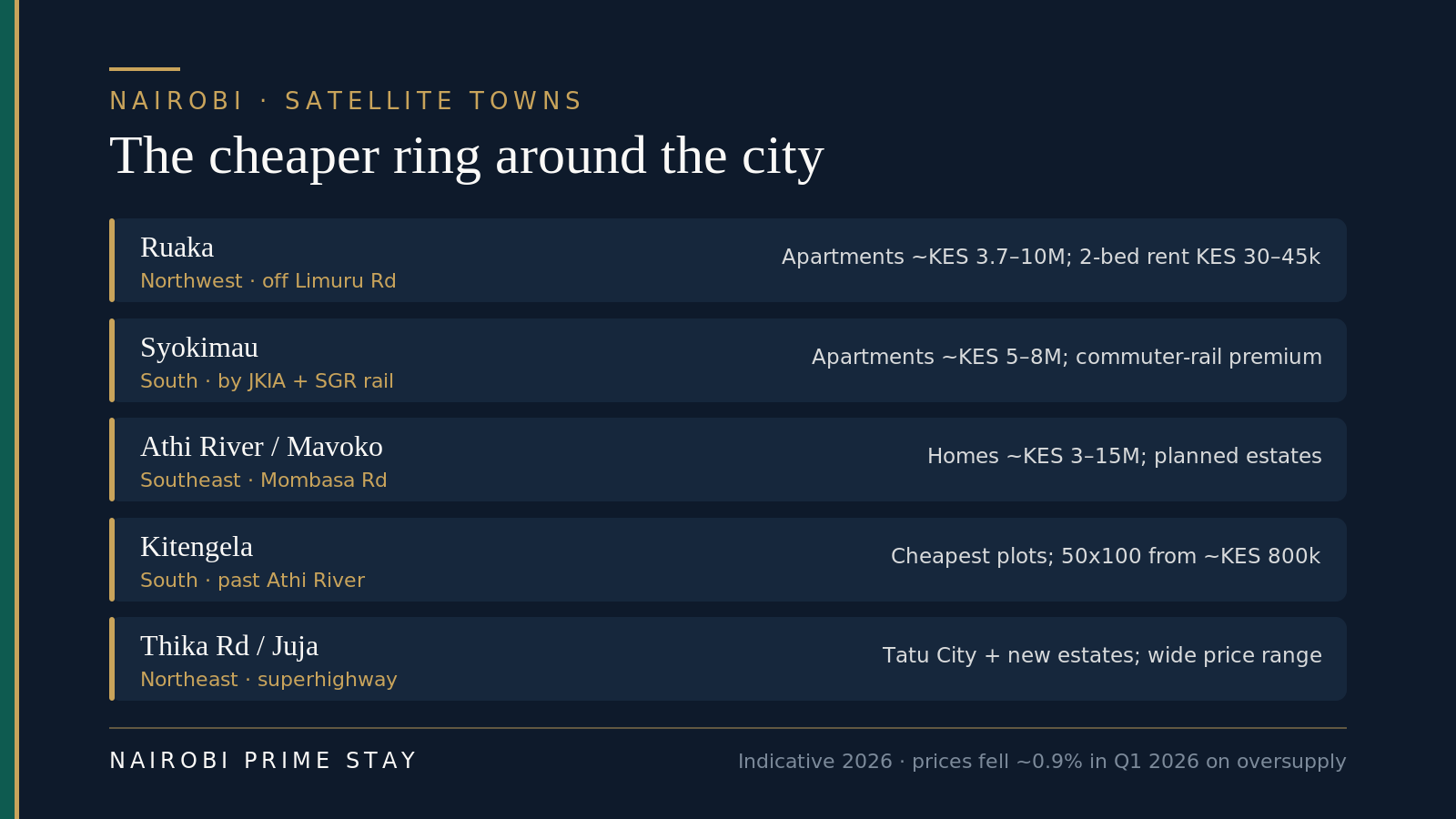 The cheaper ring around Nairobi, 2026 (indicative). Satellite-town sale prices dipped about 0.9% in Q1 2026.
Indicative 2026 prices sit well below the prime belt: one-beds run roughly KES 3.5–7M and two-beds KES 6–10M. Ruaka apartments start near KES 3.7M and average about KES 8.3M; Syokimau, prized for its SGR commuter-rail station and JKIA access, averages around KES 5–8M; Athi River and Mavoko homes span KES 3–15M depending on the estate; and Kitengela has the corridor’s cheapest land, with 50×100-foot (about ⅛-acre) plots from roughly KES 800,000.
Be honest with yourself about the trade-off. Satellite towns are where the 2026 oversupply bites hardest — HassConsult logged a 0.9% drop in satellite-town sale prices in Q1, as middle-class buyers were squeezed by the cost of living. Yields are a little higher (satellite towns average about 5.3% gross) and entry prices are friendly, but you’re swapping proximity for price: the daily drive into the Gigiri–Westlands job-and-school belt can be brutal in traffic. For an expat who needs to be near the UN, an international school or a Westlands office, a satellite town rarely makes sense to live in — but it can make sense to invest in. If that’s your angle, read the best areas to invest and our guide to Nairobi’s new developments and satellite cities.
Price versus rent: what about yields?
Rental yields in Nairobi are the strongest in years — roughly 7.4% city-wide in the latest HassConsult reading, the best since 2007. That’s gross yield: annual rent divided by price, before costs. Satellite towns came in around 5.3%.
Yields vary widely by area and price tier:
| Area / segment | Indicative gross yield (2026) |
|---|---|
| City-wide average | ~7.4% |
| Ruaka (apartments) | ~7–10% |
| Kilimani (apartments) | ~6–7.5% |
| Mid-income apartments (Cytonn) | ~6% (plus ~1% appreciation) |
| Karen (large houses) | ~3–5% |
| Satellite towns | ~5.3% |
The pattern is the same worldwide: smaller, cheaper apartments yield more; big prestige houses yield less but can appreciate and hold value. If income is your goal, the math favours well-located two-beds in high-demand rental areas over a trophy house. We dig into this in buy-to-let in Nairobi and the best areas to invest. If direct ownership sounds like too much work, Kenyan REITs give you property exposure without buying a whole unit.
Which areas are rising — and which are cooling
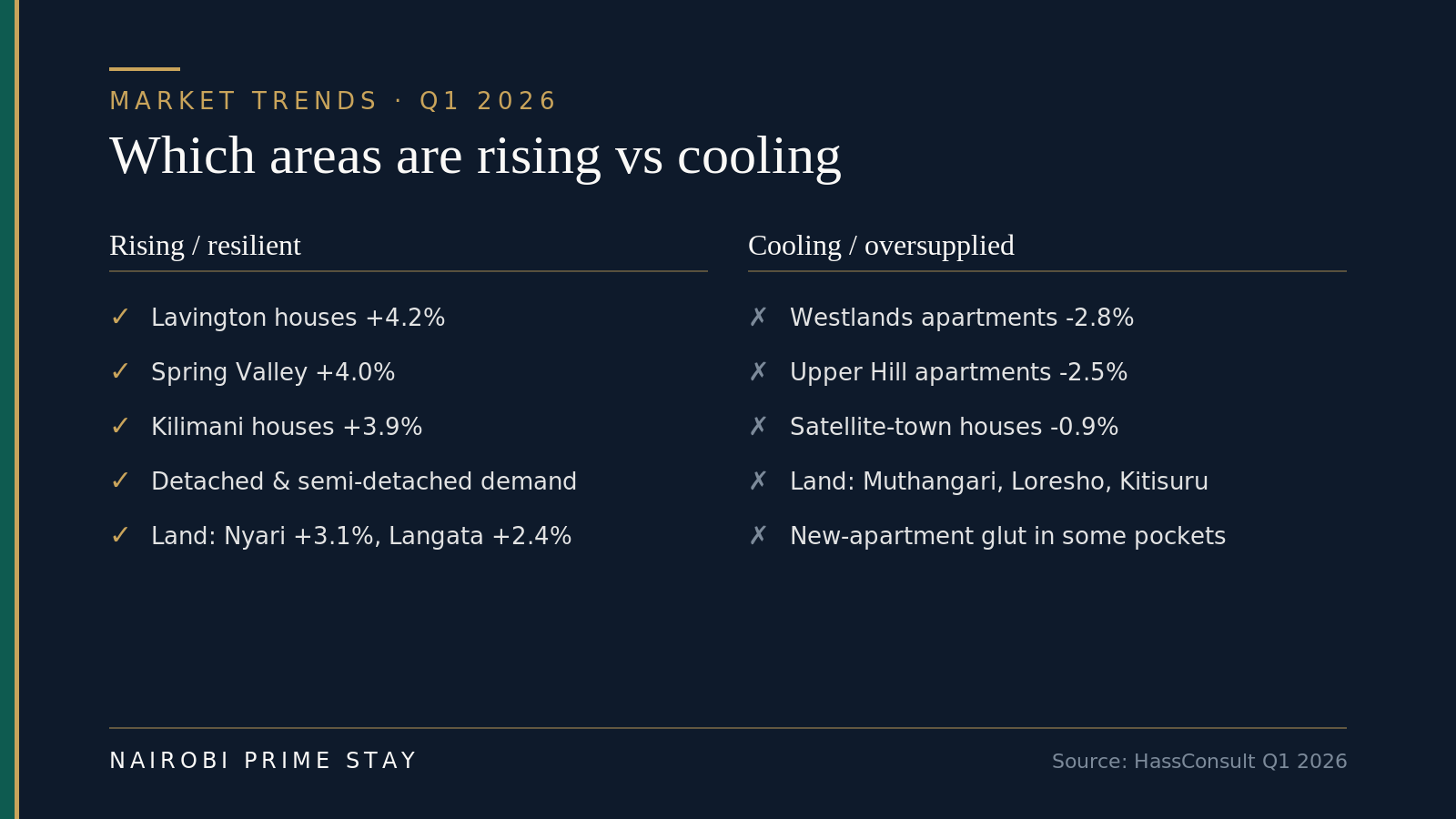 Rising versus cooling, Q1 2026 — source: HassConsult Q1 2026 index.
Rising or resilient in 2026: Lavington, Spring Valley and Kilimani led suburb house-price growth this year. Detached and semi-detached family homes are in demand across the prime belt. On land, Nyari and Langata bucked the slowdown.
Cooling or oversupplied: the apartment segment is patchy. Westlands (−2.8%) and Upper Hill (−2.5%) saw apartment prices fall in Q1 2026 — a classic sign of oversupply after years of building. Satellite-town houses dipped 0.9%, and several land pockets (Muthangari, Loresho, Kitisuru) softened.
The takeaway: “Nairobi” isn’t one market. Even within a suburb, a glut of new apartments can push prices down while standalone houses next door rise. Oversupply in the apartment segment is real in parts of the city — good for buyers and renters, tougher for sellers and yield-chasers.
The honest “it depends”
Two apartments on the same street can differ in price by 50%. What moves a Nairobi price:
- Finish and age — new, high-spec units command big premiums over tired ones.
- The building’s essentials — backup generator, borehole or water storage, 24/7 security, a lift, fibre. Our “Nairobi Five” checklist applies to buying, not just renting.
- Service charge — a low price with a punishing monthly service charge isn’t cheap.
- Exact micro-location — proximity to a good road, a mall, an international school.
- Title and paperwork — a clean title is worth paying for; a cheap price with a murky title is a trap. See conveyancing in Kenya.
- Whether you’re a cash buyer — cash still talks loudly in Kenya’s mostly-cash market.
This is why a single “price per square metre for Nairobi” is almost meaningless. Use the bands here to get oriented, then price the specific unit in front of you.
A realistic example
Say you’re relocating from the US and want a two-bed to live in, in Kilimani. Portals show asking prices of KES 14–18M for the newer blocks you like. You view six. The KES 18M unit has a generator, borehole, lift and fibre; the KES 14M unit is older, fifth-floor, no lift. You offer KES 16M on the better one and settle at KES 16.5M (~$127k) — below asking, because the market’s slow. Add roughly 7–11% in transaction costs (stamp duty, legal and valuation fees; see property taxes in Kenya). Rented instead, that same unit would cost KES 90,000–120,000 a month — which is why the gross yield on these sits around 6–7%.
What you’ll actually pay on top: transaction costs
The sticker price isn’t the whole cheque. Budget another 7–11% of the price in closing costs, and know who pays what before you sign.
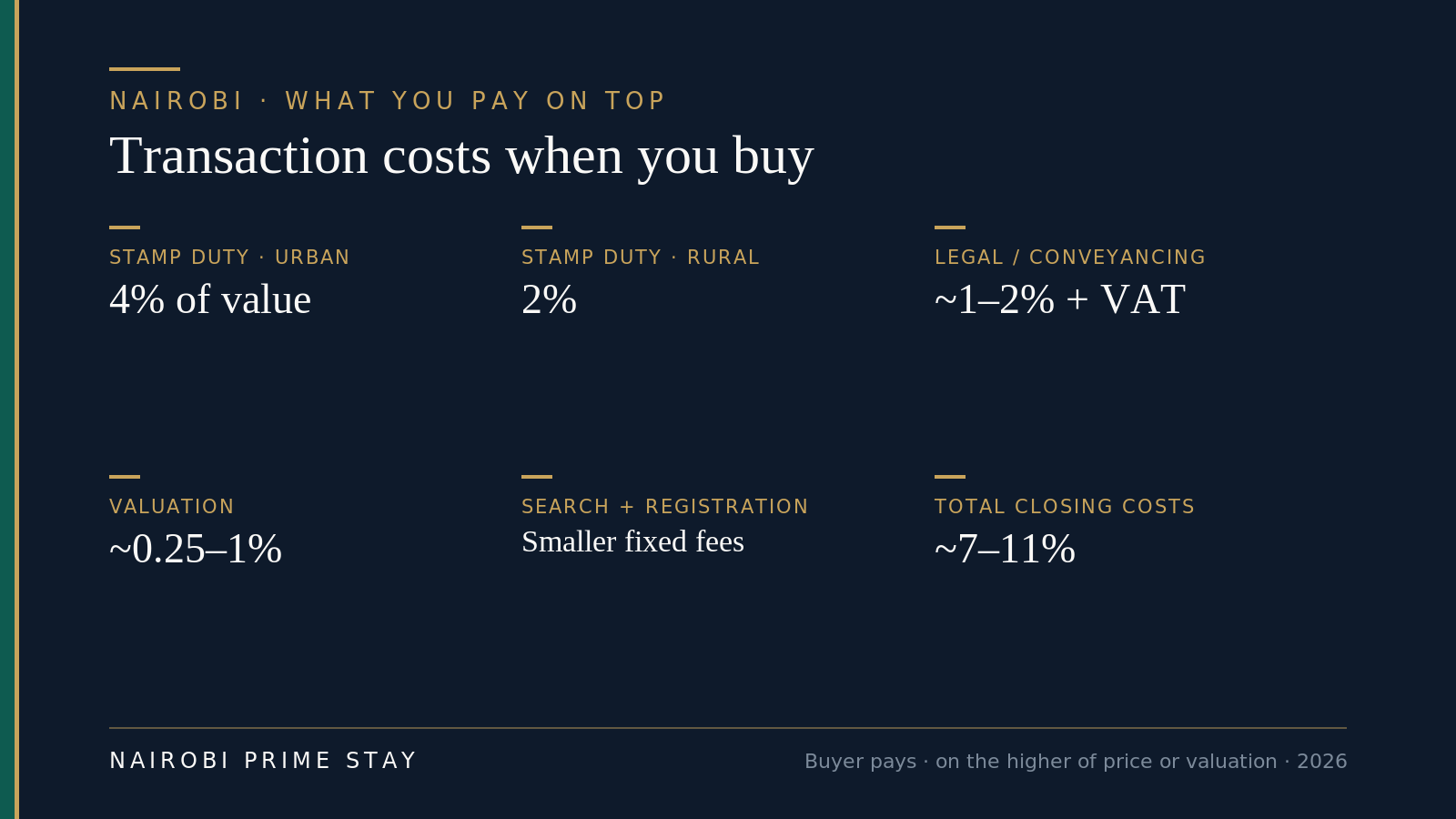 What you pay on top of the price, 2026. The buyer carries most of these.
| Cost | Rate (2026) | Who pays |
|---|---|---|
| Stamp duty (urban / Nairobi) | 4% of value | Buyer |
| Stamp duty (rural land) | 2% of value | Buyer |
| Stamp duty (commercial) | 6% of value | Buyer |
| Legal / conveyancing | ~1–2% + 16% VAT | Buyer (own advocate) |
| Valuation | ~0.25–1% | Buyer |
| Land Registry search + registration | Smaller fixed fees | Buyer |
| Agent commission | ~1.25–3% | Usually the seller |
Stamp duty is the big one, and it’s charged on the higher of the purchase price or the government valuer’s figure — so a low “agreed” price won’t shrink it. For a KES 16.5M Kilimani apartment, expect stamp duty around KES 660,000, legal fees of roughly KES 250,000–330,000 plus VAT, and valuation of perhaps KES 40,000–165,000 — call it KES 1–1.2 million (~$8,000–9,000) all in, landing near the lower end of the 7–11% range because apartments skip some land-specific fees. Foreigners pay the same rates as Kenyans but can only hold land on leasehold — see can foreigners buy property in Kenya and the full how to buy property in Kenya process before you budget.
Smart moves and costly mistakes
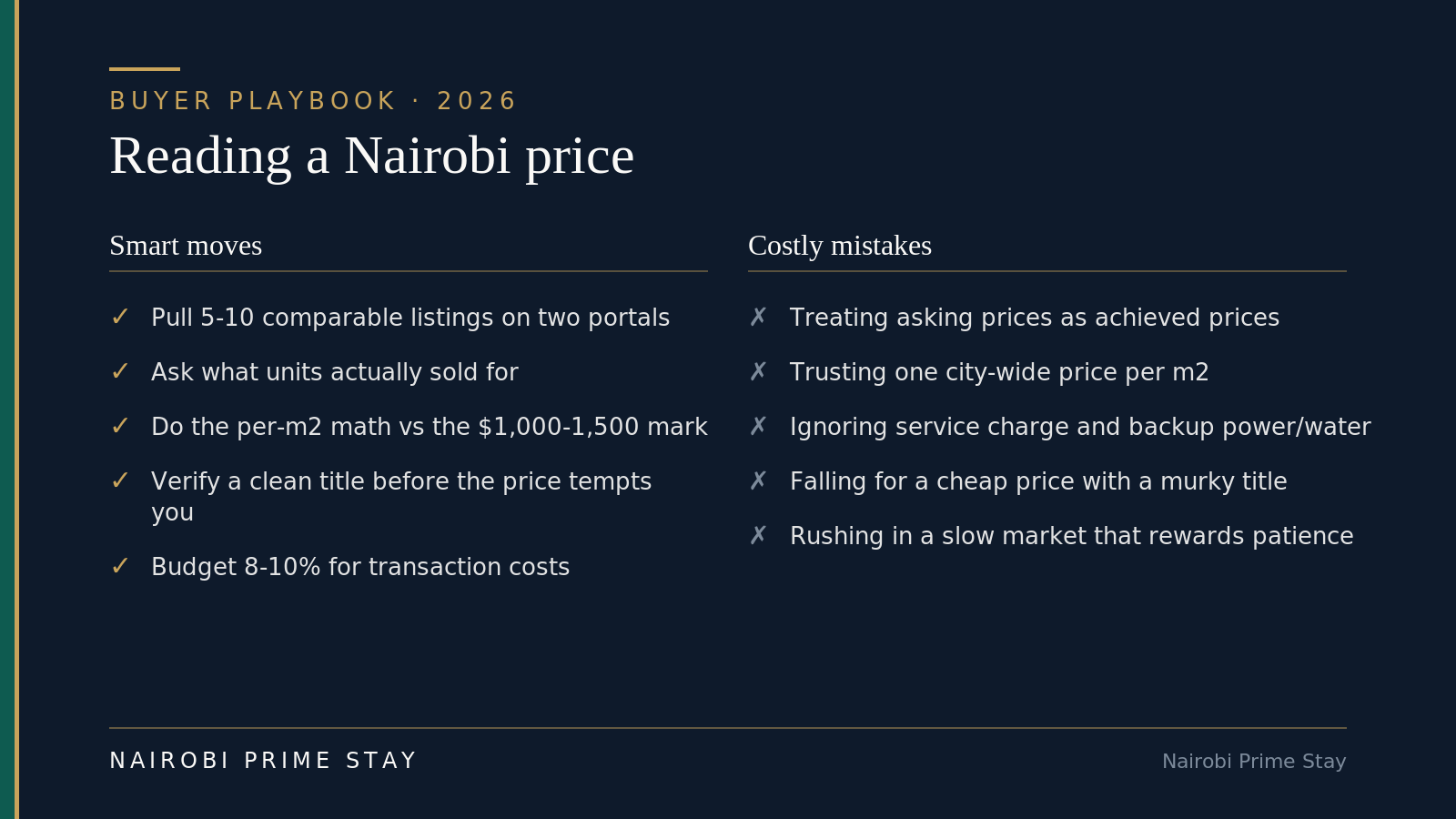 How to read a Nairobi price like a local — the moves that save money and the mistakes that cost it.
How to sanity-check a Nairobi price (checklist)
- Pull 5–10 comparable listings in the same area and size, on at least two portals.
- Ask the agent and your lawyer what comparable units actually sold for, not just asking prices.
- Do the per-square-metre math and compare to the $1,000–1,500/m² prime benchmark.
- Check the service charge and what it covers — add it to your real monthly cost.
- Confirm the building essentials: generator, water, security, lift, fibre.
- Verify the title is clean before you fall in love with the price (see conveyancing).
- If investing, calculate the gross yield (annual rent ÷ price) and compare to the ~7.4% city average.
- Date your research — quote prices “as of 2026” and re-check against HassConsult and Cytonn.
- Budget 7–11% on top for transaction costs.
- Don’t rush — in a slow market, patience is leverage.
Frequently asked questions
How much does an apartment cost in Nairobi in 2026?
Indicatively, a two-bedroom apartment in a prime Nairobi suburb costs about KES 10–25 million (roughly $75,000–$190,000) in 2026, and a three-bedroom about KES 15–45 million. The average apartment asking price across the city is around KES 18 million (about $140,000). Smaller, older or unfurnished units cost less; new, high-spec units in gated blocks cost more. These are asking-price ranges — actual sale prices are often 5–15% lower.
What is the price of property per square meter in Nairobi?
There’s no single figure, because listings are priced per unit, not per square metre. As a rough guide for 2026, a good prime-suburb apartment works out to about $1,000–1,500 per square metre, with affordable stock nearer $500 and top-end finishes above $2,000. Do the math on the specific unit rather than relying on a city-wide average.
Are property prices in Nairobi rising or falling in 2026?
Mostly rising, but slowly and unevenly. HassConsult’s Q1 2026 index showed prime-suburb house prices up about 1.1% in the quarter and roughly 7.7% over the year, led by detached and semi-detached homes. But some apartment pockets fell (Westlands −2.8%, Upper Hill −2.5%) on oversupply, and satellite-town house prices dipped 0.9%. Land-price growth has slowed to its weakest in five years.
How much does a house cost in Karen or Runda?
Standalone family houses in Karen, Runda and Muthaiga commonly run KES 40–150 million and up (about $310,000 to $1.15M+), depending on plot size, age and finish. These are Nairobi’s priciest residential addresses. Town houses elsewhere — Lavington, Kileleshwa, Kitisuru — typically fall between a large apartment and a standalone house, often KES 25–60 million.
What rental yield can I expect in Nairobi?
Gross rental yields are about 7.4% city-wide in 2026 — the highest in years. Smaller apartments in high-demand areas yield more (Kilimani roughly 6–7.5%, Ruaka up to 7–10%), while large prestige houses yield less (Karen around 3–5%). Satellite towns average about 5.2%. Gross yield is annual rent divided by price before costs, so budget for service charge, management and vacancy.
Is Nairobi property expensive compared to the US?
It’s cheaper than a major US coastal city, but not cheap. A KES 18 million (~$140,000) apartment buys a comfortable prime-suburb two- or three-bed — far more space and security than $140,000 buys in San Francisco or New York, and roughly comparable to parts of the US Midwest or South. Land and prestige houses can be surprisingly expensive. Your dollars go furthest on rent and services, less so on buying.
Should I buy or rent in Nairobi?
Many newcomers rent first, and it often makes sense. The market is slow, the paperwork is unfamiliar, and a year of renting lets you learn neighbourhoods before committing a big cheque. A serviced apartment for your first weeks is an easy soft landing while you decide. If you’re staying long-term, want rental income, or have found a clean-title unit at a fair price, buying can be worthwhile — read our buying and financing guides first.
Where can I check current Nairobi property prices?
The two indices locals trust are the HassConsult Property Price Index and Cytonn’s residential reports, both published regularly and free to read. For live asking prices, browse Kenyan listing portals and cross-check at least two. Remember that asking prices lag the market and sit above achieved prices, so treat any figure as “as of 2026” and confirm with a local agent and your lawyer before acting.
How much do apartments cost in Nairobi’s satellite towns?
Far less than in the prime suburbs. In commuter towns like Ruaka, Syokimau, Athi River and Kitengela, one-bedroom apartments run roughly KES 3.5–7 million and two-beds about KES 6–10 million in 2026 — versus KES 10–25 million for a prime-suburb two-bed. Ruaka apartments average around KES 8.3 million; Syokimau, with its SGR commuter rail, averages KES 5–8 million. Prices here dipped about 0.9% in early 2026 on oversupply, and yields run a little higher (around 5.3%), but the commute into the city is the trade-off.
What are the closing costs when buying property in Nairobi?
Budget about 7–11% of the price on top, paid mostly by the buyer. The largest item is stamp duty — 4% of the value in urban areas like Nairobi, 2% on rural land, 6% on commercial — charged on the higher of the price or the government valuation. Add legal and conveyancing fees of roughly 1–2% plus 16% VAT, a valuation fee of about 0.25–1%, and smaller search and registration charges. For a KES 16.5 million apartment, that’s roughly KES 1–1.2 million (about $8,000–9,000). Agent commission is usually the seller’s cost.
Final thoughts
Nairobi property is more affordable than most US cities and less transparent than all of them. The numbers here — KES 10–25M for a prime two-bed, about 7.4% yields, a market rising gently but cooling in spots — are your map, not your destination. Prices move, portals lag, and the unit in front of you is what actually matters. Get oriented with the bands, then price the specific home, check the title, and don’t be shy about offering below asking in a slow market.
A quick disclaimer: this is general guidance for 2026, not investment or legal advice. Verify current figures against HassConsult, Cytonn and live listings, and lean on a good local agent and lawyer.
Related reading
- Start with the property investing in Kenya pillar for the big picture.
- See the best areas to invest in Nairobi and buy-to-let returns.
- Understand the process in how to buy property in Kenya and financing and mortgages.
- Budget the extras with property taxes in Kenya and the wider cost of living in Nairobi.
- New to the city? The moving to Nairobi hub and best neighborhoods guide cover where to live.
- Foreign buyer? Read can foreigners buy property in Kenya and, if you’re abroad, diaspora property investment.
- Protect yourself: know the common property scams, or get hands-off exposure through Kenyan REITs.
Ready to look — or just watch the market?
Not ready to buy? That’s the smart default for most newcomers. A serviced apartment for your first month gives you a secure, all-inclusive base while you watch the market, view homes and learn the neighbourhoods — Wi-Fi, cleaning, generator and security included, with a $50 deposit to reserve and the balance on arrival. Want a shortlist that fits your budget and commute? Our AI relocation assistant can pull options together in a couple of minutes, any time.
Ready to look?
Find your apartment in Nairobi
Browse verified serviced apartments, or ask the AI concierge which area fits your life.