
Guides · Neighborhoods
Loresho Nairobi Neighborhood Guide: Leafy, Spacious Family Living (2026)
Loresho Nairobi Neighborhood Guide: Leafy, Spacious Family Living
The quick version
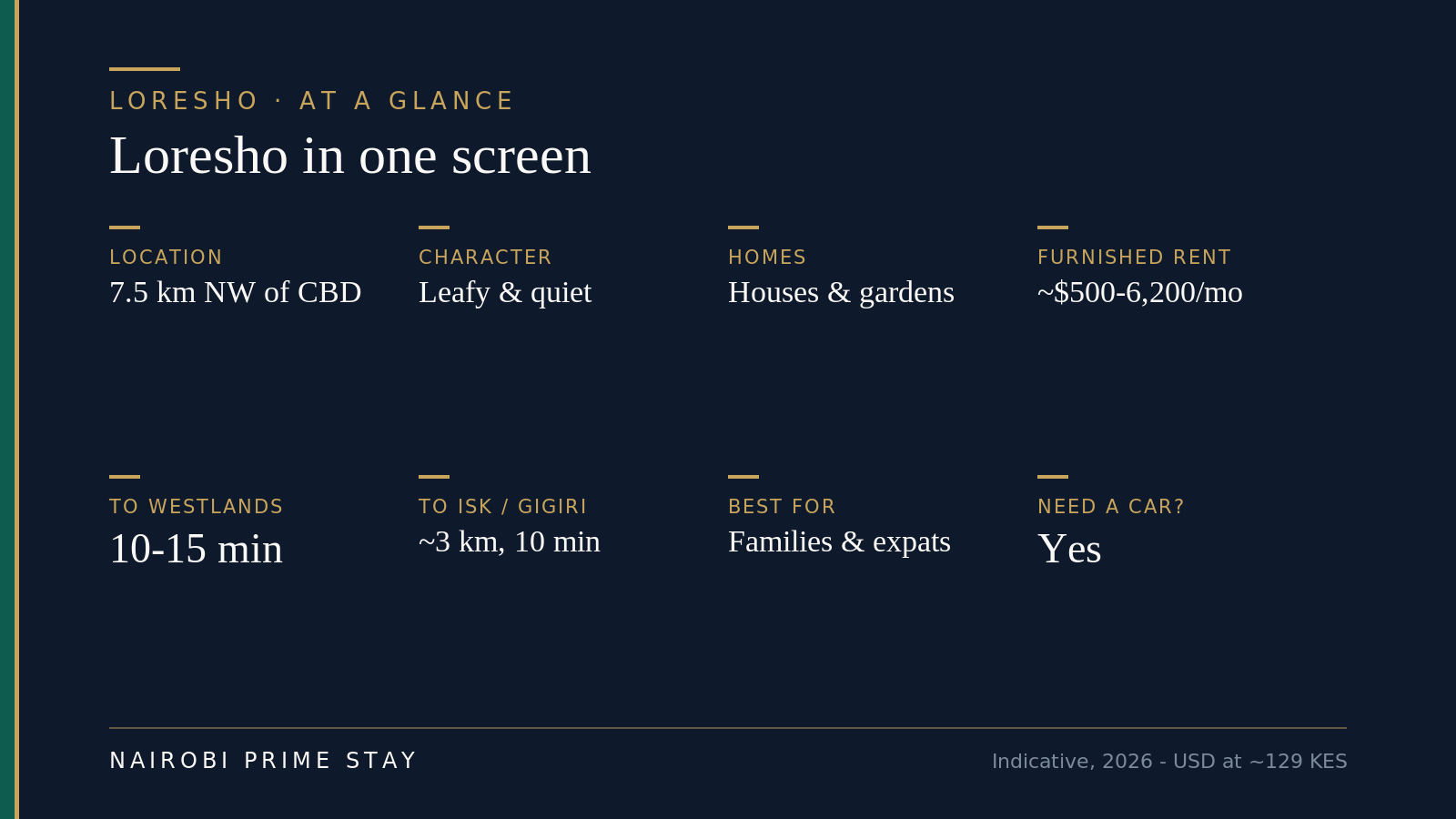
Loresho is one of Nairobi’s calmest established suburbs — leafy, spacious, and almost entirely residential. It sits on the western edge of the city, about 7.5 km north-west of the centre, between Lower Kabete and Kitisuru. People choose it for one main reason: space. Big plots, mature gardens, tall trees, and quiet lanes, while still being a 10-to-15-minute drive from Westlands.
It suits families, diplomats, and UN or NGO staff who want a real garden and a short run to the International School of Kenya, and who don’t mind driving for everything. Furnished homes run roughly KES 65,000 a month for a small apartment to KES 700,000-plus for a large house — about $500 to $5,400 at about 129 shillings to the dollar, as of July 2026. It’s house-dominant, gated, and well-patrolled.
The trade-offs are honest and simple: you’ll need a car, and there’s almost no nightlife or walkable high street. If you want space, greenery, and calm near good schools, Loresho is hard to beat. If you want to walk to a bar or live on a small budget, look at Kilimani or Westlands instead.
Why Loresho matters when you’re new
When you’re moving from the US and picturing “a house with a garden,” Loresho is close to what you imagine. A lot of Nairobi’s prime apartment areas — Kilimani, Kileleshwa, Westlands — are dense and getting denser. Loresho went the other way. It stayed low-rise and green, so the homes here are houses and townhouses far more than apartment towers.
That matters for two groups especially. Families with kids get space to run, a garden, and a short school run to the International School of Kenya in nearby Gigiri. Diplomats and UN or NGO staff get a secure, quiet base that’s close to the Gigiri diplomatic cluster without paying Gigiri’s premium. For everyone else, Loresho is the answer to “where can I get a proper house and still reach Westlands quickly?”
It’s also a useful counterweight when you’re comparing areas. If Runda feels too far and too expensive, and Lavington feels too built-up, Loresho often lands in the middle: spacious and calm, but closer in than Runda and quieter than Lavington.
Where exactly is Loresho?
Loresho lies in the western suburbs, within the Westlands area, about 7.5 km north-west of the central business district. It borders Lower Kabete to the west and Kitisuru to the north, with Spring Valley and Westlands to the south-east and Mountain View nearby. The main spine is Kapenguria Road and the lanes off Loresho Ridge, feeding onto Lower Kabete Road and, from there, Waiyaki Way toward town.
Locals split it loosely into two. “Old Loresho” is the original, larger-plot part — half-acre and bigger compounds, old trees, walled bungalows and family houses, some now decades old. The newer pockets are gated townhouse and small apartment developments built in the last fifteen years, which brought in more modern, lower-maintenance homes without changing the green, low-density feel.
Karura Forest, the city’s huge protected woodland, sits just to the east, so the air is cleaner and cooler than the inner city. The elevation and tree cover make Loresho a few degrees fresher than the CBD — pleasant most of the year, and a reason the area has always drawn people who want a calmer base.
Who lives in Loresho?
Loresho is a mix of established Kenyan families and a steady international crowd. The web of large compounds in Old Loresho has long housed professionals, business owners, and senior civil servants — people who bought decades ago and stayed. Around them, the newer gated developments attract younger families, returning diaspora, and expats who want space without buying a half-acre.
The international slice skews toward people who value quiet and proximity to schools: diplomats, UN and NGO staff, academics, and remote professionals. The pull of the International School of Kenya a few minutes away, plus the easy hop to the Gigiri diplomatic area, makes Loresho a natural pick for families on a posting. You’ll also find a fair number of medical and aid-sector workers who like being close to Westlands and the Parklands hospitals.
What you won’t find much of is a young-singles party scene. Loresho is residential to its core. Evenings are quiet, neighbours know each other, and life revolves around homes, gardens, schools, and the nearby forest rather than bars and clubs.
Is Loresho safe?
Loresho is one of the safer parts of Nairobi to live in, with the usual big-city caveats. Most homes sit behind walls and gates, many in patrolled gated communities, and the low through-traffic means quiet lanes where strangers stand out. As across Nairobi’s western suburbs, the real risk is opportunistic property crime — a phone snatched, a car broken into, a chancer testing a gate — not violence against residents.
The practical move is the same one we give for every prime suburb: check what we call the Nairobi Five before you sign. Does the home have 24/7 security (guards, a gate, cameras)? A backup generator? Reliable water (mains plus a tank, ideally a borehole)? Fibre already serving the house? Responsive management or a landlord who actually answers? A walled compound with a guard and a beam alarm is standard here, and worth confirming rather than assuming.
For the full picture — what petty crime actually looks like, ride-hailing after dark, and how to set up a home securely — read our honest is Nairobi safe guide. The short version for Loresho: behave as you would in any quiet, leafy suburb anywhere, use Uber or Bolt at night rather than walking unlit lanes, and you’re unlikely to have trouble. Thousands of families live here without incident.
Rent and homes in Loresho
Loresho is house-dominant, so the rental market looks different from the apartment suburbs. Most listings are three-to-five-bedroom houses and townhouses with gardens and staff quarters, with a growing but still smaller pool of apartments in the newer developments. Houses for rent here average somewhere around KES 500,000 a month across the whole range, on generous plots — but that average is pulled up by big homes, and there’s plenty below it.
Here’s an indicative picture as of 2026. These are orientation ranges, not quotes — actual rent depends on the exact street, plot size, finish, furnishing, and how new the development is. Furnished figures assume a fully equipped home; unfurnished and longer leases cost less. We’ve converted at roughly KES 129 to the dollar (the rate sits near 129.4 as of July 2026 — check Wise or the Central Bank of Kenya for the live number).
| Size | Unfurnished (KES/mo) | Furnished (KES/mo) | Furnished (USD, ~129) |
|---|---|---|---|
| 1-bed apartment | 45,000–75,000 | 65,000–110,000 | ~$500–850 |
| 2-bed apartment | 70,000–120,000 | 95,000–170,000 | ~$735–1,315 |
| 3-bed townhouse / apartment | 130,000–230,000 | 180,000–320,000 | ~$1,390–2,475 |
| 4-bed house | 220,000–400,000 | 300,000–550,000 | ~$2,320–4,250 |
| 5-bed+ house | 350,000–650,000 | 450,000–800,000+ | ~$3,480–6,180+ |
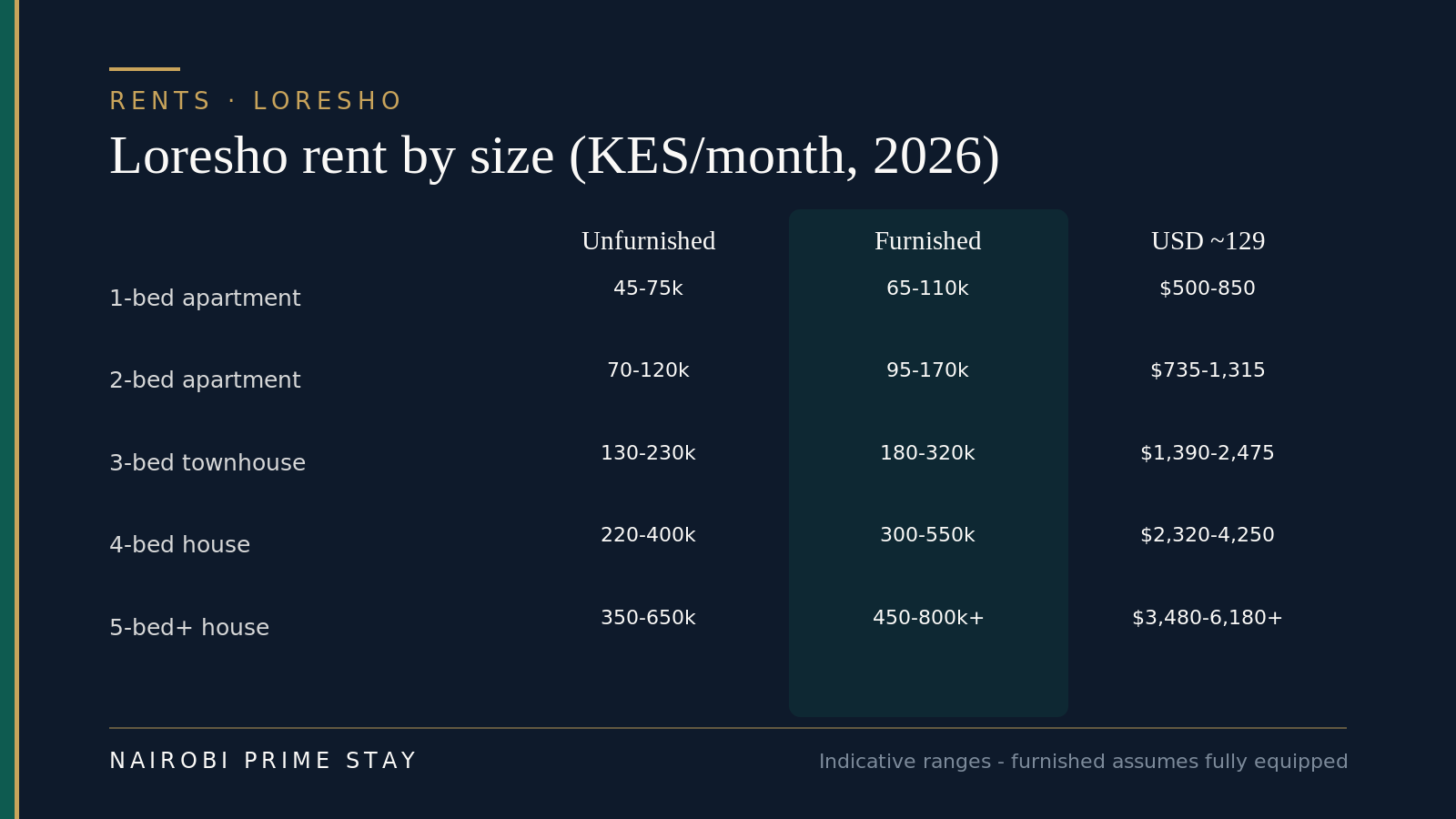
A few honest notes on the numbers. Apartments are the cheapest way into Loresho, but there aren’t many, so they go quickly — if a two-bed flat in a good development comes up around KES 70,000 to 90,000, expect competition. The sweet spot for most relocating families is a three-or-four-bed townhouse in a gated court: you get a garden, security, and shared maintenance without the upkeep of a stand-alone house on a big plot. The very top of the market — large stand-alone homes on half-acre-plus compounds — runs to KES 650,000 and beyond, with luxury five-bed all-en-suite houses in gated communities asking around $5,000 a month.
Expect to pay a deposit of one to three months plus the first month up front, sign a 12-month lease, and need a KRA PIN and ID or permit to do so. Always view in person and verify the landlord before paying anything — never wire money for a home you haven’t seen. Our cost of living guide puts these rents in the context of a full monthly budget.
Serviced apartments and a soft landing in Loresho
Because Loresho is mostly houses on year-long leases, the smartest way to arrive is not to sign anything straight away. Book a serviced apartment for your first four to eight weeks, then use that secure base to view homes, test the school run, and feel the traffic before you commit.
A serviced apartment is all-inclusive — Wi-Fi, cleaning, a backup generator, security, and furniture are handled, so you skip the setup headaches of a new country. It buys you time to learn whether Loresho’s quiet, car-dependent rhythm actually fits your family, or whether you’d be happier somewhere a touch more central like Lavington. Many people who think they want Runda or Loresho discover after a month that a different area suits their commute better — far cheaper to learn that before a 12-month lease than after.
You can base yourself in or near Loresho, or in nearby Westlands and Spring Valley, and still scout Loresho easily. See what’s available in the area on our Loresho serviced apartments page, or read the full serviced apartments guide for how the soft-landing approach works, what’s included, and typical monthly pricing. Booking is simple: a $50 deposit reserves your place and the balance is paid on arrival.
Renting a Loresho home from the US before you fly
You can line up a Loresho home from 8,000 miles away — thousands of relocating families do — but the order you do it in matters, and this is exactly where newcomers lose money. The single rule: never wire a deposit for a home you (or someone you trust) haven’t seen in person. Loresho’s scarce apartments and desirable townhouses are precisely the kind of listing scammers clone.
Here’s the safe sequence. Browse and shortlist online first, so you arrive knowing the market. Book a serviced apartment for your first four to eight weeks as a soft landing — a secure base with Wi-Fi, power backup, and security handled. View your shortlisted homes in person, or send a trusted local or relocation agent, before committing. Verify the landlord and the lease: confirm the person collecting rent actually owns or manages the property, and get a written lease and inventory. Only then sign and pay, locally, once you’re satisfied.
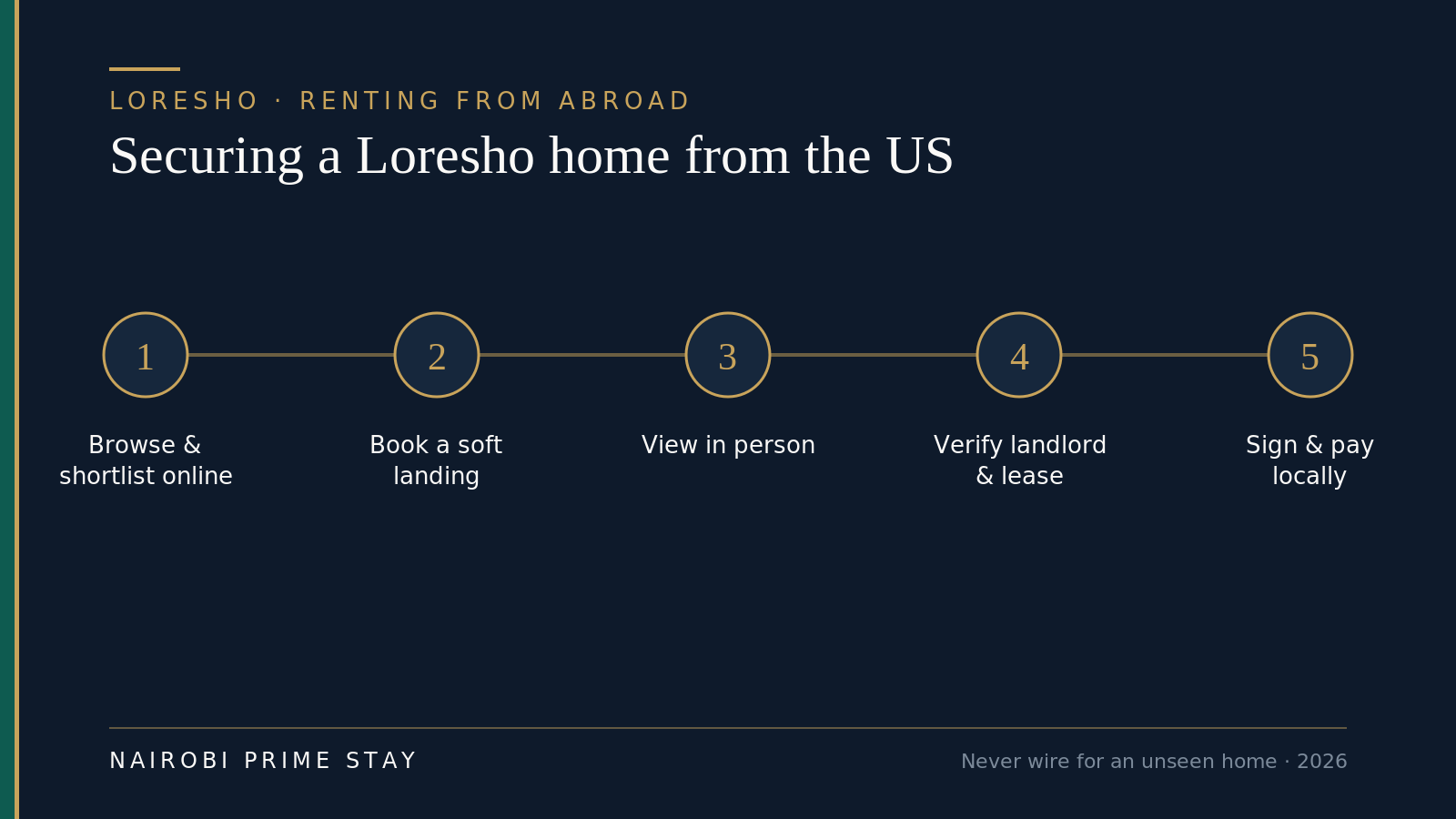 The safe order for renting Loresho from abroad — the soft landing in the middle is what lets you check everything before you commit.
Rental scams follow a pattern, and once you know it they’re easy to spot. A “landlord” advertises a beautiful Loresho house well below the market, pressures you to pay a deposit to “hold” it sight unseen, will only talk on WhatsApp, and asks for money by wire, crypto, or gift card. Real agents and landlords share the title or lease, do a live dated video tour, and hold your deposit through a lawyer — not a personal account.
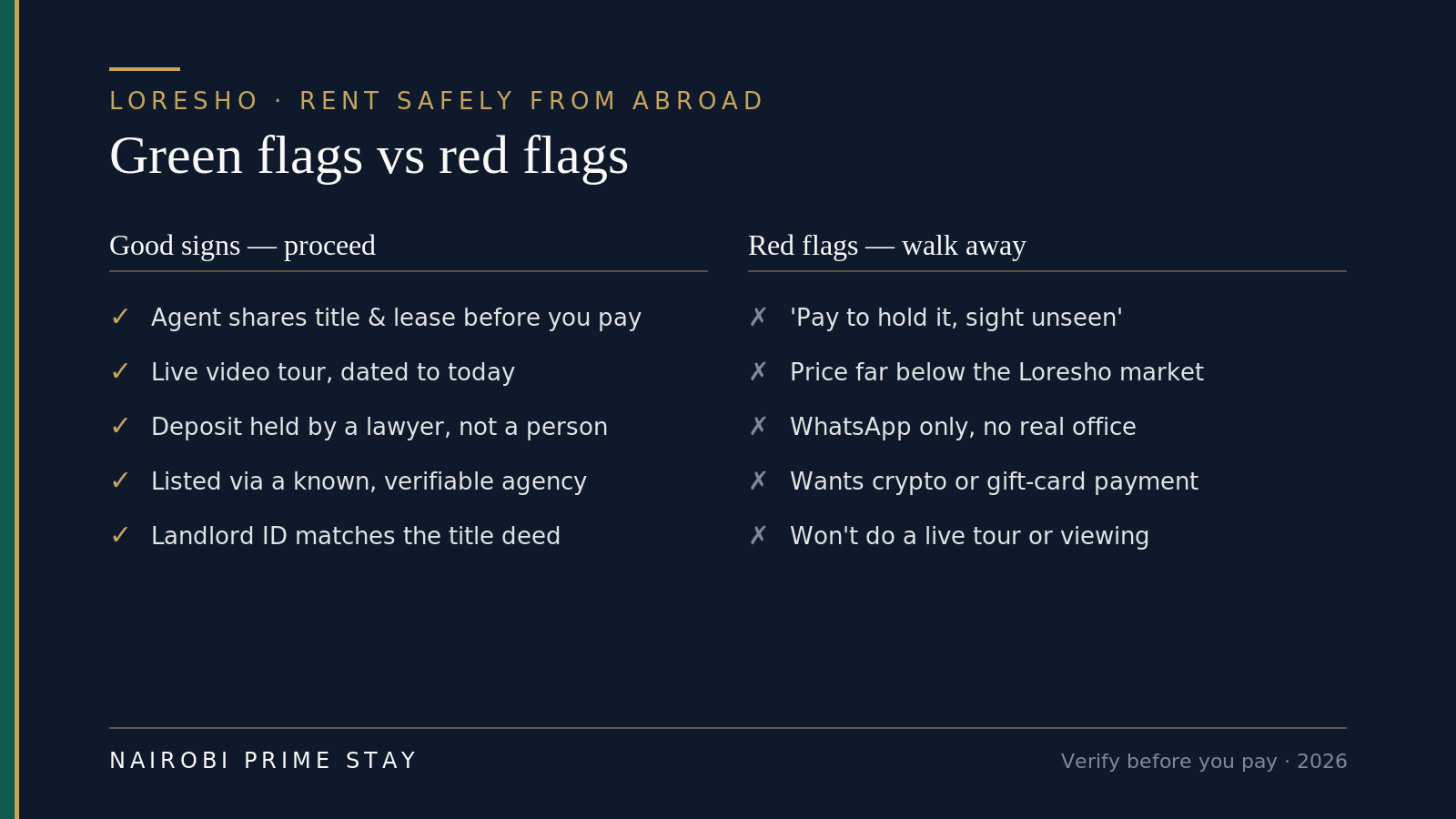 Green flags versus red flags when you’re renting from another country.
Our how to rent an apartment in Nairobi guide walks through the whole leasing process — deposits, leases, KRA PIN, inventories — and our property scams guide covers the cons in detail. If you’d rather skip the risk entirely for your first weeks, a serviced apartment lets you land safely and choose your Loresho home in person, with nothing wired in advance — a $50 deposit reserves it and the balance is paid on arrival.
The honest downside: car-dependent and very quiet
Loresho’s strengths are also its limits. The same low density that makes it calm means there’s no walkable high street, few shops within strolling distance, and almost nothing to do at night within the suburb itself. You drive to the supermarket, you drive to dinner, you drive the kids to friends. Without a car, daily life here is genuinely hard.
The roads inside Loresho are quiet, but the way out can clog. Lower Kabete Road and the Waiyaki Way corridor toward town carry heavy rush-hour traffic, and a 7.5 km trip that takes 15 minutes off-peak can take 40 or more at 8am. If your work or school sits on the wrong side of that bottleneck, the daily reality bites. Some internal lanes are also unpaved or rough in patches, which is part of the rustic charm but means a higher-clearance car earns its keep.
And it’s quiet — properly quiet. That’s the point for families and anyone craving calm, but if you’re a young professional who wants restaurants, gyms, and a social scene on your doorstep, you’ll feel isolated. The fix is to live closer to that life in Westlands or Kilimani. Loresho rewards people who treat home as the destination, not a launchpad into nightlife.
Getting around Loresho
You’ll rely on a car or ride-hailing in Loresho — there’s no way around it. Uber and Bolt both serve the area well and are the expat default: safe, cheap by US standards, and payable by card or M-Pesa. A hop to Westlands runs a few dollars. Many residents buy a car anyway, because school runs, weekend trips, and big grocery shops are far easier with your own wheels.
Here’s a rough sense of drive times from Loresho, off-peak — add a good chunk at rush hour:
- Westlands (Sarit, Westgate, offices): about 10 to 15 minutes
- International School of Kenya, Gigiri: about 10 minutes (roughly 3 km)
- Gigiri / UN complex and US Embassy: about 10 to 15 minutes
- City centre (CBD): about 20 to 30 minutes, traffic depending
- Karura Forest gates: 5 to 10 minutes
- Jomo Kenyatta International Airport (JKIA): about 45 to 70 minutes, very traffic-dependent
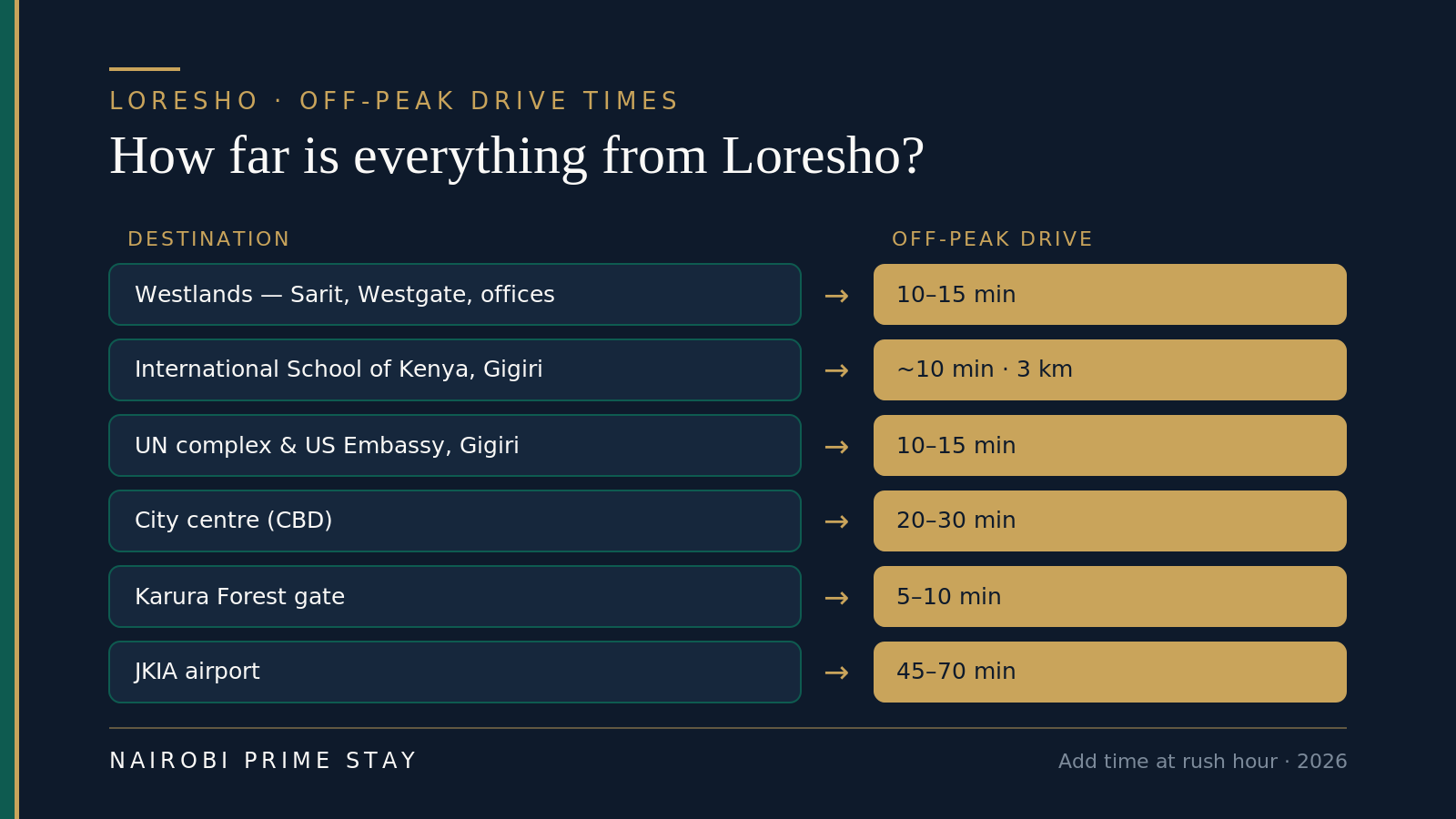 Rough off-peak drive times from Loresho — the morning and evening peaks add a good chunk to anything heading toward town.
Matatus (shared minibuses) run along Lower Kabete Road and Waiyaki Way and are the local lifeblood, but most newcomers stick to ride-hailing until they find their feet. Drive on the left, keep doors locked in jams, and plan around the morning and evening peaks rather than fighting them. Our getting around Nairobi guide has the full picture on ride-hailing, matatus, and buying a car.
Work and remote work in Loresho
Loresho works well for remote work, with one rule: confirm the infrastructure before you sign. Home fibre is widely available — Safaricom Home Fibre, Zuku, and Faiba all serve much of the area — but coverage varies street by street in the older sections, so check that a specific house is already connected rather than assuming. Tiers run roughly 40 to 150 Mbps and up, plenty for video calls and uploads.
The bigger thing to plan for is power. Nairobi has occasional outages, and a quiet suburb is no exception, so you want a home with a backup generator or your own inverter and UPS to keep Wi-Fi and calls alive. This is part of the Nairobi Five for a reason. Our internet and remote work guide covers providers, speeds, and the backup-power setup in detail.
There’s no coworking space inside Loresho itself, but Westlands — 10 to 15 minutes away — has Nairobi Garage, Ikigai, and plenty of laptop-friendly cafés. The time zone is a quiet advantage: at UTC+3, a Nairobi afternoon overlaps a US East-Coast morning, so a 4 or 5pm finish here lines up with the start of the American working day.
Shopping, eating, and the outdoors
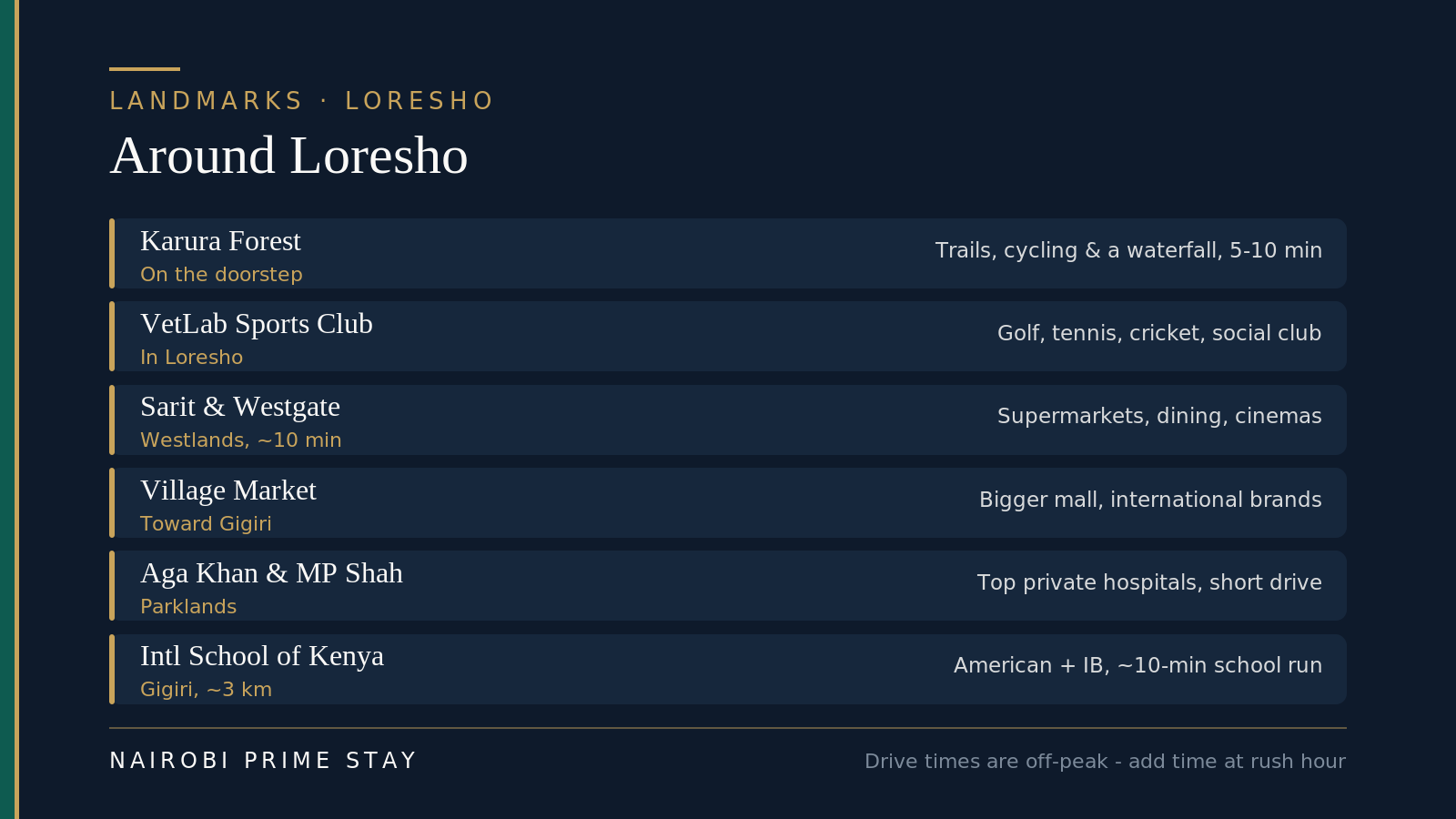
Loresho’s daily life leans on its neighbours, and the standout is Karura Forest right on the doorstep. It’s one of the best urban forests in Africa — shaded trails for walking, running, and cycling, a waterfall, picnic spots, and a couple of cafés inside the gates. For a leafy suburb, having that on your morning route is a genuine luxury. The VetLab Sports Club, a long-standing members’ club with golf, tennis, and cricket, is also right here and a social anchor for many residents. One practical heads-up, since Karura is such a draw: it isn’t free, but it’s cheap. As of 2026, under Kenya Forest Service management, entry runs about KES 174 for resident adults and KES 55 for resident children, with non-residents paying around KES 850 and KES 450; saloon-car parking is about KES 295 a day. Payment is cashless — via eCitizen or M-Pesa at the gate — and the old annual passes and Friends of Karura memberships were suspended when the fees changed in 2025, so budget for per-visit entry and confirm the current rate before you go.
For shopping and dining you head a few minutes toward Westlands. Sarit Centre and Westgate Mall cover supermarkets (Carrefour, Naivas), pharmacies, banks, restaurants, and cinemas, and Two Rivers and Village Market up toward Gigiri add more, including bigger international brands. Within and around Loresho there are small shopping centres and convenience stores for daily essentials, plus the usual roadside dukas, but the serious shopping is a short drive away.
Schools near Loresho
Loresho’s school access is one of its biggest selling points for families. The International School of Kenya (ISK) — American curriculum plus IB, in nearby Gigiri — sits roughly 3 km away, about a 10-minute drive, which makes Loresho one of the more convenient suburbs for an ISK family. Rosslyn Academy (American curriculum and AP) in Runda is also a short hop north.
Beyond those, the wider western corridor puts several international and well-regarded local schools within reach, and there are good primary and nursery options in and around Loresho itself. Whatever you’re targeting, enquire early: the best international schools run waitlists, so start months ahead, gather transcripts and records, and note that many align to a US or August academic year. Indicative international-school fees run from around $10,000 a year at the more affordable end to roughly $20,000 to $28,000 at ISK — confirm current figures directly with each school, as they change yearly.
Hospitals and healthcare near Loresho
Loresho is well placed for healthcare. The Parklands hospital cluster — Aga Khan University Hospital (JCI-accredited, strong across cardiac, cancer, and full specialist care) and MP Shah Hospital — is a short drive south-east. The Nairobi Hospital in Upper Hill and Gertrude’s Children’s Hospital in Muthaiga are a bit further but reachable, and Gertrude’s is the go-to for families with young kids.
Nairobi’s private hospitals are among the best in the region, with English-speaking specialists and costs far below US prices, though still meaningful. The standard advice holds: carry private health insurance with regional or international cover and medical evacuation, keep digital copies of your documents, and know your nearest hospital before you need it. Our healthcare in Nairobi guide covers hospitals, insurance, and costs in full. (This is general information, not medical advice.)
Loresho for property investors
For investors, Loresho is a steady, lower-yield, capital-preservation play rather than a high-cash-flow one. Like most prime western suburbs, big family houses here generate modest gross rental yields — often in the 3 to 5 percent range — because purchase prices are high relative to rent. The appeal is different: durable demand from a quality tenant pool (diplomats, UN and NGO families, established professionals), low vacancy for the right home, and land that holds value because the area can’t densify the way Kilimani has.
The clearest opportunity has been the newer gated townhouse and small-apartment developments, which let owners tap a broader rental market than half-acre mansions do, with easier maintenance and stronger relative yields. Tenant demand leans heavily on the school-and-diplomatic calendar, so a well-finished three-or-four-bed in a secure court near ISK rents reliably.
If you’re weighing Loresho against higher-yield corridors, read our best areas to invest in Nairobi guide — it compares prime suburbs like this one against growth areas where yields run higher but risk and tenant turnover do too. The honest summary: Loresho is for investors who want a safe, blue-chip asset in a proven area, not the highest possible return.
Can you buy a home in Loresho?
Yes — and plenty of diaspora buyers and long-term residents do, though most newcomers rent first. Foreigners can own property in Kenya, with one key limit: as of 2026, non-citizens can only hold land on a leasehold basis, capped at 99 years under the Constitution, and can’t own freehold or agricultural land. In practice, for a Loresho home that means a long leasehold title rather than outright freehold — normal here, and something your lawyer handles. Our can foreigners buy property in Kenya guide explains the rule in full.
Loresho is a market of houses and townhouses more than apartments, so purchase prices sit at the higher end. As rough orientation, a townhouse in a gated court typically runs into the low hundreds of thousands of dollars, while a large stand-alone home on a half-acre-plus compound can reach well over a million — but these swing hard with plot size, finish, and title, so treat them as a starting point and confirm current figures with a local agent and our Nairobi property prices guide. Gross rental yields on prime Loresho homes are modest, often 3 to 5 percent; people buy here for space, a quality tenant pool, and land that holds value, not for cash flow.
The process is where diaspora buyers most need to slow down. Engage an independent conveyancing lawyer — not the seller’s — before you pay anything. Do an official land search to confirm the seller actually owns a clean title, agree the sale, and pay the deposit into the lawyer’s client account, never directly to a “seller” you’ve only met online. Then complete the transfer, pay stamp duty (4 percent in urban areas like Nairobi — see our property taxes guide), and register the title in your name. Our guides on how to buy property in Kenya, title deeds, and diaspora property investment walk through each step, and the property scams guide covers the fake-title and power-of-attorney traps that target remote buyers.
Who Loresho suits — and who it doesn’t
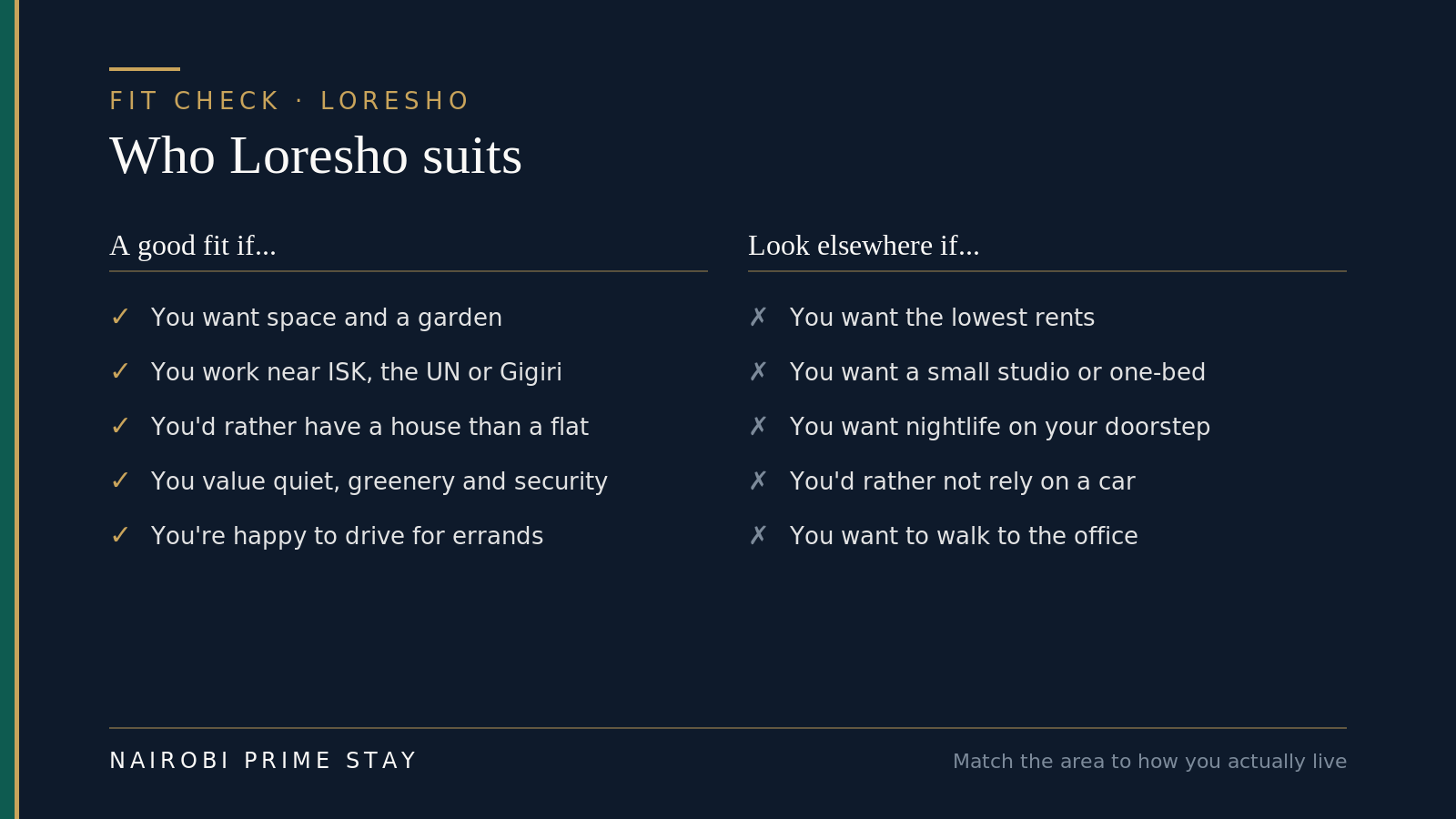
Loresho is a strong fit if you’re a family that wants space and a garden, you work at or near ISK, the UN, or the Gigiri diplomatic area, you’d rather have a house or townhouse than an apartment, you value quiet and greenery, and a car is part of your plan anyway. It’s also good for remote professionals who want a calm home base and don’t need nightlife nearby.
It’s the wrong fit if you want the lowest possible rent, a small studio or one-bed (there just aren’t many), bars and restaurants you can walk to, or a life that doesn’t depend on a car. If that’s you, the apartment suburbs serve you far better — start with our best neighborhoods in Nairobi guide to compare.
Loresho vs Kitisuru vs Spring Valley
These three western suburbs get compared a lot because they share a leafy, low-density, family character. The differences are in price, distance, and exactly how quiet you want it. Here’s an honest side-by-side as of 2026.
| Loresho | Kitisuru | Spring Valley | |
|---|---|---|---|
| Character | Established, leafy, spacious; house-dominant | Exclusive, large gated estates; very low-density | Leafy, upscale; houses + new townhouses |
| Furnished 2-bed (KES/mo) | ~95k–170k (few flats) | Few flats; houses dominate | ~160k–280k |
| Typical home | 3–5 bed houses & townhouses | Large stand-alone homes on big plots | Houses & gated townhouses |
| Best for | Families & diplomats near ISK/UN | Buyers wanting top-end space & privacy | Families & pros wanting space near Westlands |
| Feel | Calm, suburban, mid-prime | Quietest, most exclusive | Quiet, green, slightly more central |
| To Westlands (off-peak) | 10–15 min | 10–20 min | 5–10 min |
In plain terms: Loresho is the value-for-space middle option, Kitisuru is a notch more exclusive and private (and pricier), and Spring Valley sits a touch closer to Westlands with a slightly more polished, new-build feel. If proximity to ISK and Gigiri is your priority, Loresho usually wins. For the full set of areas, see the neighbourhood hub.
A realistic example
Say you’re a family of four relocating from Washington, DC for a three-year UN posting. Both kids are headed to ISK. You want a garden, security, and a school run that doesn’t eat your morning.
You arrive on an eTA and book a serviced apartment near Westlands for six weeks while you look. You quickly rule out Gigiri (lovely but pricey) and Runda (great, but the commute felt long), and settle on a four-bed townhouse in a gated court in Loresho — KES 380,000 a month furnished, with a guard, generator, borehole, fibre, and a shared lawn. The ISK run is 10 minutes. Weekends are spent in Karura Forest five minutes away. You keep a car for school and shopping, use Bolt for evenings out in Westlands, and pay rent and the M-Pesa bills from your phone.
Total housing comfortably under what the same space would cost in DC, with a garden you couldn’t have dreamed of there. The compromises you accepted knowingly: you drive for everything, and the suburb is asleep by 9pm. For this family, that’s the whole point.
Your Loresho move-in checklist
Use this as a practical run-through before you commit to a home in Loresho:
- Decide house vs townhouse vs apartment — Loresho is house-heavy, so apartments are scarce and competitive.
- Set a realistic furnished budget; for most families that’s a 3–4-bed townhouse, KES 180,000–550,000/mo.
- Do a soft landing first — a serviced apartment for 4–8 weeks so you test the commute before signing.
- Drive the ISK / Westlands / Gigiri route at 8am, not just off-peak, to feel the real traffic.
- Check the Nairobi Five: 24/7 security, backup generator, water (tank + ideally borehole), fibre already connected, responsive management.
- Confirm fibre actually serves the specific house — coverage varies street by street in older sections.
- Get your KRA PIN and ID/permit ready; you’ll need them to sign a lease.
- Budget for deposit (1–3 months) plus first month up front, and get a written lease and inventory.
- View in person and verify the landlord before paying anything — never wire for an unseen home.
- Line up schools early — ISK and the top international schools run waitlists.
Frequently asked questions
Is Loresho a good place to live in Nairobi?
Yes, if you want space and quiet. Loresho is an established, leafy, low-density western suburb about 7.5 km from the city centre, dominated by houses and townhouses with gardens. It’s a strong fit for families, diplomats, and UN or NGO staff who want a real garden and a short run to the International School of Kenya. The main trade-offs are that you’ll need a car and there’s almost no nightlife.
How much is rent in Loresho?
As of 2026, furnished homes in Loresho run roughly KES 65,000 a month for a small apartment to KES 800,000-plus for a large house — about $500 to $6,200 at around 129 shillings to the dollar. A typical furnished three-or-four-bed townhouse, the sweet spot for most families, runs about KES 180,000 to 550,000. Apartments are cheaper but scarce. These are indicative ranges; actual rent depends on the street, plot, finish, and furnishing.
Is Loresho safe?
Loresho is one of the safer parts of Nairobi, with normal big-city precautions. Most homes sit behind walls and gates, often in patrolled gated communities, and the quiet lanes mean low through-traffic. The main risk is opportunistic property crime, not violence. Check that a home has 24/7 security, and use Uber or Bolt at night rather than walking unlit lanes.
How far is Loresho from Westlands and the CBD?
Loresho is about 10 to 15 minutes from Westlands off-peak and roughly 20 to 30 minutes from the central business district, traffic depending. It sits about 7.5 km north-west of the centre. Lower Kabete Road and the Waiyaki Way corridor can clog badly at rush hour, so a trip that takes 15 minutes off-peak can take 40 or more at 8am.
Is Loresho close to the International School of Kenya (ISK)?
Yes. ISK, in nearby Gigiri, is roughly 3 km from Loresho — about a 10-minute drive. That short school run is one of the main reasons families and diplomats choose Loresho. Rosslyn Academy in Runda is also a short hop north.
Do I need a car to live in Loresho?
Practically, yes. Loresho is low-density and residential, with no walkable high street and few shops within strolling distance, so daily life without a car is hard. Uber and Bolt serve the area well and are a fine alternative for those who don’t drive, but most residents keep a car for school runs, shopping, and weekends.
Are there apartments in Loresho or mostly houses?
Loresho is mostly houses and townhouses with gardens, especially in ‘Old Loresho’ where plots are large. Newer gated developments have added townhouses and a smaller pool of apartments, so flats do exist but are limited and competitive. If you specifically want an apartment, the nearby apartment suburbs like Kilimani, Kileleshwa, or Westlands give you far more choice.
Who is Loresho best suited for?
Families wanting space and a garden, diplomats and UN or NGO staff who work near Gigiri, and remote professionals who want a calm home base near ISK and Westlands. It suits people who’d rather have a house than a flat, value quiet and greenery, and are happy to drive. It’s a poor fit if you want low rents, a small apartment, nightlife on your doorstep, or a car-free life.
Loresho or Kitisuru — which is better?
Both are leafy, low-density western suburbs, but Kitisuru is a notch more exclusive and private, with larger stand-alone homes on big plots and generally higher prices. Loresho offers more value for space and is closer and more convenient for ISK and Gigiri, with a growing supply of townhouses. Choose Kitisuru for top-end privacy and space; choose Loresho for the family-friendly, school-convenient middle ground.
Can I rent a home in Loresho before I arrive in Kenya?
Yes, but do it safely. Browse and shortlist online, then book a serviced apartment for your first few weeks and view homes in person before you sign. Never wire a deposit for a house you haven’t seen — Loresho’s scarce, desirable listings are exactly what rental scammers clone. Confirm the landlord actually owns the property, get a written lease and inventory, and pay locally once you’re satisfied.
Can foreigners buy a house in Loresho?
Yes. Foreigners can own property in Kenya, but as of 2026 non-citizens hold land on a leasehold basis capped at 99 years, not freehold. Loresho is house- and townhouse-dominant, so buy prices sit at the higher end — a gated townhouse into the low hundreds of thousands of dollars, and large stand-alone homes well beyond. Use an independent conveyancing lawyer, do an official land search, and pay into the lawyer’s client account, never to a seller directly.
What is there to do in Loresho?
Loresho’s big draw is Karura Forest on the doorstep — shaded trails for walking, running, and cycling, a waterfall, and cafés inside the gates. The VetLab Sports Club, in the area, offers golf, tennis, and cricket. As of 2026 Karura entry is about KES 174 for resident adults (around KES 850 for non-residents), paid cashless. Beyond that, the shopping and dining are a 10-minute drive in Westlands, and evenings in Loresho itself are quiet — it’s residential to its core.
Final thoughts
Loresho is for people who want their home to be the destination. It trades nightlife and walkability for space, trees, quiet, and a short run to good schools — a fair trade if that’s what you’re after, and a frustrating one if it isn’t. The honest test is simple: do you picture your Nairobi life around a garden and the forest, or around restaurants and a buzzing street? If it’s the garden, Loresho is one of the best places in the city to find it.
Whatever you decide, don’t sign a year-long lease sight-unseen. Spend a few weeks on the ground first, drive the school run at rush hour, and let the area prove itself. Loresho usually does — quietly, which is the whole idea.
Related reading
- Moving to Nairobi: the complete guide — the relocation hub that ties everything together.
- Best neighborhoods in Nairobi — compare Loresho against every other prime area.
- Kitisuru neighbourhood guide and Spring Valley guide — Loresho’s leafy western neighbours.
- Gigiri and Runda — the diplomatic-cluster suburbs next door.
- Cost of living in Nairobi — where these rents sit in a full monthly budget.
- Is Nairobi safe? and Healthcare in Nairobi — the practical safety and health picture.
- Serviced apartments in Nairobi — how a soft landing works before you commit.
Find your place in Loresho
When you’re ready to see real options, browse our serviced apartments in and around Loresho — verified homes with honest monthly pricing, ideal as a soft landing while you choose your long-term house. Not sure whether Loresho or a more central area fits your commute, schools, and budget? Our AI relocation assistant can shortlist places in a couple of minutes, day or night — or browse all serviced apartments to compare areas. A $50 deposit reserves your place, with the balance paid on arrival.
Ready to look?
Find your apartment in Nairobi
Browse verified serviced apartments, or ask the AI concierge which area fits your life.