
Guides · Neighborhoods
Upper Hill Nairobi Neighborhood Guide: Nairobi's Office District (2026)
Upper Hill Nairobi Neighborhood Guide: Nairobi’s Office District


Upper Hill at a glance.
Upper Hill is Nairobi’s office district first and a place to live second — and you should know that before you sign anything here. It’s the ridge of glass towers just south of the city center, home to Britam Tower, the UAP Old Mutual Tower, the World Bank, dozens of bank and corporate headquarters, and two of the country’s biggest hospitals. By day it hums with suits and conferences. After dark and on weekends it empties out.
That makes it a very particular kind of home. For the right person — someone who works in one of those towers, an executive who wants to fall out of bed and into a meeting, a family with a relative in treatment at The Nairobi Hospital, or an investor weighing commercial space — Upper Hill is hard to beat on convenience. For someone after a leafy garden, a school-run suburb, or nightlife under the window, it’s the wrong call, and there are better-suited areas a few minutes away.
This guide is the honest version. It covers what Upper Hill actually is, who lives here, how safe it feels, what rent costs in 2026, the real story on traffic and after-hours quiet, the hospitals and the commercial-property angle, and exactly who it suits. For the wider map of where expats live, start with our best neighborhoods in Nairobi guide and the main moving to Nairobi hub.

The quick version
Upper Hill is Nairobi’s premier business district — a compact ridge of grade-A office towers, bank headquarters and major hospitals about 3 km south of the CBD. People live here mainly to be next to their work or to medical care: the commute can be a five-minute walk, and The Nairobi Hospital is on the doorstep. Residential stock is thinner than in nearby suburbs and skews toward apartments and serviced units rather than houses with gardens.
Indicative 2026 furnished rents run about KES 100,000–180,000 a month (roughly $770–1,390) for a one-bed and KES 150,000–280,000 (roughly $1,160–2,160) for a two-bed; unfurnished costs less. The big trade-offs are rush-hour traffic, which is genuinely heavy on the roads feeding the district, and the quiet, business-only feel evenings and weekends. If you want central but livelier, look at Kilimani or Westlands; if you want central but calmer and greener, look at Riverside. If you work on the hill, though, nowhere beats living on it.
Why Upper Hill matters when you’re new
For most newcomers, Upper Hill matters in one of two ways: you’ll work here, or you’ll spend time at its hospitals. It’s where a huge share of Nairobi’s corporate, banking, development-sector and government-adjacent jobs sit, so a job offer in the city often means a daily trip to this ridge. And it’s the heart of the city’s private healthcare, so even people who live elsewhere end up here for appointments and procedures.
Living in Upper Hill solves the single biggest daily-life problem in Nairobi: traffic. The city’s distances are short but its jams are long, and where you live relative to work shapes your day more than almost anything else. If your office is on the hill, living on the hill can turn a 60-minute crawl into a 5-minute walk. That’s the core case for the neighborhood, and it’s a strong one.
Who lives in Upper Hill?
Fewer people than you’d think, given how busy it looks by day. Upper Hill is overwhelmingly commercial, so its residents are a self-selecting group: professionals who work in the towers and want zero commute, executives and consultants on assignment who value a central, business-first base, medical staff and patients’ families near the hospitals, and a steady flow of business travelers in serviced apartments and hotels. You’ll also find long-term Kenyan households in the older homes that predate the office boom, some now tucked between the high-rises.
What you won’t find much of is the family-with-a-garden crowd or the young-and-social scene. Those move to the suburbs and the livelier central areas. So if community and a residential feel matter to you, Upper Hill can feel transactional — people are here for work, not for the neighborhood. If you’d rather your home double as a base near the action and don’t need a village atmosphere, that same efficiency is the appeal.
Is Upper Hill safe?
Upper Hill is one of Nairobi’s better-secured districts during business hours, simply because it’s wall-to-wall corporate and institutional property — banks, embassies’ service offices, the World Bank, hospitals — all with serious security, guards, gates, cameras and controlled access. By day the streets are busy and watched. Like the rest of the prime areas, the main realistic risk is opportunistic petty theft rather than personal danger.
The honest caveat is the after-hours shift. Because the district empties at night and on weekends, some streets get quiet and poorly peopled once the offices close — and a quiet, deserted street is a different feel from a residential one with neighbors about. Pick a residential building with proper 24/7 security, good lighting and a manned gate, use Uber or Bolt rather than walking after dark, and keep valuables out of sight in traffic. Set up sensibly — save the emergency numbers 999 or 112, enroll in the US State Department’s STEP program, and know your nearest hospital (you’re spoiled for choice here). For the citywide picture, see our honest take on whether Nairobi is safe.
Rent and apartments in Upper Hill
Expect to pay a central-Nairobi premium for less choice than in the residential suburbs. Upper Hill’s housing is mostly apartments — older blocks, a growing number of modern towers, and serviced units aimed at corporate stays — rather than houses with gardens. Because residential supply is limited and demand comes from well-paid professionals, asking rents sit alongside the other prime central areas.

Indicative Upper Hill rents by size, 2026. Confirm current listings before you sign.
As a rough 2026 guide, a furnished one-bed runs about KES 100,000–180,000 a month (roughly $770–1,390) and a furnished two-bed about KES 150,000–280,000 (roughly $1,160–2,160), with unfurnished units meaningfully cheaper and serviced apartments — bills, internet and cleaning included — at the top of the range. Three-beds and the newest premium towers run higher. The US-dollar figures assume an exchange rate of about KES 129 to the dollar — the shilling traded near KES 129.4 on 1 July 2026 — and it moves, so check the live rate on the Central Bank of Kenya or Wise before you budget.
These are orientation ranges, not quotes. Rents vary a lot by building age, security, backup power, fibre and whether bills are bundled. Verify current listings on portals like BuyRentKenya or Property24, and never wire money for a place you haven’t seen — pay only after viewing and verifying the landlord. For how rents here compare with the rest of the city, line this up against our cost of living in Nairobi guide.
Serviced apartments and a soft landing in Upper Hill
Upper Hill is one of the most natural places in Nairobi for a serviced apartment, because so much of its demand is exactly that: people in town for work who need a secure, fully equipped base without the hassle of furnishing a place or setting up utilities. A serviced unit comes with Wi-Fi, cleaning, a backup generator and security included, on flexible monthly terms — ideal if you’re starting a job on the hill, here for a medical stay, or scouting where to settle.
Even if you plan to rent long-term, a serviced apartment for your first 4–8 weeks is the smart soft landing. It lets you start work immediately, view homes in person, and test your actual commute at rush hour before you commit to a year-long lease. Move once you’re sure. See our full explainer on serviced apartments in Nairobi for what they include and who they suit, or browse current serviced apartments in Upper Hill.
Upper Hill as Nairobi’s office district
Upper Hill is the capital’s prime business address — the place corporates moved to when the old CBD got too congested, and now the city’s densest cluster of grade-A office space. The skyline tells the story: Britam Tower, among the tallest buildings in Kenya, and the 33-storey UAP Old Mutual Tower anchor a ridge packed with bank headquarters, insurers, the World Bank and IFC, development agencies, law firms and top hotels. Roads like Hospital Road, Ralph Bunche, Mara Road, Elgon Road and Upper Hill Road are lined with them.
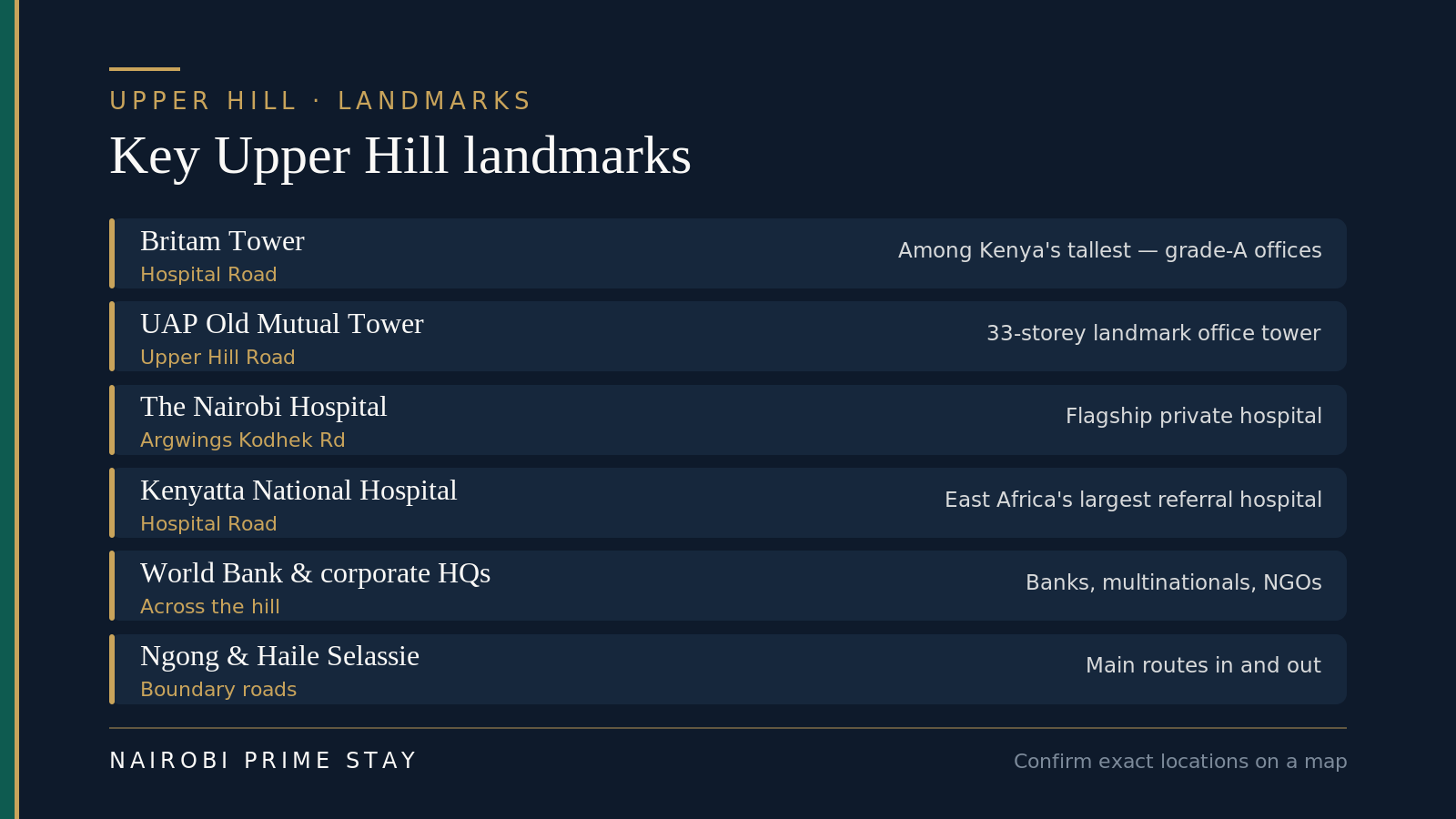
Some of the landmarks that define Upper Hill.
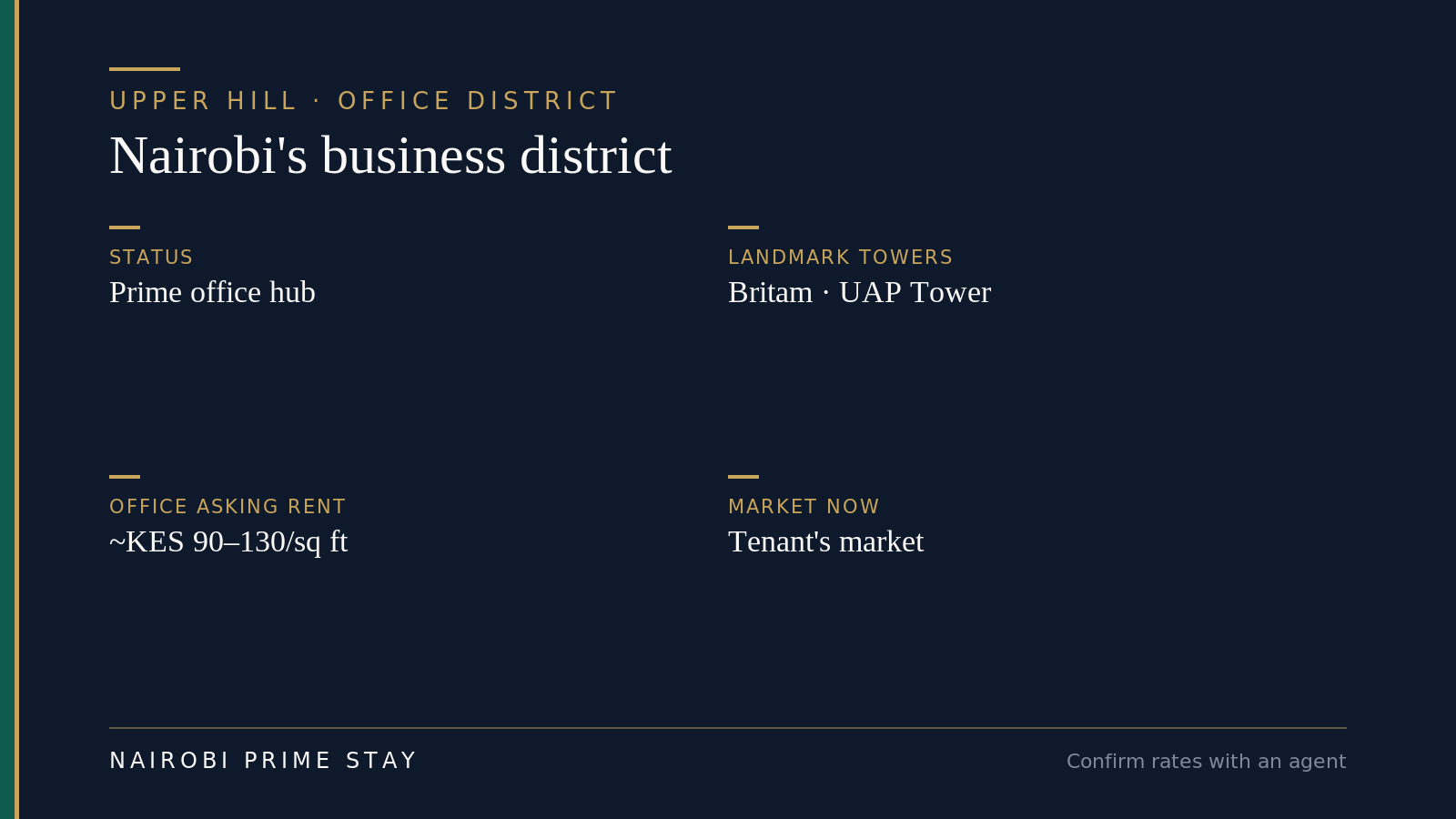
The commercial side of Upper Hill, in brief.
That building boom has a flip side worth knowing, whether you’re a tenant or an investor: Nairobi added a lot of office space quickly, and Upper Hill felt the resulting oversupply. For years that meant higher vacancy than landlords wanted, softer asking rents and real negotiating power for tenants. The glut is now easing — the wider Nairobi metro’s office oversupply fell to about 3.4 million square feet at the end of 2025, down from 5.7 million a year earlier, and vacancy dropped to roughly 15 percent from about 19 percent as companies trade older blocks for modern grade-A space. The catch is that the recovery is uneven: the best towers in prime spots like Upper Hill and Westlands are tightening first, while ageing or poorly located stock still sits empty. Indicative grade-A asking rents sit roughly around KES 90–130 per square foot per month as of 2026, though the marquee towers quote “on application,” so treat that as a ballpark and confirm live figures with a commercial agent. If you’re weighing office space as an investment, read it alongside our commercial property in Nairobi guide before you move.
The honest downside: traffic and the after-hours quiet
Two things will shape your experience here, and both are real. The first is traffic. The roads feeding Upper Hill — Ngong Road, Valley Road, Haile Selassie Avenue, Bunyala Road and the Uhuru Highway approaches — carry the whole district’s commuters, and at peak they back up badly. The irony is that living on the hill is partly a way to escape exactly this: if you can walk to your office, the jams become someone else’s problem. If you’ll commute out of the area daily, drive your actual route at rush hour before you sign, because a short distance can still mean a long crawl.
The second is the business-only rhythm. Upper Hill is built for work, so it lacks the everyday residential texture of a Kilimani or Lavington — fewer corner shops, neighborhood restaurants and the gentle bustle of people who actually live there. Evenings and weekends are quiet. For some that calm is a feature; for others it feels sterile. Be honest with yourself about which camp you’re in.
Getting around Upper Hill
Upper Hill’s saving grace is its central location. It sits about 3 km south of the CBD and butts up against Community, Kilimani and Ngong Road, so the rest of the city is genuinely close — off-peak, the CBD is 5–15 minutes and Westlands and the western suburbs 15–25. The catch, again, is peak hours, when those numbers can double.

Typical off-peak drives from Upper Hill — double them at rush hour.
For the airport, you have two routes. Ordinary traffic on Mombasa Road can make JKIA a 45-minute-plus slog at the wrong time of day. The tolled Nairobi Expressway, with interchanges at Haile Selassie Avenue and Bunyala Road on the edge of Upper Hill, skips most of that and gets you there in roughly 30–45 minutes; you pay by prepaid card, M-Pesa or cash, so confirm the current toll for your route on the Moja Expressway calculator. For the wider picture of ride-hailing, driving and getting a licence, see our getting around Nairobi guide.
You don’t strictly need a car if you live and work here, since the district is walkable internally and Uber and Bolt are cheap and everywhere — a cross-town hop is a few dollars, paid by card or M-Pesa. A car helps for school runs, weekends and cross-town commutes, and many households keep one, but plenty of hill-based professionals manage without. Avoid boda-boda (motorbike) taxis, keep car doors locked in jams, and lean on ride-hailing after dark rather than walking quiet streets.
Work and remote work in Upper Hill
For office-based work, Upper Hill is the destination, not the commute — that’s the whole point. For remote work, it’s perfectly workable but not the obvious first pick. The infrastructure is excellent: modern buildings, lifts, backup generators and fibre are standard, and Safaricom, Zuku and Faiba all serve the area, so a reliable home-office setup is easy to arrange. Just confirm a fibre provider already serves your specific building, and choose one with a generator so power cuts don’t drop your calls. Our internet and remote work in Nairobi guide covers providers and tiers.
The honest note for remote workers is atmosphere. Upper Hill has fewer of the laptop-friendly cafés and coworking spaces that cluster in Kilimani, Westlands and Lavington, so if you like working out of cafés or want a buzzy coworking scene, those areas suit better. If you mostly work from your apartment and value being central, the hill is fine — and as everywhere in Nairobi, the UTC+3 time zone means your afternoons overlap a US East-Coast morning, which is handy for US-facing roles.
Shopping, eating and going out
Day-to-day, Upper Hill leans on hotel restaurants, office-tower cafés and lunch spots built around the working crowd, plus a few well-regarded eateries dotted around. It’s fine for a business lunch or a quick dinner, but it isn’t a dining-and-nightlife destination, and choice thins out in the evenings once the offices empty.
For real variety you borrow the neighborhoods next door, all a few minutes away. Kilimani and Hurlingham are closest: the Yaya Centre, Adlife Plaza and Prestige Plaza on Ngong Road cover supermarkets, cafés, pharmacies and casual restaurants. Westlands, 15–25 minutes off-peak, has the city’s densest cluster of restaurants, malls and nightlife. The Junction Mall on Ngong Road is the handy full-size mall for a big shop. For groceries, a Carrefour or Naivas is an easy hop in any direction, and M-Pesa or a card works almost everywhere. In short, you live central and lean on the areas around you for the fun — see our restaurants and dining in Nairobi and shopping, malls and markets guides for where to go.
Schools near Upper Hill
Upper Hill is not a school neighborhood — it’s offices and hospitals — so families with kids rarely base themselves here for the schooling. The good news is that you don’t have to: the city’s international schools are a reasonable drive away, and plenty of hill-working parents live nearby and commute the kids out.
Several well-regarded schools sit in and around Kilimani and Lavington, a short hop from the hill, while the big American- and British-curriculum campuses cluster further out toward Gigiri, Runda and Karen — the International School of Kenya and Rosslyn Academy near the UN, and Braeburn and Brookhouse on the British side. Those outer campuses are 25–45 minutes away in traffic, which is a real daily consideration for the school run. If schools are your priority, most families choose a home nearer the campus and treat the hill as the commute, or pick a family-oriented suburb outright; our international schools in Nairobi guide maps the fees and locations. For little ones, a number of nurseries and daycares serve working parents in the central areas — our nurseries and daycare guide covers the options.
Hospitals and healthcare near Upper Hill
This is Upper Hill’s quiet superpower. It’s effectively Nairobi’s medical hub, home to The Nairobi Hospital — one of the country’s most established and expat-trusted private hospitals — and Kenyatta National Hospital, East Africa’s largest referral hospital. Several more private hospitals and specialist clinics sit nearby on and off Ngong Road. For anyone managing an ongoing condition, traveling with an elderly parent, or who simply wants top-tier care minutes away, living here means a hospital is a short drive — or even a walk — from your door.
Private care in Nairobi is among the best in the region, with English-speaking specialists and far lower costs than the US, though still meaningful — a private consult runs about $15–40. Carry good international health insurance with regional cover and medical evacuation, and keep digital copies of your documents. For the full picture of hospitals, insurance and how the system works, see our healthcare in Nairobi guide.
Upper Hill for property investors
For investors, Upper Hill is mainly a commercial story, and a nuanced one. On the office side, the district is the prestige address in Nairobi. The wave of construction produced a glut that pushed vacancy up and rents down for several years, but that oversupply is now shrinking as tenants migrate into modern grade-A towers — and prime Upper Hill space is among the stock tightening first. The opportunity is real for the patient and the selective — well-located, well-managed, genuinely grade-A space in a recognized address holds tenants — but generic, ageing or poorly managed buildings still compete hard on price and can sit empty for long stretches. Go in with eyes open, model conservative occupancy, and read our commercial property in Nairobi and best areas to invest in Nairobi real estate guides first.
On the residential side, the draw is a reliable tenant pool of professionals and corporates who want to live next to work, plus serviced-apartment demand from business travelers. Yields can be steady, but you’re buying into a niche — apartments and serviced units, not family homes — so match the product to that demand rather than assuming suburb-style appreciation.
Who Upper Hill suits — and who it doesn’t
Upper Hill rewards a specific kind of resident and frustrates everyone else, so it pays to be honest about which you are.
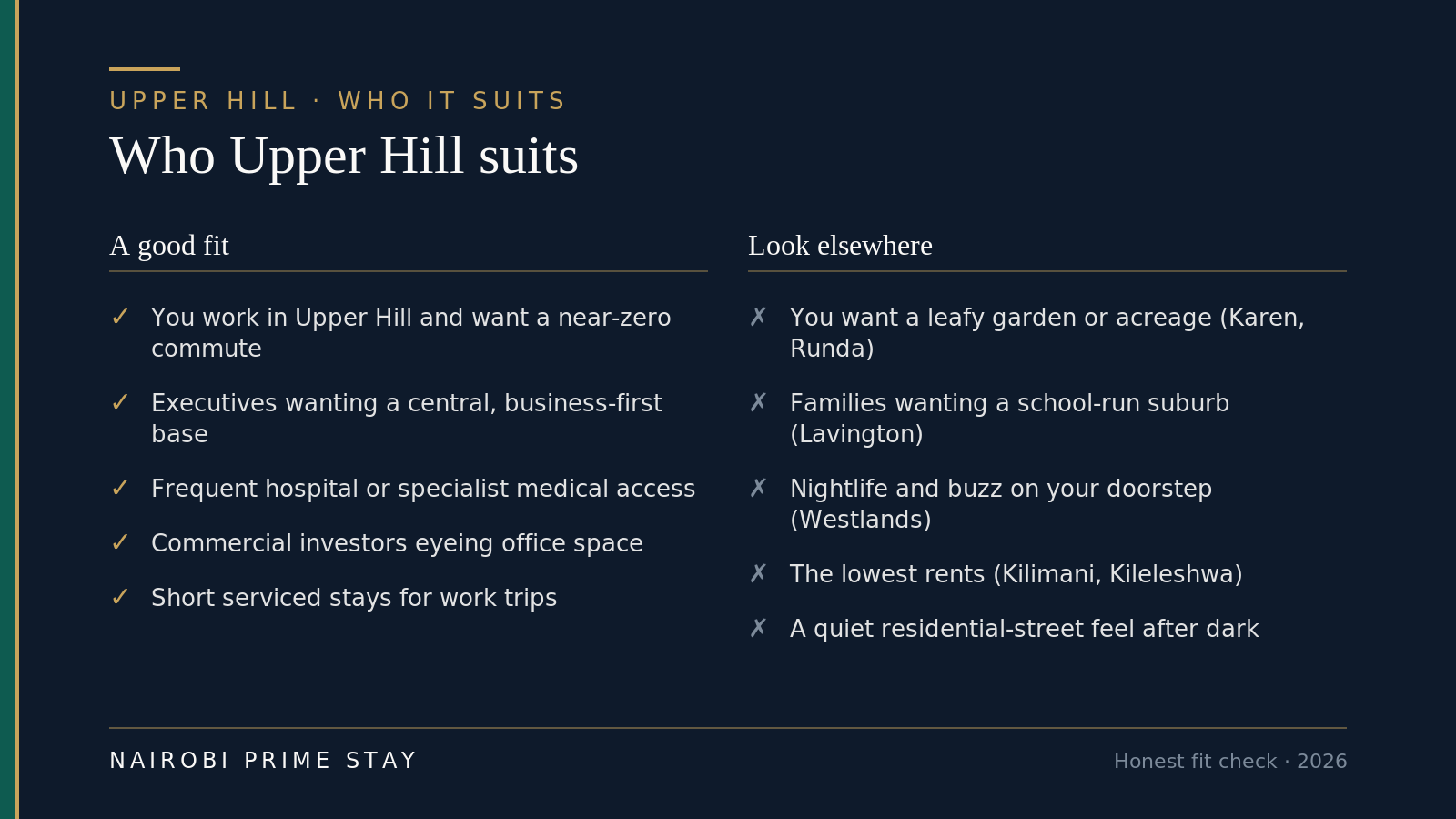
An honest fit check for Upper Hill.
It’s a strong fit if you work on the hill and want to delete your commute, if you’re an executive who values a central and efficient base, if you or your family need regular access to top hospitals, or if you’re an investor focused on commercial space. It’s the wrong choice if you want a garden and space (look to Karen or Runda), a family-friendly suburb with schools and parks (Lavington or Kilimani), nightlife and restaurants under your window (Westlands), or simply the lowest rent for the most apartment (Kilimani and Kileleshwa win there).
Upper Hill vs Kilimani vs Westlands
These three central areas often come down to the same question: how much do you want your home to be about work versus everyday life? Upper Hill is the most business-first — best if you work here — but quietest after hours. Kilimani is central, modern and the best value of the prime apartment areas, with far more residential texture. Westlands is the liveliest, with the city’s top cluster of offices, malls and nightlife, and generally lower rents than the hill for an equivalent unit.
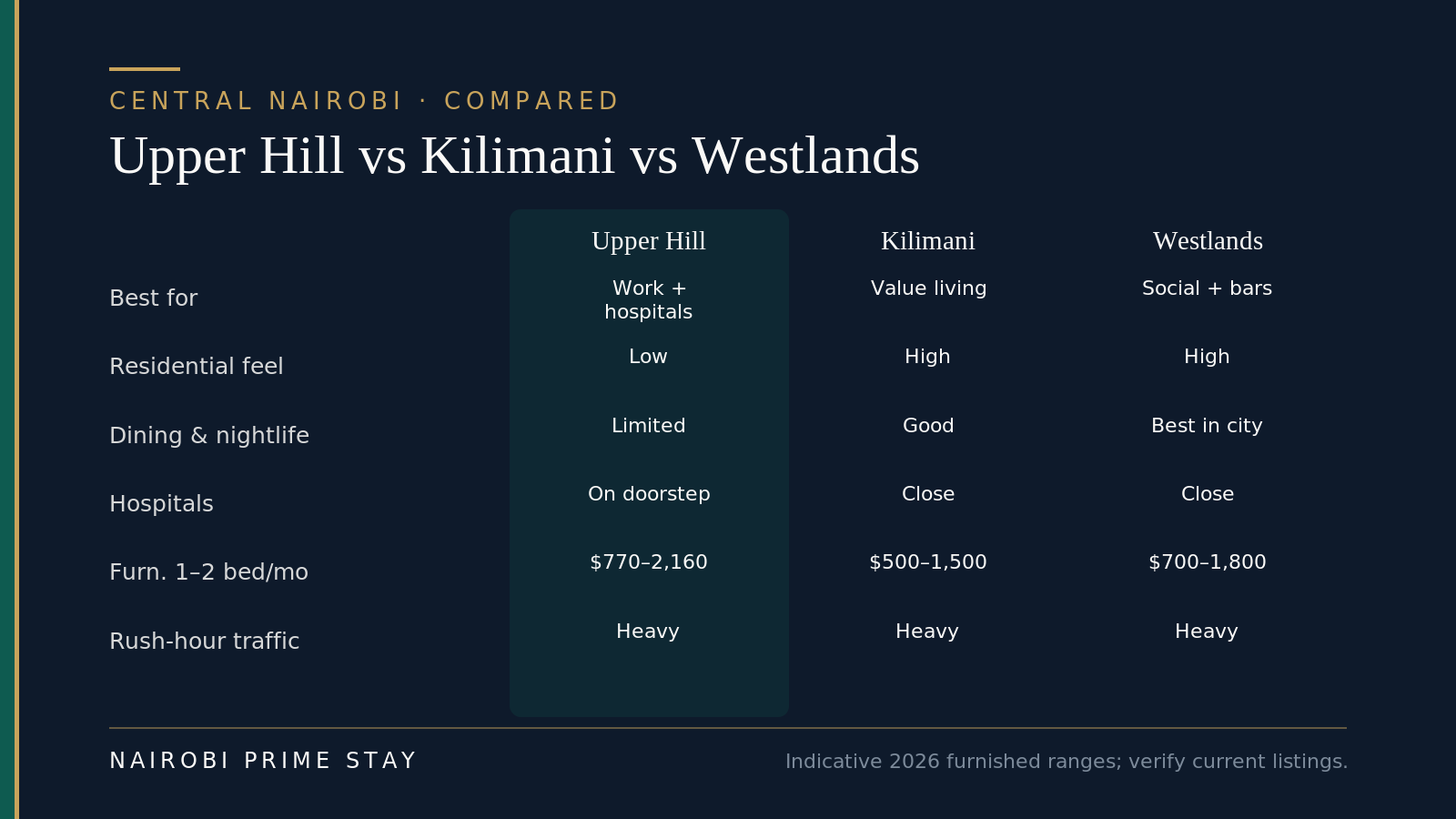
Upper Hill vs Kilimani vs Westlands at a glance — indicative 2026 furnished ranges.
| Factor | Upper Hill | Kilimani | Westlands |
|---|---|---|---|
| Best for | Working on the hill, hospitals | Value, central apartment living | Social, nightlife, offices |
| Character | Office district, quiet after dark | Busy, modern, residential | Urban energy, restaurants, malls |
| Furnished 1–2 bed/mo | ~$770–2,160 | ~$500–1,500 | ~$700–1,800 |
| Residential feel | Low (business-only) | High | High |
| Nightlife & dining | Limited; borrow nearby | Good | Best in the city |
| Hospitals | Excellent, on the doorstep | Close | Close |
| Daytime traffic | Heavy on feeder roads | Heavy | Heavy |
Figures are indicative 2026 furnished ranges; verify current listings. The short version: pick Upper Hill if your office is here or healthcare is a priority, Kilimani for the best blend of price and central living, and Westlands if you want the social scene on your doorstep.
A realistic example
Say you’re a consultant starting a one-year contract with a firm in Britam Tower, traveling without kids. Living anywhere else means a daily fight through Ngong Road or Valley Road traffic; living in Upper Hill means a 10-minute walk to your desk. You take a furnished two-bed in a modern block with a generator, fibre and 24/7 security for about KES 220,000 a month, bills included. Weekday lunches are in the towers, evenings you Bolt five minutes to Kilimani or Westlands for dinner, and weekends you’re out of the quiet district entirely — at Karura Forest, the national park or the coast. For your first month, before committing to the lease, you stay in a serviced apartment on the hill so you can test the building and the walk to work. That’s Upper Hill working exactly as intended: convenience bought deliberately, with the city’s livelier neighborhoods a short ride away.
Your Upper Hill move-in checklist
Use this to pressure-test a place before you commit:
- Confirm your real commute. If you’ll work on the hill, time the walk; if you’ll commute out, drive the route at rush hour first.
- Check the “Nairobi Five”: backup generator, reliable water supply and storage, 24/7 security, fibre already in the building, and responsive management.
- Prioritize security and lighting given the after-hours quiet — a manned gate, CCTV and a well-lit street matter more here than in a residential suburb.
- View in person and verify the landlord before paying anything; never wire for an unseen unit.
- Get the lease and inventory in writing, and confirm who covers service charge, water and security.
- Have your KRA PIN and ID/permit ready — you’ll need them to sign.
- Map your hospital and pharmacy (easy here) and save 999 / 112.
- Consider a serviced apartment for weeks 1–8 so you can test the area before a year-long commitment.
Frequently asked questions
Is Upper Hill a good place to live in Nairobi? It depends entirely on why you’re moving there. Upper Hill is excellent for people who work in its office towers and want a near-zero commute, for executives wanting a central business base, and for anyone who needs regular access to its hospitals. It’s a poor fit if you want a garden, a family-friendly residential feel, or nightlife on your doorstep — the district is business-first and empties out evenings and weekends. Match it to your reason for being there and it works very well.
How much is rent in Upper Hill? Indicative 2026 furnished rents run about KES 100,000–180,000 a month (roughly $770–1,390) for a one-bed and KES 150,000–280,000 (roughly $1,160–2,160) for a two-bed; unfurnished costs less and serviced units, with bills and cleaning included, sit at the top of the range. You’re paying a central premium for a limited residential supply. Rents vary with building age, security, backup power and whether bills are bundled, so verify current listings before you sign.
What is Upper Hill known for? Upper Hill is Nairobi’s prime office and business district — the city’s densest cluster of grade-A office space, home to Britam Tower, the UAP Old Mutual Tower, the World Bank, many bank and corporate headquarters, and top hotels. It’s also a major healthcare hub, anchored by The Nairobi Hospital and Kenyatta National Hospital. It rose as companies moved out of the congested CBD, and today it’s the address most associated with corporate Nairobi.
Is Upper Hill safe? By day, yes — it’s wall-to-wall corporate, institutional and hospital property with serious security, so the streets are busy and watched, and the main realistic risk is opportunistic petty theft rather than personal danger. The honest caveat is that the district empties at night and on weekends, so some streets get quiet and deserted after hours. Choose a residential building with proper 24/7 security and good lighting, use Uber or Bolt after dark, and keep valuables out of sight in traffic.
Upper Hill or Kilimani — which is better? Pick Upper Hill if you work on the hill or need its hospitals; pick Kilimani for better value and far more everyday residential life. Upper Hill is the most business-first of the central areas, quietest after hours, and priced at a central premium. Kilimani is central, modern, the best value of the prime apartment areas, and full of shops, cafés and restaurants. Many newcomers who don’t work on the hill find Kilimani the more livable choice.
Is Upper Hill good for families? Generally no — it’s an office and hospital district, not a school-and-parks suburb, with limited family housing and little residential texture. Families usually prefer areas like Lavington, Kilimani, Karen or Runda, where there are gardens, international schools and a neighborhood feel, and accept a commute to the hill if a parent works there. The exception is a family needing to be near ongoing medical care, where Upper Hill’s hospitals make it worth considering.
Is Upper Hill good for remote work? It’s workable but not the obvious pick. The infrastructure is excellent — modern buildings, lifts, backup generators and fibre are standard — so a reliable home office is easy to set up; just confirm a fibre provider serves your building and choose one with a generator. The downside is atmosphere: Upper Hill has fewer laptop-friendly cafés and coworking spaces than Kilimani, Westlands or Lavington, so café-and-coworking remote workers often prefer those areas.
Is Upper Hill a good place to invest in property? Mostly as a commercial play, and a nuanced one. Upper Hill is Nairobi’s prestige office address, but a building boom has produced oversupply, so prime towers have carried higher vacancy and softer rents lately — good for tenants, a caution for buyers. Selective, well-managed grade-A space holds tenants; generic stock competes hard on price. On the residential side, there’s steady demand from professionals and business travelers, but it’s an apartment-and-serviced-unit niche, not family homes. Model conservative occupancy and get local advice.
How bad is the traffic in Upper Hill, and do I need a car? The feeder roads — Ngong Road, Valley Road, Haile Selassie Avenue and the highway approaches — back up badly at peak, which is precisely why living on the hill appeals if you work there: you can walk and skip the jams. You don’t strictly need a car if you live and work in the district, since it’s walkable internally and Uber and Bolt are cheap and everywhere. A car helps for school runs, weekends and cross-town trips, but many hill-based professionals manage without one.
What hospitals are in Upper Hill? Upper Hill is Nairobi’s main hospital district. The Nairobi Hospital, one of the country’s most established and expat-trusted private hospitals, sits on Argwings Kodhek Road, and Kenyatta National Hospital, East Africa’s largest referral hospital, is on Hospital Road. Several more private hospitals, specialist clinics and diagnostic centres cluster on and off Ngong Road nearby. For anyone managing a health condition or traveling with an elderly relative, a top hospital is often a short walk or a few minutes’ drive from home — one of the strongest reasons people choose to live here.
How far is Upper Hill from the airport and the city center? Upper Hill sits about 3 km south of the CBD, so off-peak the city center is a 5–15 minute drive and Westlands 15–25 minutes. Jomo Kenyatta International Airport (JKIA) is roughly 30–45 minutes in normal traffic via Mombasa Road, or often quicker on the tolled Nairobi Expressway, which has interchanges at Haile Selassie Avenue and Bunyala Road on the edge of the district. As everywhere in Nairobi, peak-hour jams can double these times, so plan flights and meetings around rush hour.
Final thoughts
Upper Hill is a tool, and it’s superb for the job it’s built for. If you work in its towers or need its hospitals, living here buys back the time most of Nairobi loses to traffic, and the rest of the city’s life is a five-minute ride away when you want it. If that’s you, you’ll wonder why anyone with a hill job lives anywhere else. If it’s not — if you want a garden, a school run, a real neighborhood or a nightlife scene — the honest answer is that Upper Hill will underwhelm, and somewhere like Kilimani, Lavington, Westlands or Karen will serve you better. Be clear about your reason for being on the hill, weigh it against the rest of the map, and the decision makes itself.
Related reading
- Best neighborhoods in Nairobi for expats — the full map, side by side.
- Moving to Nairobi: the complete guide — the end-to-end relocation hub.
- Cost of living in Nairobi — real monthly budgets.
- Is Nairobi safe? — an honest, balanced take.
- Healthcare in Nairobi — hospitals, insurance and how the system works.
- Serviced apartments in Nairobi — what they include and who they suit.
- Commercial property in Nairobi — the office-market angle for investors.
- Internet and remote work in Nairobi — providers, tiers and working from home.
- Getting around Nairobi — ride-hailing, driving and the Nairobi Expressway.
- Kilimani, Riverside and Westlands — the central alternatives.
When you’re ready to see real options, browse our serviced apartments in Upper Hill — verified, all-inclusive, with honest monthly pricing — or see everything across the city on the apartments page. Not sure whether Upper Hill, Kilimani or somewhere livelier fits your commute and budget? Our AI relocation assistant can shortlist places in a couple of minutes, day or night.
Ready to look?
Find your apartment in Nairobi
Browse verified serviced apartments, or ask the AI concierge which area fits your life.