
Guides · Neighborhoods
Riverside Nairobi Neighborhood Guide: Central, Leafy, Diplomatic Calm (2026)
Riverside Nairobi Neighborhood Guide: Central, Leafy, Diplomatic Calm


Riverside at a glance.
Riverside is where people land when they want to be central and social like Westlands, but come home to something quieter and greener. It’s a leafy corridor that follows the Nairobi River for a couple of kilometers, threading high-end apartments and embassy compounds along Riverside Drive and the lanes off it, just south of Westlands and a short hop from the city center. It has long been one of Nairobi’s most polished addresses — discreet, well-secured, and full of diplomats, executives and the kind of resident who values calm over buzz.
This guide is for someone deciding whether to live here. It covers who your neighbors will be, how safe it feels, what rent actually costs in 2026, the honest trade-offs of a fast-building corridor, where you’ll shop and eat, and the schools and hospitals nearby. It’s straight about the downsides, because that’s the only kind of neighborhood guide worth reading. For the wider map of where expats live, start with our best neighborhoods in Nairobi guide and the main moving to Nairobi hub.
The quick version
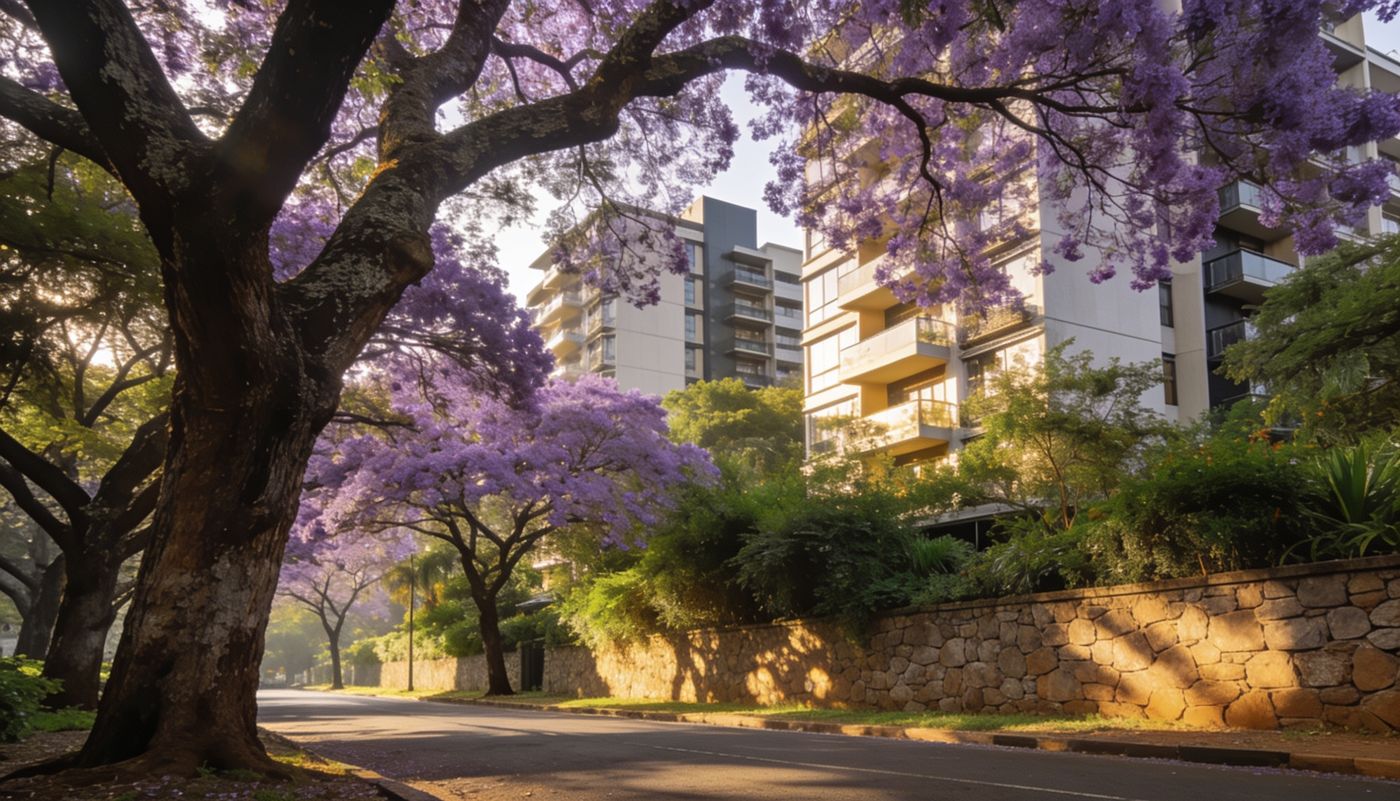
Riverside is a central, leafy, high-end corridor just off Westlands that trades a little of Westlands’ energy for more calm, greenery and privacy. It suits executives, diplomats, remote workers and couples who want a polished apartment minutes from the action but on a quiet, tree-lined street. Furnished one-beds run roughly KES 90,000–170,000 a month (about $690–1,310) and furnished two-beds KES 150,000–280,000 (about $1,155–2,155); unfurnished costs less, and prime three-beds run higher. It’s one of the safest-feeling parts of the city, helped by the embassy presence and heavy security. The trade-offs are price — it sits at the upper end of the central suburbs — and the same building boom reshaping the corridor, which means construction in spots and busier roads onto Westlands at peak. Families wanting big gardens still lean to Lavington, Karen or Runda; people who want the lowest rents and the liveliest scene look next door at Westlands and Kilimani. (Figures are indicative for 2026 at about KES 130 to the dollar — the shilling traded near 129.4 on 1 July 2026; confirm current listings before you sign.)
Why Riverside matters when you’re new
For a first home in Nairobi, Riverside offers a rare combination: genuinely central, genuinely calm, and genuinely secure. You’re minutes from Westlands’ offices, malls and restaurants, a short drive from the CBD and Upper Hill, yet you come home to a green, low-key street rather than a wall of nightlife. The embassy presence means the area is well-patrolled and quiet by design, and the apartment stock skews modern and well-equipped — lifts, backup generators, borehole water, secure parking, often a gym or pool — so daily life is easy from day one.
It’s also a smart, low-risk base while you learn the city. From Riverside you can reach most of the western suburbs in fifteen minutes off-peak, view homes across Westlands, Kilimani and Lavington, and figure out where you actually want to settle — all without committing to a 12-month lease before you know the streets. If your work or social life is anchored on Westlands and the center, few areas keep you closer while still feeling calm.
Who lives on Riverside?
A distinctly international, professional crowd. Riverside has long been a diplomatic address — embassies and ambassadors’ residences sit along the drive, the German and Japanese missions among the longest established — so your neighbors skew toward diplomats, UN and NGO staff, senior executives on corporate packages, and international consultants on one- to three-year postings. Mixed in are well-off Kenyan professionals and business families, plenty of couples, and a growing number of remote workers who want a quiet, central base.
The result is one of the more grown-up, settled feels in central Nairobi. It’s quieter and a touch older than Westlands’ young, social energy, and less family-heavy than the garden suburbs out west. Because so many residents are here on official or corporate postings, leases tend to be longer and the streets stay calm and orderly during the day. It’s an easy place to belong as a newcomer: central enough to be social, secure enough to relax, and full of people who themselves arrived from somewhere else. If you’re posted here by an embassy, the UN or an NGO, our guide to embassy and UN housing in Nairobi explains how housing allowances and preferred areas usually work.
Is Riverside safe?
Riverside is one of the safest-feeling neighborhoods in Nairobi, helped by the embassy presence and the heavy security that comes with it. Patrols are frequent, the streets are quiet, and most residences sit behind manned gates, perimeter walls, CCTV and serious access control. As anywhere in the city, the realistic risk is opportunistic petty theft — a snatched phone, an attempted break-in on a poorly secured compound — rather than personal danger, and the diplomatic density makes even that less common here than in busier areas.
The habits that keep you comfortable are the usual Nairobi ones. Use Uber or Bolt at night rather than walking with valuables, keep your phone out of sight and car doors locked in traffic, and favor the busier, better-lit roads after dark. Pick a building with proper security — guards, a real gate, cameras, good lighting — and you’ll rarely give safety a second thought. For the full, balanced picture across the city, read our honest take on whether Nairobi is safe.
Rent and apartments on Riverside
Riverside is an apartment-and-residence area at the upper end of the central market: modern one-, two- and three-beds in well-finished blocks, plus high-end townhouses and a shrinking number of older standalone houses, many now leased to embassies. It generally costs more than Westlands or Kilimani for an equivalent unit, because you’re paying for the address, the calm, the greenery and the security. Here’s the 2026 picture, indicative and rounded; new blocks with full amenities sit at the top, older buildings at the bottom.
| Size | Unfurnished (KES/mo) | Furnished (KES/mo) | Furnished (USD, ~130) |
|---|---|---|---|
| Studio / 1-bed | 55,000–95,000 | 90,000–170,000 | ~$690–1,310 |
| 2-bed | 90,000–160,000 | 150,000–280,000 | ~$1,155–2,155 |
| 3-bed / townhouse | 160,000–300,000 | 250,000–450,000+ | ~$1,925–3,460+ |
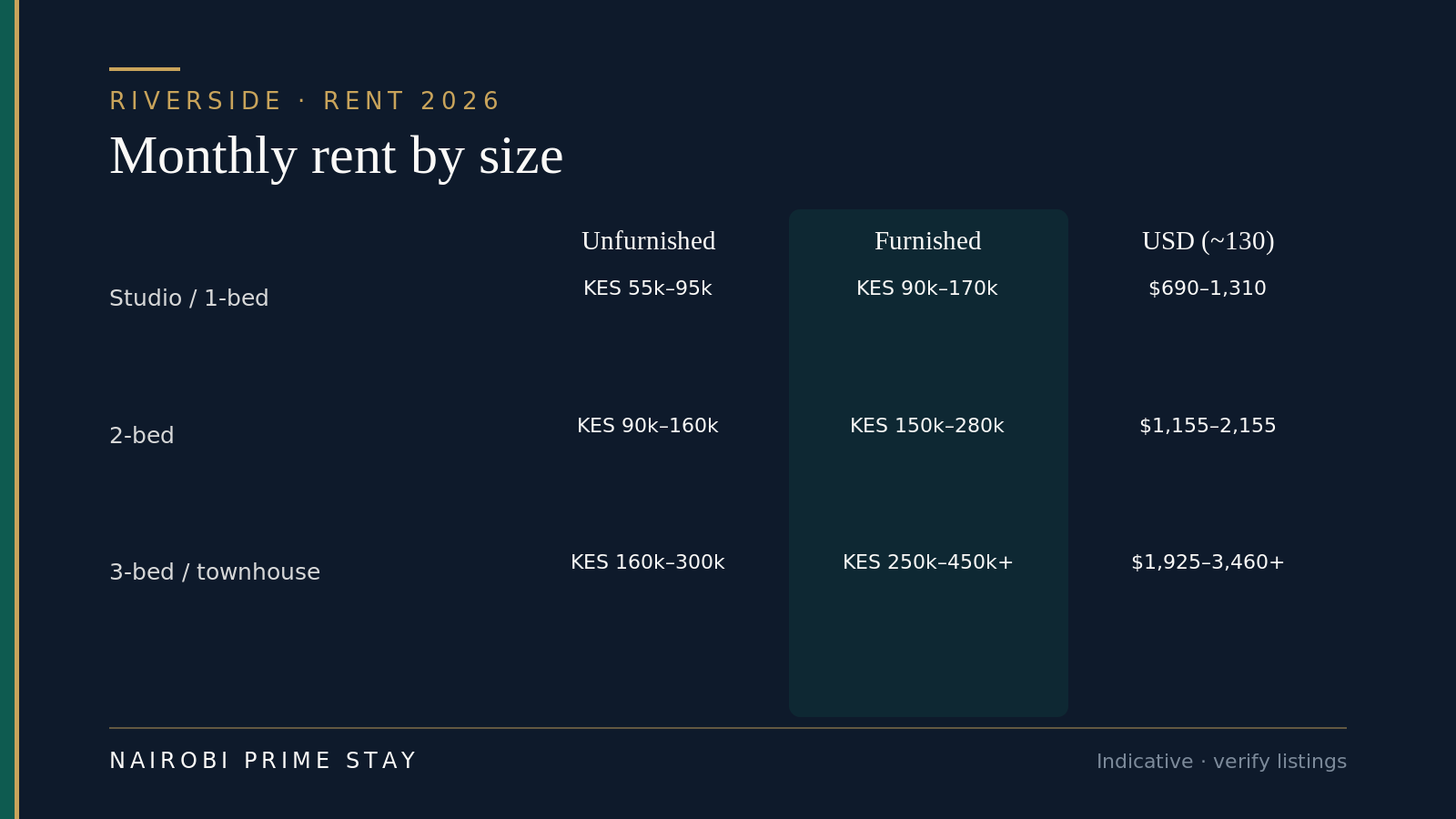
Indicative Riverside rents, 2026. Furnished and serviced units cost more but bundle utilities, internet and cleaning.
The priciest, most prestigious blocks cluster along Riverside Drive itself and the quieter lanes nearest the river; you’ll find better value on the Westlands-facing edge and in older buildings. On unfurnished places there’s almost always a monthly service charge on top of rent — for security, water, common areas, and often a gym or pool — so always ask what’s included and what’s extra. Furnished and serviced units carry a meaningful premium over unfurnished, but they fold in utilities, fast internet and cleaning, which is exactly what you want for a first landing.
Before you sign anything, check what we call the “Nairobi Five”: a backup generator, reliable water supply and storage (a tank or borehole), 24/7 security, fibre internet already serving the building, and responsive on-site management. Riverside generally scores well on all five, but it varies block to block, so confirm each one. For how Riverside fits your overall budget, see our cost of living in Nairobi guide — and never wire money for a place you haven’t viewed and verified.
Serviced apartments and a soft landing on Riverside
A serviced apartment is the easiest way to start on Riverside, and the area has a strong, growing supply of them aimed squarely at the diplomats and executives who pass through. You get a furnished, all-inclusive base — Wi-Fi, cleaning, a backup generator and 24/7 security included — on a flexible monthly term, so you can land, work and explore without committing to a year-long lease before you know the streets. Given Riverside’s role as a corporate and diplomatic gateway, this is a particularly natural place to begin — and if your employer is arranging the move, our corporate housing in Nairobi guide covers how companies handle staff apartments here.
That’s the soft-landing strategy we recommend for most arrivals: stay serviced for the first four to eight weeks, use that time to view long-term homes and test commutes, then sign once you’re sure. In a corridor where the difference between a riverside-quiet lane and a busy Westlands-edge road is one block, that trial month is genuinely useful. With us, a $50 deposit reserves your dates and the balance is paid on arrival — nothing more before you travel. See how it works in our serviced apartments in Nairobi guide, or go straight to apartments on Riverside.
The honest downside: price and the building boom
Riverside’s first trade-off is simple: it’s expensive. It sits at the upper end of the central suburbs, and for an equivalent apartment you’ll usually pay more than in Westlands or Kilimani next door. You’re buying the address, the calm and the security as much as the square meters, and that premium is real. If budget is your main lever, the same lifestyle a notch cheaper is a few minutes away in Kilimani or Kileleshwa.
The second trade-off is the densification reshaping the whole corridor. Riverside’s land is valuable, so old houses keep giving way to new apartment towers, and a few went up faster than the roads around them. In practice that means three things to walk in knowing about. First, construction: on some stretches you’ll have a building site as a neighbor for a while, with the noise and dust that brings. Second, traffic: the routes onto Westlands and Waiyaki Way clog at peak hours, and Riverside’s own narrow lanes feel it. Third, the river: parts of the corridor sit low, and heavy rain in the long rains (March–May) can mean brief flooding or drainage backups in the wrong spot. None of this makes Riverside a poor choice — it remains one of the calmest, greenest central addresses — but it’s why choosing your specific street and building matters. Visit at rush hour and after rain, and ask the watchman the honest questions before you sign.
Getting around Riverside
Riverside’s location is its quiet superpower: it’s central, so wherever you’re going tends to be close. Westlands and its malls, offices and restaurants are 5–10 minutes off-peak; the CBD is roughly 10–20 minutes; Upper Hill’s offices and hospitals, Kilimani, Lavington and Hurlingham are all a short drive away. The catch, as everywhere in Nairobi, is rush hour, when the routes onto Westlands and Waiyaki Way back up and the same trips can double or worse. If you’ll commute daily to a fixed office or school, drive the actual route at peak before you sign — in central Nairobi the off-peak and on-peak versions of the same trip feel like different cities.
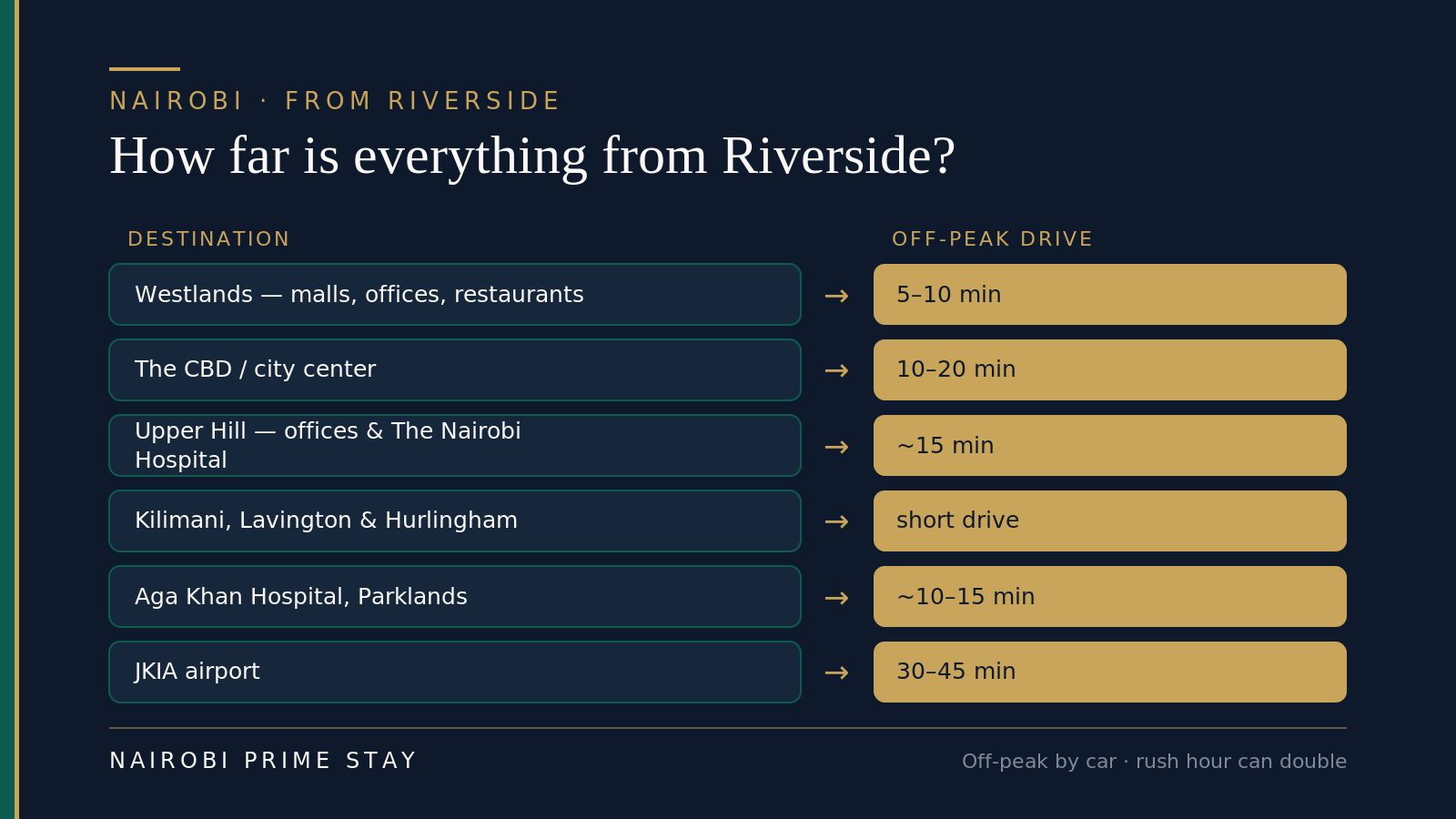
Typical off-peak drive times from Riverside — rush hour can double them.
Two things make daily life easy. First, Uber and Bolt are everywhere, cheap and the expat default — a cross-town hop is a few dollars, and most people use ride-hailing rather than driving themselves into a jam. Second, because Westlands is so close, a full supermarket, pharmacy, café or mall is never more than a few minutes away, so errands stay quick. Matatus run the main roads if you want the local way. Many residents keep a car for weekends and school runs, but plenty of people who live here and work nearby manage fine without one. For the full rundown on ride-hailing, matatus and driving yourself, see our getting around Nairobi guide.
Work and remote work on Riverside
Riverside is an excellent, slightly under-the-radar pick for remote work: it pairs Westlands’ central location and modern infrastructure with a calmer, quieter home environment for calls and focus. The newer apartment stock means lifts, generators and fibre are common, and you’re a few minutes from the coworking spaces and laptop-friendly cafés of Westlands and Kilimani when you want to get out of the house. The diplomatic calm of the streets is a real asset on a day full of video calls.
The practical side holds up well. Fibre is widely available — Safaricom, Zuku and Faiba all serve the corridor — but pick a building with a backup generator (or run your own UPS) so power cuts don’t drop your calls. Nairobi sits at UTC+3, so your afternoons overlap the US East-Coast morning, which is convenient if you work with American teams. Our internet and remote work in Nairobi guide covers providers, speeds and the backup-power reality in detail.
Shopping, eating and going out
Riverside keeps everyday shopping minutes away and the city’s busiest scene right next door — which is exactly how its residents like it. There’s no single giant mall inside the corridor; instead, you lean on what’s a few minutes off in Westlands, and there’s plenty. Sarit Centre and Westgate are the big anchors for supermarkets, shops and restaurants, with The Oval and the General Mathenge strip adding more dining and offices on the Riverside-Westlands edge. For a full grocery run, a Carrefour, Naivas or Chandarana is never far. Smaller cafés, delis and restaurants are dotted along Riverside Drive and the lanes off it.
Dining and nightlife are the same story: Riverside itself is quiet by design, while Westlands — arguably the city’s densest cluster of restaurants and bars — is five minutes away. That’s much of the area’s appeal. You come home to a calm, green street, then drive a few minutes to the buzz when you want it, and back to quiet when you’re done. For people who like being near everything without living inside it, the balance is hard to beat.
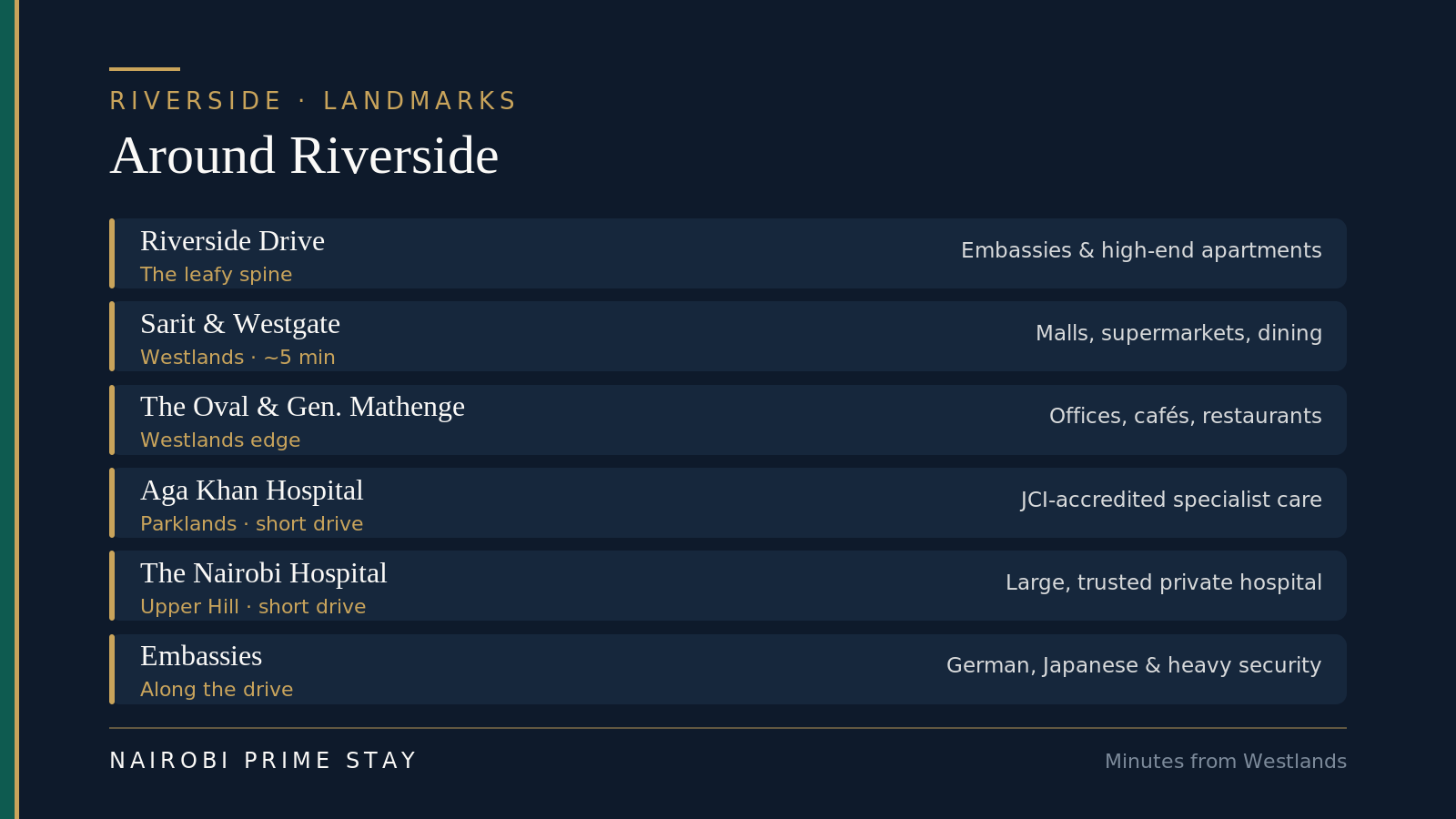
Key Riverside landmarks — the leafy spine, the nearby Westlands malls, embassies and hospitals.
Schools near Riverside
Riverside isn’t a school district itself, but it’s well placed to reach several good ones. The nearest cluster sits across Westlands and Parklands — schools like Aga Khan Academy and a range of international and private options are a short drive away — and the larger Lavington and Hurlingham cluster, with its British- and international-curriculum schools, is close by too. Braeburn and the Riara Group, on the Lavington–Kileleshwa side, are a manageable drive.
For the big American and IB campuses — like the International School of Kenya — you’re looking at a longer cross-town drive toward Gigiri. The practical takeaway: Riverside works well for couples, singles and small families who value a central, calm base, with schooling reachable rather than on the doorstep. Families whose whole week revolves around a particular Gigiri-side or Karen campus often weigh a home closer to it. Either way, apply months ahead — the best schools keep waitlists. Our best neighborhoods guide lines up the family-friendly areas side by side, and our British schools in Nairobi guide covers the main campuses, fees and waitlists.
Hospitals and healthcare near Riverside
Healthcare is one of Riverside’s quiet advantages — it sits within a short drive of several of Nairobi’s best private hospitals. Aga Khan University Hospital (JCI-accredited, full specialist care) is close by in Parklands, along with MP Shah; The Nairobi Hospital, one of the city’s largest and most trusted, is a short drive toward Upper Hill; and Avenue and other private hospitals are within easy reach. Private clinics, dentists and well-stocked pharmacies are scattered through the surrounding Westlands and Parklands area.
As anywhere in Kenya, use the private system and carry good international health insurance that includes medical evacuation. Our healthcare in Nairobi guide covers the main hospitals, typical costs and what your insurance should include.
Riverside for property investors
Riverside is one of Nairobi’s most resilient prime rental markets, and worth understanding even if you only plan to rent. Its real edge is tenant quality: embassies, multinationals and international organizations sign long leases — often two to three years — for staff housing, and they pay reliably. That gives a well-located Riverside apartment something most Nairobi neighborhoods can’t match: predictable, low-churn, hard-currency-backed income from blue-chip tenants. The address, the security and the diplomatic demand keep the corridor desirable through cycles.
The honest caveats are price and supply. Entry prices are high, so headline rental yields can be thinner than in cheaper, faster-growing areas — you’re buying stability, not the punchiest percentage. And like the rest of central Nairobi, the corridor has seen a lot of new apartment building, so generic, cookie-cutter units compete on price while genuinely prime, well-managed ones hold their value and tenants. If you’re weighing a purchase, read our best areas to invest in Nairobi real estate guide for how Riverside stacks up against the alternatives.
Who Riverside suits — and who it doesn’t
Riverside is a strong fit for executives, diplomats, remote workers and couples who want a polished, central apartment with more calm, greenery and security than Westlands — and don’t mind paying a premium for it. If you like being minutes from the action but coming home to a quiet, tree-lined street, value top-tier security, and would rather have a balcony and a lift than a big garden, you’ll be happy here. It’s also an easy, safe place to land first and find your feet.
It’s a weaker fit if you want the lowest prime-area rents (look to Kilimani or Kileleshwa), if you want a large garden and acreage (that’s Karen, Runda or parts of Lavington), or if you want the liveliest nightlife literally on your doorstep rather than five minutes away (Westlands). None of that makes Riverside “worse” — it’s just a particular kind of life: central, calm and upscale.

A fit check, not a verdict — plenty of people happily split the difference.
Riverside vs Westlands vs Kilimani
These three central areas get compared constantly, because they sit side by side and overlap. Here’s the shorthand.
| Riverside | Westlands | Kilimani | |
|---|---|---|---|
| Character | Leafy, high-end, embassies, calm-but-central | Dense urban hub — offices, malls, nightlife | Dense modern apartments, best value |
| Furnished 2-bed (KES/mo) | 150k–280k | 100k–230k | 90k–200k |
| Best for | Executives, diplomats, calm seekers | Singles, social professionals | Value seekers, remote workers, investors |
| Nightlife | Low (Westlands is minutes away) | High | High |
| Traffic & noise | Moderate | High | High |
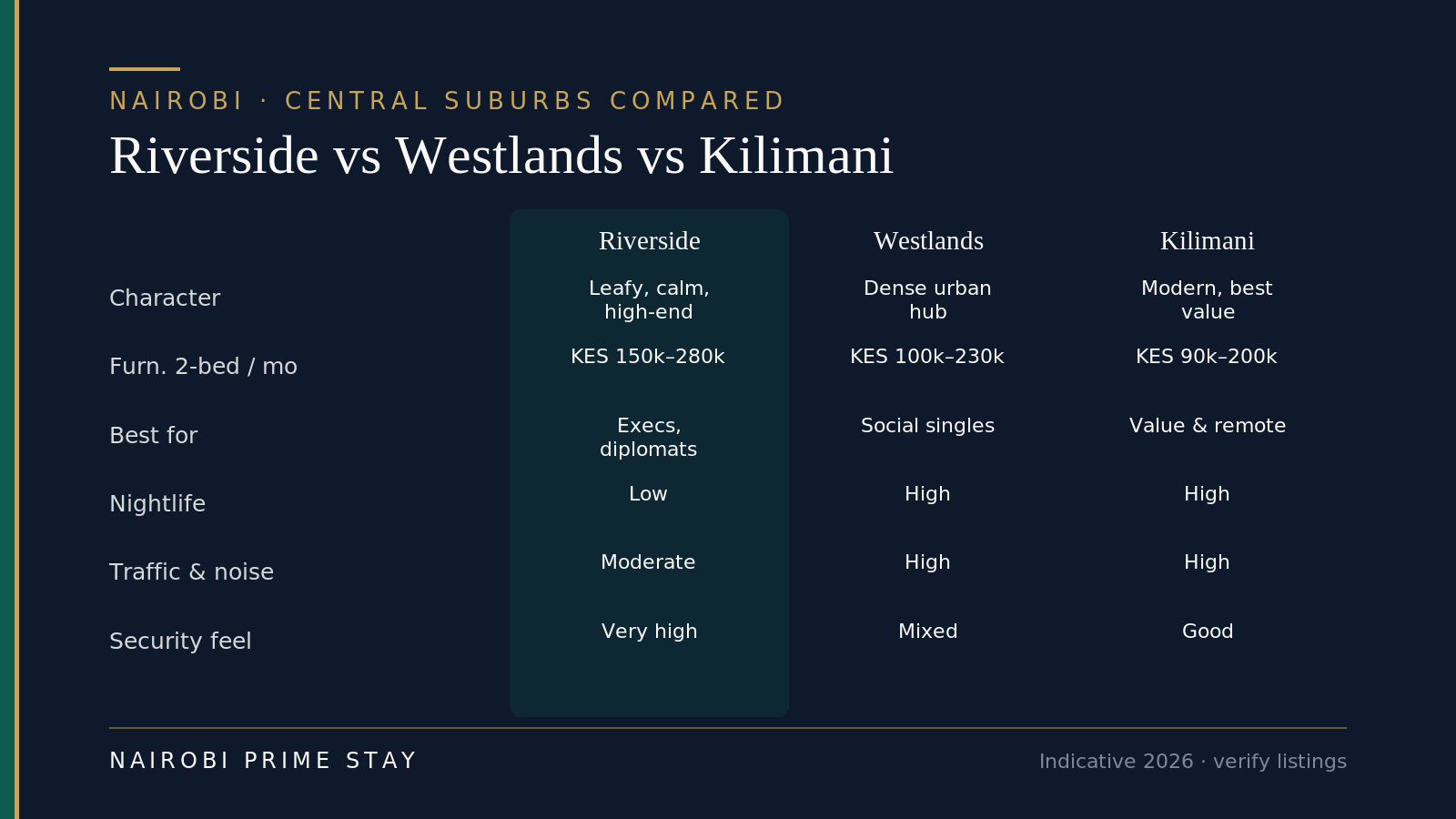
Riverside against its two closest neighbors — the three areas newcomers compare most.
Choose Riverside for a central location with more calm, greenery and security, Westlands for being in the middle of the action, and Kilimani for the best value and a lively, modern apartment scene. Many newcomers view all three in a single week before deciding — they’re a few minutes apart.
What about Upper Hill?
Upper Hill is Riverside’s other close neighbor, just to the south, and the two get mixed up. The quick difference: Upper Hill is a fast-growing office-and-hospital district — corporate towers, The Nairobi Hospital, and a lot of daytime traffic — while Riverside is residential, leafy and calm. Choose Upper Hill if you want to walk to an office there or live beside the hospitals; choose Riverside for a quiet home to come back to that’s still minutes from the same places. Plenty of people live in Riverside and simply drive the few minutes into Upper Hill for work. Our Upper Hill neighborhood guide has the full picture.
A realistic example
Say you’re a couple in your early 40s — one of you is posted to an international organization with a housing allowance, the other works remotely for a US company. Riverside fits almost too neatly: a modern furnished two-bed off Riverside Drive runs around KES 220,000 a month all-in, the posted partner is at the office in Westlands or the CBD in ten to fifteen minutes, and the remote partner takes afternoon calls in quiet that overlap the US East-Coast morning. You pick a building with a generator and borehole so power and water cuts never reach your workday, keep one car for weekends, and use Bolt the rest of the time. You get Westlands’ convenience and Gigiri-style security without either area’s drawbacks — and when friends visit, the restaurants and bars are a five-minute drive, not under your window. That’s Riverside doing its job: central, secure, calm.
Your Riverside move-in checklist
- Decide your street first — a quiet lane near the river feels very different from a busy Westlands-edge road.
- Visit shortlisted buildings at rush hour and after heavy rain to judge traffic, noise and drainage honestly.
- Ask the watchman whether the road or compound floods in the long rains — some low-lying riverside spots do.
- Confirm the “Nairobi Five”: generator, water storage/borehole, 24/7 security, fibre in the building, responsive management.
- Check the monthly service charge and exactly what it covers before you sign.
- Compare the all-in price against a similar unit in Kilimani or Kileleshwa so you know what the address is costing you.
- Get a Safaricom SIM and M-Pesa at the airport on arrival — you’ll pay for nearly everything with it.
- Test the actual fibre speed in the unit, not just the provider’s brochure.
- Use a serviced apartment for your first month while you view long-term homes.
- Save 999 / 112, note your nearest hospital (Aga Khan and The Nairobi Hospital are close), and enroll in the US State Department’s STEP program.
Frequently asked questions
Is Riverside a good place to live in Nairobi? Yes — especially for executives, diplomats, remote workers and couples who want a polished, central apartment with more calm, greenery and security than Westlands. Riverside is leafy and quiet but still minutes from Westlands, the CBD, Upper Hill and the hospitals, and the embassy presence keeps it well-patrolled. The trade-offs are price — it sits at the upper end of the central suburbs — and the ongoing building boom, which brings construction and busier roads in spots.
How much is rent on Riverside Drive? Indicative 2026 furnished rents run about KES 90,000–170,000 a month (roughly $690–1,310) for a one-bed and KES 150,000–280,000 (roughly $1,155–2,155) for a two-bed; unfurnished costs less, and prime three-beds or townhouses run higher. Riverside generally costs more than Westlands or Kilimani for an equivalent unit because you’re paying for the address, calm and security. Furnished and serviced units cost more but include utilities, internet and cleaning. Verify current listings before you sign.
Is Riverside safe? Riverside is one of the safest-feeling neighborhoods in Nairobi, helped by the embassy presence and the heavy security that comes with it. Patrols are frequent, the streets are quiet, and most residences sit behind manned gates, perimeter walls, CCTV and access control. The main realistic risk is opportunistic petty theft rather than personal danger; use Uber or Bolt at night, keep valuables out of sight, and pick a building with proper security and lighting.
Riverside or Westlands — which is better? They sit side by side, so it comes down to calm versus buzz. Riverside is leafier, quieter, more secure and more upscale, usually costing more for an equivalent unit; Westlands is denser and livelier, with the city’s best cluster of offices, malls and nightlife on the doorstep and generally lower rents. Executives, diplomats and couples wanting quiet often choose Riverside; singles and social professionals lean Westlands. Many newcomers view both before deciding — they’re five minutes apart.
Is Riverside good for families? It can suit small families who value a central, calm and secure base, with good schools and hospitals a short drive away in Westlands, Parklands and Lavington. But it’s apartments more than gardens, so families wanting a big yard and acreage often prefer Lavington, Karen or Runda, and families set on a specific Gigiri-side campus may want a home closer to it. For central living with reachable schooling, Riverside works well.
Is Riverside good for remote work? Yes — it pairs Westlands’ central location and modern infrastructure with a calmer, quieter home environment for calls and focus. Lifts, generators and fibre are common in the newer blocks, and coworking spaces and laptop-friendly cafés in Westlands and Kilimani are minutes away. Choose a building with a backup generator so power cuts don’t drop your calls, and you’ll find afternoons overlap US East-Coast mornings.
How far is Riverside from the CBD and Westlands? Riverside sits about 3 km from the city center, just south of Westlands along the Nairobi River. Off-peak, Westlands is roughly 5–10 minutes by car and the CBD about 10–20; Upper Hill, Kilimani, Lavington and the hospitals are all a short drive. At rush hour those times can double as routes onto Westlands and Waiyaki Way back up, so if you’ll commute daily, drive your actual route at peak before you sign.
Is Riverside a good place to invest in property? Riverside is one of Nairobi’s most resilient prime rental markets, prized for tenant quality: embassies, multinationals and international organizations sign long leases — often two to three years — for staff housing and pay reliably. The caveats are high entry prices, which can mean thinner headline yields than cheaper areas, and a lot of new building, so generic units compete on price while genuinely prime, well-managed ones hold value. You’re buying stability more than the punchiest percentage.
Do I need a car on Riverside? Not necessarily. Riverside is central, Westlands and its shops are minutes away, and Uber and Bolt are cheap and everywhere, so people who live and work nearby often manage without one. A car helps if you’ll do a daily school run or a cross-town commute, and many households keep one for weekends — but it’s not essential for everyday life.
Does Riverside flood in the rainy season? Some low-lying spots can. Parts of the corridor sit close to the Nairobi River, so during the long rains (March–May) a few streets and compounds see brief flooding or drainage backups after heavy downpours, while higher lanes stay dry. It’s very localized, so it comes down to your exact street and building. If you can, visit after heavy rain, and ask the watchman whether the road or compound floods before you sign.
How far is Riverside from JKIA airport? Jomo Kenyatta International Airport (JKIA) is about 20 km southeast of Riverside — roughly 30–45 minutes by car off-peak, but an hour or more at rush hour or in heavy rain, since the route crosses the city. Give yourself a generous buffer for departures, especially on weekday mornings. See our JKIA airport guide for arrival, transfer and pickup tips.
Riverside or Upper Hill — which is better? Riverside is residential, leafy and calm; Upper Hill is a commercial office-and-hospital district just to the south. Choose Riverside for a quiet home minutes from Westlands and the CBD, and Upper Hill if you want to walk to a corporate office there or live beside The Nairobi Hospital. Riverside has the nicer streets to come home to; Upper Hill can mean a shorter work commute if your office is in one of its towers. Many people live in Riverside and drive the few minutes into Upper Hill.
Final thoughts
Riverside is the polished middle ground of central Nairobi — Westlands’ convenience and Gigiri’s security without quite either area’s drawbacks — and for the right person that’s the whole appeal. If you want a modern apartment that’s minutes from everything but set on a quiet, green, well-secured street, you’ll settle in fast and rarely feel you compromised. The honest costs are the price premium and the ongoing building boom, both of which you can largely design around by choosing your street and building with care. If you want the lowest rents, look to Kilimani or Kileleshwa; if you want a big garden, look to Karen or Runda; if you want the nightlife under your window, look to Westlands. Either way, line Riverside up against the rest of the map before you commit.
Related reading
- Best neighborhoods in Nairobi for expats — the full map, side by side.
- Moving to Nairobi: the complete guide — the end-to-end relocation hub.
- Cost of living in Nairobi — real monthly budgets.
- Is Nairobi safe? — an honest, balanced take.
- Serviced apartments in Nairobi — what they include and who they suit.
- Best areas to invest in Nairobi real estate — where Riverside fits for buyers.
- Westlands, Kilimani and Lavington — the neighboring central suburbs.
When you’re ready to see real options, browse our serviced apartments on Riverside — verified, all-inclusive, with honest monthly pricing — or see everything across the city on the apartments page. Not sure whether Riverside, Westlands or somewhere leafier fits your commute and budget? Our AI relocation assistant can shortlist places in a couple of minutes, day or night.
Ready to look?
Find your apartment in Nairobi
Browse verified serviced apartments, or ask the AI concierge which area fits your life.