
Guides · Neighborhoods
Lang'ata Nairobi Neighborhood Guide: Space, Greenery and Value (2026)
Lang’ata Nairobi Neighborhood Guide: Space, Greenery and Value

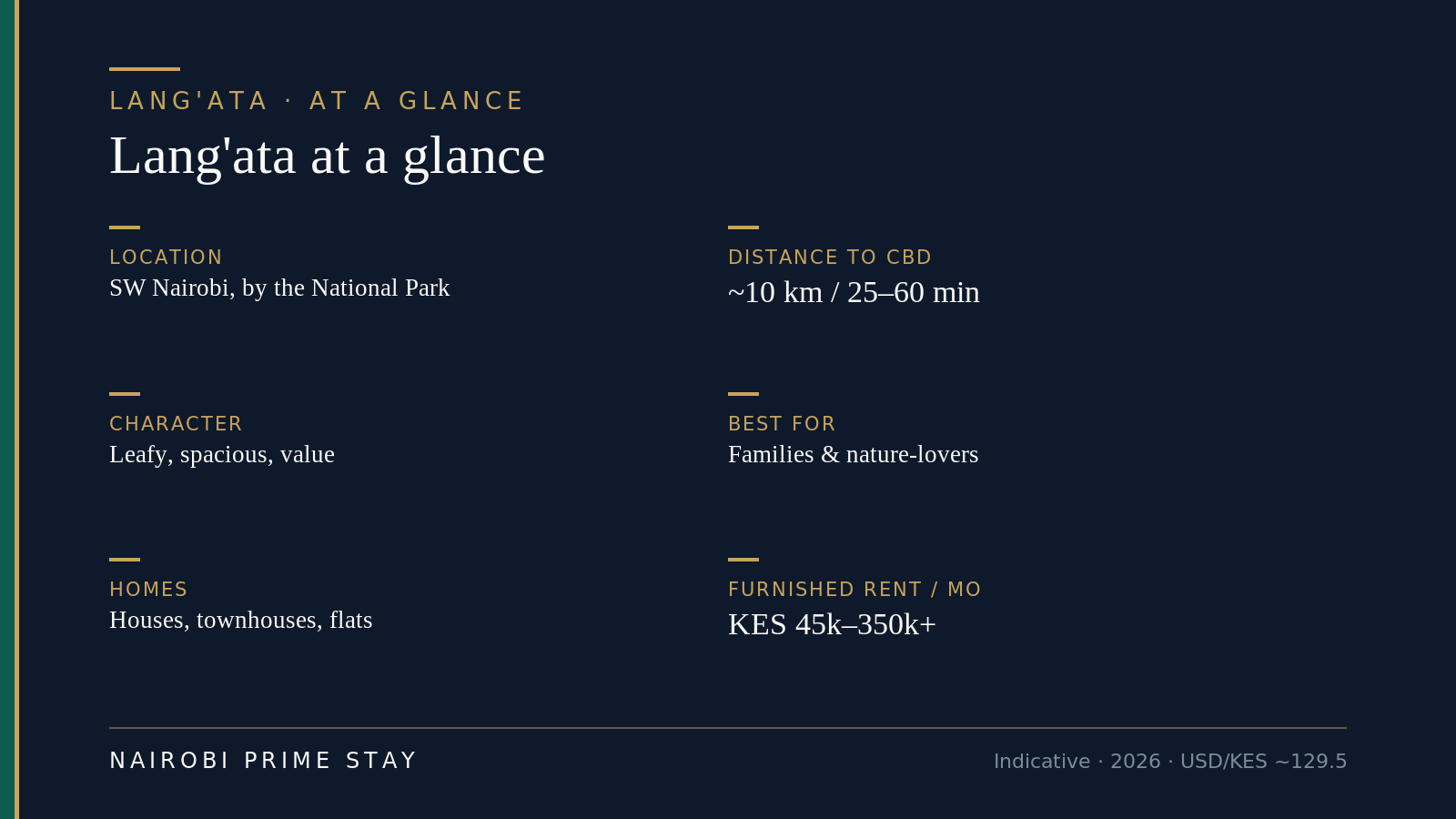 Lang’ata at a glance — space, greenery and value on the edge of the National Park.
The quick version
Lang’ata is a leafy, spacious suburb in southwestern Nairobi, about 10 km from the city centre, wrapped along the northern edge of Nairobi National Park. Its appeal is simple: you get gardens, trees, calm and a real sense of space — much of what people love about neighboring Karen — at noticeably lower rents. If you like the idea of a green, low-rise, family-friendly area but Karen’s price tags make you wince, Lang’ata is the value answer right next door.
It’s also Nairobi’s wildlife doorstep. The main gate of Nairobi National Park is on Lang’ata Road, the Giraffe Centre and the famous Sheldrick elephant orphanage are local weekend staples, and the park’s plains are close enough that residents on the southern edge sometimes hear it at night. Housing is mostly standalone houses and gated townhouses, with a growing number of apartments, so there’s something across a wide budget. As of 2026, furnished homes run roughly KES 45,000 to 350,000-plus a month (about $350 to $2,700 at around 129.5 shillings to the dollar), with unfurnished costing meaningfully less.
The honest trade-offs are the commute and the mix. Lang’ata Road is one of the most congested arteries in the city at rush hour, so the drive into town can test your patience. And Lang’ata is more socioeconomically mixed than the sealed western suburbs — leafy estates sit near busier, denser pockets — which many people like for feeling real, but it’s worth knowing going in. We’ll cover who it suits and who it doesn’t, in detail, below.
Why Lang’ata matters when you’re new
For a newcomer, Lang’ata solves a specific puzzle: how to get space, greenery and a family-friendly feel without paying the top-suburb premium. Most of Nairobi makes you choose between a leafy garden suburb and an affordable one. Lang’ata sits in the overlap — calmer and greener than the central apartment areas, cheaper than Karen, Runda or Gigiri, and with the National Park and its wildlife attractions right there.
It’s especially worth knowing if you’re moving with kids, a dog, or a love of the outdoors. This is a part of Nairobi where children can have a garden, where weekend life can revolve around the park, the Giraffe Centre and the Bomas of Kenya, and where the pace is slower than the city core. Families who want Karen’s lifestyle on a smaller budget very often land here.
This guide gives you the honest picture: where Lang’ata is, who lives there, how safe it really is, what you’ll pay, how you’ll get around, the wildlife and weekends, the schools and hospitals, and how it stacks up against Karen. For the bigger picture first, start with our complete guide to moving to Nairobi and our best neighborhoods in Nairobi overview, then come back here when Lang’ata is on your shortlist.
Where exactly is Lang’ata?
Lang’ata sits about 10 km southwest of the central business district, between Karen to the west and Nairobi National Park to the south and east. To the north it runs up against Wilson Airport, Nairobi West and South C; Lang’ata Road is the spine that ties it all together, running from the city out past Wilson Airport, Uhuru Gardens and the park gate toward Karen and the Bomas roundabout.
It isn’t one uniform estate but a collection of pockets with different characters. Leafier, lower-density areas like Otiende, the roads off Lang’ata Road toward the park, and the Hardy fringe near Karen feel suburban and green. Closer to Nairobi West and South C, and around the busier stretches of Lang’ata Road, it’s denser and more urban. Part of choosing Lang’ata well is choosing the right pocket for the life you want.
Because it’s on the city’s edge, getting out of town can be quick — when the roads cooperate. The Southern Bypass skirts the park and connects Lang’ata toward Karen, the Nairobi–Nakuru highway and, in the other direction, Mombasa Road and the airport, without going through the centre. The catch is the daily commute inward: Lang’ata Road into the CBD is heavily congested at peak, which is the single biggest thing to weigh about living here.
Who lives in Lang’ata?
Lang’ata is a mixed, family-heavy, down-to-earth neighborhood — less of an expat enclave than Gigiri or Karen, and more a genuine cross-section of Nairobi. You’ll find long-settled Kenyan families in older bungalows, younger families in newer gated townhouses, professionals who want space without the Karen price, and a thread of expats, aid workers and nature-lovers drawn by the park and the calm.
It tends to attract people who value the outdoors and a slower pace over status or nightlife. Conservationists and people who work with the wildlife trusts, pilots and crew based at Wilson Airport, teachers at the nearby schools, and families who want a garden and a dog all gravitate here. It’s the kind of area where weekends mean the park, a walk, or a barbecue at home rather than a rooftop bar.
For an American moving over, that mix is part of the charm. You’re in a real, lived-in Nairobi neighborhood rather than a sealed compound — neighbors are as likely to be Kenyan as foreign, and life feels woven into the city. It suits people who want authenticity and space, and who are happy to trade a bit of polish and a short commute for both.
Is Lang’ata safe?
Lang’ata is reasonably safe by Nairobi standards, with the usual big-city caveats and a bit more variation than the sealed western suburbs. Because it’s socioeconomically mixed, security depends a lot on the specific estate and street: the gated communities and leafy pockets are calm and well-guarded, while busier, denser areas warrant more everyday awareness. Most expats and middle-class families here live behind a gate with a guard, and within those compounds daily life is quiet and uneventful.
The realistic risk is opportunistic petty crime — phone snatching, the odd break-in, theft from cars in traffic — rather than personal danger. The same habits that work everywhere in the city work here: choose a home with a proper perimeter wall, gate, guards and an alarm; keep valuables out of sight in traffic on Lang’ata Road; use Uber or Bolt at night rather than walking unfamiliar stretches; and take local advice on which pockets to favor. A gated estate or a well-secured standalone house makes a real difference.
For a full, balanced treatment of crime, areas to be careful in and practical precautions, read our honest take on whether Nairobi is safe. The short version for Lang’ata: pick your estate and street carefully, secure your home properly, take normal precautions, and most families live here for years without trouble.
What you’ll pay: rent in Lang’ata
Lang’ata is one of the better-value leafy suburbs in Nairobi, and that’s the main financial reason to choose it. As of 2026, furnished homes span roughly KES 45,000 to 350,000-plus a month, with a typical furnished family house landing well below what the same thing costs in Karen. Unfurnished homes — of which there’s plenty here — cost meaningfully less, so longer-stay renters and families do especially well. At about 129.5 shillings to the dollar, even comfortable houses sit in a range that would barely cover an apartment in Gigiri or Riverside.
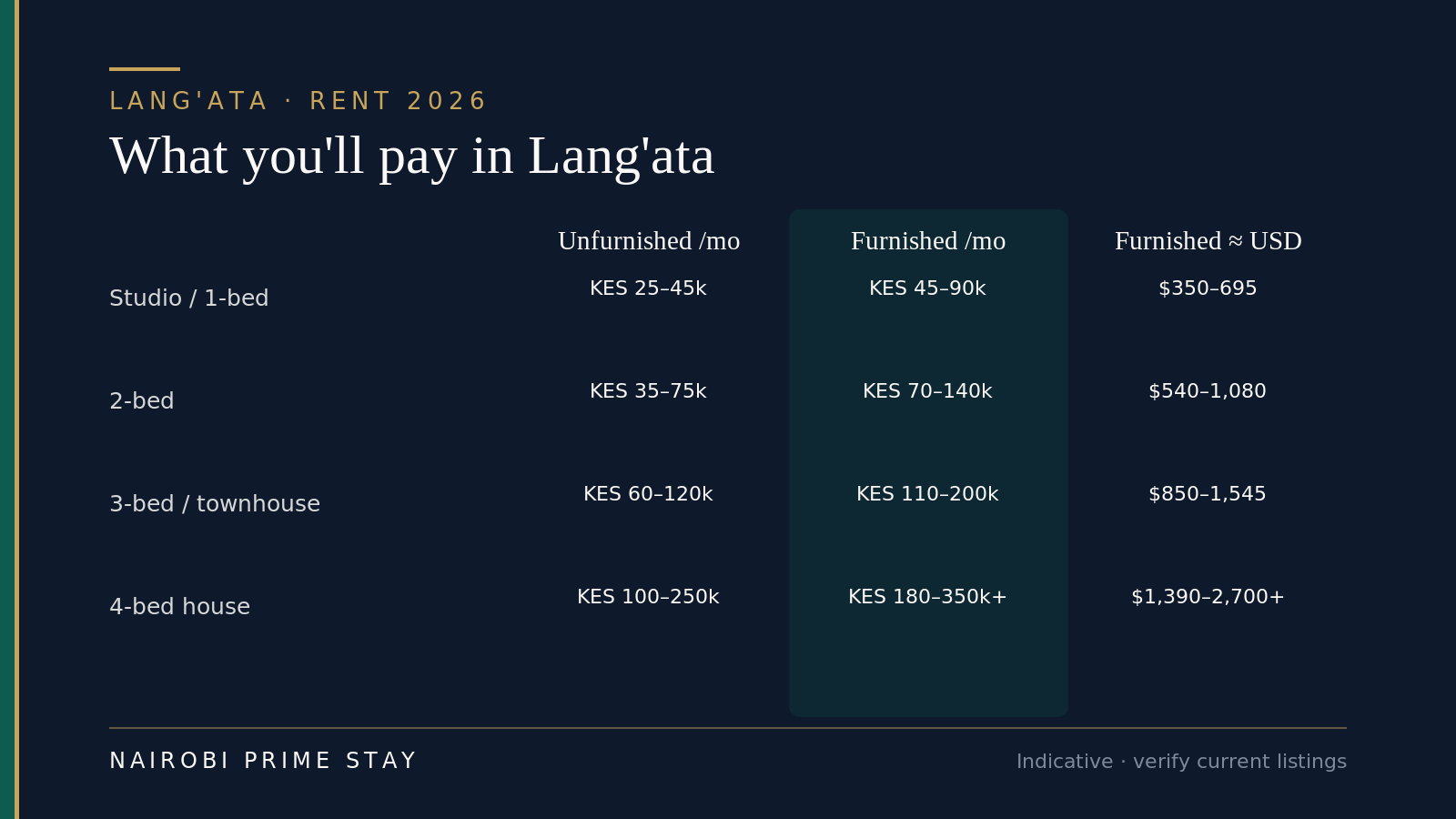 Indicative Lang’ata rents for 2026 — per month. Verify against current listings; the figure depends on the pocket, the plot, the finish and what’s included.
Here’s the same picture as a table. Treat these as orientation ranges, not quotes — the real number swings a lot with the specific pocket, whether it’s a house or an apartment, the size of the plot and garden, and whether it’s a smart gated community or an older standalone.
| Home type | Unfurnished / month | Furnished / month | Furnished ≈ USD |
|---|---|---|---|
| Studio / 1-bed | KES 25,000–45,000 | KES 45,000–90,000 | $350–695 |
| 2-bed | KES 35,000–75,000 | KES 70,000–140,000 | $540–1,080 |
| 3-bed apt / townhouse | KES 60,000–120,000 | KES 110,000–200,000 | $850–1,545 |
| 4-bed house (garden) | KES 100,000–250,000 | KES 180,000–350,000+ | $1,390–2,700+ |
A few things drive the spread. A big standalone house on a mature plot in a leafy pocket near the park sits at the top; an apartment or a smaller townhouse in a denser stretch sits much lower and can be excellent value. Furnished, all-inclusive homes carry a premium of roughly a third to a half over bare ones, and furnished stock is thinner here than in the central apartment areas, so a serviced option can be the easiest furnished route for a first stay. Always check whether service charge, water, security and garden upkeep are inside the rent or billed on top. To see how Lang’ata rent fits a realistic monthly budget alongside groceries, transport, a car and help, use our Nairobi cost of living guide.
Serviced apartments and a soft landing
A serviced apartment is a smart way to start in Lang’ata, or to test it against Karen before you commit. You get a furnished, all-inclusive base — Wi-Fi, cleaning, a backup generator and security included — while you spend a few weeks actually living the area: doing the Lang’ata Road commute at rush hour, driving the school run, and seeing whether the space and quiet suit you or whether you’d rather be more central.
That trial matters here more than almost anywhere, because Lang’ata’s two big variables — the commute and the pocket — are exactly the things you can’t judge from a listing. A house that looks perfect online might sit on a stretch that crawls for an hour at 8am, or in a denser pocket than the photos suggest. A month on the ground tells you which streets and which routine actually work before you sign a year-long lease on a family house.
Serviced stock in Lang’ata itself is more limited than in the apartment-dense central suburbs, so it’s worth lining options up early — and Karen, right next door, widens the choice considerably. When you’re ready, browse our serviced apartments in Lang’ata — verified, all-inclusive, with honest monthly pricing — or read how the soft-landing approach works in our serviced apartments in Nairobi guide. A serviced base for your first month lets you choose your actual home with your eyes open.
The honest downside
Lang’ata’s weaknesses are the flip side of its strengths. Space and value on the city’s edge come with a real commute and more variation than a sealed suburb. Here’s the honest reckoning.
Lang’ata Road traffic. This is the big one. Lang’ata Road is among the most congested commuter routes in Nairobi, and at peak — roughly 7 to 9 in the morning and 5 to 7 in the evening — the drive into town can be slow and draining. The Southern Bypass helps for trips around the city and out of town, but the daily inbound commute to the CBD or Upper Hill is the single biggest thing to weigh. If you’ll do that drive every day, test it before you sign.
It’s mixed, not manicured. Lang’ata isn’t a uniform, polished enclave. Leafy estates sit near busier, denser, more workaday pockets, and the quality of streets, security and upkeep varies more than in Karen or Runda. Most people see the mix as a plus — it feels real and alive — but if you want everything uniform and gated, you’ll want to be selective about the pocket or look further west.
You’ll need a car. Like Karen, Lang’ata is a drive-everywhere suburb. Public transport is matatus, walkable amenities are limited outside the malls, and the spread-out layout assumes a car. Factor one in for the school run, the shop and weekends.
Fewer amenities on the doorstep. This isn’t a walk-to-a-hundred-restaurants neighborhood. Day-to-day shopping leans on Galleria and a few smaller centres, and the dense café-and-nightlife scene is over in Karen, Kilimani or Westlands. For some that calm is the whole point; if you want buzz within walking distance, it isn’t here.
None of this is a dealbreaker — it’s simply the trade for space, greenery and value beside the park. Go in knowing it, choose your pocket and commute carefully, and Lang’ata rewards you.
Getting around
Lang’ata is a car-first neighborhood, so plan on driving or ride-hailing. Uber and Bolt are the expat default — safe, cheap and easy, paid by card or M-Pesa — and they work well for trips to Karen, the malls or the airport. Most residents also keep their own car, because the school run, the weekly shop and weekend trips to the park all assume one, and because waiting on a ride for every errand gets old in a spread-out suburb.
For drivers, the location is a story of two directions. Heading out and around the city, Lang’ata is well placed: the Southern Bypass gives you a quick run to Karen, Kikuyu, the Nakuru highway and, the other way, Mombasa Road and Jomo Kenyatta International Airport, all without crossing the centre. Heading inward at rush hour is the hard part — Lang’ata Road into town is genuinely congested, so time your trips around the peaks, and consider work or schools that don’t demand that drive twice a day.
Wilson Airport, on Lang’ata Road, is a quiet practical perk: it’s Nairobi’s hub for domestic and safari flights, so a weekend trip to the Mara or the coast can start ten minutes from home. For the bigger picture on driving, licences, matatus and the SGR train, our moving to Nairobi guide covers how getting around really works.
Working remotely from Lang’ata
Lang’ata works fine for remote work, with the same two checks that matter everywhere in Nairobi: confirm the home’s fibre and backup power before you sign. Home fibre from Safaricom, Zuku or Faiba reaches most established estates, with packages from around KES 3,000 a month for everyday speeds up to faster business tiers. The things to verify are that fibre already serves your specific house or block — coverage is patchier on the city’s edge than in the central apartment belts — and that there’s a backup generator or an inverter and UPS, because a power cut without one takes your Wi-Fi and your calls with it.
The trade-off versus a central area is the café and coworking scene. Lang’ata is light on laptop-friendly cafés and dedicated coworking compared with Kilimani or Westlands, though Karen next door has more, and a home office in a quiet, green house suits heads-down work nicely. The time zone helps too: at UTC+3, your Nairobi afternoon overlaps the US East Coast morning, which works well for American remote roles. For the full setup — providers, real speeds, backup power and where the coworking spaces are — see our internet and remote work guide.
The wildlife on your doorstep
Lang’ata’s signature feature is something no other Nairobi suburb can match: you live on the edge of a national park. The main gate of Nairobi National Park — 117 square kilometers of open plains with lions, rhino, giraffe, zebra and buffalo, all within sight of the city skyline — is right on Lang’ata Road. The park is unfenced on its southern side, so wildlife moves freely across the wider ecosystem, and residents close to the boundary genuinely do hear it on a quiet night.
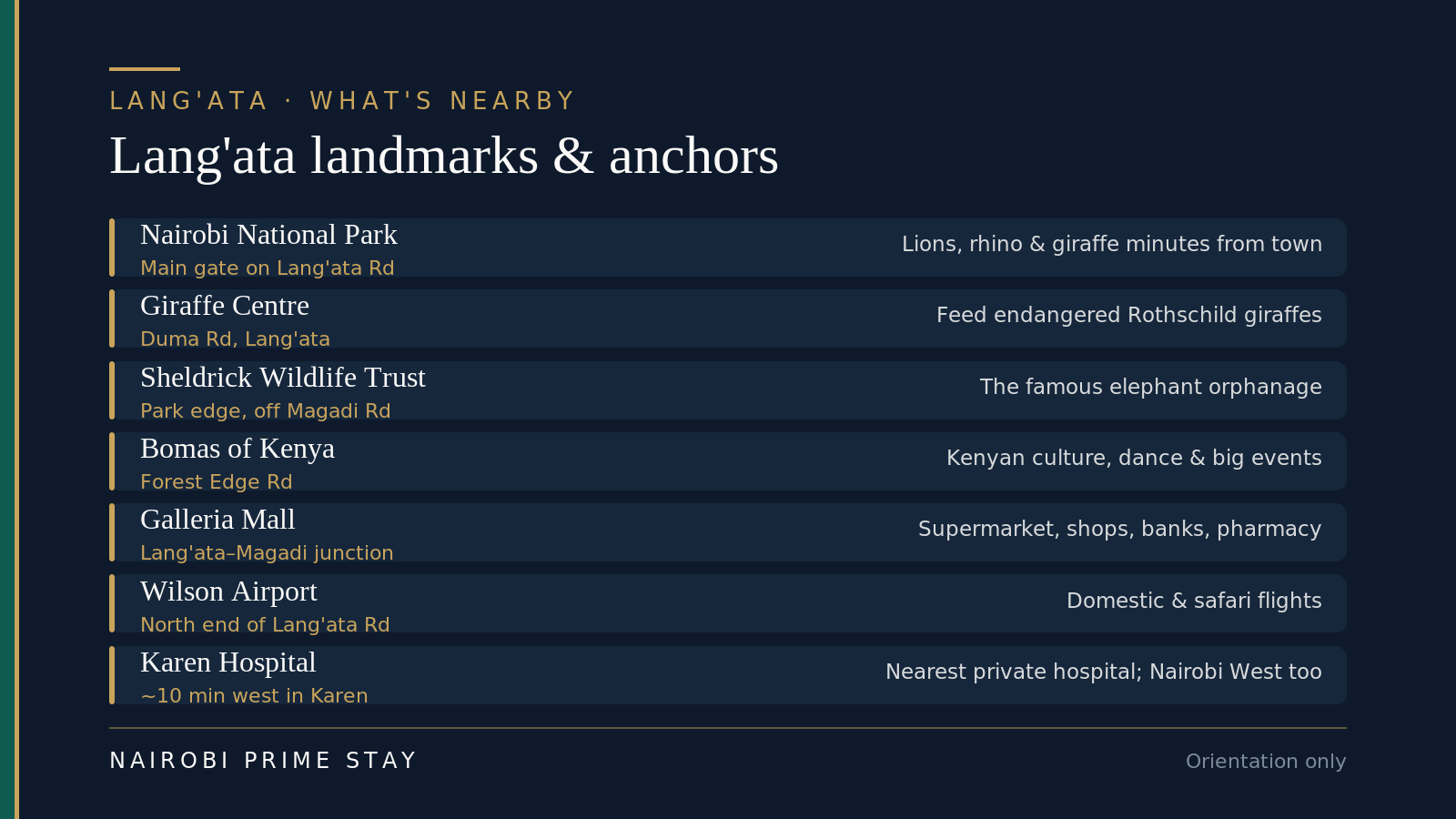 The everyday anchors of Lang’ata — the National Park, the wildlife attractions, Galleria, Wilson Airport and top hospitals close by.
The wildlife attractions clustered here are the kind of thing visitors fly across the world for, and you’d have on your weekend doorstep. The Giraffe Centre on Duma Road lets you hand-feed endangered Rothschild giraffes from a raised platform — a local rite of passage for families. The David Sheldrick Wildlife Trust, on the park’s edge, runs the world-famous elephant orphanage, open for a magical hour each morning. Bomas of Kenya showcases the country’s cultures through dance and music, and the redeveloped Uhuru Gardens national monument is close by. It’s a remarkable backyard.
For getting further afield, Lang’ata is well set up too. Wilson Airport puts safari country and the coast within a short flight, and the Southern Bypass speeds you out toward the Rift Valley lakes and beyond. If weekend escapes are part of why you’re moving to Kenya, this corner of the city makes them easy — our guide to weekend trips from Nairobi covers where to go and how.
Shopping, dining and everyday life
Lang’ata’s everyday shopping is comfortably covered, even if it isn’t a dense retail hub. Galleria Mall, at the Lang’ata and Magadi Road junction, is the main anchor — a proper shopping mall with a large supermarket, pharmacy, banks, an ATM hall, cafés and services that handle the weekly shop and most errands. T-Mall, toward Nairobi West, is another handy stop, and the big malls and supermarkets of Karen — the Hub, Galleria’s neighbors and more — are a short drive west for anything you can’t find locally.
Dining is more low-key than the central suburbs, and that suits the area. There are neighborhood cafés and restaurants along Lang’ata Road and around the malls, and a couple of genuine destinations: Carnivore, the famous open-air nyama choma (grilled-meat) restaurant, has been a Nairobi institution for decades and sits right here in Lang’ata. For a wider choice of international restaurants, rooftop bars and nightlife, Karen, Kilimani and Westlands are the places to drive to. Lang’ata’s own rhythm is more about the garden, the park and the home barbecue than a buzzing dinner scene.
For families, that quieter, outdoorsy life is the appeal. Weekends here lean toward the park, the Giraffe Centre, a walk, a swim or a long lunch at Carnivore rather than the mall and the club. If that sounds like your idea of Nairobi, Lang’ata delivers it more affordably than anywhere comparable.
Hospitals and healthcare nearby
Lang’ata has solid healthcare access, with two well-regarded private hospitals close at hand. Karen Hospital, about ten to fifteen minutes west in Karen, is a respected private hospital convenient for the whole southern arc of the city. Nairobi West Hospital, just north toward Nairobi West and South C, is another established private option a short drive away. Between them, plus the clinics, pharmacies and labs dotted along Lang’ata Road and in the malls, day-to-day medical needs are well covered.
For the biggest names and the most specialized care — Aga Khan University Hospital and MP Shah in Parklands, or The Nairobi Hospital in Upper Hill — you’re looking at a cross-town drive, longer in traffic. That’s the same trade every southern and western suburb makes, and for most routine and even serious care, the nearby hospitals handle it well. If you have an ongoing condition or specific specialist needs, it’s worth mapping the exact hospital you’d rely on before you choose your pocket.
Private care in Nairobi is genuinely good and far cheaper than the US, though still a meaningful cost — a specialist consult runs roughly $15 to $40, with procedures much less than American prices but not trivial. The standard advice applies: carry solid private or international health insurance, ideally with regional cover and medical evacuation. For the full landscape — hospitals, insurance, costs and how the system works — read our Nairobi healthcare guide. This is general information, not medical advice.
Schools in and near Lang’ata
Lang’ata is reasonably placed for schools, helped enormously by sitting right next to Karen’s strong school cluster. Within Lang’ata and the immediate area you’ll find nurseries, primary schools and a range of private and local options. Just west in Karen are some of the city’s best-known international schools — Brookhouse, Hillcrest, the Banda School and others — which are a realistic short drive for Lang’ata families and a big reason the area works for them.
For the full American, IB or British curricula many expat families want, the Karen cluster covers a lot, while the largest American-and-IB schools — the International School of Kenya and Rosslyn Academy — sit far to the north near Gigiri and Runda. From Lang’ata that’s a long cross-city commute, often 45 minutes to well over an hour in traffic, so families set on those specific schools usually weigh it carefully or look at a northern suburb instead. If the Karen-side schools fit, though, Lang’ata gives you their proximity at a lower housing cost.
If schools are a deciding factor, line up the specific school first and the neighborhood second, and drive the route at 7:30am to see the real timing. Our international schools in Nairobi guide covers the main options, curricula and fees so you can plan it properly. For many families, Lang’ata’s blend of space, value and access to the Karen schools is the whole reason they choose it.
The investor angle
For property investors, Lang’ata is a steady, family-driven market with a value angle rather than a high-yield apartment play. The draws are consistent demand for houses and townhouses from families who want space, a deep pool of long-term tenants, and entry prices below Karen for similar lifestyle. Standalone family houses and well-run gated townhouse communities let reliably, and the area’s appeal to people who stay for years means lower turnover than the transient central apartment market.
The honest cautions are location-specific. Lang’ata’s value depends heavily on the pocket — a home in a leafy, secure estate near the park is a very different asset from one on a busy, denser stretch — so location selection matters more here than in a uniform suburb. The Lang’ata Road commute caps demand from buyers who need a fast CBD run, and yields on big houses, as everywhere in Nairobi’s prime-house segment, tend to be modest on a percentage basis even when capital values hold up. Apartments and townhouses generally show better rental yields than large houses.
If you’re buying to let, favor the better pockets, run the numbers conservatively, and weigh houses for tenant stability against apartments for yield. For where Lang’ata fits in the wider city, see our guide to the best areas to invest in Nairobi real estate. None of this is investment advice — verify current prices, yields and demand with local agents before you commit.
Who Lang’ata suits — and who it doesn’t
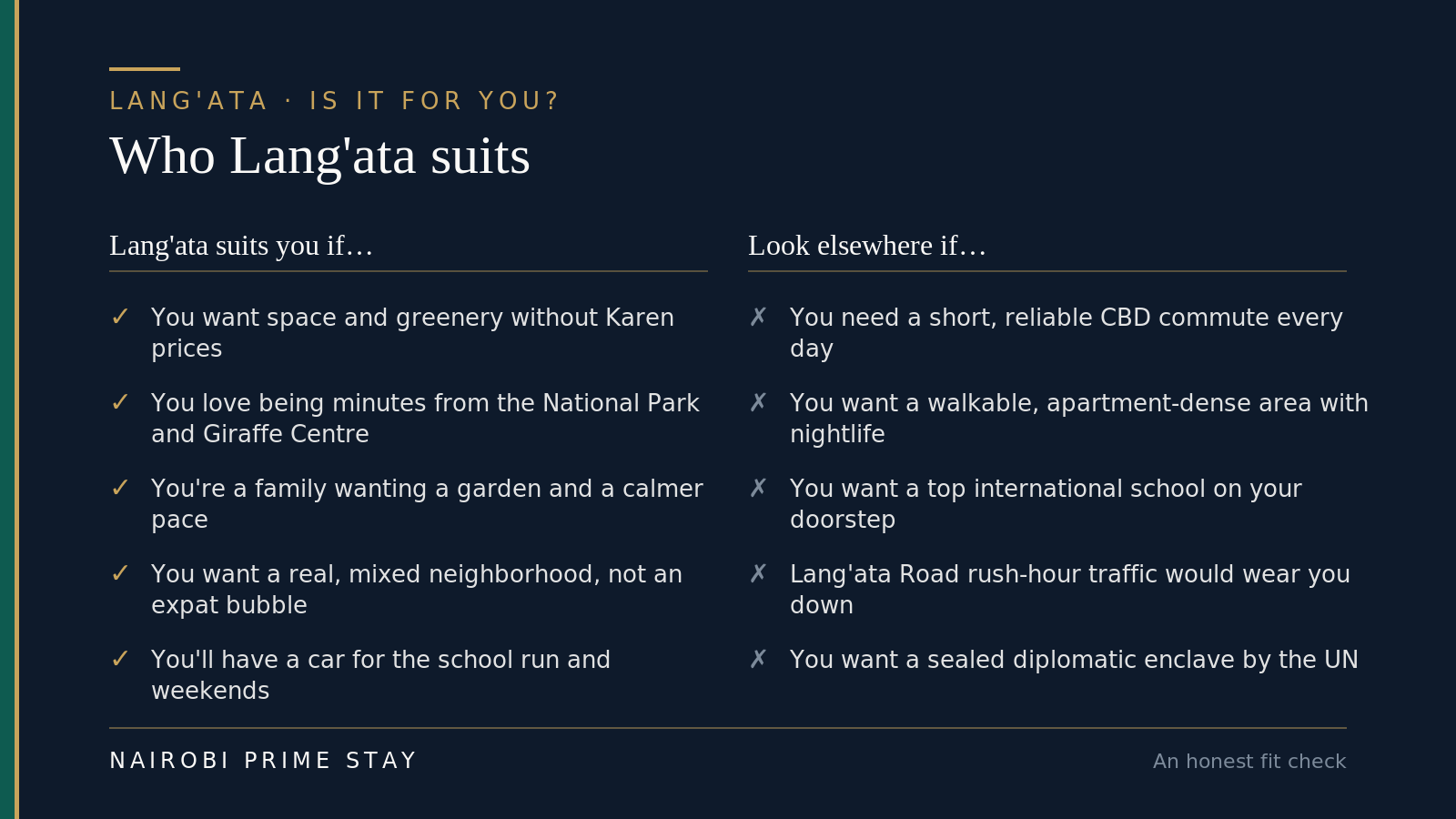 An honest fit check — Lang’ata rewards people who want space, greenery and value, and don’t mind a drive.
Lang’ata suits families who want a garden and a calmer pace without Karen’s price tag; nature-lovers who’d happily live beside a national park; value-seekers who like leafy, low-rise living but not the top-suburb premium; and remote workers and couples who want a quiet, green base and don’t need to be central. If your ideal Nairobi has trees, space, a dog and the park at the weekend, it’s a strong fit.
It suits you less well if you need a short, reliable commute into the CBD every day — Lang’ata Road traffic will test you. If you want a walkable, apartment-dense area with restaurants and nightlife on the doorstep, look at Kilimani or Westlands. If you want everything uniform, gated and manicured, Karen or Runda deliver more consistency. And if you need a diplomatic address minutes from the UN, Gigiri is the obvious call. Match the area to your daily life, not just the listing photos.
Lang’ata vs Karen vs Lavington
These three are the natural comparison set for a family weighing space, greenery and value across different price points. Here’s how they stack up.
| Factor | Lang’ata | Karen | Lavington |
|---|---|---|---|
| Vibe | Leafy, mixed, value, by the park | Spacious, polished, upmarket | Green, central, family-friendly |
| Best for | Families, nature-lovers, value-seekers | Families wanting space and top schools | Families wanting space near the centre |
| Furnished family home / mo | KES 180,000–350,000+ | KES 250,000–600,000+ | KES 200,000–450,000+ |
| Homes | Houses, townhouses, some apartments | Houses on big plots, townhouses | Houses, townhouses, apartments |
| Commute to CBD | Long (Lang’ata Rd traffic) | Long (distance + traffic) | Moderate, more central |
| Wildlife / outdoors | Outstanding (National Park) | Very good (forests, stables) | Limited |
| Value for money | Excellent | Premium | Moderate |
The quick read: choose Lang’ata for the best value and the wildlife on your doorstep; Karen for more space, polish and the strongest school cluster, at a premium; and Lavington for a greener family suburb that’s closer to the city centre. All three reward a car and a love of space over a short commute and city buzz.
A week in the life: a relocating family
Picture a family from Denver — two parents, two kids aged seven and ten, and a dog they refused to leave behind. They want a garden, good schools and a sense of adventure, and Karen’s house prices stretched their budget further than they liked. They take a serviced house in Lang’ata for their first six weeks while they settle the kids and look around.
Life quickly finds a rhythm. The kids start at a school on the Karen side, a fifteen-minute drive that one parent does on the way to a co-working day or a home-office morning. Weekday afternoons are homework and the garden; the dog has space to run for the first time in the move. The house has fibre and a generator, so a power cut doesn’t interrupt a video call lining up with the US morning. Groceries come from Galleria, and a forgotten errand is a quick Bolt away. The Lang’ata Road commute is the one gripe — the parent with CBD meetings learns to leave before 7am or after 9.
By week six they’ve done the math. A furnished four-bed with a garden costs them well under the Karen equivalent, the school run is short, and weekends have become the best part of the move — the Giraffe Centre, a morning at the elephant orphanage, a long lunch at Carnivore, a walk with the park on the horizon. They sign a year’s lease two streets from the serviced house. Lang’ata didn’t dazzle them with polish; it gave them space, value and a wilder, greener childhood for the kids, which is exactly what they came for.
Your Lang’ata move-in checklist
Before you sign anything in Lang’ata, work through this short list.
- Pick your pocket carefully. A leafy estate near the park and a busy stretch toward town are very different daily lives — visit a few and compare.
- Drive your commute at rush hour before committing — Lang’ata Road into the CBD is the area’s biggest trade-off, so feel it yourself.
- Check the home’s security: perimeter wall, gate, guards, alarm, and the estate’s overall setup.
- Confirm fibre actually serves the house or block, not just the area — coverage is patchier on the city’s edge.
- Check backup power: a generator or an inverter and UPS for the inevitable outages, essential if you work from home.
- Plan for a car. This is a drive-everywhere suburb; budget for one and for fuel.
- Map your school run if you have kids, and drive it at 7:30am for the real timing.
- Ask what’s included: is service charge, water, security and garden upkeep in the rent or billed on top?
- Map your nearest hospital — Karen Hospital and Nairobi West are closest — especially if you have specific medical needs.
- Consider a serviced home for the first month so the pocket, the commute and the routine prove themselves before you commit.
Frequently asked questions
Is Lang’ata a good place to live in Nairobi?
Yes, if you want space, greenery and value rather than a short commute or city buzz. Lang’ata is a leafy, family-friendly suburb in southwest Nairobi on the edge of Nairobi National Park, with houses and gardens at rents noticeably below neighboring Karen. It suits families, nature-lovers and value-seekers who’ll have a car, and less so people who need a quick daily CBD commute or want a walkable, apartment-dense area.
How much is rent in Lang’ata?
As of 2026, furnished homes in Lang’ata run roughly KES 45,000 to 350,000-plus a month, with a furnished family house typically around KES 180,000 to 350,000 (about $1,390 to $2,700 at roughly 129.5 shillings to the dollar). Unfurnished homes cost meaningfully less and there is plenty of unfurnished stock. These are indicative ranges; the actual figure depends a lot on the pocket, whether it’s a house or apartment, the plot and what’s included.
Is Lang’ata safe?
Lang’ata is reasonably safe by Nairobi standards, with a bit more variation than the sealed western suburbs because it’s socioeconomically mixed. Security depends on the specific estate and street: gated communities and leafy pockets are calm and well-guarded, while busier areas warrant more everyday awareness. The realistic risk is opportunistic petty crime rather than personal danger, so choose a well-secured home, take normal big-city precautions, and most families live here for years without trouble.
Is Lang’ata cheaper than Karen?
Yes. Lang’ata offers much of Karen’s leafy, low-rise, family-friendly lifestyle at noticeably lower rents, which is its main appeal. A furnished family house that runs KES 250,000 to 600,000-plus in Karen often lands closer to KES 180,000 to 350,000 in Lang’ata. The trade-offs are that Lang’ata is more mixed and less uniformly polished, and it shares Karen’s long commute into the city.
How far is Lang’ata from the city center, and what’s the commute like?
Lang’ata sits about 10 km southwest of the central business district along Lang’ata Road. The honest catch is traffic: Lang’ata Road is one of the most congested commuter routes in Nairobi, so the inbound drive at peak can be slow. The Southern Bypass makes trips around the city and out of town much quicker, and Wilson Airport for domestic and safari flights is right on Lang’ata Road.
Do I need a car to live in Lang’ata?
Effectively yes. Lang’ata is a spread-out, drive-everywhere suburb where the school run, the weekly shop and weekends all assume a car, and walkable amenities are limited outside the malls. Uber and Bolt are plentiful, cheap and a good backup, but most residents keep their own car. If you’d rather not drive in Nairobi, a central apartment area like Kilimani or Westlands suits better.
What is there to do in Lang’ata?
Lang’ata’s standout is the wildlife on its doorstep. The main gate of Nairobi National Park, with lions, rhino and giraffe minutes from the city, is on Lang’ata Road, and the Giraffe Centre and the famous David Sheldrick elephant orphanage are local weekend staples. Bomas of Kenya showcases the country’s cultures, the Carnivore restaurant is a Nairobi institution here, and Wilson Airport makes weekend safaris and coast trips easy.
Are there good schools in or near Lang’ata?
Yes, helped by sitting right next to Karen’s strong school cluster. Lang’ata itself has nurseries, primaries and local and private schools, while some of the city’s best-known international schools — Brookhouse, Hillcrest, the Banda School and others — are a short drive west in Karen. The largest American and IB schools, the International School of Kenya and Rosslyn Academy, are far north near Gigiri and a long commute, so families set on those usually weigh the drive carefully.
Which hospitals are near Lang’ata?
Lang’ata has solid healthcare access. Karen Hospital, about ten to fifteen minutes west in Karen, is a respected private hospital, and Nairobi West Hospital just to the north is another established option a short drive away. For the biggest specialist names — Aga Khan University Hospital and MP Shah in Parklands, or The Nairobi Hospital in Upper Hill — you’re looking at a cross-town drive, longer in traffic.
Final thoughts
Lang’ata is for people who want space, greenery and a wilder edge to city life, at a price that undercuts the smarter suburbs. It trades the short commute and the walkable buzz of central Nairobi for a garden, a slower pace and a national park at the end of the road. The honest test is simple: picture your Nairobi week. If it revolves around a green garden, a quick school run to Karen, weekends at the park and a rent that leaves room to breathe, Lang’ata is hard to beat. If it revolves around a short commute, a walkable high street and nightlife on the doorstep, you’ll be happier more central.
Whatever you decide, don’t sign a year-long lease sight-unseen. Spend a few weeks on the ground first, drive Lang’ata Road at rush hour, and let the area and its pace prove themselves before you commit.
Related reading
- Moving to Nairobi: the complete guide - the relocation hub that ties visas, money, healthcare and housing together.
- Best neighborhoods in Nairobi - compare Lang’ata against every other area in one place.
- Karen neighborhood guide - the polished, premium neighbor next door, and Lang’ata’s main comparison.
- Lavington neighborhood guide - a greener family suburb that’s closer to the city centre.
- Healthcare in Nairobi - the hospitals, insurance and how the private system works.
- Serviced apartments in Nairobi - how a soft landing works and why it’s the smart first month.
- Cost of living in Nairobi - slot Lang’ata rent into a realistic monthly budget.
- Weekend trips from Nairobi - the parks, lakes and coast that Lang’ata’s location makes easy.
Find your place in Lang’ata
When you’re ready to see real options, browse our serviced apartments in Lang’ata - verified, all-inclusive, with honest monthly pricing - or our full apartment catalogue across Lang’ata, Karen and the wider city. A serviced home for your first month gives you a secure, fully-equipped base while you choose your pocket, test the Lang’ata Road commute and find the right school run before signing a year-long lease. A $50 deposit reserves your place and the balance is paid on arrival, so there’s nothing more to pay before you travel.
Not sure whether Lang’ata, Karen or a more central area fits your budget, commute and family life? Our AI relocation assistant can shortlist homes around your priorities in a couple of minutes, any time of day.
Ready to look?
Find your apartment in Nairobi
Browse verified serviced apartments, or ask the AI concierge which area fits your life.