
Guides · Neighborhoods
Hurlingham Nairobi Neighborhood Guide: Central, Convenient, Great Value (2026)
Hurlingham Nairobi Neighborhood Guide: Central, Convenient, Great Value
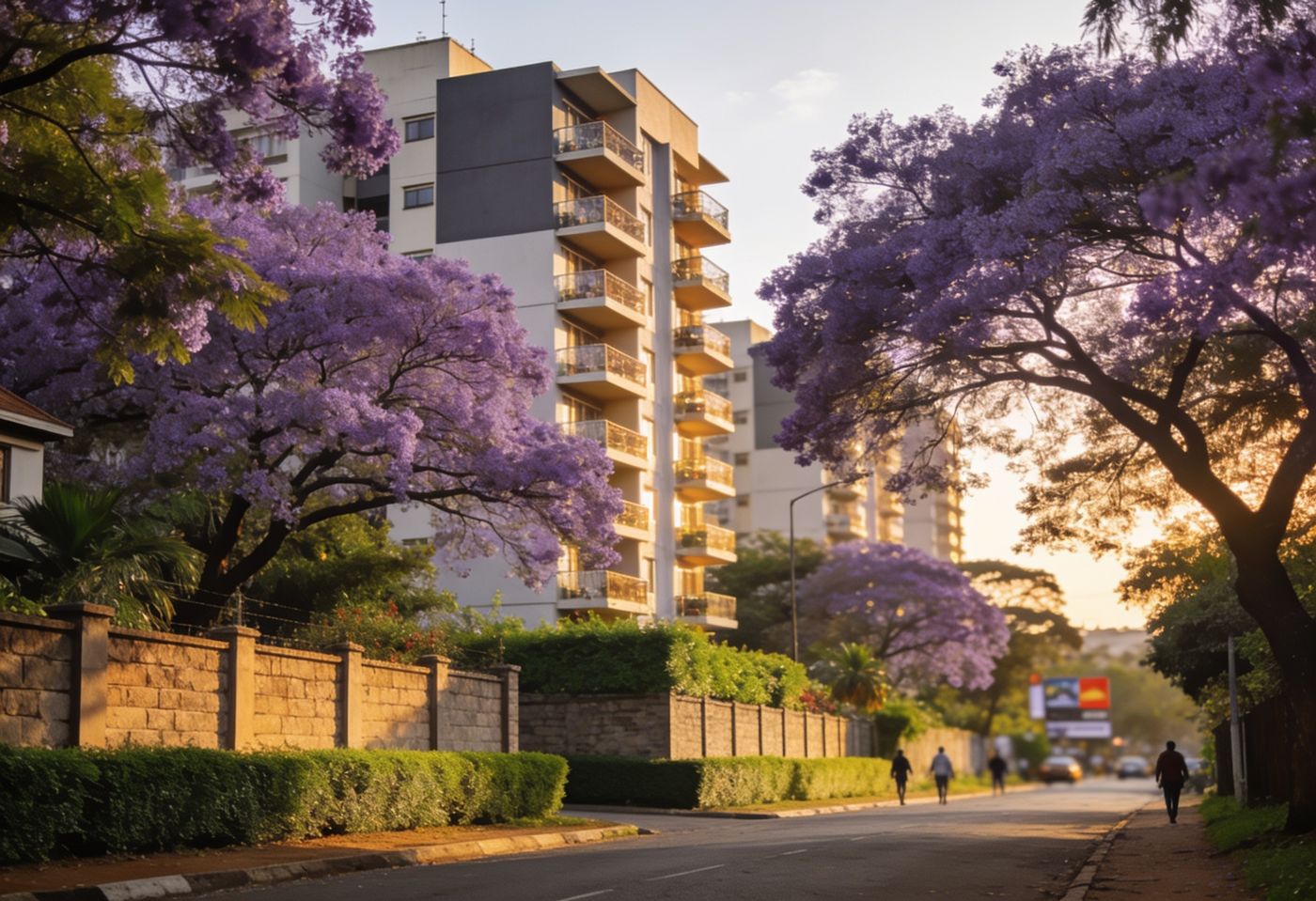
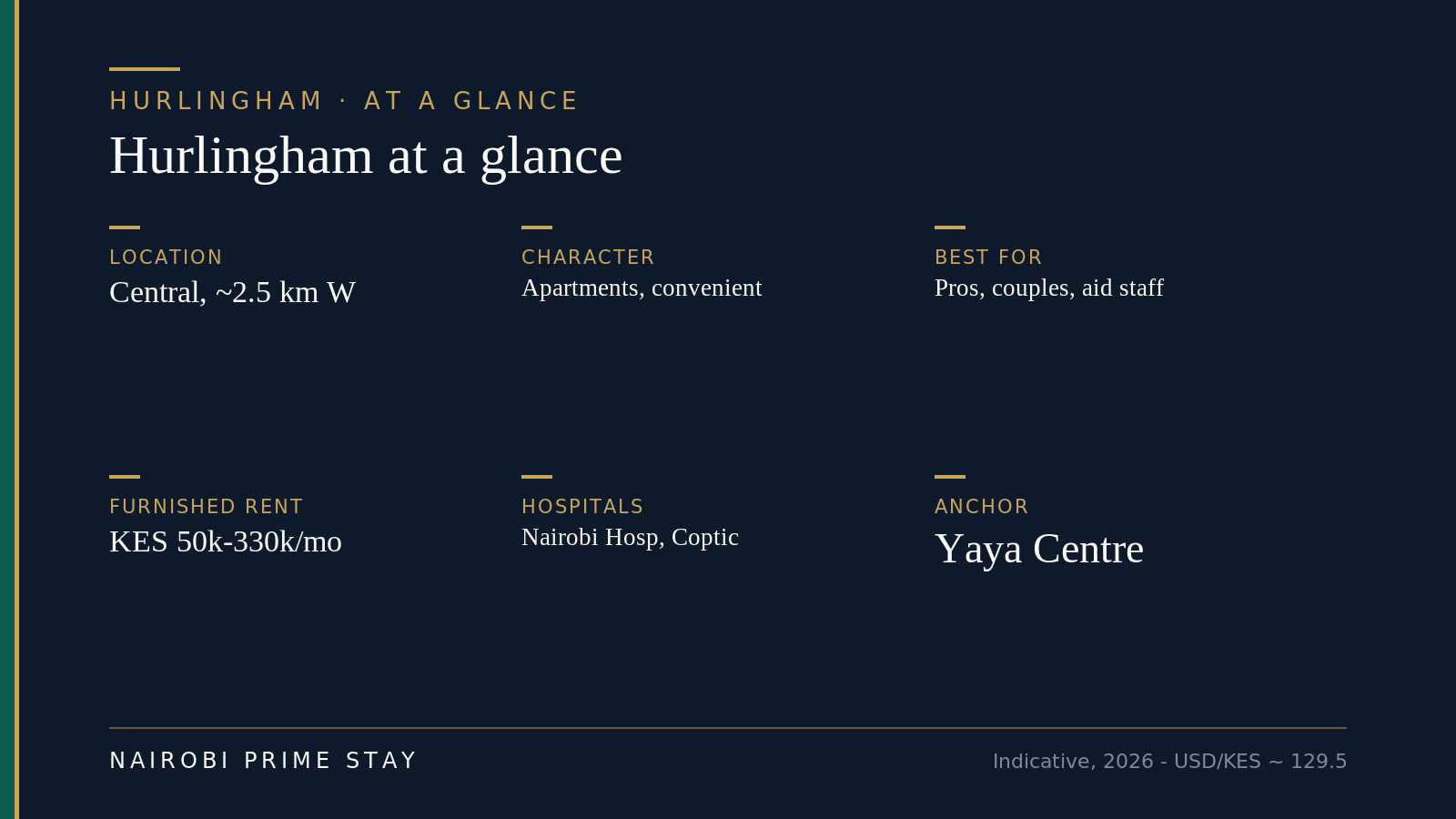 Hurlingham at a glance — central, convenient and well-priced, with Yaya Centre and top hospitals close by.
The quick version
Hurlingham is a central, apartment-dense neighborhood about 2.5 km west of the city centre, wedged between Kilimani to the north and Upper Hill to the east. Its whole appeal is convenience: you’re close to almost everything — offices, hospitals, malls, restaurants and the main roads out of town — at apartment rents that undercut the smarter western suburbs. If you want to be in the middle of the action without paying Gigiri or Riverside prices, Hurlingham is one of the most practical addresses in the city.
The housing is almost entirely apartments, built around Yaya Centre and along Argwings Kodhek Road. There’s a deep mix of older low-rise flats and a wave of newer mid- and high-rise blocks with balconies, pools, gyms and backup power. As of 2026, furnished apartments run roughly KES 50,000 to 330,000 a month (about $385 to $2,550 at around 129.5 shillings to the dollar), with a typical furnished two-bed nearer KES 100,000 to 180,000. Unfurnished costs noticeably less. That’s real value for somewhere this central.
The honest trade-offs are traffic and density. Hurlingham sits on some of Nairobi’s busiest roads — Ngong Road and Argwings Kodhek both clog at peak times — and it’s a built-up, mixed commercial-and-residential area rather than a quiet, leafy estate. If you want a big garden and total calm, this isn’t it. If you want to live centrally, walk to a mall and a hundred restaurants, and keep your rent sensible, it’s hard to beat. We’ll cover who it suits and who it doesn’t, in detail, below.
Why Hurlingham matters when you’re new
For a newcomer, Hurlingham solves a specific problem: how to live centrally, reach work and top healthcare in minutes, and still keep your housing budget under control. Most of Nairobi’s prime areas make you choose between being central and getting value. Hurlingham, like its neighbor Kilimani, quietly gives you both — and it’s even closer to the Upper Hill business district and The Nairobi Hospital.
It’s also a genuinely easy place to land. Yaya Centre — an upscale mall with a big supermarket, pharmacy, banks, cafés and a food court — sits right in the middle of the neighborhood, so your first-week essentials are a short walk away. Around it is one of the densest clusters of restaurants and services in the city. For someone who’s just arrived and doesn’t yet have a car or a routine, that walkable convenience takes a lot of friction out of settling in.
This guide gives you the honest picture: where Hurlingham is, who lives there, how safe it really is, what you’ll pay, how you’ll get around, the shopping and hospitals, and how it compares to its neighbors. For the bigger picture first, start with our complete guide to moving to Nairobi and our best neighborhoods in Nairobi overview, then come back here when Hurlingham is on your shortlist.
Where exactly is Hurlingham?
Hurlingham sits about 2.5 km west of the central business district, straddling Argwings Kodhek Road (which older maps still call Hurlingham Road). It’s bordered by Kilimani to the north, Upper Hill to the east, Ngong Road to the south, and the leafier pockets of Kileleshwa and Lavington to the west. Day to day, it functions as the southern, slightly more value-focused end of the larger Kilimani-Hurlingham apartment belt.
The neighborhood is organized around two things: the Hurlingham shops at the Argwings Kodhek and Ngong Road junction, and Yaya Centre a little to the north. Most apartments, restaurants and clinics sit on or just off Argwings Kodhek, Lenana Road, Ralph Bunche Road and the smaller Kirichwa roads that thread between them. It’s compact enough to walk across, which is rare for Nairobi.
Because it’s so central, the rest of the city opens up quickly. Argwings Kodhek connects straight to Ngong Road and the Southern Bypass, while Kirichwa Road links to Uhuru Highway and the CBD. Upper Hill’s offices and The Nairobi Hospital are five to ten minutes away; Westlands, the Yaya-to-Sarit run and the wider city are a short hop. The catch — as everywhere central — is that “short” means distance, not always time, once rush hour bites.
Who lives in Hurlingham?
Hurlingham is a young, professional, mixed neighborhood — less of an expat bubble than the western suburbs and more of a working slice of modern Nairobi. The new apartment blocks have drawn a steady stream of single professionals, young couples, and small families, alongside a long-settled base of Kenyan residents who’ve lived in the older flats and bungalows for years.
There’s also a distinct international thread. Hurlingham and the surrounding Kilimani belt are popular with aid and NGO workers — people regularly sent into the field for weeks or months, who want a secure, low-maintenance, central apartment they can lock up and leave. Remote workers, consultants and embassy or development staff round out the mix. It’s the kind of place where your neighbors are as likely to be Kenyan as foreign, which many people find a refreshing change from the compound life further west.
For an American moving over, that mix is part of the appeal. You’re in a real neighborhood with a strong day-to-day rhythm — a regular café, a familiar supermarket run, a gym you walk to — rather than sealed off behind a gate. It suits people who want to feel woven into the city rather than apart from it, and who value convenience over acreage.
Is Hurlingham safe?
Hurlingham is reasonably safe by Nairobi standards, with the caveats that come with any central, busy, mixed-use area. It isn’t a sealed diplomatic enclave like Gigiri, and it doesn’t pretend to be. Most residents live in apartment blocks with a gate, a guard and controlled parking, and within those buildings daily life is calm and uneventful.
The realistic risk is opportunistic petty crime — phone snatching, pickpocketing or the occasional car break-in around busy junctions and in traffic — rather than personal danger. The same sensible habits that work everywhere in the city work here: keep your phone out of sight in traffic, don’t leave valuables visible in a parked car, use Uber or Bolt after dark instead of walking unfamiliar streets late, and choose a building with a proper gate, guards and cameras.
Because Hurlingham is densely populated and well-lit, with shops, restaurants and people around for most of the day and evening, it doesn’t feel isolated — which many newcomers find reassuring. For a full, balanced treatment of crime, areas to avoid and practical precautions, read our honest take on whether Nairobi is safe. The short version for Hurlingham: pick a secure building, take normal city precautions, and you’ll be fine.
What you’ll pay: rent in Hurlingham
Hurlingham is one of the better-value central neighborhoods in Nairobi, and that’s the main financial reason to choose it. As of 2026, furnished apartments span roughly KES 50,000 to 330,000 a month, with a typical furnished two-bed landing around KES 100,000 to 180,000. Unfurnished apartments cost meaningfully less, and there’s plenty of unfurnished stock, so longer-stay renters can do well. At about 129.5 shillings to the dollar, even the furnished mid-range sits comfortably below what the same standard costs in Riverside or Gigiri.
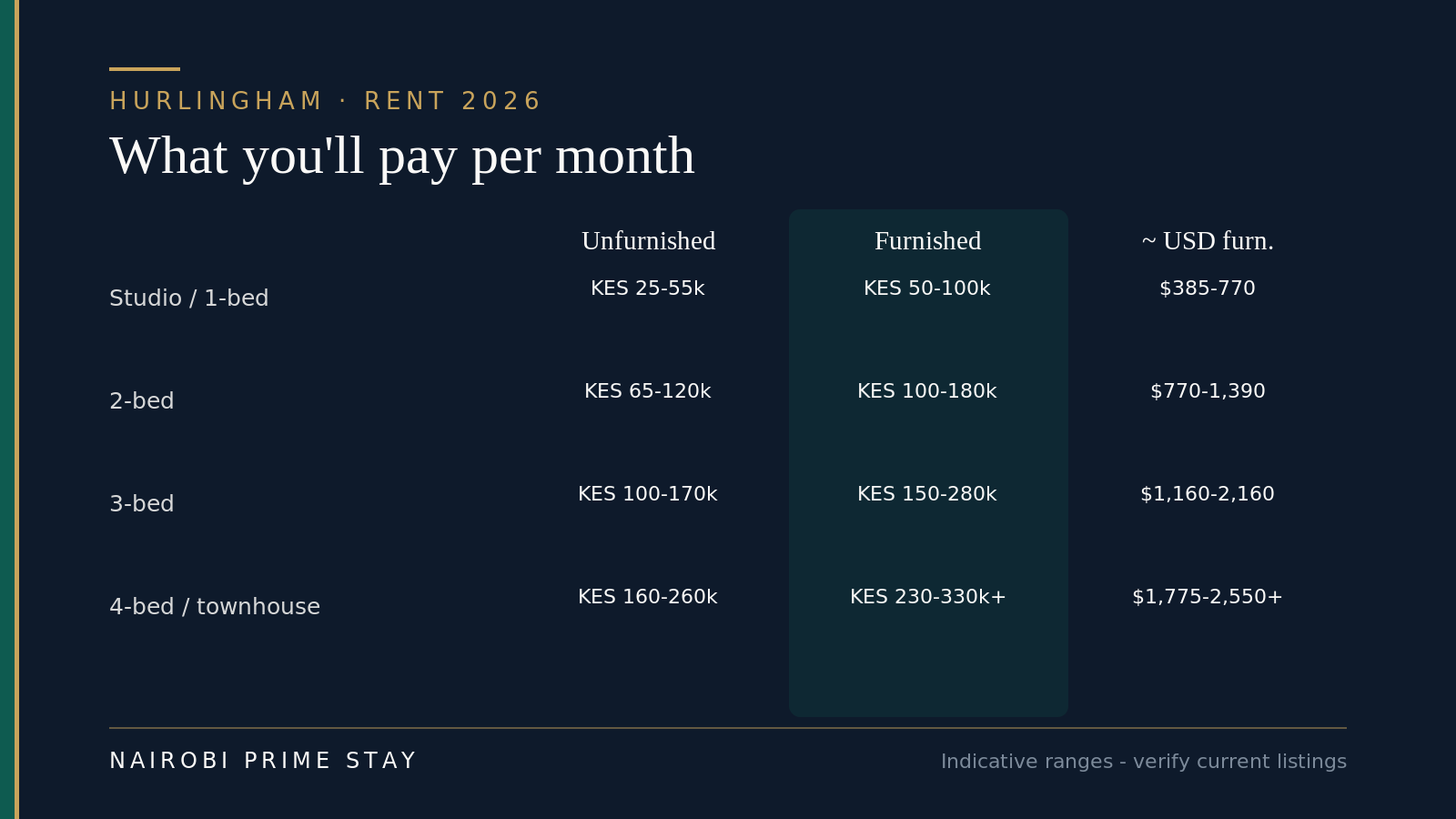 Indicative Hurlingham rents for 2026 — furnished, per month. Verify against current listings; the figure depends on the building, finish and what’s included.
Here’s the same picture as a table. Treat these as orientation ranges, not quotes — the actual number depends on the building, the finish, the floor and whether service charge, water and a backup generator are included.
| Home type | Unfurnished / month | Furnished / month | Furnished ≈ USD |
|---|---|---|---|
| Studio / 1-bed | KES 25,000–55,000 | KES 50,000–100,000 | $385–770 |
| 2-bed | KES 65,000–120,000 | KES 100,000–180,000 | $770–1,390 |
| 3-bed | KES 100,000–170,000 | KES 150,000–280,000 | $1,160–2,160 |
| 4-bed / townhouse (rarer) | KES 160,000–260,000 | KES 230,000–330,000+ | $1,775–2,550+ |
A few things drive the spread. Newer high-rise blocks with a pool, gym, lift and backup generator sit at the top of each band; older low-rise flats — of which Hurlingham has many — sit lower and can be excellent value if you don’t need the gloss. Furnished, all-inclusive units carry a premium of roughly a third over bare ones. And service charge, typically KES 8,000 to 20,000 a month, is sometimes baked into the rent and sometimes billed on top, so always ask. To see how Hurlingham rent fits a realistic monthly budget alongside groceries, transport and help, use our Nairobi cost of living guide.
Serviced apartments and a soft landing
A serviced apartment in Hurlingham is a smart way to start, especially if you’re weighing it against Kilimani or Upper Hill. You get a furnished, all-inclusive base — Wi-Fi, cleaning, a backup generator and security included — while you spend a few weeks actually living in the area: doing your shopping at Yaya, driving the Ngong Road commute at rush hour, and seeing whether the central buzz energizes you or wears you down.
That trial matters, because Hurlingham’s character is exactly the thing you can’t judge from a listing. Some people love being able to walk to a mall, a gym and dinner. Others realize they’d rather trade ten minutes of commute for a quieter, greener street. A month on the ground tells you which camp you’re in before you commit to a year-long lease.
When you’re ready, browse our serviced apartments in Hurlingham — verified, all-inclusive, with honest monthly pricing — or read how the soft-landing approach works in our serviced apartments in Nairobi guide. A serviced apartment for your first month lets you choose your actual home with your eyes open.
The honest downside
Hurlingham’s weaknesses are the flip side of its strengths. It’s central and lively, which also means it’s busy, built-up and often loud. Here’s the real reckoning.
Traffic. This is the big one. Ngong Road and Argwings Kodhek are among the busiest roads in Nairobi, and Hurlingham sits right on them. Between roughly 7 to 9 in the morning and 5 to 7 in the evening, short distances can mean slow journeys, and the Ngong Road corridor in particular can crawl. Plan your day around the peaks and it’s manageable; ignore them and you’ll sit in jams. The flip side: when traffic is light, you can reach much of the city fast.
Density and noise. Hurlingham is a built-up apartment district, with blocks close together and a lot of commercial activity mixed in. That means more street noise, more people and more cars than a leafy suburb. A unit on a quieter interior road is a very different experience from one over a busy junction — choose carefully.
Construction. Like Kilimani next door, Hurlingham is densifying fast, so there’s ongoing building work as older plots become new towers. Ask about active sites near any apartment you’re considering, and favor a unit that doesn’t face a fresh hole in the ground.
Limited green and tight parking. Private gardens are scarce here — this is balconies-and-shared-courtyards living, not lawns. Parking can be tight on the busier blocks and around Yaya at peak shopping times. If immersive greenery and space are your priorities, you’ll be happier in Kileleshwa, Lavington or the suburbs further west.
None of this is a dealbreaker — it’s simply the trade you make for a central, convenient, well-priced neighborhood. Go in knowing it, and Hurlingham rarely disappoints.
Getting around
Hurlingham is one of the easier neighborhoods to get around from, precisely because it’s so central. Uber and Bolt are everywhere, cheap and the expat default — most trips within town are a few dollars, paid by card or M-Pesa. For a quick errand to Yaya or dinner on Lenana Road, you can often just walk, which is genuinely rare for Nairobi.
For driving, the location is a real advantage. Argwings Kodhek feeds straight onto Ngong Road and the Southern Bypass, and Kirichwa Road connects to Uhuru Highway for the CBD and the airport run. Upper Hill, Westlands and Kilimani are all minutes away off-peak. The catch, again, is peak-hour traffic on Ngong Road and Argwings Kodhek; time your trips around the rush and the central position pays off.
Many residents do keep a car for weekend trips and big shops, but Hurlingham is one of the neighborhoods where you can genuinely manage on ride-hailing and your own two feet, especially as a single professional or a couple. If you’d rather not drive in Nairobi at first — a sensible choice for newcomers — this is a good place to be car-free.
Working remotely from Hurlingham
Hurlingham works well for remote work, with the same caveats as anywhere in the city: confirm the building’s fibre and backup power before you sign. Home fibre from Safaricom, Zuku or Faiba is widely available across the neighborhood, with packages from around KES 3,000 a month for everyday speeds up to far faster business tiers. The thing to verify is that fibre already serves your specific building, and that there’s a backup generator for the inevitable power cuts — without one, an outage takes your Wi-Fi and your video calls with it.
For getting out of the apartment, you’re spoiled for choice. Hurlingham and the surrounding Kilimani belt have one of the densest clusters of laptop-friendly cafés in the city, and Yaya Centre alone has several spots you can settle into for a few hours. Coworking options across Kilimani and Westlands — Nairobi Garage, Ikigai and others — are a short hop away. The time zone (UTC+3) suits US remote roles too: your afternoon overlaps the US East Coast morning. For the full setup — providers, speeds, backup power and coworking — see our internet and remote work guide.
Shopping, dining and green space
Hurlingham’s everyday convenience is its quiet superpower. Yaya Centre, on Argwings Kodhek Road, is the anchor — an upscale mall with a large supermarket, pharmacy, banks, an ATM hall, cafés, a food court and a rooftop with city views. For most residents it covers the weekly shop and a hundred small errands without ever needing the car. A little further out on Ngong Road you’ve got two more malls: the older, scruffier-but-handy Adams Arcade, and the sleek Junction with its supermarket, cinema and brand stores.
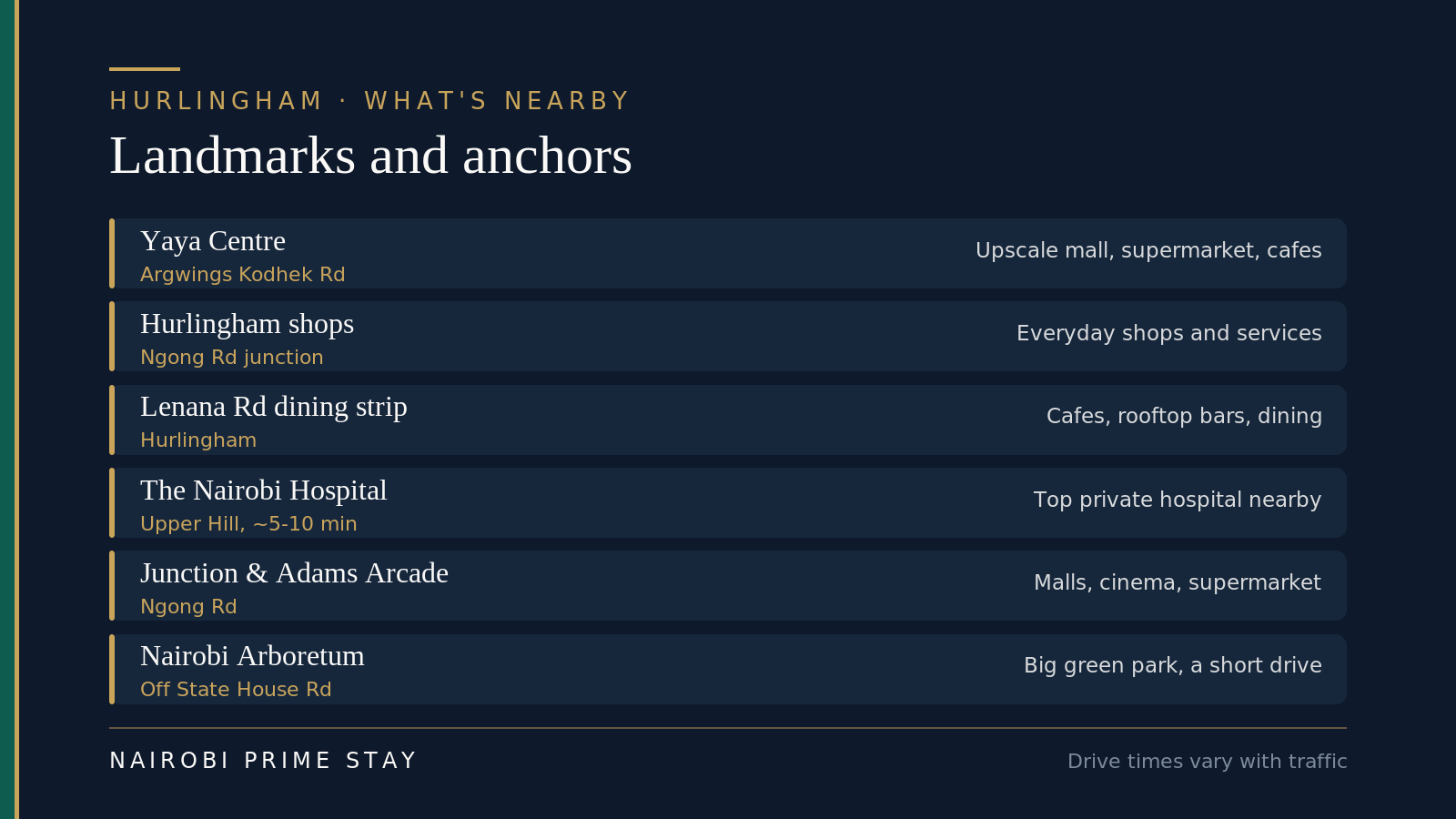 The everyday anchors of Hurlingham — Yaya Centre, the restaurant strip, the Ngong Road malls and top hospitals minutes away.
The dining is excellent and dense. The strip along Lenana Road and Argwings Kodhek packs in cafés, rooftop bars and restaurants spanning African, Asian, European and Middle Eastern food — places like Cultiva and The Harvest are local favorites, and there’s a steady churn of new openings. You can eat cheaply and brilliantly or treat yourself, all within walking distance. For nightlife and a livelier after-dark scene, Kilimani and Westlands are close by.
Green space is the one thing Hurlingham is short on within its own streets, but it isn’t far. The Nairobi Arboretum — a large, leafy park with walking trails and shade — is a short drive north toward State House, and it’s a favorite weekend escape for residents who want to walk or run somewhere green. Within the neighborhood, your outdoor life is more likely to be a rooftop, a balcony or a gym than a garden.
Hospitals and healthcare nearby
Hurlingham has excellent healthcare access — one of its strongest practical selling points. The Nairobi Hospital, one of the country’s most established private hospitals with broad specialties and a long expat following, is in neighboring Upper Hill, roughly five to ten minutes away. Coptic Hospital sits right on Ngong Road on the neighborhood’s edge. And Hurlingham itself is dotted with private clinics, specialist practices, dentists, labs and pharmacies, many clustered along Argwings Kodhek and Ralph Bunche Road.
For some residents, that proximity is a genuine reason to choose the area. If you or a family member has an ongoing condition, you’re expecting a baby, or you simply value top care being close, living minutes from The Nairobi Hospital removes a real worry — no cross-town dash in traffic when it matters. The other leading private hospitals — Aga Khan University Hospital and MP Shah in Parklands — are a manageable drive across town as well.
Private care in Nairobi is genuinely good and far cheaper than the US, though still a meaningful cost — a specialist consult runs roughly $15 to $40, with procedures much less than American prices but not trivial. The standard advice applies: carry solid private or international health insurance, ideally with regional cover and medical evacuation. For the full landscape — hospitals, insurance, costs and how the system works — read our Nairobi healthcare guide. This is general information, not medical advice.
Schools in and near Hurlingham
Hurlingham isn’t a school-cluster neighborhood the way Lavington or Gigiri are, but it’s well placed for the city’s options. Within and around the area you’ll find nurseries, primary schools and a number of private and faith-based options, and the dense school belt of Kilimani, Kileleshwa and Lavington is right next door — places like Braeburn, Riara and several others are a short drive away.
For the international curricula American families often want — full American, IB or British programs — the big international schools sit further out. The International School of Kenya and Rosslyn Academy are toward Gigiri and Runda in the north-west, roughly a 30 to 45 minute drive depending on traffic, while Brookhouse, Braeburn and others are scattered across the city. That commute is the main thing to weigh if top-tier international schooling is your priority and you still want to live centrally.
If schools are a deciding factor, map the specific school run before you choose Hurlingham, and drive it at 7:30am to see the real timing. Our international schools in Nairobi guide covers the main options, curricula and fees so you can line up the school first and the neighborhood second. For many singles, couples and small families without school-age kids, though, Hurlingham’s central convenience easily wins out.
The investor angle
For property investors, Hurlingham is a steady, demand-led apartment market rather than a flashy one. The draws are consistent rental demand and central value. There’s a deep, reliable tenant pool — young professionals, couples, aid and NGO workers on rotation, medical staff and consultants — which keeps well-located apartments occupied. Rental yields on Nairobi apartments sit broadly around the mid-single digits citywide, and well-managed Hurlingham units near Yaya and the hospitals tend to let quickly, including to the serviced and short-let market.
The honest caution is the same one facing all of Nairobi’s central apartment belts: a lot of new supply. Hurlingham, Kilimani and Kileleshwa have all seen heavy apartment construction, which has softened prices and rents in places and rewards quality over quantity. A bright, well-finished unit in a managed building with parking, a lift, a backup generator and a pool will out-let a generic block every time. Proximity to Yaya Centre, Upper Hill and The Nairobi Hospital is a durable advantage worth paying for.
If you’re buying to let, run the numbers conservatively, factor in service charge and the odd void, and prioritize location and management over square footage. For where Hurlingham fits in the wider city, see our guide to the best areas to invest in Nairobi real estate. None of this is investment advice — verify current prices, yields and demand with local agents before you commit.
Who Hurlingham suits — and who it doesn’t
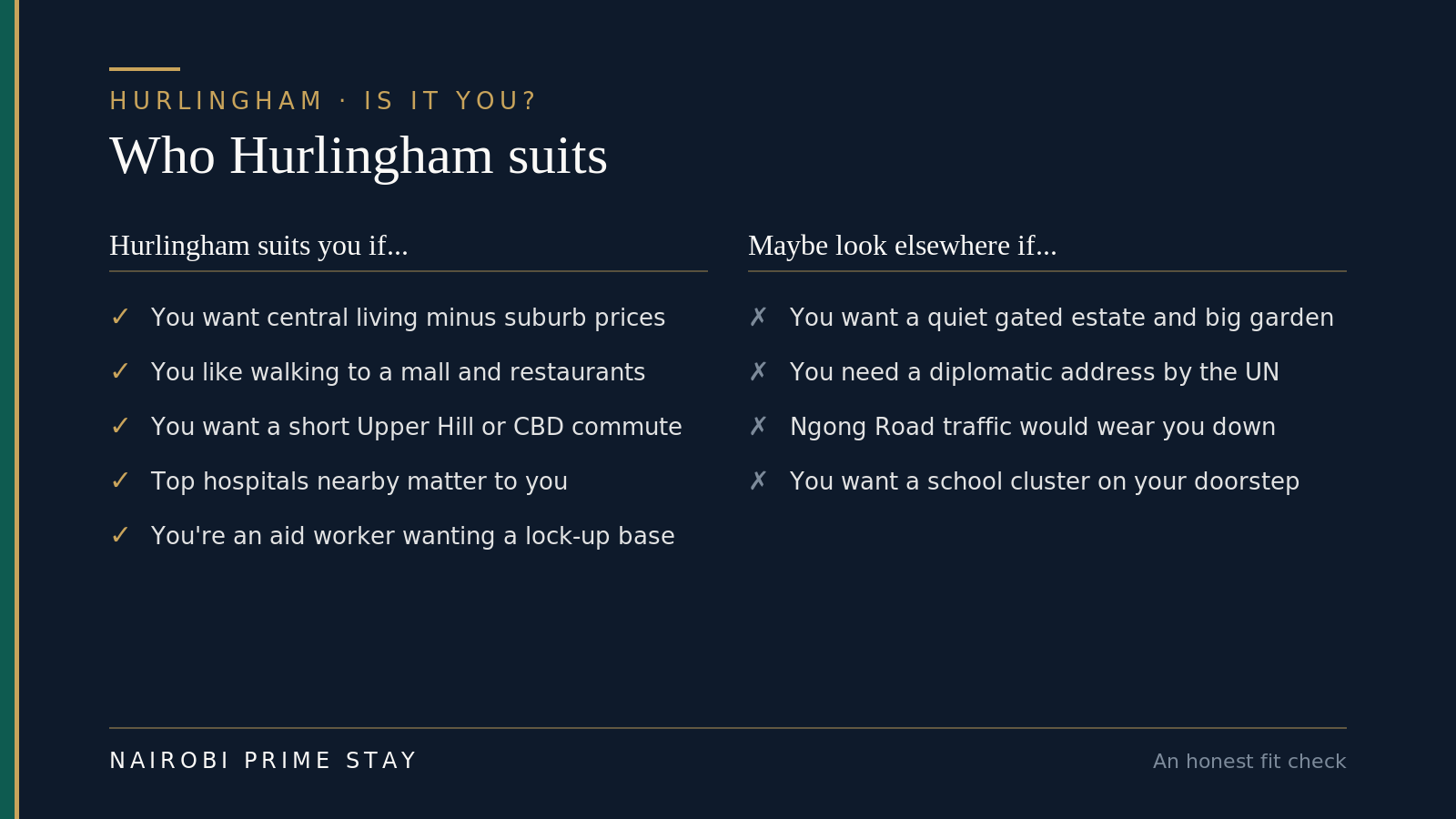 An honest fit check — Hurlingham rewards people who want central, convenient, good-value city living.
Hurlingham suits remote workers and young professionals who want to be central and connected without western-suburb rents; couples and small families who value walkable convenience; aid, NGO and development staff who want a secure, low-maintenance base they can lock up and leave; executives who want a short commute to Upper Hill or the CBD; and anyone who wants top hospitals minutes away. If you want to feel part of a real, busy Nairobi neighborhood, it’s ideal.
It suits you less well if you’re set on a quiet, gated, leafy estate with a big garden — look at Kileleshwa, Lavington, Karen or Runda. If you need a diplomatic address minutes from the UN, Gigiri is the obvious call. If heavy traffic and density genuinely stress you, a calmer suburb will serve you better. And if you need a tight school cluster on your doorstep, Lavington edges it.
Hurlingham vs Kilimani vs Upper Hill
These three central neighborhoods are the natural comparison set — all apartment-led, well-connected and close together. Here’s how they stack up.
| Factor | Hurlingham | Kilimani | Upper Hill |
|---|---|---|---|
| Vibe | Central, convenient, value | Central, modern, busy | Business district, quiet after hours |
| Best for | Professionals, couples, aid workers | Young pros, first-timers | Executives wanting a short commute |
| Furnished 2-bed / mo | KES 100,000–180,000 | KES 90,000–200,000 | KES 150,000–280,000 |
| Value for money | Excellent | Very good | Moderate |
| Standout feature | Yaya + hospitals + central value | Most central, most choice | Offices + The Nairobi Hospital |
| Green space | Limited (Arboretum nearby) | Limited | Limited |
| Watch out for | Ngong Road traffic, density | Construction, oversupply | After-hours quiet, traffic |
The quick read: choose Hurlingham for value, walkable convenience and hospital access; Kilimani for the widest choice of modern apartments at the center of everything; and Upper Hill if you work there and want to live where you work. All three are close enough that you can live in one and use the others freely.
A week in the life: a development consultant
Picture a consultant from Washington, DC — she works for an international development organization, spends a week or two each month traveling to field sites, and wants a secure, central base she can leave without worry. She takes a serviced two-bed in Hurlingham for her first six weeks while she looks around.
When she’s in town, life is easy and local: coffee and emails at a Yaya café, a short Bolt to meetings in Upper Hill or the CBD, lunch on Lenana Road, a gym in her building. The apartment has fibre and a generator, so a midday power cut doesn’t interrupt a call with head office, whose East Coast morning lines up with her Nairobi afternoon. When she travels for fieldwork, the building’s guards and gate mean she can lock up and go with peace of mind. On free weekends she walks in the Arboretum or drives to The Junction for a film and a big shop.
By week six she’s done the math. Her furnished two-bed costs well under what the equivalent would in Riverside, she’s never needed her own car, and the convenience suits a job that keeps her moving. She signs a year’s lease two streets from where she started. Hurlingham didn’t dazzle her on day one — it just made everything easier, which is exactly how this neighborhood tends to win people over.
Your Hurlingham move-in checklist
Before you sign anything in Hurlingham, work through this short list.
- Pick your micro-location. A quiet interior road and a unit over a busy junction are very different daily experiences — visit both.
- Check the building’s “Nairobi Five”: backup generator, water storage, 24/7 security, fibre already installed, and responsive management.
- Drive your commute at rush hour before committing — Ngong Road and Argwings Kodhek distances are short but peak traffic is real.
- Ask what’s included: is service charge, water and the generator in the rent or billed on top?
- Check for active construction next door, and avoid a unit facing a fresh site.
- Confirm parking if you’ll have a car — it’s tight on the busier blocks and around Yaya.
- Have your paperwork ready: KRA PIN, passport and permit are needed to sign a lease.
- Test mobile and fibre signal in the actual unit, not just the lobby.
- Walk to Yaya and your nearest restaurant strip — that everyday convenience is the whole point of living here.
- Consider a serviced apartment for the first month so the area proves itself before you commit.
Frequently asked questions
Is Hurlingham a good place to live in Nairobi?
Yes, if you want central, convenient, good-value city living. Hurlingham is one of the better-value central neighborhoods in Nairobi, built around Yaya Centre between Kilimani and Upper Hill, with top hospitals minutes away and apartment rents below the smarter western suburbs. It’s busy and densely built rather than quiet and leafy, so it suits professionals, couples and aid workers more than people set on a big garden and a gated estate.
How much is rent in Hurlingham?
As of 2026, furnished apartments in Hurlingham run roughly KES 50,000 to 330,000 a month, with a typical furnished two-bed nearer KES 100,000 to 180,000 (about $770 to $1,390 at roughly 129.5 shillings to the dollar). Unfurnished apartments cost noticeably less and there is plenty of unfurnished stock. These are indicative ranges; the actual figure depends on the building, size, finish and what is included.
Is Hurlingham safe?
Hurlingham is reasonably safe by Nairobi standards, with the normal caveats of a central, busy, mixed-use area. It isn’t a sealed diplomatic enclave, but most residents live in apartment blocks with a gate, a guard and controlled parking, and daily life is calm. The realistic risk is opportunistic petty crime around busy junctions and in traffic, not personal danger, so take normal big-city precautions and choose a building with proper security.
Where is Hurlingham, and how far is it from the city center?
Hurlingham sits about 2.5 km west of the central business district, straddling Argwings Kodhek Road between Kilimani to the north and Upper Hill to the east. The CBD, Upper Hill’s offices and The Nairobi Hospital are all about five to ten minutes away off-peak, and Argwings Kodhek connects straight to Ngong Road, the Southern Bypass and Uhuru Highway. The main catch is peak-hour traffic on Ngong Road.
Is Hurlingham good for remote work?
Yes. Home fibre from Safaricom, Zuku or Faiba is widely available, with packages from around KES 3,000 a month, and the area has one of the densest clusters of laptop-friendly cafés in the city, plus coworking spaces a short hop away in Kilimani and Westlands. Confirm that fibre already serves your specific building and that there’s a backup generator for power cuts. The UTC+3 time zone overlaps the US East Coast morning in your afternoon.
Which hospitals are near Hurlingham?
Hurlingham has excellent healthcare access. The Nairobi Hospital, a long-established private hospital with broad specialties, is in neighboring Upper Hill about five to ten minutes away, and Coptic Hospital is on Ngong Road on the area’s edge. Hurlingham itself has many private clinics, specialists, dentists, labs and pharmacies, and Aga Khan University Hospital and MP Shah in Parklands are a manageable drive across town.
Do I need a car to live in Hurlingham?
Not necessarily. Because Hurlingham is so central, Uber and Bolt are plentiful and cheap, and you can often walk to Yaya Centre, restaurants and clinics, which is rare for Nairobi. Many residents keep a car for weekend trips and big shops, but singles and couples can comfortably manage car-free here, especially at first. The main downside is peak-hour traffic on Ngong Road and Argwings Kodhek.
Hurlingham or Kilimani, which is better?
They’re neighbors with similar DNA — central, apartment-led and walkable. Hurlingham is the slightly more value-focused southern end, closest to Upper Hill and The Nairobi Hospital and built around Yaya Centre, while Kilimani is busier, more built-up and offers the widest choice of modern apartments. Choose Hurlingham for value and hospital access, and Kilimani for choice and being in the thick of it. They’re minutes apart, so you can live in one and use the other freely.
Are there apartments or houses in Hurlingham?
Hurlingham is overwhelmingly an apartment neighborhood. There is a deep mix of older low-rise flats and newer mid- and high-rise blocks with balconies, pools, gyms and backup power, so you can choose between great value and modern amenities. There are very few large standalone houses with gardens, so if outdoor space is your priority you’ll want a suburb like Kileleshwa, Lavington, Karen or Runda.
Final thoughts
Hurlingham is for people who want to live in the middle of things, reach work and top healthcare in minutes, walk to a mall and a hundred restaurants, and keep their rent sensible. It trades the garden, the gate and the calm of the western suburbs for central convenience, walkability and value. The honest test is simple: picture your Nairobi week. If it revolves around a short commute, a quick shop at Yaya, dinner on Lenana Road and a fair rent, Hurlingham is hard to beat. If it revolves around a lawn, a hedge and total quiet, you’ll be happier further west.
Whatever you decide, don’t sign a year-long lease sight-unseen. Spend a few weeks on the ground first, drive the commute at rush hour, and let the neighborhood and its buzz prove themselves before you commit.
Related reading
- Moving to Nairobi: the complete guide - the relocation hub that ties visas, money, healthcare and housing together.
- Best neighborhoods in Nairobi - compare Hurlingham against every other area in one place.
- Kilimani neighborhood guide - the busier, bigger-choice neighbor just to the north.
- Upper Hill neighborhood guide - the business district next door, if you want to live where you work.
- Kileleshwa neighborhood guide - a calmer, greener central alternative to weigh against Hurlingham.
- Healthcare in Nairobi - the hospitals, insurance and how the private system works.
- Serviced apartments in Nairobi - how a soft landing works and why it’s the smart first month.
- Cost of living in Nairobi - slot Hurlingham rent into a realistic monthly budget.
Find your place in Hurlingham
When you’re ready to see real options, browse our serviced apartments in Hurlingham - verified, all-inclusive, with honest monthly pricing - or our full apartment catalogue across Hurlingham, Kilimani and the wider city. A serviced apartment for your first month gives you a secure, fully-equipped base while you do your shopping at Yaya, test the traffic and choose your actual home before signing a year-long lease. A $50 deposit reserves your place and the balance is paid on arrival, so there’s nothing more to pay before you travel.
Not sure whether Hurlingham, Kilimani or Upper Hill fits your budget, commute and lifestyle? Our AI relocation assistant can shortlist apartments around your priorities in a couple of minutes, any time of day.
Ready to look?
Find your apartment in Nairobi
Browse verified serviced apartments, or ask the AI concierge which area fits your life.