
Guides · Neighborhoods
Muthaiga Neighborhood Guide: Nairobi's Old-Money Diplomatic Address (2026)
Muthaiga Neighborhood Guide: Living in Nairobi’s Old-Money Diplomatic Address
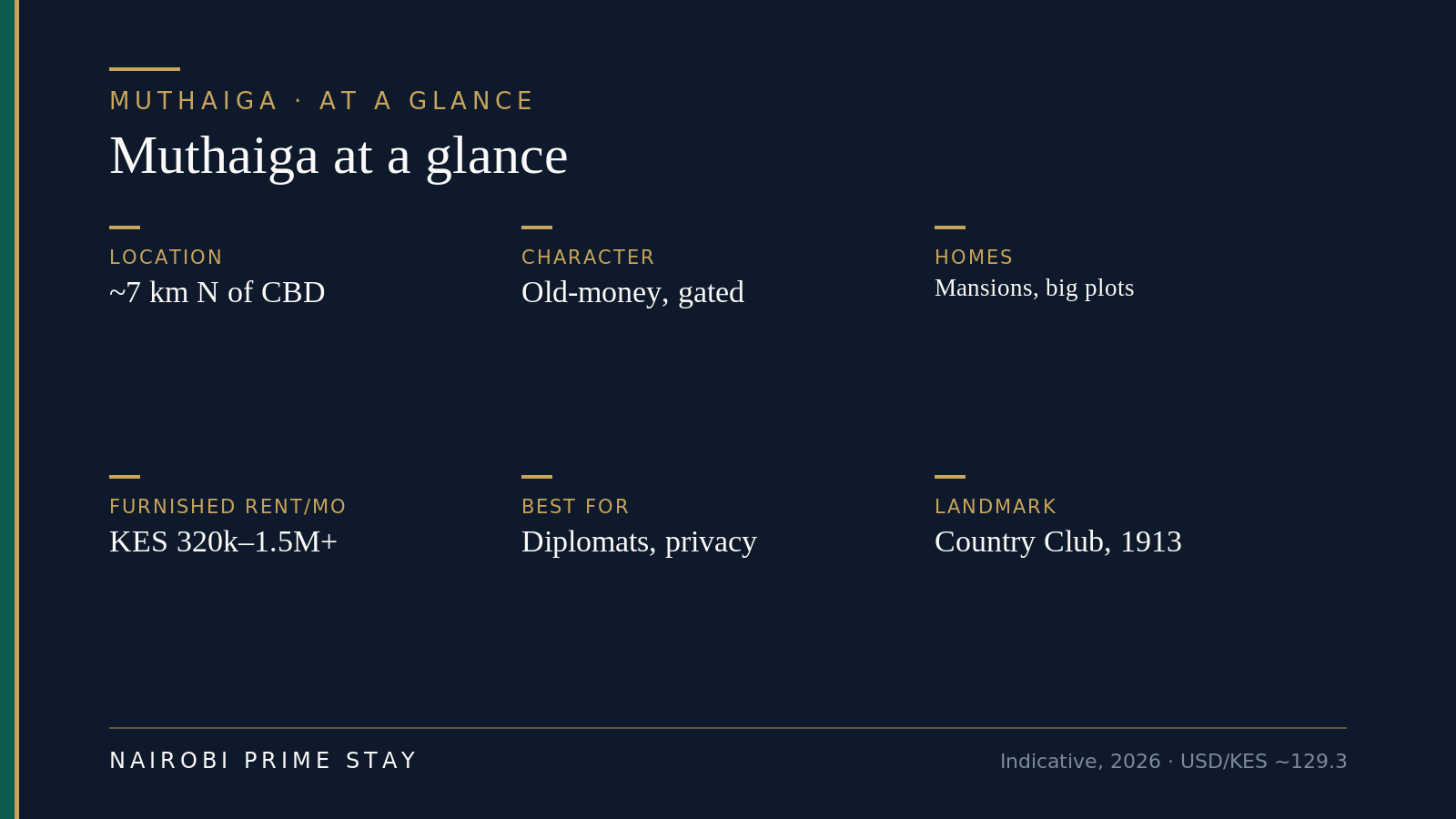
Muthaiga at a glance.
Muthaiga is where Nairobi’s old money, ambassadors and quietest wealth have lived for a century — behind tall hedges, on plots measured in acres, a short drive north of the city center. It’s the most established and, by most counts, the most expensive address in Kenya. The streets are wide and tree-lined, the homes are large and set far back from the road, and the whole place is built around privacy. If Gigiri is the diplomatic office park and Runda is the modern gated estate beside it, Muthaiga is the grand old neighbor — older, leafier, more private, and prouder of it.
This guide is for someone weighing up whether to live here. It covers who your neighbors will be, why Muthaiga feels so secure and so quiet, what a home actually rents for in 2026, the honest trade-offs — you’ll need a car, apartments are scarce, and you pay top of the market — and where you’ll shop, eat, golf and send the kids to school. It’s straight about what Muthaiga is and isn’t, because that’s the only kind of neighborhood guide worth your time. For the wider map of where expats live, start with our best neighborhoods in Nairobi guide and the main moving to Nairobi hub.
The quick version
Muthaiga is an established, old-money, low-density suburb about 7 km north of the CBD, next to Gigiri and the UN. It suits diplomats and ambassadors, senior UN and NGO staff, and well-off families who want maximum space, privacy and security — and who are happy to live by car. It’s almost entirely large standalone houses and mansions on half-acre to two-acre plots, many of them ambassadorial residences, with only a handful of luxury apartments, so it’s the wrong place for anyone who wants a modern flat. Furnished homes run roughly KES 180,000 a month for one of the rare apartments or townhouses up to KES 900,000–1,500,000-plus for a mansion or ambassadorial residence (about $1,400 to $11,600+); a typical good four- or five-bedroom house sits around KES 500,000. It’s one of the most secure and prestigious parts of the city, anchored by the historic Muthaiga Country Club and home to Gertrude’s Children’s Hospital, with the UN and the top international schools a short drive north. The trade-offs are real: it’s car-dependent, it’s expensive, and there’s no walkable high street or apartment scene. People who want that look at Lavington, Kilimani or Westlands; those who want similar space with a slightly more modern feel look next door at Runda. (Figures are indicative for 2026 at about KES 129.3 to the dollar — verify current listings before you sign.)
Why Muthaiga matters when you’re new
For diplomatic and senior expat arrivals, Muthaiga is one of the names that comes up first — and often it’s the residence the posting comes with. It sits right beside Gigiri, so the commute to the UN headquarters and the embassies is short, and it holds, or sits minutes from, the schools those families need. It also offers the thing a lot of senior relocating families are quietly after: a large, private, walled home with a real garden, on a street where nothing much happens by design. Land in a serviced base nearby, and you can view homes, schools and the commute inside a tight, green patch of the city’s north. For ambassadors, country directors and established families, Muthaiga is frequently the address that feels built for the life they’re moving into.
Who lives in Muthaiga?
Old money, senior diplomats, and very private wealth. Muthaiga has been the address for Kenya’s elite and the diplomatic corps for a century, and the mix today reflects that: foreign ambassadors and embassy residences, senior UN and NGO figures, long-established Kenyan business families, captains of industry, and a quieter layer of political and professional wealth. Many of the homes are official ambassadorial residences. The feel is grown-up, discreet and settled — high hedges, long driveways, guards at the gate, and almost no street life on purpose. You won’t find young singles, a café strip or anything resembling a scene here. Muthaiga skews older, family-oriented, and deeply private. People come to settle, raise children behind a wall, host the occasional garden lunch, and be left alone. That privacy is the entire point, and it’s why the area has held its cachet for generations.
Is Muthaiga safe?
Muthaiga is one of the most secure places to live in Nairobi. The same three layers that protect neighboring Runda apply here, if anything more so. First, the homes: nearly every house sits behind a high wall or hedge and a gate, with an alarm, and most keep their own guard. Second, the area layer: Muthaiga’s long-established residents and the private security firms that serve the suburb run patrols and coordinated response across it. Third, the diplomatic presence: with this concentration of ambassadorial residences and senior officials, the baseline of policing and attention is higher than in an ordinary suburb. The main risk is the same opportunistic petty crime you manage anywhere in the city, and it’s lower here than in busier areas.
The habits that keep you comfortable are the familiar ones. Choose a home with a solid wall, a manned gate and an alarm; keep car doors locked and windows up in traffic on the main roads in and out; and use Uber or Bolt at night rather than walking the quiet, dark lanes — Muthaiga’s streets are deliberately sleepy after dark, with few pedestrians, so they’re for driving, not strolling. None of this is unique to Muthaiga; it’s how all of Nairobi’s well-off suburbs work. For the full, balanced picture, read our honest take on whether Nairobi is safe.
Rent and houses in Muthaiga
Muthaiga is a house market — more so than almost anywhere else in the city. The bulk of what you’ll rent is a large standalone family home: four to six bedrooms, behind a wall or hedge, with a mature garden, staff quarters, and often a separate study or guest wing. Plots are big — half an acre to two acres in Old Muthaiga — which is the whole appeal and the reason rents sit where they do. There are a small number of gated townhouses and a handful of luxury apartments, mostly toward the Muthaiga North and Limuru Road edges, but they’re the exception, not the rule. At the top sit the grand ambassadorial residences on the biggest plots. Here’s the 2026 picture, indicative and rounded; newer, serviced and larger homes sit at the top of each band, older or smaller ones at the bottom.
| Type | Unfurnished (KES/mo) | Furnished (KES/mo) | Furnished (USD, ~129.3) |
|---|---|---|---|
| Rare: 2–3 bed apartment or townhouse | 120,000–220,000 | 180,000–320,000 | ~$1,390–2,475 |
| 4-bed house, garden + DSQ | 250,000–400,000 | 320,000–520,000 | ~$2,475–4,020 |
| 4–5 bed standalone, big garden + DSQ | 400,000–650,000 | 500,000–850,000 | ~$3,870–6,575 |
| Mansion / ambassadorial residence (1–2 acres) | 700,000–1,200,000+ | 900,000–1,500,000+ | ~$6,960–11,600+ |
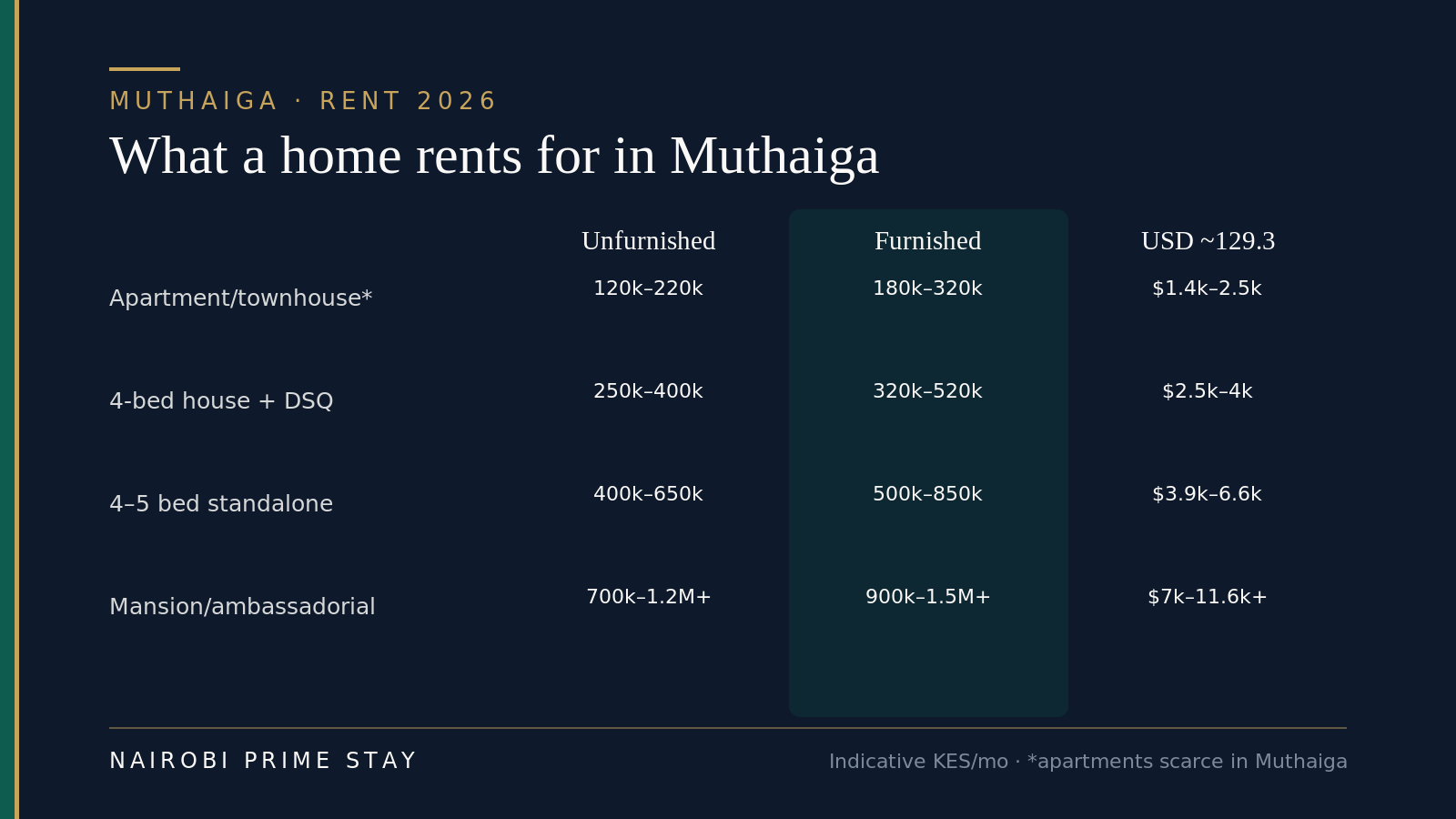
Indicative Muthaiga rents, 2026. Muthaiga is overwhelmingly large houses; apartments are scarce, and furnished, serviced homes that bundle utilities, internet and cleaning sit at the top of each band.
A few things shape where you land. Plot size, the age of the house and its finish matter most — a refurbished home on a one-acre plot rents very differently from a tired 1980s house that hasn’t been touched. Old Muthaiga, with its mature trees and biggest plots, commands more than the newer pockets. Service charge is a smaller factor here than in apartment areas, because most homes are standalone — but on a big plot you carry the garden, the borehole or water tank, the generator and the staff yourself, so factor those running costs in. And because many of the best houses are held by embassies and companies on long leases, good standalone homes can be slow to come up and move quickly when they do. As always, confirm who pays for water, security and the garden before you compare two places.
Before you sign anything, check what we call the “Nairobi Five”: a backup generator, reliable water supply and storage (a tank or borehole — many Muthaiga homes rely on boreholes), 24/7 security, fibre internet already serving the house, and responsive management or a landlord who answers the phone. For how Muthaiga fits your overall budget, see our cost of living in Nairobi guide — and never wire money for a place you haven’t viewed and verified.
Serviced apartments and a soft landing near Muthaiga
A serviced apartment is the smart way to start, even when your long-term plan is a Muthaiga house. Here’s the honest catch, and it’s a real one: Muthaiga itself has very few serviced apartments, because it’s a house suburb, not an apartment district. The serviced options cluster in and around neighboring Gigiri, Parklands and Westlands — a short drive away — so you can base yourself nearby and house-hunt Muthaiga from there without committing to a 12-month lease and a full house move on day one.
That’s the soft-landing strategy we recommend for most arrivals, and it fits Muthaiga especially well, because the homes here are big, often unfurnished, and slow to set up. Stay in a furnished, all-inclusive serviced place — Wi-Fi, cleaning, a backup generator and 24/7 security included — for your first four to eight weeks. Use that time to tour schools, view standalone houses, learn the difference between Old Muthaiga and the newer edges, and drive the commute at rush hour. Then sign once you’re sure. With us, a $50 deposit reserves your dates and the balance is paid on arrival — nothing more before you travel. Browse serviced apartments in Nairobi for how it works, or see apartments around Muthaiga.
The honest trade-offs: scarce apartments, a car, and the price
Muthaiga’s downsides are the flip side of its appeal. The first is that there’s almost no apartment stock. If you want a modern flat with a gym and a rooftop, this isn’t your suburb — you’ll be looking at houses, with only a rare townhouse or apartment as an exception. People who specifically want apartment living look at Kilimani, Kileleshwa or Westlands instead.
The second is that it’s car-dependent — genuinely, not as a figure of speech. There’s no walkable high street, no corner-shop strip, no café you can stroll to. To buy groceries, grab a coffee, take the kids to a class or meet a friend, you drive. Households here run on cars, usually more than one, because a single car can’t cover a parent’s commute and a separate school run. If you don’t drive, Muthaiga will feel isolating in a way a more central, walkable suburb wouldn’t.
The third is price. Muthaiga is at the very top of Nairobi’s rental market — often the most expensive address in the country — and you pay for the space, the security, the plot and the pedigree. A family could rent a large modern apartment in Kilimani or a comfortable house in Lavington for a fraction of a Muthaiga mansion, and many do. The flip side: if your employer provides housing — as many embassies, the UN and multinationals do for senior staff — Muthaiga’s cost is often covered, which is exactly why the area is full of those households. A couple of smaller things round out the honest picture: some grand homes are older and need a landlord willing to maintain them, and the very calm that draws established families can read as dull to anyone after a social scene. None of this makes Muthaiga a poor choice — for the right household it’s one of the best places to live in the city. Just go in clear-eyed: you’re trading walkability, apartments and rent for space, security, privacy and prestige.
Getting around Muthaiga
Plan your life around a car in Muthaiga. The suburb sits just off two main arteries — Limuru Road on one side and the Thika Road corridor on the other — with Muthaiga Road running through it, and most daily trips funnel onto one of those. The good news is that the places Muthaiga residents need most are close: the UN and embassies in Gigiri and the Village Market mall are about a 10-minute drive, the city center is roughly 15 minutes off-peak, and the hospitals of Parklands are a short hop. The catch, as everywhere in Nairobi, is rush hour, when Limuru Road and Thika Road back up and a 10-minute trip can stretch to 30 or 40, especially around school drop-off and pickup.
For trips you’d rather not drive, Uber and Bolt work fine in Muthaiga — cheap, reliable, the expat default — though you’ll wait a couple of minutes longer for a pickup here than in a busy central area, simply because it’s quiet. Matatus run the main roads but aren’t really how Muthaiga households get around. The honest summary: ride-hailing covers the occasional trip, but a family living here day to day will own at least one car, and usually two. If you’ll commute to a fixed office or school, drive that exact route at 8 a.m. and 5 p.m. before you sign — the off-peak and on-peak versions of the same trip feel like different cities.
Work and remote work in Muthaiga
Muthaiga is a calm, comfortable place to work from home, with the obvious caveat that it’s residential — there’s no café-and-coworking buzz on your doorstep. What you get instead is quiet: a walled house with a garden where calls don’t compete with traffic, and usually a spare room or a study that makes a proper home office. When you do want a coworking space or a busy café, the hubs of Westlands and Gigiri’s Village Market are a short drive away.
The infrastructure holds up well. Fibre is widely available across Muthaiga — Safaricom, Zuku and Faiba all serve the area — but, as anywhere in Nairobi, choose a home with a backup generator (or run your own UPS or inverter) so power cuts don’t drop your calls; on a big standalone house, a generator or solar-plus-battery setup is close to essential. Nairobi sits at UTC+3, so your afternoons overlap the US East-Coast morning, which is convenient if you work with American teams. Our internet and remote work in Nairobi guide covers providers, speeds and the backup-power reality in detail.
Shopping, eating and the outdoors
Muthaiga has no high street of its own, but it’s ringed by some of the best malls and green space in the city, all a short drive away. Village Market in next-door Gigiri is the anchor — a large mall with over 100 shops, a supermarket, a food court and open-air restaurants, plus a cinema, a bowling alley and a long-running craft market, with the Tribe and Trademark hotels attached. Two Rivers, one of East Africa’s biggest malls, sits a little further north with Carrefour, international brands and restaurants. For a quick shop you’re rarely more than ten minutes from a full Carrefour, Naivas or Chandarana, and the shops and restaurants of Parklands are close on the other side.
The green is the other half of the appeal. Nairobi City Park borders the suburb, and the 2,500-acre Karura Forest — with walking and cycling trails, a waterfall and forest cafés — is a short drive away, where Muthaiga families spend weekend mornings. Dining is relaxed and mostly mall- or club-based rather than a buzzy strip: the restaurants at Village Market and the hotels cover most cuisines, and for a livelier night out people drive the fifteen minutes to Westlands. It’s a sit-down-with-family kind of area, which is exactly what its residents want.
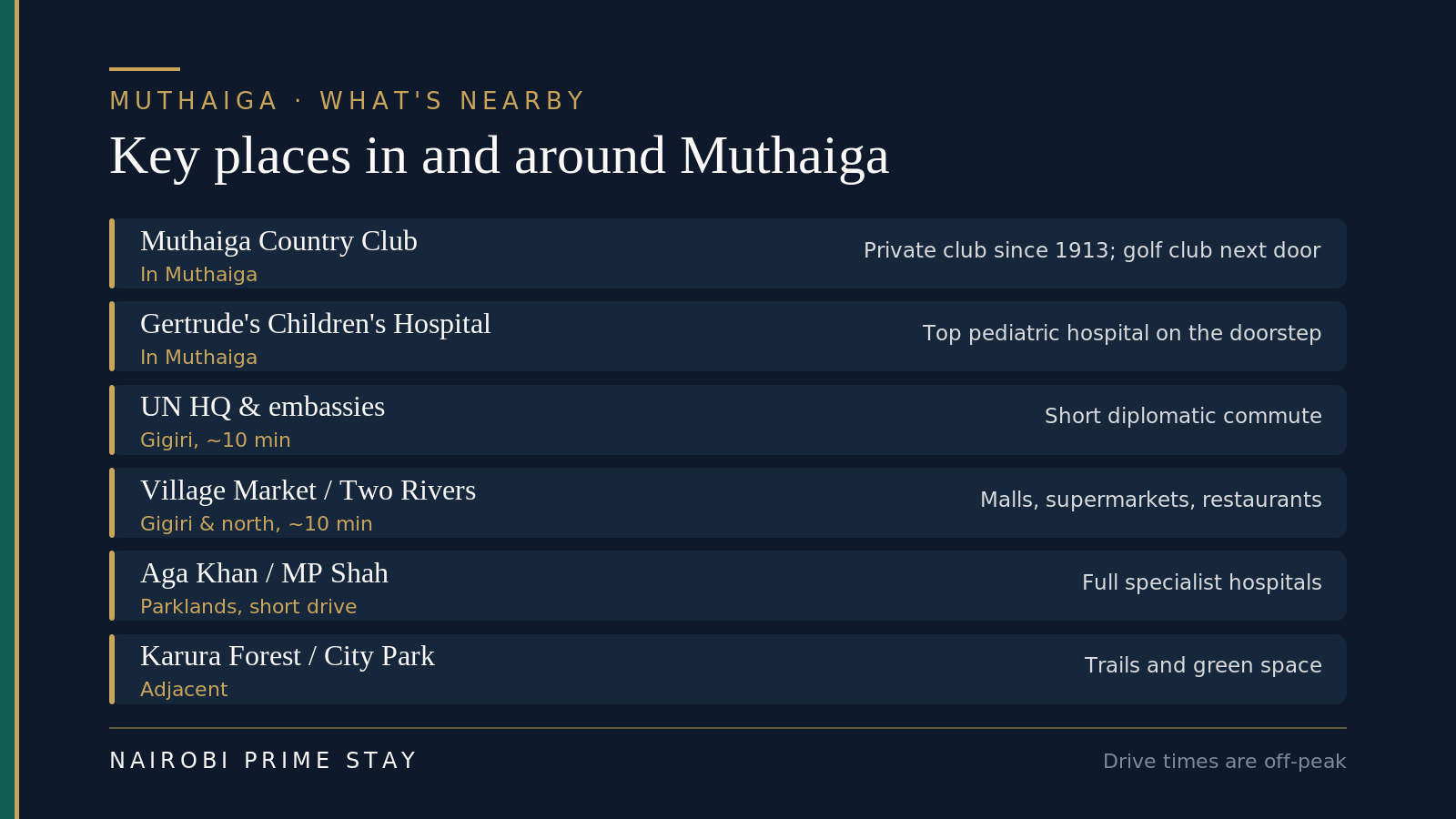
Key places in and around Muthaiga — the club, the hospital, the UN, the malls and the green space.
The Muthaiga Country Club and the old-money character
You can’t understand Muthaiga without the Muthaiga Country Club. Opened on New Year’s Eve in 1913, it’s Nairobi’s oldest and most storied private club — the gathering place of the colonial elite a century ago, with a reputation in those days as wild as it was grand, and today a discreet members’ institution with dining, sport and social life behind its famous pink walls. Many members play next door at the Muthaiga Golf Club, an 18-hole championship course with a history of its own. Membership is private and not something you simply buy on arrival, but the club’s presence shapes the suburb: it’s a large part of why Muthaiga feels established, exclusive and a little hushed, and it’s a social anchor for the families who do belong.
That history is the texture of the place. Muthaiga was laid out for the colony’s grandees more than a hundred years ago with deliberately large plots and strict building rules, and it has stayed that way — which is why the trees are tall, the walls are old, and the neighborhood carries a sense of permanence that newer suburbs can’t manufacture. For some people that pedigree is the entire draw. For others it reads as quiet to the point of sleepy. Both are fair; knowing which camp you’re in tells you a lot about whether Muthaiga is your suburb.
Schools near Muthaiga
Muthaiga sits within a short drive of Nairobi’s best international schools, which is a real reason diplomatic and expat families pick it. The two that matter most to American families are just north: the International School of Kenya (ISK), which runs an American curriculum plus the IB on the Gigiri–Runda edge, and Rosslyn Academy, an American-curriculum school with AP courses in nearby Runda. Both are roughly a 10–15 minute drive from a Muthaiga home off-peak. Several respected British-curriculum and other schools cluster in the surrounding areas too, and the Aga Khan Academy in Parklands is close, so most families find a fit within a manageable radius.
Top international fees are a major line item — ISK runs roughly $20,000–28,000 a year and Rosslyn closer to $10,000, indicative for 2026 — so budget for them as a separate cost and confirm current figures with each school. Apply months ahead either way; the best schools keep waitlists, and many align to a US/August school year. Our best neighborhoods guide lines up the family-friendly areas side by side, and the neighboring Runda guide covers the same school cluster in more detail.
Hospitals and healthcare near Muthaiga
Healthcare access is excellent from Muthaiga — better than from most suburbs — because Gertrude’s Children’s Hospital, the city’s best-known pediatric hospital, is right here in the area. That matters a great deal if you have young kids. For adults and full specialist care, Aga Khan University Hospital in Parklands (JCI-accredited) and MP Shah Hospital, also in Parklands, are both a short drive away, and The Nairobi Hospital in Upper Hill is reachable off-peak. For day-to-day needs there are private clinics, dentists, labs and well-stocked pharmacies in the surrounding malls, along Limuru Road and in Parklands.
As anywhere in Kenya, use the private system and carry good international health insurance that includes medical evacuation. Our healthcare in Nairobi guide covers the main hospitals, what care costs, and what your insurance should include.
Who Muthaiga suits — and who it doesn’t
Muthaiga is a strong fit for diplomats and ambassadors, senior UN and NGO staff, and established families who want maximum space, privacy and security — and who are happy to live by car. If you want a walled house with a big garden on a quiet, tree-lined street, value being minutes from the UN and the top schools, and have housing either provided or comfortably in budget, Muthaiga is hard to beat. It’s also one of the easiest places in the city to live a private, low-drama family life with real outdoor space and a sense of permanence.
It’s a weaker fit if you want a modern apartment, a walkable neighborhood, or the cheapest central rent — Kilimani, Kileleshwa, Lavington and Westlands all do those better. It’s the wrong pick if you don’t want to depend on a car for every errand, or if you’re a young single after nightlife and a social scene on the doorstep; Muthaiga’s calm will feel isolating. And if you want similar space and security with a slightly more modern, slightly less formal feel — and a few more gated-townhouse options — neighboring Runda is worth a close look. None of that makes Muthaiga “better” or “worse”; it’s a secure, green, spacious, old-money family life near the UN, and that’s exactly what its residents come for.
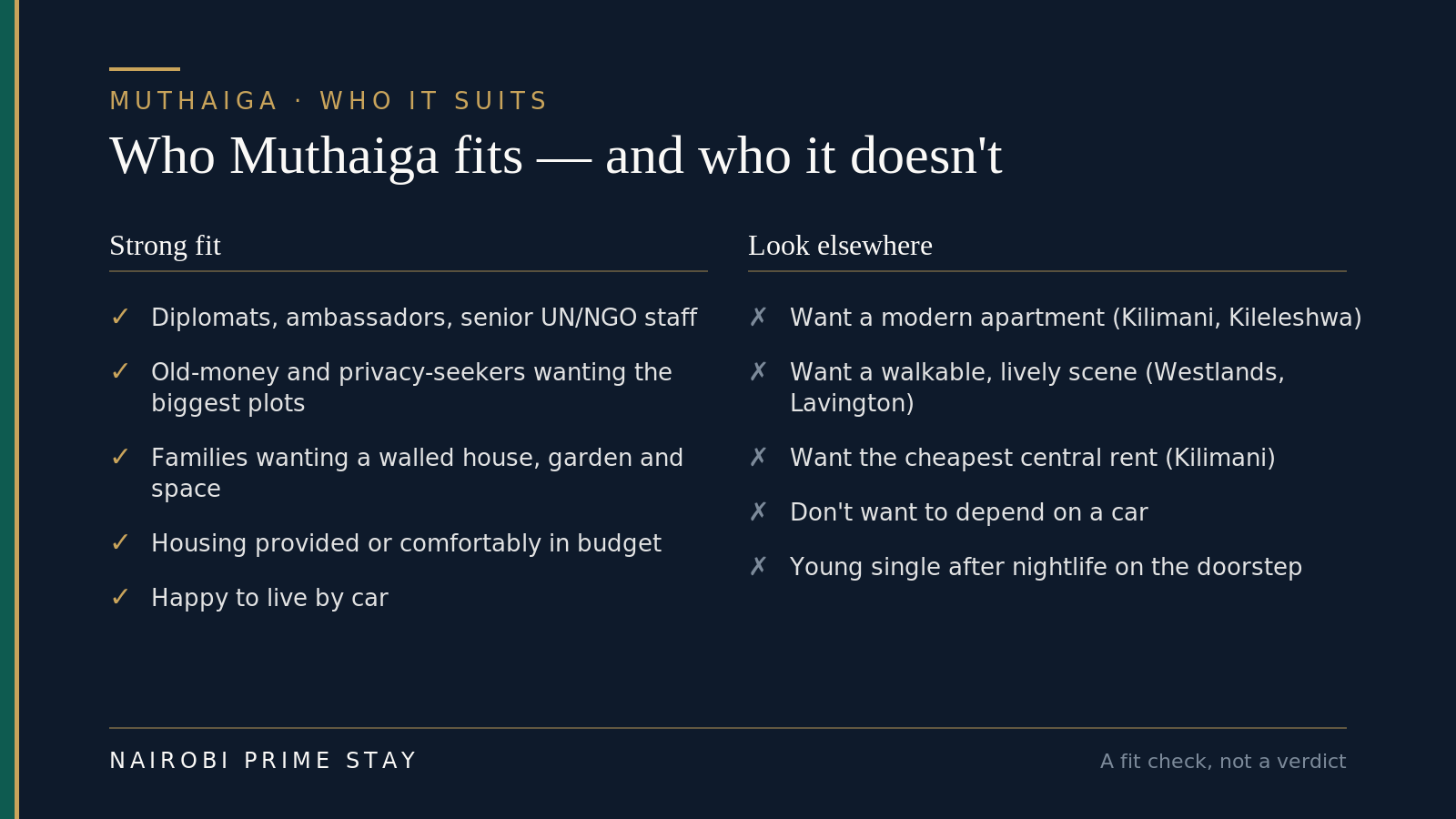
A fit check, not a verdict — plenty of households happily weigh these against each other.
Muthaiga vs Runda vs Gigiri
These three northern neighbors get compared constantly by diplomatic and executive families. Here’s the shorthand.
| Muthaiga | Runda | Gigiri | |
|---|---|---|---|
| Character | Old-money, leafy, very private | Gated houses, big plots, modern | Diplomatic core — UN, embassies |
| Homes | Large houses on big plots; few apartments | Mostly houses + gated townhouses | Houses and some serviced apartments |
| Furnished home (KES/mo) | 320k–1.5M+ | 200k–1.3M+ | 200k–520k+ (incl. apartments) |
| Best for | Established families, privacy, prestige | Families, execs near schools | UN/embassy staff who want to be closest |
| Walkable? | No — car for everything | No — car for everything | Barely — mostly drive |
| Distance to UN HQ | ~10 min | ~10 min | Walk to 5 min |
Choose Muthaiga for the biggest plots, old-money calm and prestige; choose Runda for a marginally wider range of homes — including gated townhouses — and the tightest link to ISK and Rosslyn; and choose Gigiri if being closest to the UN and embassies, with the option of a serviced apartment, matters most. Families who want greenery and schools but a more central, walkable life often look instead at Lavington, and those who want space with more of a semi-rural feel look south to Karen.
A realistic example
Say you’re arriving as an ambassador or a senior UN official with a partner and two school-age kids, housing covered by your posting. Muthaiga fits the brief almost perfectly. You take a five-bedroom standalone house with a mature garden, staff quarters and a generator on a one-acre plot for around KES 700,000 a month — covered by the package — the kids start at ISK or Rosslyn a 10–15 minute drive north, and the working parent is at the UN headquarters or an embassy in Gigiri inside fifteen minutes off-peak. Weekend mornings are spent on the trails in Karura Forest or at the Country Club; the big grocery shop is a ten-minute run to Village Market. You keep two cars — one for the commute, one for the school run and errands — because in Muthaiga that’s simply how it works. You start in a serviced apartment near Gigiri or Parklands for the first six weeks, tour two schools and view several houses before signing, and you choose your street for its security and its plot. That’s Muthaiga doing its job: a secure, private, spacious base built around the diplomatic life.
Your Muthaiga move-in checklist
- Be honest about the apartment question — if you want a modern flat, Muthaiga isn’t it; look at Kilimani, Kileleshwa or Westlands.
- Settle the car question — Muthaiga needs at least one car, usually two; if you won’t drive, reconsider the area.
- If schools matter, shortlist ISK, Rosslyn or others before you pick a street, and apply months ahead — the best keep waitlists.
- Drive your real commute and school run at 8 a.m. and 5 p.m. before you sign — Limuru and Thika Roads back up at peak.
- On a standalone house, confirm the water source (borehole vs tank vs mains), the generator, and who maintains the garden and DSQ.
- Confirm the “Nairobi Five”: generator, water storage/borehole, 24/7 security, fibre in the house, responsive management.
- Check the age and upkeep of the house — some Muthaiga homes are grand but tired; confirm the landlord will maintain it.
- Get a Safaricom SIM and M-Pesa at the airport on arrival — you’ll pay for nearly everything with it.
- Test the actual fibre speed at the house, not just the provider’s brochure.
- Use a serviced apartment near Gigiri or Parklands for your first month while you tour schools and view long-term homes.
- Save 999 / 112, note your nearest hospital (Gertrude’s for kids, Aga Khan in Parklands), and enroll in the US State Department’s STEP program.
Frequently asked questions
Is Muthaiga a good place to live in Nairobi? Yes, especially for diplomats and ambassadors, senior UN and NGO staff, and established families who want maximum space, privacy and security. Muthaiga is an old-money, low-density suburb of large houses and mansions on half-acre to two-acre plots, about 7 km north of the CBD beside Gigiri and the UN, anchored by the historic Muthaiga Country Club and home to Gertrude’s Children’s Hospital. The trade-offs are that it’s car-dependent, expensive, and has almost no apartments.
How much is rent in Muthaiga? Muthaiga is a house market. Indicative 2026 furnished rents run about KES 320,000-520,000 a month (roughly $2,500-4,000) for a four-bedroom house, KES 500,000-850,000 for a four-to-five-bed standalone with a big garden, and KES 900,000 to over 1,500,000 for a mansion or ambassadorial residence on one to two acres (about $7,000-11,600-plus). The rare apartment or townhouse runs about KES 180,000-320,000 furnished. A typical good house sits around KES 500,000, unfurnished costs less, and you should verify current listings before you sign.
Is Muthaiga safe? Muthaiga is one of the most secure suburbs in Nairobi. Nearly every home sits behind a high wall or hedge and a gate with an alarm and often its own guard, private security firms patrol the area, and the heavy diplomatic presence raises the baseline of policing. The main risk is opportunistic petty crime, which is lower here than in busier areas; keep car doors locked in traffic and use Uber or Bolt at night rather than walking the quiet lanes.
Does Muthaiga have apartments or houses? Almost entirely houses. Muthaiga is a low-density suburb of large standalone homes and mansions on big plots, with mature gardens and staff quarters; only a handful of gated townhouses and luxury apartments exist, mostly toward the Muthaiga North and Limuru Road edges. If you specifically want a modern apartment, you’ll look to areas like Kilimani, Kileleshwa or Westlands; for a serviced apartment as a soft landing, the options are in nearby Gigiri, Parklands and Westlands rather than Muthaiga itself.
What is the Muthaiga Country Club? The Muthaiga Country Club is Nairobi’s oldest and most prestigious private club, opened on New Year’s Eve in 1913 and known for its pink walls and colonial-era history. Today it’s a discreet members’ institution with dining, sport and social life, and many members play at the adjacent Muthaiga Golf Club, an 18-hole championship course. Membership is private rather than something you buy on arrival, but the club is a big part of why the suburb feels so established and exclusive.
Is Muthaiga good for families? Yes - it’s one of Nairobi’s top family suburbs, especially for diplomatic and established families. It offers large, secure walled houses with big gardens, very low crime, and Gertrude’s Children’s Hospital right in the area, with the International School of Kenya and Rosslyn Academy a short drive north. The main caveats are that it’s car-dependent and there’s no walkable high street, so families here keep at least one car and usually two.
What schools and hospitals are near Muthaiga? For schools, the International School of Kenya (American plus IB) and Rosslyn Academy (American with AP) are about a 10-15 minute drive north in the Gigiri-Runda area, with British-curriculum options and the Aga Khan Academy in Parklands nearby. For healthcare, Gertrude’s Children’s Hospital is in Muthaiga itself, and Aga Khan University Hospital and MP Shah are a short drive away in Parklands. Top international school fees run roughly $10,000-28,000 a year, indicative for 2026.
Muthaiga or Runda - which should I choose? They’re similar in spirit - both gated, green, secure and house-dominant - but Muthaiga carries an older-money, big-estate pedigree and some of the largest plots in the city, while Runda is slightly more modern, with more gated-townhouse options at the entry end and a tighter link to ISK and Rosslyn. Choose Muthaiga for maximum privacy, prestige and plot size; choose Runda for a marginally wider range of homes and the closest fit for school-age families. Both are premium and car-dependent, and many families view both together before deciding.
Do I need a car in Muthaiga? Effectively yes. Muthaiga has no walkable high street - you drive to groceries, coffee, school and errands - and most households keep at least one car, often two, since one car can’t cover both a commute and a separate school run. Uber and Bolt work fine for occasional trips, but you’ll wait a little longer for a pickup than in a busy central area. If you don’t want to depend on a car, a more central, walkable suburb like Lavington or Westlands will suit you better.
Final thoughts
Muthaiga is the suburb you pick when you want the most space, the most privacy and the most established address in Nairobi - and when you’re happy to live by car. For the right household it delivers exactly that: a large walled house with a mature garden on a quiet, tree-lined street, a short run to the UN and the top schools, Gertrude’s Hospital on the doorstep, and the Country Club and Karura Forest close by. The honest costs are a top-of-market rent, a real dependence on a car, and almost no apartment stock - all of which you can plan around, especially if your housing is provided, as it is for many of Muthaiga’s residents. If you want a walkable, livelier or cheaper base, look at Lavington, Kilimani or Westlands; if you want similar space with a slightly more modern feel, look next door at Runda. Either way, line Muthaiga up against the rest of the map before you commit.
Related reading
- Best neighborhoods in Nairobi for expats - the full map, side by side.
- Moving to Nairobi: the complete guide - the end-to-end relocation hub.
- Is Nairobi safe? - an honest, balanced take.
- Cost of living in Nairobi - real monthly budgets.
- Serviced apartments in Nairobi - what they include and who they suit, and your soft landing.
- Runda and Gigiri - the two neighbors Muthaiga is most compared with.
- Ridgeways - the leafy, gated value alternative north along Kiambu Road, beside Karura Forest.
- Karen and Lavington - other family-friendly options to weigh.
- Healthcare in Nairobi - hospitals, costs and what your insurance should cover.
When you’re ready to see real options, browse our serviced apartments around Muthaiga - verified, all-inclusive, with honest monthly pricing - or see everything across the city on the apartments page. Not sure whether Muthaiga or somewhere more central, walkable or cheaper fits your family, commute and budget? Our AI relocation assistant can shortlist places in a couple of minutes, day or night.
Ready to look?
Find your apartment in Nairobi
Browse verified serviced apartments, or ask the AI concierge which area fits your life.